-
Call Now
1800-102-2727


Energy Stored In a Capacitor

You must have seen in several TV dramas when an injured character is being revived using a defibrillator that delivers an electric current through a patient’s heart to get it beat rhythmically. It typically makes use of the energy in a capacitor. The usage of capacitors in microelectronics like handheld calculators is another example of the energy stored in the capacitor. It is important to understand how energy is stored in a capacitor and can be easily calculated.
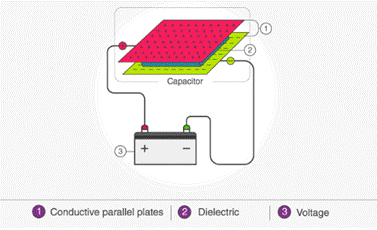
Image: Energy Stored In a Capacitor
Table of Contents
- What is Capacitor?
- How Does a Capacitor Hold Energy?
- Derivation of Energy Stored in Capacitor
- How to Calculate the Energy Stored in a Capacitor?
- Uses of Capacitor Energy
- Practice Problems
- Frequently Asked Questions
What is Capacitor?
A capacitor is a tool for storing electrical energy. The majority of capacitors possess two terminals that are placed side by side with an insulator in between. Sometimes, the whole unit is converted into a compact device to conserve space. Furthermore, certain capacitors are featured with multiple layers for added functionality.
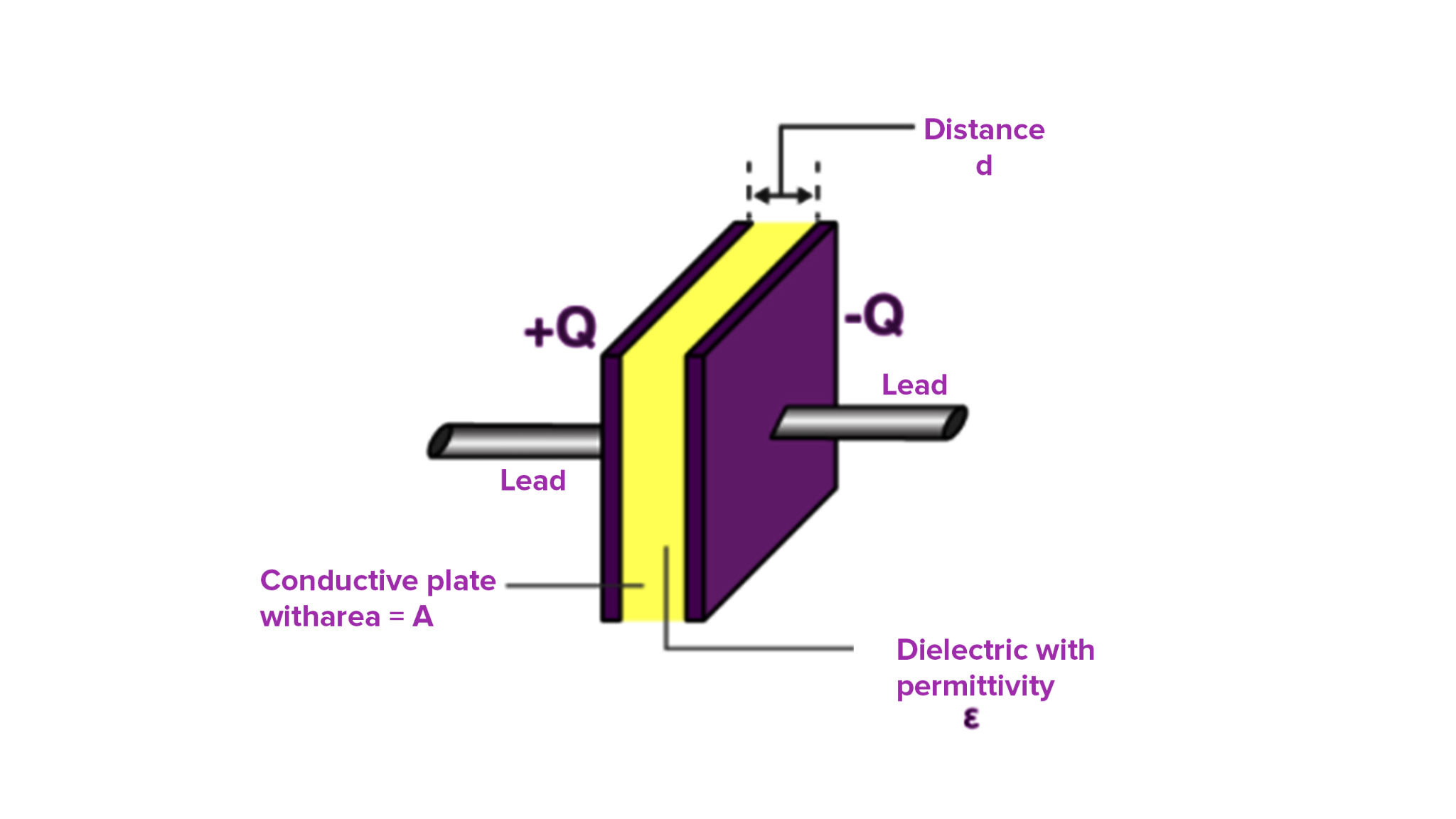
Image: Capacitor
How does a Capacitor Hold Energy?
You cannot observe any interaction between two positive terminals. Rather they exhibit the fastest possible exit from one another. However, the two similar charges resist each other if forcibly come closer. Also, energy is required to make them come close. Additionally, the required energy is not completely utilised. Instead, it is stored as an electric field, a tension-type, so far as the charges remain uncomfortably clasped.
Furthermore, the charges utilise energy to speed themselves once they have the liberty to move. Thus, capacitors are referred to as the parts that store electric fields.
Derivation of Energy Stored in Capacitor
Suppose a capacitor that has been charged a given voltage V whose energy is required to be measured. Thus, the positive charge Q and voltage, i.e., the potential difference, are multiplied to achieve the energy or work W needed to move a positive charge closer to each other.
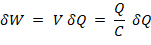
Common logic, however, can lead individuals to suppose that a capacitor with charge V retains QV joules of energy due to the capacitor requiring much energy to attain the desired state. But the case is different, though.
Rather, their resisting capability keeps growing until it becomes strong due to the charges moving closer and closer to one another. It follows non-linear methods. Thus, the integration method is the only process to attain the energy contained in a capacitor.
For example, if Capacitor C stores a charge Q, calculating the voltage V across it will become easier. Additionally, a small amount of charge can be introduced into the system after utilising a small amount of energy. As a result, an expression can be written in terms of Q.

Once the equation is understood, the amount of energy required to push charge Q to the capacitor can similarly be measured by integrating the entire  .
.
Consider the expression for the energy stored in the capacitor written below.
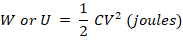
How to Calculate the Energy Stored in a Capacitor?
The numerical solution helps you in a better understanding of calculation.
Example: A capacitor possessing a charge of 100V and capacitance of 40F. Calculate the energy the capacitor carries.
Solution:
As per the formula of capacitor energy 
Substitution the values, we get
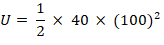


Uses of Capacitor Energy
There are various advantages of energy stored in a capacitor which include the following:
- Audio equipment
- Camera flashes
- Magnetic coils
- Lasers
- Defibrillator
- Supercapacitors
- Remote sensing
- Electronic noise filtration
- Power conditioning
- Smartphones
- Radios
- Laptops
- Portable chargers
- Inverters
- Solar Panels
Practice Problems
Q1. The formula to find the energy stored in a capacitor is
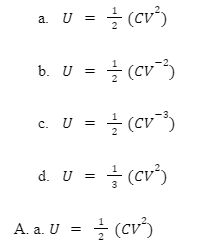
Explanation: To calculate the energy stored in a capacitor, we use the formula  .
.
Q2. A device that stores electrical energy is called
a. Capacitor
b. Insulator
c. Conductor
d. None of the above
Ans: a. Capacitor
Explanation: Capacitor is a device that stores electrical energy.
Q3. In the formula  , the unit of
  is
is
a. Ampere
b. Coulomb
c. Joules
d. Volts
Ans: d. Volts
Explanation: V is measured in volts.
Frequently Asked Questions
Q1. Why do capacitors degrade with time?
Answer: The aluminium foil, paper, and electrolyte inside the capacitor degrade with time, losing the ability to function well.
Q2. What are the consequences if the capacitor fails?
Answer: Capacitors can fail for a wide range of reasons that lead to short circuits or damage to the circuit. It may sometimes even cause an explosion.
Q3. Can a capacitor lose energy voltages?
Answer: Yes. It is known that an outside current can alter the stored voltage of the device. Though internal leakage paths of electrons to move from one plate to another can also result in energy voltage loss of a capacitor.
Q4. Can power be affected by capacitors?
Answer: A capacitor aids in improving power factors by mitigating the reactive power supply line, which is gained by storing the magnetic reversal energy.

 Call Now
 Let's Chat
 Share
Share