-
Call Now
1800-102-2727


Electron and Electron Charge

An atom is the smallest particle defining any element. It is further made up of three sub-particles, proton, electron and neutron. Electrons are the negatively charged entities revolving around the atom’s nucleus and equating the charges carried by protons. Playing a crucial role in current flow, these are of immense significance to impart the characteristics of any type of material. Here is a brief discussion on electrons and their charge.
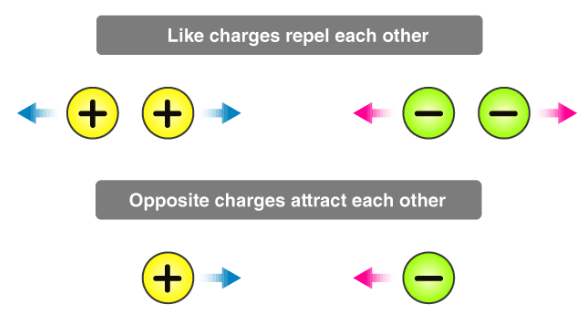
Image: Electron Charge
Table of Contents
- Discovery of Electrons
- Electron Charge
- Electron Shell
- Energy Gap
- Electron Cloud
- Positrons
- Electron Diffraction
- Electron Affinity
- Electron Bonding
- Practice Problems
- Frequently Asked Questions
Discovery of Electron
The existence of electrons was brought forward by Richard Laming. Further research by Irish Physicist G. Johnstone Stoney made him suggest the name ‘electron’ for the particle. The credit for the final discovery or identification goes to British physicist J. J. Thomson and his team in 1897.
Electron Charge
As the electron is negatively charged, it can cancel out the proton’s positive charge. The charge is defined as the physical property allowing matter to experience electromagnetic force. The electron charge is denoted by the symbol e; its magnitude is a universally constant number,  C.
C.
The electron mass is  . Compared to the mass of a proton or neutron, the average mass of an electron is approximately
  of these entities. However, the electron charge in atomic units is -1. The loss or gain of electrons contributes to ion formation, and the number of electrons lost or gained accounts for the charge.
Electron Shell
Electrons revolve around the shell in their orbitals. The first electron shell accommodates only two electrons, while the number increases with subsequent shells. The number of electrons in each shell is given by the formula 2n2, where n is the number of electron shells.
The orientation of electrons in their orbitals is another significant consideration while understanding the presence and placement of electrons in the shell. The electrons in the outermost shell are considered valence electrons and readily participate in bond and ion formation.
Energy Gap
Each atom comprises energy bands and gaps where electrons are present. The magnitude of the energy gap between energy bands determines the characteristic property of electron flow, further determining electron conduction. The large gap between the two is seen in insulators, while the least gap is seen in conductors. The medium gap that can be filled with impurities is available in semiconductors.
Electron Cloud
It is the component of the type of atomic representation where electrons are showcased as a cloud of fast-moving electrons. The electron cloud holds such fast movement that there is no specific position of electrons. The model is suitable for predicting the electron density.
Positrons
These are the electrons with positive signs. Their collision with an electron results in gamma-ray photons. They are also known as antiparticles of electrons.
Electron Diffraction
It states the wave nature of electrons is important and evident in the interaction of an electron beam with crystalline material. Electron diffraction finds significance in accurate analysis of the crystal structure of matter at atomic and molecular levels. The applications of electron diffraction are common in SEM and TEM.
Electron Affinity
It refers to an atom's tendency or ability to attract or accept an electron. It is also defined as the energy change occurring on the conversion of the gaseous state of an electron to form a negative ion.
Electron Bonding
Electrons form multiple types of bonds, such as:
- Covalent Bonds: The atoms look forward to attaining stable configuration. They share the electrons between two or more atoms while may or may not develop polarity.
- Ionic Bonds: The movement of valence electrons from one particular atom to another is referred to as an ionic bond.
- Metallic Bond: These are found in metallic conductors where electrons and positive charges or holes participate together in bond formation.
Practice Problems
Q1. What is the number of electrons in Helium and Oxygen?
a. 2, 8
b. 8, 2
c. 8, 8
d. 2, 6
Ans. a. 2, 8
Explanation: Helium is an inert gas with a stable octet, and oxygen has a total of eight electrons.
Q2. What does the charge of +2 on an atom represent?
a. The atom comprises two extra electrons.
b. The atom lacks two electrons.
c. The atom contains only two electrons.
d. The +2 charge does not exist.
Ans. b. The atom lacks two electrons.
Explanation: The charge of +2 is seen in elements of group 2 of the periodic table.
Q3. How is electron charge related to current?
a. Charge = Current  Time
Time
b. Current = Charge Time
c. Time = Charge Current
d. These are not related to each other
Ans. a. Charge = Current Time
Explanation: Charge refers to the product of the electric current and time.
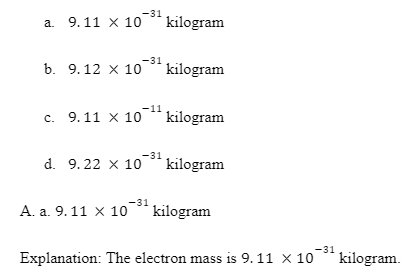
Q4. The mass of an electron is
Frequently Asked Questions
Q1. Where are electrons used in technology?
Ans. The electrons are used in smartphones, computers, televisions and multiple other devices.
Q2. What is electronic configuration?
Ans. The electronic configuration is the specific arrangement of electrons in the atom considering their orbitals and spins.
Q3. Electrons can be present in how many energy levels?
Ans. A single electron can be present at one energy level at a time.

 Call Now
 Let's Chat
 Share
Share