-
Call Now
1800-102-2727


Electron Affinity and Electron Gain Enthalpy - Anomalies in Electron Gain Enthalpy, Difference Between Electron Affinity and Electron Gain Enthalpy, Practice Problems, FAQs

Imagine a fictional city for a while! In the city, once lived an affluent motorhead (a car-lover). He was rich enough to collect any new car that was released. It was so satisfying for him to buy cars. This was due to his high affinity (or love) for cars!
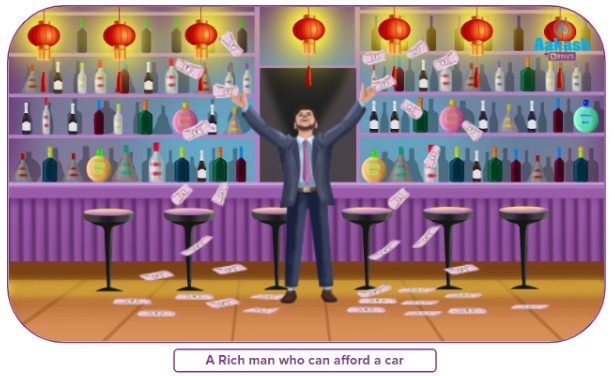
On the contrary, in the same city, there lived a poor beggar for whom buying a car was a faraway dream. In fact, due to this state of poverty, it was difficult for him to own any such luxurious stuff.

The two differently characterised men are just like two different atoms, behaving differently towards accepting (or owning) an electron (or car). So, atoms may be stabilised on gaining electrons (by losing energy), or atoms might need to be given the energy to make them accept electrons!
The greater the electron affinity, the easier it is to accept electrons and the more negative will be its electron gain enthalpy (∆egH). On the addition of an electron, if energy is liberated, the electron affinity is considered to be positive. Electron Affinity has a sign convention opposite to that of its corresponding ∆egH value.
TABLE OF CONTENTS
- Exceptional Trends/Anomalies in Electron Gain Enthalpy
- Electron Affinity
- Electron Affinity and Electron Gain Enthalpy
- Difference between Electron Affinity and Electron Gain Enthalpy
- Practice Problems
- Frequently Asked Questions - FAQ
Exceptional Trends/Anomalies in Electron Gain Enthalpy
- Electron gain enthalpy corresponds to the energy change associated when an electron is added to an isolated neutral gaseous atom. We shall discuss in detail the various factors affecting electron gain enthalpy.
- Fluorine’s electron gain enthalpy is less negative than that of chlorine. The corresponding order of it for halogens is Cl > F > Br > I. In the case of fluorine, the valence shell electronic configuration is 1s2 2s2 2p5.
- On adding another electron to the valence shell, it causes severe electron-electron repulsion (due to the exceptionally smaller size of fluorine) due to which the system becomes relatively unstable. Comparatively, it is easier to add an electron to a chlorine atom.
- Electron gain enthalpy order for chalcogens is S > Se > Te > Po > O.
- Due to the smaller size of oxygen, the addition of an electron causes severe electron-electron repulsions. The experimental data suggest that oxygen (O) has the least electron gain enthalpy among chalcogens.
Electron Affinity
- It is defined as the energy released when an electron is added to a neutral isolated gaseous atom. The order of electron gain enthalpy will be opposite of electron affinity.
- Electron affinity increases from left to right across a period and from top to bottom in a group because the electrons added to the energy levels get closer to the nucleus.
- Non-metals have a much greater electron affinity as compared to metals.
Electron Affinity and Electron Gain Enthalpy
These two terms are often thought to be the same, but there is a slight difference between the two. Electron affinity is the extent to which an atom or molecule attracts additional electrons.
Using concepts of thermodynamics, a relationship has been established between electron gain enthalpy and electron affinity.
Relation between Electron Affinity and Electron Gain Enthalpy
Electron Gain Enthalpy = Electron Affinity - 
Where R= Universal Gas Constant
T = Temperature.
Difference between Electron Affinity and Electron Gain Enthalpy
|
Electron Affinity |
Electron Gain Enthalpy |
|
It corresponds to the energy liberated when an electron is added to a neutral isolated gaseous atom. It is negative as the corresponding electron gain enthalpy’s magnitude. |
It is the enthalpy change associated with the process of the addition of an electron to a neutral gaseous atom to convert it to a negative ion. |
Example
- Let us consider the oxygen family elements O, S, Se, Te, Po.
- Order of electron affinity or negative electron gain enthalpy (considering the magnitude) is S > Se > Te > Po > O.
- Order of electron gain enthalpy will be the reverse of this, i.e., O > Po > Te > Se > S.
Practice Problems
Q 1 The electron gain enthalpy of:
a. Carbon is greater than oxygen
b. Sulphur is less than oxygen
c. Iodine is greater than bromine
d. Bromine is less than chlorine
Option (D)
Answer: Down the group, electron gain enthalpy decreases owing to increase in atomic radii and hence decrease in effective nuclear charge. Hence, bromine has less electron gain enthalpy than chlorine.
Q 2. Which of these elements have the maximum electron affinity?
a. Na
b. S
c. Mg
d. Al
Option (B)
Answer: Electron affinity increases as we go from left to right across a period. So, sulphur has the maximum electron affinity among the given elements.
Q 3. Electron gain enthalpy order of Al, N, O Cl is:
a. N<O<Cl<Al
b. O<N<Al<Cl
c. Al<N<O<Cl
d. Cl<N<O<Al
Option (C)
Answer: Nitrogen has a half-filled orbital, hence its tendency to accept electrons is lesser than that of oxygen. Aluminium is a metal that has a lower electron gain enthalpy than non-metals. Chlorine has the highest electron gain enthalpy as accepting one electron will make it achieve a stable electronic configuration.
Q 4. Among halogens, which element has the highest electron gain enthalpy?
a. F
b. Cl
c. Br
d. I
Option (B)
Answer: Fluorine, owing to its small size, faces interelectronic repulsions on accepting an electron. Whereas chlorine, due to its relatively larger size, can readily accept an electron to achieve a stable electron configuration. So, chlorine has the highest electron gain enthalpy among the halogens.
Frequently Asked Questions-FAQs
Q 1. Why is the formation of F- exothermic, while the formation of O2- is endothermic?
Answer: In the case of F-, it is the first electron gain enthalpy that releases energy as the formation of F- makes it stable by giving it an octet configuration. Hence, the formation of F- is exothermic. In the case of O2-, it is the second electron gain enthalpy (from O- to O2-) for which the energy has to be supplied from outside owing to interelectronic repulsion. Therefore, the formation of O2- is endothermic.
Q 2. Why are the electron gain enthalpies of some of the elements of the 2nd period, namely O and F, less negative than the corresponding elements of the third period?
Answer: Elements of the 2nd period have the smallest atomic size among the elements in their respective group. Consequently, there are considerable electron-electron repulsions within the atom itself and hence the additional electron is not accepted with the same ease as is the case with the remaining elements in the same group.
Q 3. Why are the second or higher successive electron gain enthalpies generally positive?
Answer: When an electron is added to the uni-negative ion, it experiences interelectronic repulsion from the anion, due to which energy has to be supplied to overcome the repulsion. Thus, the addition of the second electron requires energy due to which the second electron gain enthalpy is generally always positive.
Q 4. With an increase in atomic radii, would electron affinity increase or decrease?
Answer: With increasing atomic radii, the tendency to gain electrons would decrease on account of decreased effective nuclear pull faced by the incoming electron. Hence electron affinity would decrease.
Related Topics
|
Factors Affecting Electron Gain Enthalpy |
Electron Gain Enthalpy |
|
Potassium |
Successive Ionisation Enthalpy |
|
Successive Electron Gain Enthalpy |
Enthalpy of Ionisation |

 Call Now
 Let's Chat
 Share
Share