-
Call Now
1800-102-2727


Electrolytic Refining

A fascinating procedure used to purify metals and other high-quality materials is known as electrolytic refining. Harnessing electricity's power eliminates impurities, resulting in purifying products that meet stringent quality standards.
Table of Contents
- What is Electrolytic Refining?
- Electrolytic Refining of Metals
- Electrolytic Refining of Minerals
- The Procedure of Refining Against Impurities
- Importance of Electrolytic Refining
- Practice Problems
- Frequently Asked Questions
What is Electrolytic Refining?
A technique used to purify metals by applying electric current in a liquid solution is referred to as electrolytic refining. The procedure is generally utilised for refining metals like copper, gold, nickel and silver. It enables the elimination of impurities from raw materials like other metallic or non-metallic components, producing a product with high quality.
Depending on the metal in the electrolytic refining process, an electrolyte, i.e., metal salt aqueous solution, is frequently used. When an electric current with a sufficient voltage is provided, the impure metal dissolves at the anode, forming clean or pure metal at the cathode. Electrolytic refining is also called electrorefining.
Electrolytic Refining of Metals
The electrolyte and other factors must be set so that no impurity can flow from the anode to the cathode while proceeding with metal deposition and anodic dissolution with high efficiency. The anode cannot passivate, aiming to generate a high-quality, occasionally extremely crystalline deposit at the cathode. When it is crucial to impose the proper behaviour on both electrodes, additives are applied to the electrolyte. For example, electrolytic refining of copper.
Copper is extracted from coal, known as blister copper, which is approximately 98 to 99 per cent pure. However, an electrolytic refining procedure is applied to make it 99.95 per cent pure and reach the desired quality standard to utilise it as an electrical component. The anode, or positive electrode, is a block of impure copper. The negative electrode, i.e., cathode, is a copper sulphate acidified with sulphuric acid and is utilised as a graphite-coated electrolyte beside pure cotton tubes.
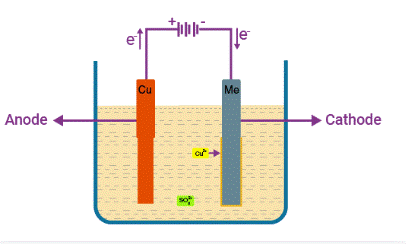
Image: Electrolytic refining of copper.
During electrolysis, copper sulphate dissociates into positively charged copper ions ( ) and negatively charged sulphate ions (SO4-). The positive copper ions or cations flow towards the cathode, where they absorb electrons from the cathode. The copper atom is precipitated on the cathode’s graphite layer. When electrolytically processing metals by electro-grinding, the cathode is coated with graphite to extract the concentrated materials. This electrolysis technique is one of the growing procedures. On the other hand, the metallic impurities in the anode combine with sulphuric acid to dissolve, creating metallic sulphate in the electrolytic solution. Gold and silver impurities that are generally not formed by a sulphuric acid-copper sulphate solution are deposited as the anode dust or sludge.
Electrolytic Refining of Minerals
Electrolytic refining of certain major minerals is as follows.
a. Gold
Hydrochloric acid is utilised in the electrolytic refining procedure. Anode comprises a gold alloy, and cathode comprises a thin sheet of gold. When the ion flow occurs, pure gold with a higher purity rate is travelled to the cathode. The procedure is also called the cycle of Wohlwill.
b. Silver
The cathode comprises pure silver, whereas the anode comprises crude silver. The process of electrolytic refining is the same as gold. Still, the difference is in the nitric acid bath, where silver anodes are diffused, achieving 99.9 per cent of pure silver.
The Procedure of Refining Against Impurities
Metallurgy involves a heavy rate of grinding and refining. Each metal extracted from ore is typically impure in composition. Refining is a method to eliminate impurities to form a high-quality pure material. Impurities can be isolated from raw materials through distinct procedures relying on the materials' characteristics and impurities. Apart from the electrolytic refining process, some other techniques used to refine the crude metals include
a. Chromatographic techniques
b. Zone refining
c. Vapour phase refining
d. Distillation
e. Liquation
Electrolytic refining is a preferred procedure over electro-winning, and such facilities are found ranging between the scale of 1,000 to 100,000 tonnes annually worldwide. Typically, these are a component of a large project to retrieve raw materials from primary ores and waste. Therefore the system requires to be built to handle a metal feed with varying quality and generate a concentration of all the components that exist in a shape that can be processed further. Furthermore, electrolytic refining produces a high metal purity.
Electrolytic refining procedures that utilise molten salts or non-aqueous electrolytes are the subject of future research. It is so because they value the possibility of enhancing current densities and refining by lowering the unstable oxidation states in water. For example, refining copper using Cu+ would almost reduce the energy required.
Importance of Electrolytic Refining
Electrolytic refining holds numerous significant importance for industries for the following reasons.
a. To gain highly purified materials.
b. Promotes recycling and sustainability.
c. Economically efficient, and
d. Easy customisation and alloy production.
Practice Problems
Q1. Choose the techniques used for refining materials
a. Electrorefining
b. Zone refining
c. Distillation
d. All of the above
Ans: d. All of the above
Explanation: Other than electrolytic refining, zone refining and distillation are other techniques for metal purification.
Q2. When current is supplied to the liquid solution to purify metals, it is called
a. Electrolytic refining
b. Electrolysis
c. Electroporation
d. None of the above
Ans: a. Electrolytic refining
Explanation: Electrolytic refining is the technique in which current is applied to the aqueous solution to purify the metals.
Q3. After refining the metal copper, it gains the purity of
a. 99.95 per cent
b. 99.98 per cent
c. 99.9 per cent
d. 100 per cent
Ans: a. 99.95 per cent
Explanation: After undergoing the electrolytic refining technique, the high-quality copper achieved can be 99.95 per cent of purity.
Frequently Asked Questions
Q1. State five advantages of copper.
Answer: The five advantages of copper include
- It possesses high thermal and electric conductivity.
- It has a low corrosion level.
- It possesses extremely high alloy properties.
- It provides ease for rolling mould, extrusion, and casting.
- Posses low toxicity for humans,
Q2. What is an electrode?
Answer: An electrode is utilised in electrolysis as a solid electric conductor through which electric current enters or exits an object, region or substance like non-, metallic solids, gases, liquids, plasma, or vacuums.
Q3. Why is electrolytic refining not used to refine sodium?
Answer: This is due to the fact that once sodium is formed, it tends to react strongly with the water that is currently present in the solution and cannot afterwards remain in a metallic form.

 Call Now
 Let's Chat
 Share
Share