-
Call Now
1800-102-2727


Electrode Potential and Standard Electrode Potential: Definition, Measurement, Practice Problems and FAQs:

Have you ever seen a manual weighing machine with weights?
Obviously yes, imagine you went to a grocery shop and asked the shopkeeper for 3 kg of rice. First, he took a 3 kg weight and put it at one end of the balance. Now slowly he added rice to the other end. You must have observed that to bring out the equilibrium in the balance shopkeeper either removes or add sugar.

What if he had the actual idea of what amount to be removed?
Definitely, it would have saved a lot of time.
Similarly in electrochemistry during the half cell reaction, it is important to find out how easily a substance can lose or gain electrons to attain equilibrium. This information is achievable with electrode potential and standard electrode potential.
Table of content
- Electrode potential
- Standard electrode potential
- Measurement of electrode potential
- Determination of standard electrode potential of Zn/Zn2+ electrode
- Determination of standard electrode potential of Cu/Cu2+ electrode
- Practice Problems
- Frequently Asked Questions (FAQs)
Electrode potential
Electrode potential is defined as the electromotive force (EMF) developed in a galvanic cell made with the electrode against a standard reference electrode. It is denoted by E and the unit of electrode potential is volt.
In simple terms, Potential difference developed between the metal rod and its ions in the solution.
Let’s understand the concept of electrode potential, consider a metal rod (M) placed in contact with its own ions (Mn+). One of the following three options is then possible:
- Mn+ ions may collide with the metal rod and deflected back without undergoing any change.
- Mn+ ions, on collision with the metal rod may gain electrons and change into metal atoms, i.e., Mn+ ions are reduced.
………………….(i)
- Metal atoms of the metal rod may lose electrons and change into Mn+ ions, i.e., metal atoms get oxidized
…………………..(ii)
- What actually happens depends upon the relative tendency of the metal or its ions. If metal ions have relatively higher tendency to get reduced, reaction (i) will occur. Metal ions (Mn+) will gain electrons from the metal rod. As a result, metal rod will develop a positive charge with respect to the solution and ultimately the following equilibrium will be attained.
- If metal has relatively higher tendency to get oxidized, reaction (ii) will occur, the electrons will accumulate on the metal rod which will, therefore, develop a negative charge. This in turn may attract some metal ions from the solution which may change into metal atoms. Thus, in both case, there is a separation of charges between the metal rod and its ions in the solution. Hence, a potential difference exists between them.
- The term "electrode potential" refers to the electrical potential difference that has been created between the metal and its ions in the solution, or it can be used to describe to the tendency of an electrode to lose or acquire electrons when it comes into contact with a solution containing its own ions.
|
Oxidation potential |
Reduction potential: |
|
|
|
|
|
|
Standard electrode potential
The electrode potential but changes with the concentrations of the salt solution with which the electrode in contact and the temperature.
For a reference, a standard condition was defined as a concentration of one molar and measured at 298 K. If a gas is involved, the standard conditions chosen are 1-atmosphere pressure and 298 K.
The potential developed when the element is in contact with one molar solution at 298 K is called standard electrode potential and represented by Eº.
Standard Hydrogen Electrode SHE:
A hydrogen gas at 1 bar pressure is passed into 1 M HCl at 298 K in which a foil of platinum coated with platinum black (finely divided platinum) remains immersed. Pt only serves as an inert electrode through which electrons can flow in or out. This electrode potential is taken as reference electrode and assumed to have zero potential. This hydrogen gas reference electrode is called as the standard or normal hydrogen electrode (S.H.E. or N.H.E.).
Standard Hydrogen electrode can be used either as an anode or cathode depending upon the potential of the other electrode. With higher electron donating tendency element SHE acts as an cathode. With less electrode donation electrode it will act as an anode.
When this electrode serves as the anode of a cell and oxidation occurs, the following reaction occurs:
i.e., some hydrogen gas changes into H+ ions which go into the solution. The following reaction takes place when this electrode functions as a cathode, or when reduction occurs:
i.e., some H+ ions from the solution change into H₂ gas. Thus, the electrode is reversible with respect to H+ ions. This electrode is usually represented as: Pt, H₂ (g) |H+ (Conc = c)
The electrode potential of the standard hydrogen electrode is taken as 0.000 at 298 K.
Measurement of electrode potential
The absolute value of the electrode potential of a single electrode (called single electrode potential) in contact with its salt solution but cannot be determined because oxidation half reaction or reduction half reaction cannot take place alone. It can only be measured when combined to form a redox couple by using some other electrode like SHE, calomel electrode.
- To determine the electrode potential of any electrode, a cell is set up using this electrode as one of the electrodes and the second electrode is the standard hydrogen electrode. The EMF of the cell is measured.
- EMF of the cell will directly provide the electrode potential of the electrode under investigation because it is the sum of the oxidation potential of the electrode where oxidation occurs and the reduction potential of the electrode where reduction occurs, and one of the electrodes involved is the standard hydrogen electrode, for which the electrode potential is taken to be zero.
- In addition, the direction of the current flow reveals whether the investigated electrode undergoes reduction or oxidation in relation to the hydrogen electrode. Thus, the electrode potential is often referred to as the oxidation potential or the reduction potential.
- A reading on the voltmeter will be obtained only if the positive terminal of the voltmeter has been connected to the positive electrode,that is on which reduction occurs and the negative terminal to the negative electrode, that is on which oxidation occurs.
The determination of electrode potential may be further illustrated with the help of the following two simple examples :
Determination of standard electrode potential of Zn/Zn2+ electrode
A cell comprising of a zinc electrode immersed in 1 M ZnSO4 solution and a standard hydrogen electrode is set up.
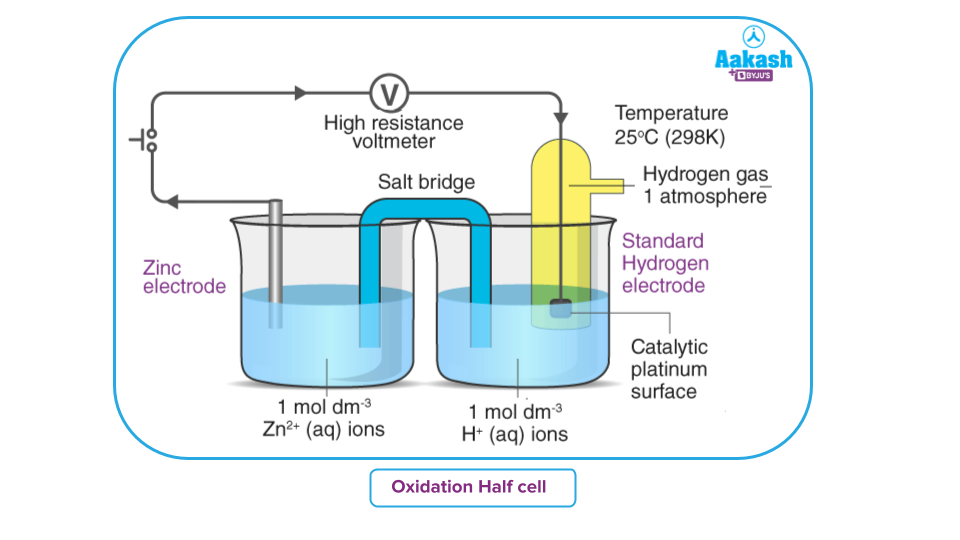
Oxidation :
The above cell's EMF is calculated to be 0.76 volt.. Hence, the standard electrode potential of Zn/Zn2+ electrode = 0.76 volt. Additionally, the current's direction of flow suggests that oxidation occurs at the zinc electrode. Hence, 0.76 volt is the standard oxidation potential of the Zn/Zn2+ electrode.
Determination of standard electrode potential of Cu/Cu2+ electrode
A standard hydrogen electrode and a copper electrode dipped in a 1 M CuSO4 solution are used to set up a cell.
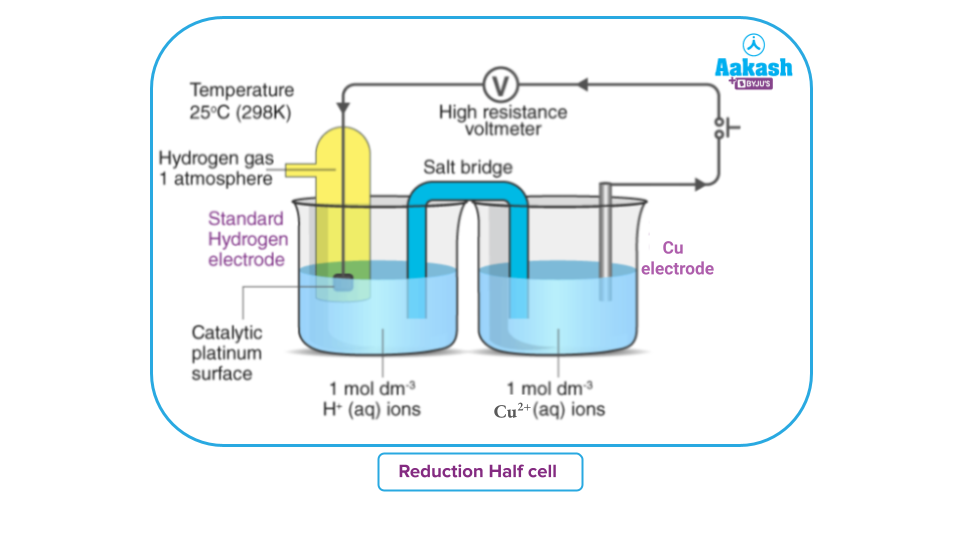
Reduction half cell
Reduction :
The cell's EMF is calculated to be 0.34 volt.. Hence, the standard electrode potential of Cu/Cu2+ electrode = 0.34 volt.Additionally, the current's direction of flow suggests that reduction occurs at the copper electrode. Hence, 0.34 volt is the standard reduction potential of Cu/Cu2+electrode.
It is important to mention here that it is common practice to express all the electrode potentials as reduction potentials. Since the reduction half reaction is just the reverse of the oxidation half reaction, therefore, reduction potential is obtained from the oxidation potential by simply changing the sign, i.e., for any electrode.
Thus, for the zinc electrode, Standard Reduction Potential = - 0.76 V
Practice Problems
Q.1 What should be the temperature for the measurement of standard electrode potential?
a. 300K
b. 200K
c. 273K
d. 298K
Answer: (D)
Solution: Potential is measured at 298K, 1 atm of pressure, and 1M of electrolyte concentration. These are considered standard conditions.
Q.2 Electrode potential determines the _______
a. Kinetic of a cell reaction
b. Thermodynamics of a cell reaction
c. Tendency of the electrode to loose or gain electron
d. None of the above
Answer: (C)
Solution: Electrode potential is defined as the electromotive force (EMF) developed in a galvanic cell made with the electrode against a standard reference electrode. It is denoted by E and the unit of electrode potential is volt. The tendency for an electrode to gain or lose electrons when in contact with its own ionic solution.
Q.3 Stronger the oxidizing agent, greater will be the:
a. Oxidation potential
b. Reduction potential
c. Both A & B
d. None of the above
Answer: (B)
Solution: Property of an oxidizing agent is to oxidize other but itself it should get reduced. The tendency of an electrode to gain electrons or to get reduced is known as its reduction potential. Hence, greater the value of reduction potential, stronger is the oxidizing agent.
Q.4 which of the following is not a factor that can affect the value of electrode potential?
a. Nature of metal or electrode.
b. The concentration of metal ions in solution.
c. Temperature.
d. Size of the vessel
Answer: (D)
Solution: Electrode potential is generally affected by the following factors
- Nature of metal or electrode.
- The concentration of metal ions in solution.
- Temperature.
Frequently Asked Questions (FAQs)
Q.1 What are the two important factors that can affect the value of electrode potential?
Answer: Electrode potential generally depends on the temperature of the system and concentration of the metal ions. If any of these factors are altered then the value of electrode potential will change.
Q.2 Is electrode potential an intensive or extensive property?
Answer: An intensive property is a physical quantity whose value is independent of the amount of the substance measured. Electrode potential depends on the concentration of the metal ion. Hence, it is an extensive property.
Q.3 Why electrons only move from anode to cathode?
Answer: Because electrons have a negative charge, electron flow flows in the opposite direction as conventional current. As a result, electrons leave the device through the anode and enter through the cathode.
Q.4. What distinguishes EMF from conventional electrode potential?
Answer: EMF is the voltage in a circuit when no current is flowing, whereas electrode potential is the voltage in a circuit when current is flowing. Electrode potential is the result, whereas EMF is the cause.

NEET Related Links
JEE MAIN Related Links
JEE Advanced Related Links
JEE Advanced Eligibility Criteria
JEE Advanced Chemistry Syllabus
JEE Advanced Registration Dates
CUET Related Links
Important Topics
Anemometer : Measurement of Wind Speed
Angular Acceleration Atomic Theory Audible and Inaudible Sound Average Speed and Average Velocity Average Velocity Avogadros Number Avogadros Hypothesis Azimuthal Quantum Number Balanced Force Bar Magnet Biconvex Lens Boyles Law Buoyancy Calorimeter Carnot Engine Celestial Bodies Centripetal And Centrifugal Force Concave and Convex Lenses Concave Convex Mirrors Contact and Non Contact Force Controlled Thermonuclear Fusion Convection Currents Convex Lens Convex Mirror Destructive Interference Difference Between Conduction Convection and Radiation Difference Between Electric Field and Magnetic Field Difference Between Heat And Temperature Difference Between Series And Parallel Circuits Differences Between Acceleration And Velocity Distance and Displacement Distance Time Graph Electrical Force : Electric Forces and Their Types Electromagnetic Waves : Definition, Equation and Properties of Electromagnetic Waves Electromagnetism Electron Spin Fluid Flow : Bernoullis Equation Derivation and Fluid Mechanics Fluid Friction : Types and Factors of Fluid Friction Frames of Reference : Inertial and Non- Inertial Frame of Reference Frequency and Wavelength Frictional Force Importance of Hydrosphere Instantaneous Speed and Velocity Introduction to Motion Kinetic and Potential Energy Difference Law Of Conservation of Energy Layers of the Earth Light Energy Light Sources List of physics scientists and Their inventionsLoudness of Sound
Magnetic Dipole Moment Magnetic Field Non - Contact Force Non - Renewable Energy Ohms Law Optics P Wave Physics Symbols Plane Mirrors Poissons Ratio Projectile Motion Properties of Water : Anomalous Expansion of Water Radius of Gyration Reflection of Light Reflection of Waves Relative Density Resonance Reverberation Rolling Friction Rotation and Revolution Screw Gauge Semiconductors and Insulators Sliding Friction Speed Time Graphs Static Friction Stefan Boltzmann Law Stress Tension Tension Force Thermometer: Clinical Laboratory Thermometer Types of Rocks Types of Waves Uniform Motion and Non Uniform Motion Unit of Voltage Uses of Convex Lens Uses Of Convex Mirror Uses of Electromagnet Uses of Optical Fibre Wave Wavelength of Light What is Scattering of Light Working of Electric Bell Conventional and Non-conventional Sources of Energy Buoyant Force Bulk Modulus of Elasticity Bernoulli’s Principle Angular Momentum Difference Between Speed And Velocity ForceUnit of Heat
Difference between Distance and Displacement Simple Microscope Derivation Of Equation Of Motion Thermometer: Clinical & Laboratory Thermometer Difference between Concave and Convex LensDerivation Of Lens Maker Formula
Unit Of Pressure Velocity Uses of Plane Mirror
Wave Theory of Light
Unit of Density Unit of Light Unit of Force Unit of Magnetic Field Unit of wavelength Unit of Viscosity Uses of Electroplating Young's Modulus
What is the Scattering of Light
Lenz Law Space Wave Propagation Schrodinger Wave Equation Relation between Fahrenheit and Celsius Refractive Index Potentiometer Working Pascal Law Oscillatory Motion Optical Instruments Newton's Laws of Motion - First Law Modulation and Demodulation Magnetic Flux Lens Formula and Magnification Kaleidoscope Faradays Law Epsilon Naught Value Energy Bands Electrostatics Electroscope AC Generator Unit of Current Lithosphere Bending Equation Derivation Difference Between Pound and Kilogram Semiconductor Devices OTEC - Ocean Thermal Energy Conversion Hall Effect Rectilinear Propagation of Light Difference Between Ammeter and Voltmeter Coefficient of Linear Expansion Ampere’s Law Cyclone and Thunderstorm Save The Environment From Pollution Particle Nature of Light Types of DC Motor Uses Of Transistor Derivation of Phase Rule Unit of Humidity

 Call Now
 Let's Chat
 Share
Share