-
Call Now
1800-102-2727


Electrochemistry

We use the products of electrochemistry in our daily life as batteries in our TV and AC remotes, the batteries in the iPhones or the nerve impulses that work in our bodies. How do these batteries function? What kind of reactions go inside these systems? Many other reactions and functions are explained by electrochemistry and its various components.
Table of Contents
- What is electrochemistry?
- Metallic and electrolytic conductors
- Types of cells
- Electrolytes
- Electrolysis
- Electrode potential
- Electrochemical series
- Application of electrochemical series
- Nernst equation
- Practice problems
- FAQs
What is electrochemistry?
Electrochemistry is the discipline of chemistry that studies the conversion of chemical energy and electrical energy, including the movement of electrons between molecules and ions.
In electrochemical reactions, electrons move between different materials, converting chemical energy into electrical energy or vice versa.
Electrochemistry also involves various processes, including producing electricity through chemical reactions, the electrolysis of compounds to yield desired products, and the exploration of fundamental ideas relating to electron transfer and reaction dynamics.
Metallic and Electrolytic Conductors
Metallic conductors are substances that facilitate the flow of electric charge due to the presence of free-moving electrons inside their atomic makeup.
The electric field propels the free electrons whenever a potential difference (voltage) is established across a metallic conductor, causing an electric current to flow. Examples of metallic conductors include copper, silver, aluminium, etc.
Electrolytic conductors are materials that carry electricity when immersed in an electrolyte solution or when melted. Positively charged ions (cations) and negatively charged ions (anions) are produced when electrolytes ionise in a solvent.
The movement of the cations and anions toward the oppositely charged electrodes causes an electric current to flow whenever an electric potential is generated within an electrolyte solution or molten electrolyte. Examples of electrolytic conductors include aqueous solutions of acids, bases and salts.
Metallic conductors channel electricity by moving free electrons through a metal lattice, whereas electrolytic conductors channel electricity by moving ions in an electrolyte solution or in their molten form.
Types of cells
There are different kinds of cells used in electrochemistry, such as the following:
Galvanic Cells
A galvanic cell is an electrochemical cell that generates electrical energy by redox reactions that occur freely. It transforms chemical energy into electrical energy. The cell comprises two half-cells that are joined together using a conductive route. Each half-cell has an electrode submerged in an electrolyte solution.
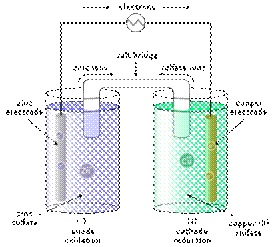
Image: Galvanic cell
The spontaneous oxidation-reduction reaction occurs at the electrodes, resulting in a potential difference (voltage) between them. This potential difference creates an electric current when electrons move across an external circuit. Galvanic cells are commonly used in batteries and fuel cells.
Electrolytic Cell
An electrolytic cell is an electrochemical cell that uses electrical energy to conduct a redox reaction. It changes electrical energy into chemical energy. The cell is made up of two electrodes, a cathode and an anode, that are immersed in an electrolyte solution. An external power source drives the electrolytic cell's electrode reactions.
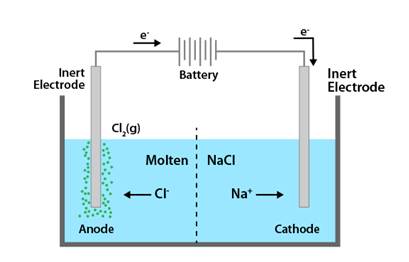
Image: Electrolytic Cell
The electrolysis of the electrolyte takes place by passing an electrical potential (voltage) across the electrodes. This enables the deposition of materials on the electrodes and controlled chemical reactions. Applications for electrolytic cells include water electrolysis, electroplating, electrorefining, and industrial chemical synthesis.
Electrolytes
An electrolyte is a material that generates ions that can generate an electric current when melted or dissolved in water. They are important in several kinds of chemical, biological, and electrochemical reactions. The electrolyte produces both positively charged ions, called cations, and negatively charged ions, known as anions. There are two kinds of electrolytes:
Strong Electrolytes
Strong electrolytes are substances that totally dissociate into ions when dissolved in water or melted. Strong electrolytes are good conductors of electricity since they have a large concentration of ions in their solution or melt. Examples of strong electrolytes are H2SO4, NaCl, KNO3 and more.
Weak Electrolytes
Weak electrolytes are compounds that, when dissolved in water or melted, only partially dissociate into ions. Whenever a weak electrolyte dissolves in water, it creates a dynamic balance between ions and uncharged particles. Due to their comparatively low ion concentration, weak electrolytes have a lower electrical conductivity than strong electrolytes. Examples of weak electrolytes include acetic acid, ammonia and more.
Electrolysis
Electrolysis is a chemical procedure that employs electrical energy to promote a redox reaction. In electrolysis, an electrolyte becomes subjected to an electric current, which causes the electrolyte to break down into its component ions and resulting in reactions at the electrodes.
Electrolysis occurs in an electrolytic cell with two electrodes, a cathode, the negative electrode and an anode, the positive electrode, which is submerged in an electrolyte solution or molten electrolyte.
Faraday discovered the relationship between the quantity of material released or deposited at the electrode and the quantity of current flowing through the electrolyte.
Faraday’s First Law
According to Faraday’s first law, the amount of electricity passed is proportional to the number of ions that are oxidised or reduced at each electrode during the flow of current.
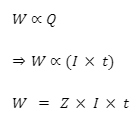
Where
W = mass of the material deposited or released on the electrode
Q = amount of charge used
I = strength of the current in ampere
t = amount of time for which current was passed through the electrolyte
Z = electrochemical equivalent
Faraday’s Second Law
Faraday’s second law states that when the electrolytic solution is exposed to the same amount of power during electrolysis, a variety of materials are released that are proportional to their chemical equivalent weights.
W ∝ E
W/E = F (constant)
F = 96500 C per mole
Applications of Electrolysis
Some of the applications of electrolysis include the following:
- Electrolysis is used to deposit a thin coating of metal onto the surface, known as electroplating.
- It is used in the electrorefining process, which is used to purify metals.
- It is utilised in fuel cell technology, storing energy, and manufacturing hydrogen.
Electrode potential
When a metal is dissolved in a solution of its ions, it develops a charge in relation to the solution that is either negative or positive. As a result, a distinct potential difference between the metallic component and the solution develops. This potential differential is referred to as electrode potential.
Electromotive Force (EMF)
The electromotive force (EMF) of a cell, also known as cell potential or cell voltage, is the highest potential difference or voltage that a cell can generate between its electrodes. It is the driving force behind the movement of electrons in an electrochemical cell. The Nernst equation can be used for calculating the EMF.
Electrochemical Series
The electrochemical series, also referred to as the activity series or electromotive force (EMF) series, is a list of metals and nonmetals organised according to how likely they will go through oxidation or reduction during an electrochemical process.
It offers details about the relative potencies of oxidising and reducing agents, which helps predict the direction of electron flow during redox reactions.
The standard reduction potentials (E°), which reflect a species' propensity to gain electrons (reduction) or lose electrons (oxidation) in a half-cell reaction, are used to rank metals and nonmetals in the electrochemical series.
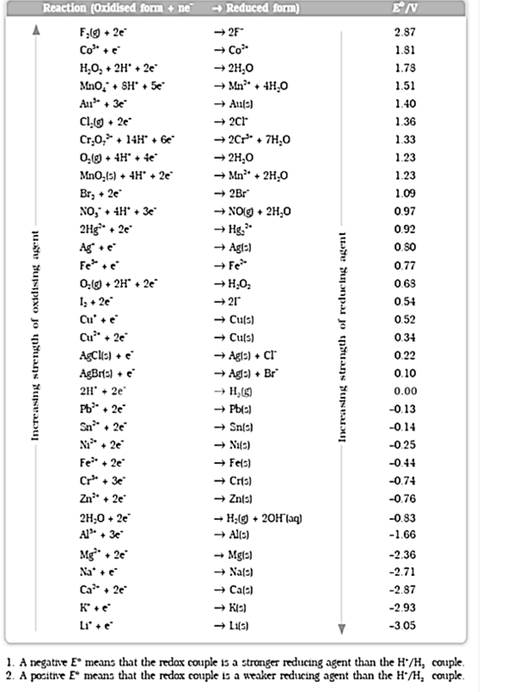
Image: Electrochemical Series
Application of electrochemical series
There are various applications of electrochemical series, such as the following:
- By comparing the standard reduction potentials of various species, the electrochemical series enables us to estimate the sustainability of redox reactions.
- The electrochemical series serves to detect the half-reactions of oxidation and reduction and figure out the total potential of the cell.
- The electrochemical series offers options for choosing suitable electrode materials for a range of applications. Higher-ranking metals in the series are more noble and have stronger corrosion resistance, making them appropriate to be used as electrode materials in electrolysis and electrochemical reactions.
- The electrochemical series is essential in the creation and choosing of battery components. It is possible to build batteries with accurate cell potentials and efficiency attributes by selecting the proper metal combinations and their corresponding reduction potentials.
- Knowing the electrochemical series is helpful in figuring out and preventing corrosion.
Nernst equation
The Nernst equation is an equation that connects the concentrations of the reactants and products that occur during the redox reaction of an electrochemical cell to the equilibrium potential of the cell.
The Nernst equation enables us to determine an electrochemical cell's potential in non-standard conditions where the reactant and product concentrations are not equal to 1 M. It helps evaluate if a redox reaction is spontaneous or nonspontaneous under a specific range of settings and offers an understanding of how changes in concentration impact the cell potential.
The Nernst equation is given by
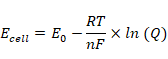
Where
Ecell = cell potential under non-standard conditions
E0 = standard cell potential
R = universal gas constant (8.314 J/(mol. K))
T = temperature in Kelvin
n = the number of electrons transferred in the redox reaction
F = Faraday’s constant (96500 C/mol), the charge of one mole of electrons
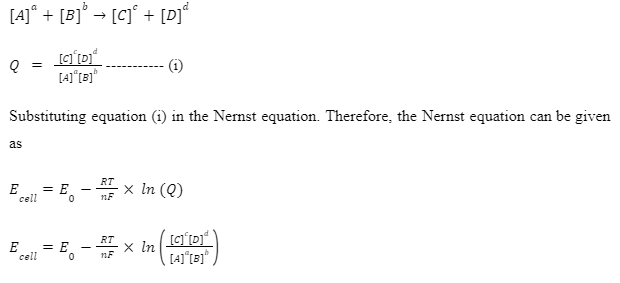
Q = reaction quotient, the concentration of products divided by the concentration of reactants
For a chemical reaction,
Practice Problems
Q 1. Which of the following is the stronger reducing agent?
a. Cu
b. Pb
c. Li
d. Zn
Ans. c. Lithium is the strongest reducing agent among the following, with a standard electrode reduction potential of -3.05 V.
Q 2. Which of the following is an everyday use of electrochemistry?
a. Batteries
b. Gold plating of decorative items
c. Nerve impulses
d. All of the above
Ans. d. Electrochemistry has various uses in everyday life. All of the following examples are the use of electrochemistry in daily life.
Q 3. What is the electric charge required for electrode deposition of one equivalent of the substance?
a. 96500 C per second
b. Charge of 1 mole of electrons
c. One ampere per hour
d. 1 ampere per second
Ans. b. According to Faraday's laws, one mole of electrons added or removed during the process of reduction or oxidation will release, dissipate or deposit one equivalent weight of the substance, and the amount of charge needed to complete this is equal to the charge on one mole of electrons.
FAQs
Q1. What is the symbol of anode and cathode?
Ans. The symbol for anode and cathode is A and K, respectively. An anode is positively charged, and a cathode is negatively charged in electrolysis.
Q2. What is an example of a cathode?
Ans. The positive (+) marked side of the household battery is an example of a cathode.
Q3. What are Lenz’s law and Faraday’s law?
Ans. The direction of an induced current is determined by Lenz's law, and Faraday's law equates the amount of the induced back EMF to the rate of fluctuation in the induced magnetic field.

 Call Now
 Let's Chat
 Share
Share