-
Call Now
1800-102-2727


Electrochemical Series: Redox Reactions, Electrode Potential, Electrochemical Series, Application of Electrochemical Series, Practice Problems and FAQs:

Imagine you’re making matar paneer. Everything is almost ready and suddenly your sibling said he/she wants to add capsicum. Now you’re skeptical whether adding capsicum at this stage will be good or not.
How easy it would have been if there was a series of vegetables with its magnitude of impact on any dish.
Well, not sure about cooking but in chemistry, we do have a series that can tell us the relative activity of metals and their ions. This series can help us to predict, how a reaction will proceed in aqueous solution with a particular metal and which metal can replace other metal in its salt solution.
It is called an Electrochemical series. Let’s unfold its basics and understand how useful this series is for electrochemistry.
Table of content
- Electrochemical series
- Applications of Electrochemical series.
- Practice Problem
- Frequently Asked Questions (FAQs)
Definition of Electrochemical series
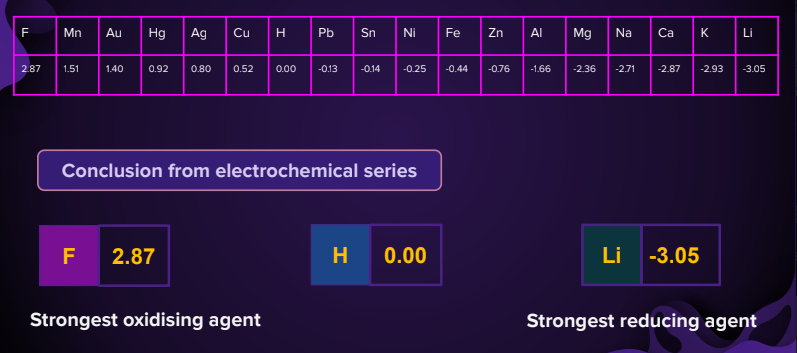
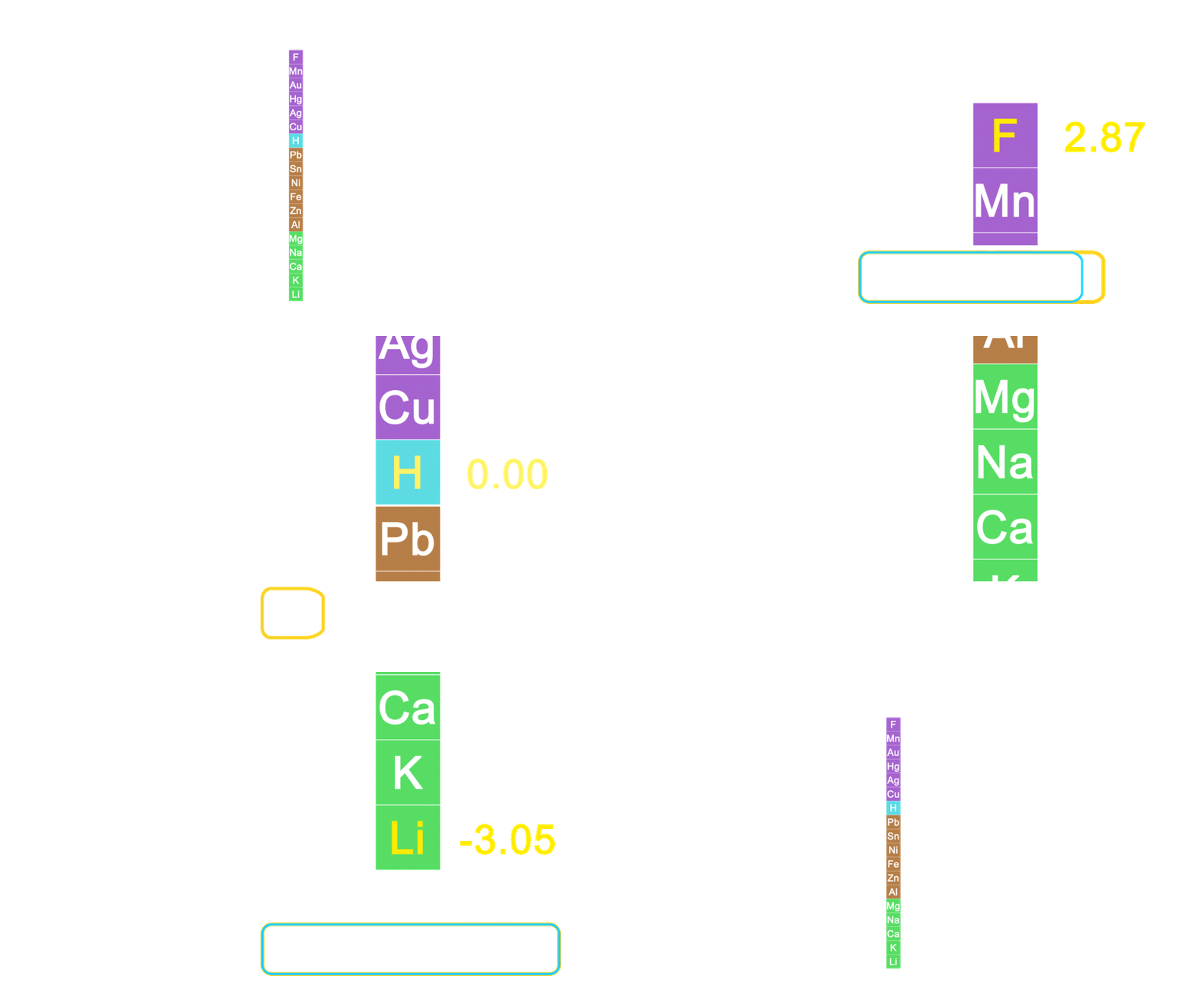
Electrochemical series, also referred to as activity series, is a list that describes the arrangement of elements in order of their increasing electrode potential values. Here substances are arranged in the order
of highest reduction potential to the lowest reduction potential.
Standard electrode potentials at 298K
- The standard electrode potentials of a large number of electrodes have been determined using standard hydrogen electrode as the reference electrode, for which the electrode potential has been arbitrarily fixed as zero.
- Also, as already mentioned, it is a common practice to express the electrode potentials as the reduction potentials. Since reduction half reaction is just the reverse of oxidation half reaction, the reduction potential of any electrode is obtained from its oxidation potential by simply changing the sign.
- Further, according to the latest convention of sign, the electrode at which reduction takes place with respect to standard hydrogen electrode has reduction potential which is given a positive sign; the electrode at which oxidation takes place with respect to standard hydrogen electrode has a positive oxidation potential or expressed as reduction potential, it will have a negative sign.

Redox Reaction and electrode potential
- The electrode potential is the tendency of an electrode to lose or gain electrons when it is in contact with the solution of its ions in a half-cell. It's measured in volts.
- Oxidation is the loss of electrons whereas reduction is gain of electrons.
- The cell potential is the difference between the cathode and anode electrode potentials (reduction potentials). When no current is drawn through the cells, it is referred to as the standard electromotive force (emf).
Applications of Electrochemical series.
1. To compare the oxidizing and reducing powers of various metals and their ions.
As by convention, positive sign is used to represent the reduction potential, this implies that greater is the reduction potential, more easily is the substance (element or ion) reduced or in other words, stronger oxidizing agent it is.
F2, has the highest reduction potential and Li+ ion has the lowest reduction potential, this means that F2 is reduced most easily whereas Lithium ions are reduced with greatest difficulty. In other words, F2 is the strongest oxidizing agent whereas Li+ ions are the weakest oxidizing agent. Conversely, writing the reaction in the reverse order, it can be postulated that lithium will be oxidized most easily and hence is the best reducing agent whereas fluoride ions are oxidized with greatest difficulty and hence are weakest reducing agents.
2. To compare the relative activities of metals.
The greater a metal's oxidation potential, the easier it can lose electrons and thus the greater its reactivity.. As a result, metals with higher oxidation potentials can displace metals with lower oxidation potentials from salt solutions. For example, oxidation potentials of Mg, Zn, Fe, Cu and Ag are in the order :
Mg>Zn> Fe > Cu > Ag
As a result, each metal can displace metals below from salt solutions. As a result, their reactivity is in the preceding order.
3. To calculate the standard EMF of any galvanic cell.
A galvanic cell is based on a reaction which can be split into two half reactions, viz.,
(1) Oxidation half reaction and
(ii) Reduction half reaction
Standard EMF of the cell = Standard oxidation potential of the oxidation half reaction + Standard reduction potential of the reduction half reaction
As Oxidation potential = - Reduction potential, the above expression may also be written in the form :
Standard EMF of the cell
= Standard reduction potential of the reduction half reaction - Standard oxidation potential of the oxidation half reaction
Further, as in the representation of acell, the electrode on which oxidation takes place is written on the left hand side and the electrode on which reduction takes place is written on the right hand side.
Standard EMF of the cell
= standard reduction potential; of the right hand side electrode - standard reduction potential of the left hand side electrode.
E0cell=E0cathode- E0anode
Example:
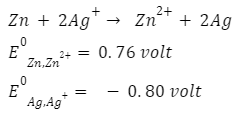
Let’s calculate the standard EMF of a cell which has cell reaction as
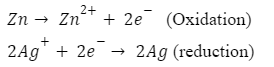
Solution: First let’s break the above reaction into two half cell reaction
If you look at the above data, it is the standard oxidation potential of both Zinc and silver.
To calculate the standard EMF of the cell we need reduction potential of silver electrode and oxidation potential of zinc electrode.
Reduction potential of Ag electrode = -Oxidation potential of Ag electrode
= -(-0.80 volt)= +0.80 volt
Standard EMF of the cell = Standard oxidation potential of Zn electrode + Standard reduction potential of Ag electrode = 0.76+0.80 volt = 1.56 volts
4. To predict whether a metal reacts with acid to give hydrogen gas.
In order that a metal A(assuming it to be monovalent) may react with an acid to give H₂ gas, following reaction should take place :
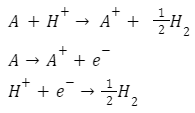
Thus, the metal should have the tendency to lose electrons, i.e., undergo oxidation, with respect to hydrogen. Thus, all metals lying above hydrogen in the electrochemical series react with the acid to give hydrogen gas. Further, evidently, lower the reduction potential (i.e., more negative the reduction potential) higher is the reactivity.
5. Predicting the redox reaction's spontaneity.
To see whether a given redox reaction is feasible or not, the EMF of the cell based upon the given redox reaction is calculated. The EMF of the cell must be positive for a redox reaction to occur spontaneously. If the EMF comes out to be negative, the direct reaction, as given, cannot take place; the reverse reaction may take place. This is illustrated by the numerical problems given below.
Example:
Let’s predict whether zinc and silver react with 1M sulphuric acid to give hydrogen gas or not. 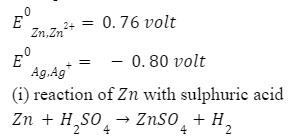
Cell representation will be : Zn|Zn2+||H+|H2
Standard EMF of the cell = Standard reduction potential of R.H.S electrode - Standard reduction potential of L.H.S. electrode
= 0 - (-0.76) = + 0.76 volt
EMF is positive. Hence, reaction of Zn with sulphuric acid takes place.
(ii) reaction of Ag with sulphuric acid

Cell representation will be : Ag|Ag+||H+|H2
Standard EMF of the cell = Standard reduction potential of R.H.S electrode - Standard reduction potential of L.H.S. electrode
= 0 - 0.80 = -0.80 volt
EMF is negative. Hence, reaction of Zn with sulphuric acid doesn’t take place.
6. To calculate the minimum voltage required to bring about electrolysis of a salt solution.
Example:
Let’s calculate the minimum voltage required to bring about the electrolysis of 1M copper sulphate solution at 298 K.
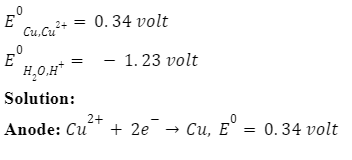

Minimum voltage required for the electrolysis is 0.89 V
Practice Problem
Q1. Which of the following metal can displace Zn from it’s salt solution?
A. Mg
B. Fe
C. Cu
D. Ag
Answer: (A)
Solution: A metal with greater oxidation potential can displace metals with lower oxidation potentials from their salt solution.
The oxidation potential of the above metal has the following order
Mg>Zn> Fe > Cu > Ag
Hence, only Mg can displace Zn from its salt solution.
Frequently Asked Questions (FAQs)
Question 1. Can we predict the rate of reaction using electrochemical series?
Answer: The electrochemical series is also limited in that it cannot tell us the rate of reaction of half-reaction. Just because one reaction is expected to occur before another does not guarantee that it will occur at all.
Question 2. Why the electrode potential of hydrogen is taken zero?
Answer: An electrode's absolute electrode potential cannot be determined without first forming a complete cell. As a result, hydrogen is chosen as a standard reference electrode with an electrode potential of zero.
Question 3. Are EMF and potential difference same?
Answer: No, these two terms are different from each other.EMF is the potential difference between the two electrodes of the cell when no current is flowing in the circuit. Potential difference is the difference in the electrode potentials of the two electrodes under any condition.
Question 4. Why can’t we measure the absolute value of an electrode potential of an electrode?
Answer: It is not possible to determine the absolute value of electrode potentials because oxidation and reduction can’t take place alone. Hence a reference electrode is used to determine electrode potential of an electrode.
Related Topics
|
Types of Electrodes |
Faraday's Laws |
|---|---|
|
Metallurgy |
Electrolysis |
|
Standard Electrode Potential |
Nernst Equation |

 Call Now
 Let's Chat
 Share
Share