-
Call Now
1800-102-2727


Dry Cell - Definition, Working Principle and Types of Dry Cell

In our daily life, we use many electronic devices that use dry cells, such as wall clocks, watches, battery toys, remote control of TV, cameras etc. It is a type of simple electric battery with electrochemical cells. One of its important working principles is to convert chemical energy into electrical energy. Thus, these cells are used to generate electricity.
Table of Contents:
- What is a Dry Cell?
- Types Of Dry Cells
- Working Principle of Primary Cell
- Working Principle of Secondary Cell
- Advantages of Dry Cells
- Applications of Dry Cells
- Practice Problems On Dry Cell
- Frequently Asked Questions
What is a Dry Cell?
The dry cell is a simple electrochemical cell used as an electricity-producing source. It converts chemical energy into electrical energy to run electronic devices. This cell was developed by a French engineer named Georges Leclanche in 1866, after which dry cells are named Leclanche cells.
A certain number of cells combine together to form a battery. It consists of one or more electrochemical cells, which convert chemical energy into electrical energy. The lead-acid battery is an advanced dry cell. However, earlier, it was heavy and easily destructible. With the same principle, an advanced version of the dry cells is introduced and comes in different voltages and sizes.
In 1881, Carl Gassner of Mainz invented the modified form of the Leclanche battery, which is the commercial form of a zinc-carbon cell. It has many applications, such as flashlights, calculators, radios, toys, etc.
Types Of Dry Cells
Dry cells are classified into two types based on their nature. They are primary cells and secondary cells.
Primary Cells
- In primary cells, the chemical reactions are irreversible.
- Once the electrochemical reactions consume chemical reagents, the cells are dead and fail to produce electricity. They can’t be recharged again.
- Primary cells are smaller, and they are easy to transport.
- The fixed output voltage is 1.5 V
Secondary Cells
- In secondary cells, the chemical reactions are reversible.
- These cells can be reused and recharged multiple times.
- Once the electrochemical reactions consume chemical reagents, the cells can be recharged by using battery charges to generate electricity.
- Secondary cells can also be transported; however, they are larger than primary cells.
- The output voltage is not fixed, and it depends upon the load attached to them.
Working Principle Of Primary Cell
1. Zinc Carbon Cell
The chemical reaction in primary cells takes place only once. In a zinc-carbon cell, the zinc performs as the anode. The carbon or graphite rod acts as the cathode. The rod touches the brass cap on the top. The zinc is covered on the sides but not at the bottom. It is surrounded by low moisture electrolytes such as ammonium chloride (NH4Cl) paste, manganese dioxide (MnO2) and zinc chloride (ZnCl2). The reaction in the anode and cathode are as follows:
At Anode:
Oxidation refers to the loss of electrons. At the anode, oxidation takes place. As a result of oxidation, the zinc corrodes over time.
Zn(s) → Zn2+ + 2e-
At Cathode:
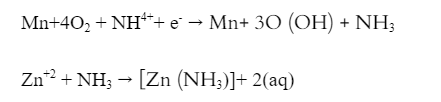
Reduction refers to the process of gaining electrons. At the cathode, reduction takes place. The manganese oxidation state is reduced from the +4 to +3 oxidation state. Ammonia that is released is trapped by Zn2+ ions to form [Zn (NH3)]+2. It is in aqueous form and soluble in nature.
2. Mercury Cell
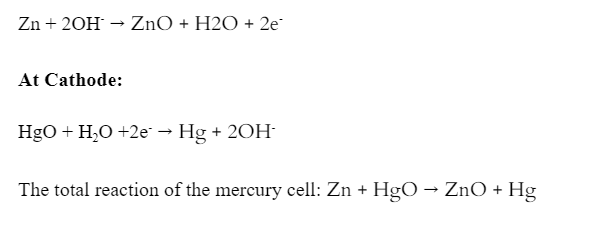
In mercury cells, the cathode is HgO, and the anode is the zinc metal. The reaction takes place as follows:
At Anode:
3. Alkaline Battery
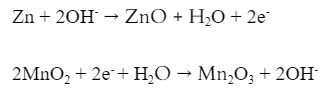
Like zinc-carbon cells, the alkaline battery has the same half-cell reactions.
Working Principle of Secondary Cell
1. Nickel-cadmium Cell
The Nickel-cadmium cell is also called the NiCd cell. It comprises cadmium and nickel, in which cadmium acts as an anode and nickel plate acts as a cathode. Sodium hydroxide or potassium hydroxide acts as an electrolyte. During disposal, cadmium releases harmful substances to the environment. So NiCd cells are not used now.
2. Lithium-ion Cell
Lithium-ion batteries are popularly used on many electronic devices such as cell phones, laptops, iPods, etc. Lightweight carbon and lithium are used to make the electrodes of these cells. During disposal, they are less harmful to the environment than NiCd cells.
Advantages of Dry Cells
Some of the advantages of Dry cells are listed below:
- Dry cells are simple and easy to use in electronic devices.
- They are cheap and easily available.
- They have high energy density and are easy to create in compact sizes.
- Dry cells are easy to carry and safe during transportation.
- They have very low hazardous effects on the environment.
Applications of Dry Cells
- Primary cells are used in small electronic gadgets that can be transported, such as clocks, watches, calculators, etc.
- Lithium batteries are used in devices like smoke detectors and cameras as they only require minimum output.
- Lead storage cells are used in automobiles and inverters.
Practice Problems On Dry Cell
Q1. Which of the following is used as the cathode in a Zinc carbon cell?
a. Zinc
b. Carbon rod
c. Ammonium chloride
d. None of the above
Ans: b. Carbon rod
In a zinc-carbon cell, the zinc performs as the anode. The carbon or graphite rod acts as the cathode. The rod touches the brass cap on the top.
Q2. Which of the following is incorrect about secondary cells?
a. Irreversible
b. Rechargeable cells
c. Reusable cells
d. None of the above
Ans: a. Irreversible
In secondary cells, the chemical reactions are reversible. These cells can be reused and recharged multiple times.
Q3. Which of the following cells is used in inverters?
a. Lithium batteries
b. Lead storage cells
c. Nickel-cadmium Cell
d. Zinc Carbon Cell
Ans: b. Lead storage cells
Lead storage cells are used in automobiles and inverters.
Frequently Asked Questions
Q1. What is meant by an electrode?
Ans: An electrode is a conductor that is used to create electrical contact with non-metallic solids or liquids or any substance of the circuit.
Q2. What is meant by cations?
Ans: Cations are referred to the ions that have a net positive charge and can move towards the negative electrode.
Q3. What is meant by anions?
Ans: Anions are referred to the ions that have a net negative charge and can move towards the positive electrode.

NEET Related Links
JEE MAIN Related Links
JEE Advanced Related Links
JEE Advanced Eligibility Criteria
JEE Advanced Chemistry Syllabus
JEE Advanced Registration Dates
CUET Related Links
Important Topics
Anemometer : Measurement of Wind Speed
Angular Acceleration Atomic Theory Audible and Inaudible Sound Average Speed and Average Velocity Average Velocity Avogadros Number Avogadros Hypothesis Azimuthal Quantum Number Balanced Force Bar Magnet Biconvex Lens Boyles Law Buoyancy Calorimeter Carnot Engine Celestial Bodies Centripetal And Centrifugal Force Concave and Convex Lenses Concave Convex Mirrors Contact and Non Contact Force Controlled Thermonuclear Fusion Convection Currents Convex Lens Convex Mirror Destructive Interference Difference Between Conduction Convection and Radiation Difference Between Electric Field and Magnetic Field Difference Between Heat And Temperature Difference Between Series And Parallel Circuits Differences Between Acceleration And Velocity Distance and Displacement Distance Time Graph Electrical Force : Electric Forces and Their Types Electromagnetic Waves : Definition, Equation and Properties of Electromagnetic Waves Electromagnetism Electron Spin Fluid Flow : Bernoullis Equation Derivation and Fluid Mechanics Fluid Friction : Types and Factors of Fluid Friction Frames of Reference : Inertial and Non- Inertial Frame of Reference Frequency and Wavelength Frictional Force Importance of Hydrosphere Instantaneous Speed and Velocity Introduction to Motion Kinetic and Potential Energy Difference Law Of Conservation of Energy Layers of the Earth Light Energy Light Sources List of physics scientists and Their inventionsLoudness of Sound
Magnetic Dipole Moment Magnetic Field Non - Contact Force Non - Renewable Energy Ohms Law Optics P Wave Physics Symbols Plane Mirrors Poissons Ratio Projectile Motion Properties of Water : Anomalous Expansion of Water Radius of Gyration Reflection of Light Reflection of Waves Relative Density Resonance Reverberation Rolling Friction Rotation and Revolution Screw Gauge Semiconductors and Insulators Sliding Friction Speed Time Graphs Static Friction Stefan Boltzmann Law Stress Tension Tension Force Thermometer: Clinical Laboratory Thermometer Types of Rocks Types of Waves Uniform Motion and Non Uniform Motion Unit of Voltage Uses of Convex Lens Uses Of Convex Mirror Uses of Electromagnet Uses of Optical Fibre Wave Wavelength of Light What is Scattering of Light Working of Electric Bell Conventional and Non-conventional Sources of Energy Buoyant Force Bulk Modulus of Elasticity Bernoulli’s Principle Angular Momentum Difference Between Speed And Velocity ForceUnit of Heat
Difference between Distance and Displacement Simple Microscope Derivation Of Equation Of Motion Thermometer: Clinical & Laboratory Thermometer Difference between Concave and Convex LensDerivation Of Lens Maker Formula
Unit Of Pressure Velocity Uses of Plane Mirror
Wave Theory of Light
Unit of Density Unit of Light Unit of Force Unit of Magnetic Field Unit of wavelength Unit of Viscosity Uses of Electroplating Young's Modulus
What is the Scattering of Light
Lenz Law Space Wave Propagation Schrodinger Wave Equation Relation between Fahrenheit and Celsius Refractive Index Potentiometer Working Pascal Law Oscillatory Motion Optical Instruments Newton's Laws of Motion - First Law Modulation and Demodulation Magnetic Flux Lens Formula and Magnification Kaleidoscope Faradays Law Epsilon Naught Value Energy Bands Electrostatics Electroscope AC Generator Unit of Current Lithosphere Bending Equation Derivation Difference Between Pound and Kilogram Semiconductor Devices OTEC - Ocean Thermal Energy Conversion Hall Effect Rectilinear Propagation of Light Difference Between Ammeter and Voltmeter Coefficient of Linear Expansion Ampere’s Law Cyclone and Thunderstorm Save The Environment From Pollution Particle Nature of Light Types of DC Motor Uses Of Transistor Derivation of Phase Rule Unit of Humidity

 Call Now
 Let's Chat
 Share
Share