-
Call Now
1800-102-2727


Dobereiner’s Law of Triads - Need for Classification of Elements, Examples and Drawbacks of Dobereiner’s Triads, Practice Problems and FAQ

Chemistry has its authentic history! No knowledge came without experimentation!
Imagine a chef entering a kitchen where all the ingredients are scattered randomly. He would eventually end up taking hours to make a dish that he had planned owing to the problems he would have to face searching for the right ingredient.

It will be easier for him to work in a more organised kitchen, where he can find all the needed ingredients and kitchenware in segregated places/cabinets.

Such a scenario existed for the elements present in our surroundings too!
Every matter that exists in our surroundings is made up of basic units known as elements. By 1800, only 31 chemical elements were known. With further advancement in technology, in 1865, about 63 more elements were discovered. At present, 118 elements are known to us, some of which are man-made.
Studying them all in an organised manner led to the emergence of the Periodic Table.
TABLE OF CONTENTS
- What is Periodic Classification of Elements?
- Need for Periodic Classification of Element
- Dobereiner’s Law of Triads
- Examples of Dobereiner’s Triads
- Drawbacks of Dobereiner’s Triads
- Practice Problems
- Frequently Asked Questions - FAQ
What is Periodic Classification of Elements?
- The term ‘periodic’ refers to the properties that repeat themselves at regular intervals, and this particular phenomenon is periodicity.
- Categorising the discovered elements into different classes/families is known as periodic classification.
- This approach involves the arrangement of related elements, the separation of unlike elements, and the comparison of the properties of elements.
Need for Periodic Classification of Elements
- Scientists, researchers and explorers, have always looked for ways of arranging the elements known to us, to reflect the similarities between their properties.
- So, scientists searched for a systematic way to organise their knowledge by classifying elements. By this classification, the elements with similar properties could be studied simultaneously. This would alleviate the problem of studying elements separately.
- Classifying elements into a similar group of categories would help scientists to predict the properties of the elements and their compounds.
- It would also become easier to compare and contrast the related properties of elements and their compounds from different groups/categories.
Dobereiner’s Law of Triads
In the early 1800s, German chemist Johann Dobereiner, first observed the similarities in some elements based on their properties.
- He recognised several sets of three chemically similar elements known as triads.
- For example, in lithium (Li), sodium (Na), and potassium (K), the properties of the middle element could be predicted from the properties of the other two.
- In a triad, the atomic weight of the central element is the average atomic weight of the remaining two elements.
- Dobereiner termed this grouping method “the Law of triads”.
The given elements were grouped:
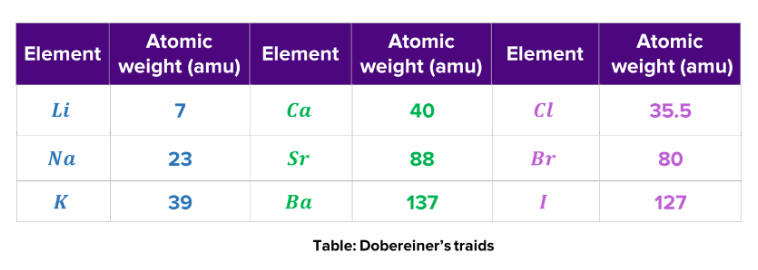
Examples of Dobereiner’s Triads
Finding atomic weight of strontium from the given triad: Ca, Sr, Ba
The atomic weight of Sr = 
= 
= 88.65 u
Finding atomic weight of bromine from the given triad: Cl, Br, I
The atomic weight of Br = 
= 
= 81.2 u
Drawbacks of Dobereiner’s Triads
- Since Dobereiner’s relationship, referred to as the law of triads, seemed to work only for a few elements, it was dismissed, as it was merely a coincidence.
- For example, in F, Cl, and Br, the atomic mass of Cl is not an arithmetic mean of the atomic masses of F and Br.
Practice Problems
Q1. Which is the correct order for sodium, potassium, and lithium, to justify Dobereiner's Law of Triads?
- Lithium, Sodium, Potassium
- Sodium, Lithium, Potassium
- Potassium, Lithium, Sodium
- Sodium, Potassium, Lithium
Answer: According to Dobereiner’s Law of Triads,
The atomic weight of Na = 
= 
= 23 u
So, option A) is the correct answer.
Q2. Let us consider Dobereiner’s triad X, Y and Z. The atomic masses of X and Z are 32 and 125 respectively. What is the atomic mass of Y?
- 109
- 93.5
- 78.5
- 98
Answer: According to Dobereiner’s Law of Triads,
The atomic weight of Y = 
= 
= 78.5 u
So, option C) is the correct answer.
Q3. Which element is in the Dobereiner’s Triad: Ca, __, Ba?
- Sr
- Mg
- Be
- Cs
Answer: Strontium is the right answer as its atomic weight is an average of both Ca and Ba.
So, option A) is the correct answer.
Q4. Which of the following triad does not comply with the law put forward by Dobereiner?
- Ca, Sr, Ba
- F, Cl, Br
- Li, Na, K
- S, Se, Te
Answer: The atomic mass of chlorine is not equal to the arithmetic average of the atomic masses of fluorine and bromine. The atomic mass of Cl is 35.5, whereas the arithmetic means of atomic masses of F and I is 72.95.
So, option B) is the correct answer.
Frequently Asked Questions - FAQ
Question 1. How many Dobereiner’s triads are there?
Answer: There were a total of 5 triads composed as per this law of triads, namely (Li, Na, K), (Ca, Sr, Ba), (Cl, Br, I), (S, Se, Te) and (Fe, Co, Ni).
Question 2. What relevance does Dobereiner’s law of triads have, in context to the modern periodic table?
Answer: This law was one of the very first attempts in the history of developing the modern periodic table. In fact, it was the first to draw an analogy between the physical properties of elements which later formed part of the same groups (vertical columns).
Question 3. Chlorine, bromine, and iodine form one of Dobereiner’s triads, but fluorine, chlorine and bromine do not. Why is it so?
Answer:
|
Triad |
Atomic Masses |
|
Chlorine |
35.4 u |
|
Bromine |
79.9 u |
|
Iodine |
126.9 u |
The arithmetic mean of atomic masses of chlorine and iodine is 81.1 u which is quite close to 79.9 u. Hence, it is considered a part of the triad.
The atomic mass of chlorine is 35.5 u, whereas the arithmetic means of the atomic masses of fluorine (19 u) and iodine(126.9 u) is 72.95 u. So, there exists a huge discrepancy between these two values.
So F, Cl, Br is not a Dobereiner’s triad.
Related Topics
|
Modern Periodic Table |
Atomic Radii |
|
Newlands' Law of Octaves |
Ionic Radii |
|
Mendeleev’s Classification |
Ionisation Enthalpies |

 Call Now
 Let's Chat
 Share
Share