-
Call Now
1800-102-2727


Depression in Freezing Point - Definition, Formula, Graphical Representation, Practice Problems and FAQ

Let's pretend we're going on an arctic expedition. We can see sheets of ice and glaciers as we sail over the ocean.
"Is the entire ocean frozen?" is a common query.
The response is a resounding "no."
The large concentration of dissolved salts in seawater lowers its freezing point. This phenomenon is called the depression in freezing point. Seawater does not totally freeze due to the presence of these dissolved salts/impurities.
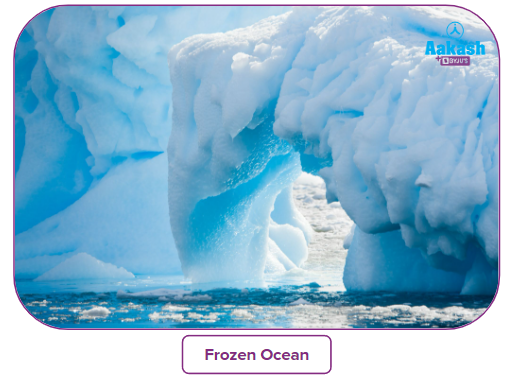
TABLE OF CONTENTS
- Definition of Freezing Point
- Definition of Depression in Freezing Point
- Formula for Depression in Freezing Point
- Graphical Representation of Depression in Freezing point
- Determination of Molal Depression Constant
- Example of Depression in Freezing Point
- Practice Problems
- Frequently Asked Questions - FAQ
Definition of Freezing point
The temperature of a liquid at which it changes its state from liquid to solid at atmospheric pressure is called the freezing point.
Factors affecting the freezing point are:
- If the intermolecular forces between the liquid molecules are strong, then its freezing point is high.
- If the intermolecular forces between the liquid molecules are weak, then its freezing point is relatively low.
Definition of Depression in Freezing Point
Depression in freezing point refers to the lowering of the freezing point of the solvents upon the addition of solutes. It is a colligative property.
Formula for Depression in Freezing Point
Generally, depression in freezing point is directly proportional to the molality of the added solutes. The depression in the freezing point of the solution can be described by the following formula;




Where  Depression in freezing point
 Molal depression constant or cryoscopic constant or freezing point depression constant
 Molality of the solution.
 Mass of the solute
 Molar mass of the solute
 Mass of the solvent in
Graphical Representation of Depression in Freezing Point
The liquid phase is in dynamic equilibrium with the solid phase at the freezing point of the substance. Freezing of the solution takes place when its vapour pressure equals the vapour pressure of the pure solid solvent as shown in the figure.
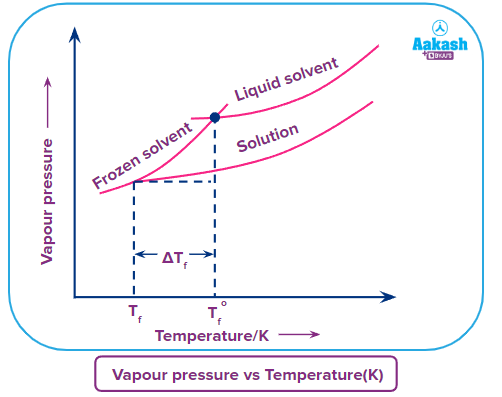
According to Raoult’s law, at low temperature, when a non-volatile solute is added to the solvent, its vapour pressure decreases and becomes equal to the vapour pressure of the solid solvent. Thus, the freezing point of the solution decreases.
Let  be the freezing point of the pure solvent and
  be its freezing point when a non-volatile solute is dissolved in it. The decrease in freezing point
  is known as depression in freezing point.
Determination of Molal Depression Constant or Cryoscopic Constant or Freezing Point Depression Constant
 is the characteristic of the solvent and can be calculated from the thermodynamic relationship,

Where, 
 latent heat of fusion in
  of solvent.
 freezing point of the solvent

 universal gas constant
Example of Depression in Freezing Point
Salting of icy roads
You may have noticed that applying salt to ice causes it to melt, and this is a popular process for de-icing snow-covered roads. The most popular salts used to de-ice roadways are sodium chloride ( ) and calcium chloride (
 ). The fundamental rationale for sprinkling salt on an ice road is that a solution of water containing dissolved salts has a lower freezing point than pure water due to the solution's lower freezing point. Water generally freezes at
  (
( ), but when salt is added, the temperature reduces. The overall freezing point is lower when the salt concentration is higher.
Practice Problems
Q1. Find the freezing point of the solution obtained by mixing  of glucose in
  of water given that
Answer.






Q2. Find the depression in freezing point of sucrose that must be added to  of sucrose in
  of water given that
Answer.









Q3. If the latent heat of fusion of ice is  , calculate the molal depression constant for water.
Answer.



Q4. An aqueous solution of a non-electrolyte boils at  . The freezing point of the solution will be
  ,
,
Answer.


 0.52
0.52






Frequently Asked Questions - FAQ
Question 1. Is freezing exothermic or endothermic?
Answer. Endothermic processes include fusion, vapourisation, and sublimation, whereas exothermic processes include freezing, condensation, and deposition. When water is placed in the freezer, it gradually loses heat to the environment. As the water molecules lose energy, they begin to move slowly, getting closer and closer until they form ice. The water releases heat into the environment as a result of this process. So, freezing is an exothermic reaction.
Question 2. What are the six types of phase changes?
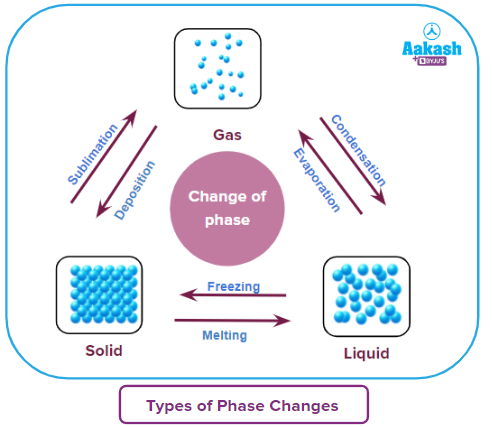
Answer. The six-phase changes are sublimation, deposition, condensation, evaporation, freezing and melting.
Question 3. What are supercooled liquids?
Answer. For the majority of substances melting point and freezing point have to be the same but a few substances have a slight difference between their melting points and freezing points. These substances can be cooled beyond their freezing point while retaining their liquid form. Hence, super-cooling is a state where liquids do not solidify even below their normal freezing points.
Question 4. How does snowfall occur?
Answer. Everyone is enthralled by the sight of snowfall. Have you ever been curious about the process of snow formation? Do you understand the science going on here?
Snowfall is based on the concept of freezing. The creation of snow occurs when the atmospheric temperature is at or below the freezing point of water, which is  , and there is a minimum amount of moisture present in the air. Because warm air has the capacity to contain more water vapours, the heaviest snowfall occurs when there is relatively warm air near the ground. Snowfall is rare in dry locations since it requires moisture and freezing temperatures to produce. The dry valleys of Antarctica, for example, have low humidity and strong, cold winds that remove moisture from the air. As a result, a small amount of snow falls in this severely cold region.
Related Topics
| Distillation Curves | Elevation in Boiling point |
| Steam distillation | Osmosis and Osmotic pressure |
| Van’t Hoff Equation | Raoult's Law - Applications |
| Azeotropic mixtures | Henry's Law - Applications and Limitations |

NEET Related Links
JEE MAIN Related Links
JEE Advanced Related Links
JEE Advanced Eligibility Criteria
JEE Advanced Chemistry Syllabus
JEE Advanced Registration Dates
CUET Related Links
Important Topics
Anemometer : Measurement of Wind Speed
Angular Acceleration Atomic Theory Audible and Inaudible Sound Average Speed and Average Velocity Average Velocity Avogadros Number Avogadros Hypothesis Azimuthal Quantum Number Balanced Force Bar Magnet Biconvex Lens Boyles Law Buoyancy Calorimeter Carnot Engine Celestial Bodies Centripetal And Centrifugal Force Concave and Convex Lenses Concave Convex Mirrors Contact and Non Contact Force Controlled Thermonuclear Fusion Convection Currents Convex Lens Convex Mirror Destructive Interference Difference Between Conduction Convection and Radiation Difference Between Electric Field and Magnetic Field Difference Between Heat And Temperature Difference Between Series And Parallel Circuits Differences Between Acceleration And Velocity Distance and Displacement Distance Time Graph Electrical Force : Electric Forces and Their Types Electromagnetic Waves : Definition, Equation and Properties of Electromagnetic Waves Electromagnetism Electron Spin Fluid Flow : Bernoullis Equation Derivation and Fluid Mechanics Fluid Friction : Types and Factors of Fluid Friction Frames of Reference : Inertial and Non- Inertial Frame of Reference Frequency and Wavelength Frictional Force Importance of Hydrosphere Instantaneous Speed and Velocity Introduction to Motion Kinetic and Potential Energy Difference Law Of Conservation of Energy Layers of the Earth Light Energy Light Sources List of physics scientists and Their inventionsLoudness of Sound
Magnetic Dipole Moment Magnetic Field Non - Contact Force Non - Renewable Energy Ohms Law Optics P Wave Physics Symbols Plane Mirrors Poissons Ratio Projectile Motion Properties of Water : Anomalous Expansion of Water Radius of Gyration Reflection of Light Reflection of Waves Relative Density Resonance Reverberation Rolling Friction Rotation and Revolution Screw Gauge Semiconductors and Insulators Sliding Friction Speed Time Graphs Static Friction Stefan Boltzmann Law Stress Tension Tension Force Thermometer: Clinical Laboratory Thermometer Types of Rocks Types of Waves Uniform Motion and Non Uniform Motion Unit of Voltage Uses of Convex Lens Uses Of Convex Mirror Uses of Electromagnet Uses of Optical Fibre Wave Wavelength of Light What is Scattering of Light Working of Electric Bell Conventional and Non-conventional Sources of Energy Buoyant Force Bulk Modulus of Elasticity Bernoulli’s Principle Angular Momentum Difference Between Speed And Velocity ForceUnit of Heat
Difference between Distance and Displacement Simple Microscope Derivation Of Equation Of Motion Thermometer: Clinical & Laboratory Thermometer Difference between Concave and Convex LensDerivation Of Lens Maker Formula
Unit Of Pressure Velocity Uses of Plane Mirror
Wave Theory of Light
Unit of Density Unit of Light Unit of Force Unit of Magnetic Field Unit of wavelength Unit of Viscosity Uses of Electroplating Young's Modulus
What is the Scattering of Light
Lenz Law Space Wave Propagation Schrodinger Wave Equation Relation between Fahrenheit and Celsius Refractive Index Potentiometer Working Pascal Law Oscillatory Motion Optical Instruments Newton's Laws of Motion - First Law Modulation and Demodulation Magnetic Flux Lens Formula and Magnification Kaleidoscope Faradays Law Epsilon Naught Value Energy Bands Electrostatics Electroscope AC Generator Unit of Current Lithosphere Bending Equation Derivation Difference Between Pound and Kilogram Semiconductor Devices OTEC - Ocean Thermal Energy Conversion Hall Effect Rectilinear Propagation of Light Difference Between Ammeter and Voltmeter Coefficient of Linear Expansion Ampere’s Law Cyclone and Thunderstorm Save The Environment From Pollution Particle Nature of Light Types of DC Motor Uses Of Transistor Derivation of Phase Rule Unit of Humidity

 Call Now
 Let's Chat
 Share
Share