-
Call Now
1800-102-2727


Properties of Cathode Rays: Definition of Cathode Rays, Properties, Applications, Practice Problems & FAQs

Rohit, a student from class 11th is a remarkable football player. He is the highest goal scorer in the inter-school tournament. After a lot of hard work, his team reached the finals of the tournament. But before the big final, Rohit had an injury in his right leg. He immediately went to see a doctor, where he was prescribed to go through an X-Ray scan to check whether his bone is in good condition or not.
Have you ever wondered how these X-Rays operate in scanning the fractured bones?
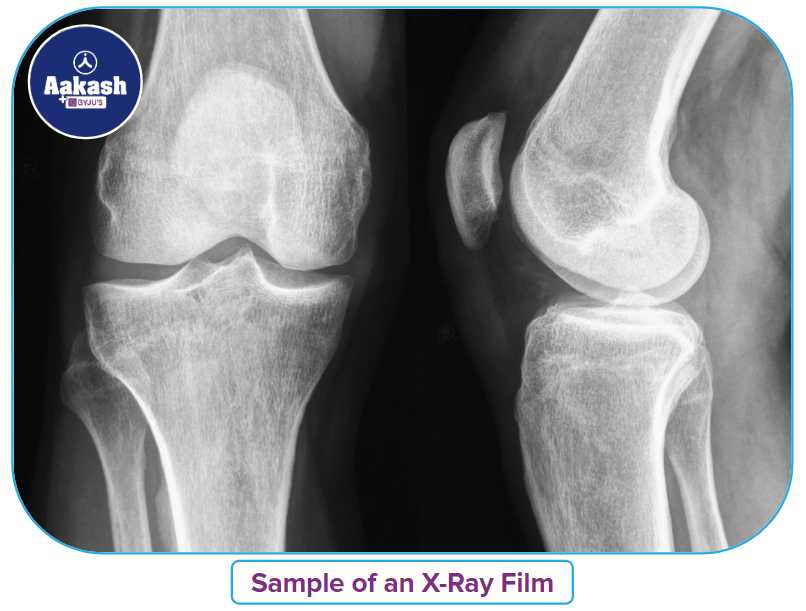
What is the mechanism that X-Rays even penetrate the skin layer and muscle to get the image of bones?
Cathode rays, which helped J.J Thompson in the discovery of the electron and unleashed the new world of subatomic particles, are an important component in the working principle of the X-Rays.
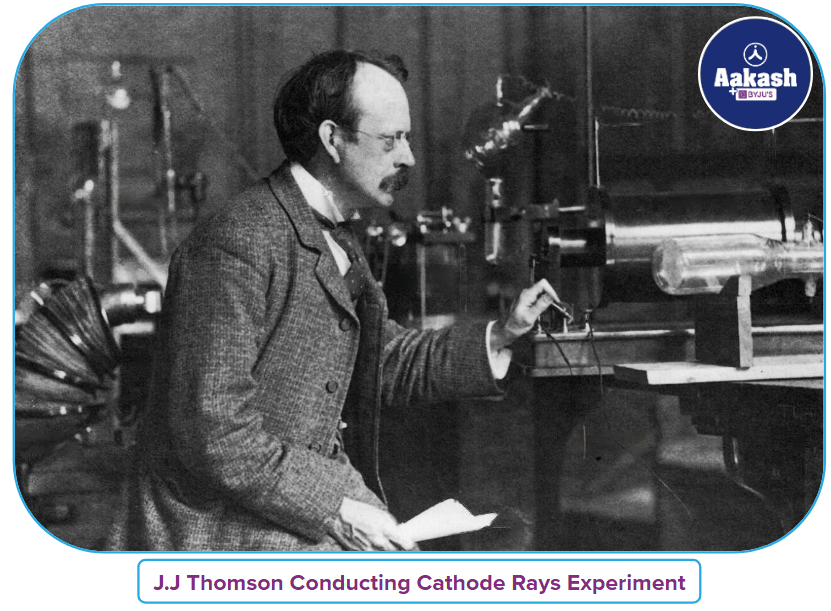
Apart from discovery of electrons, cathode rays held a major role in developing television, electronic microscopes, etc.
In this article, we will unfold some of the important properties of cathode rays.
Table of Content
- What is a Cathode Ray?
- Properties of Cathode Rays
- Applications of Cathode Rays
- Practice Problems
- Frequently Asked Questions – FAQs
What is a Cathode Ray?
Cathode ray is a beam of negatively charged particles (electrons) which originate at the cathode (negatively charged plate) and move towards the anode (positively charged plate) in a cathode ray discharge tube.
Properties of Cathode Rays
- Cathode rays travel in straight lines. This is backed by the fact that they cast sharp shadows of objects placed in their path.
- A thin metal plate becomes incandescent when cathode rays are concentrated on it.
- Cathode rays are the stream of electrons so they have a particle nature. Hence can come in contact with objects and exert mechanical pressure. This is supported by the observation that when a light paddle wheel is positioned in the path of the cathode rays, it rotates.
- Cathode rays are negatively charged particles. Cathode rays are deflected towards the plate which is positively charged when an electric field is applied.
- Similarly, when a magnetic field is applied perpendicular to the direction of the propagation of the cathode rays, they get deflected in the direction expected for negatively charged particles. This further proves that the cathode rays are negatively charged particles.
- Cathode rays produce a faint greenish fluorescence when they strike the walls of the discharge tube.
- The gas present in the discharge tube is ionised by the cathode rays.
- When cathode rays are incident on heavy metals such as tungsten, they produce X-rays.
- Cathode rays penetrate thin metal foils.
- The characteristics of the cathode rays are not affected by the nature of the gas taken in the discharge tube.
- The characteristics of the cathode rays are not affected by the nature of the material from which cathode is made.
- The speed of cathode rays, which ranges from 130th to 110th the speed of light is very high.
- Cathode rays may act in a wavelike manner. They demonstrate the interference and diffraction.
Applications of Cathode Rays
Invention of television:
Throughout the initial decades of the 20th century, researchers continued to explore new uses for cathode ray tube technology. Then A. A. Campbell suggested projecting video images onto the screen using a cathode ray tube. American inventor Philo Farnsworth used Zworykin's kinescope and a magnet to focus on the stream of electrons on the screen to create the image, and it immediately attracted interest. Philo Farnsworth is referred to as the father of digital televisions as a result of his contributions. The majority of image viewer devices are made using modern cathode ray tube technology, which also includes the electron guns used in many scientific and medical applications.
Electron microscopy:
The majority of image-viewing devices are made using modern cathode ray tube technology, which also includes the electron guns used in many scientific and medical applications. One example of a cathode-ray tube research application is the microscope, which was developed by Ernst Ruska in 1928. Since electrons have a short wavelength and are used to magnify objects that are too small for visible light to resolve, electron microscopy uses the electron stream to enlarge the image. Some commonly used electron microscopy in laboratories includes SEM (Scanning Electron Microscopy) & TEM (Transmission Electron Microscopy).

X- rays:
The cathode and anode of a cathode ray tube, also known as a highly evacuated glass lamp, which emits X-rays, are made of heavy metals with high melting points, such as tungsten and platinum. When a high voltage is applied between the electrodes, a stream of electrons known as cathode rays is propelled from the cathode towards the anode. When the electrons strike the anode, X-rays are generated.
Recommended Video: Discovery of Electron - Atomic Structure Class 11 Chemistry | JEE Important Topics | JEE Main 2022
Practice Problems
Q1. According to the experiment conducted by J. J. Thomson, cathode rays are:
- Neutral
- Negatively charged
- Positively charged
- Can’t be determined
Answer: (B)
Solution: J. J. Thomson conducted an experiment in a discharge tube to observe the behaviour of cathode rays. On either side of the discharged ray, a negative pole and a positive pole were positioned. The cathode rays were deflected toward the positive pole. This demonstrates the negative charge of cathode rays. So, option B is the correct answer.
Q2. Which of the following properties truly represents the nature of cathode rays?
- The amount of voltage has no effect on the characteristics of the cathode rays.
- The nature of gas does not affect the characteristics of the cathode rays.
- The cathode rays travel from cathode to the anode in the cathode ray tube.
- All of the above
Answer: (D)
Solution: The magnitude of the voltage and the type of gas have no bearing on the characteristics of cathode rays. Negatively charged cathode rays move from the cathode's negative end to the anode's positive end. As a result, the claims made in options A, B, and C are true.
Therefore, choice D is the right response.
Q3. In what circumstances should a cathode ray experiment be conducted?
- Low Pressure and High Voltage
- Low Pressure and Low Voltage
- High Pressure and High Voltage
- High Pressure and Low Voltage
Answer: (A)
Solution: The ideal conditions for the cathode ray experiment are low pressure and high voltage. This is because, in conditions of low pressure and high voltage, gas is ionised and accelerated to eject a large number of electrons from the cathode. Hence, option A is the correct choice.
Q4. In which of the following conditions X-Rays will be produced?
- When a slowly moving electron will strike a heavy metal.
- When a fast-moving electron will strike a heavy metal.
- When a slowly moving electron will strike a soft metal.
- When a fast-moving electron will strike a soft metal.
Answer: (B)
Solution: The cathode and anode of a cathode ray tube, also known as a highly evacuated glass lamp, which emits X-rays, are made of heavy metals with high melting points, such as tungsten and platinum. When a high voltage is applied between the electrodes, a stream of electrons from the cathode is accelerated towards the anode and known as cathode rays. X-rays are created when quick electrons collide with heavy metals. Therefore, option B is the correct choice
Frequently Asked Questions - FAQs
Q. Why can't we see cathode rays?
Answer: Cathode rays are electron streams which means they are made up of subatomic particle electrons. Subatomic particles are not visible through our naked eyes. We can only observe them under an electronic microscope.
Q. Is it possible for cathode rays to generate heat during its movement?
Answer: Electrons are accelerated in cathode rays. They possess a lot of kinetic energy. They lose some of their energy when they hit something because of friction, which heats the object they hit. This causes molecules to vibrate. The energy generated from the vibrational energy causes heat.
Q. Which metal is generally used as a cathode in electronic devices?
Answer: In electronic devices using cathode ray tubes, the cathode, or electron emitter, is made of a caesium alloy. Caesium is used as a cathode in many electrical vacuum tube systems because, when heated or exposed to light, it rapidly releases electrons.
Q. Why do gases that are under low pressure conduct electricity?
Answer: The mean free path of the electron is high at low pressure because gas atoms are not closely packed at this pressure. The atoms are not too close together and the electrons have enough time to accelerate when the gas pressure is low (but not too low). As a result of their collision with another atom, they are given enough energy by the electric field to ionise additional atoms. At low pressure, gas conducts electricity as a result.

 Call Now
 Let's Chat
 Share
Share