-
Call Now
1800-102-2727


Calcium Sulphate (CaSO4)- Molecular Formula, Structure, Preparation, Properties, Uses, Practice Problems and FAQ

Let us consider a tragic scenario.
Let’s say we break our hands or legs in an intense game of football. What do we do?
We helplessly visit the nearby hospital. We have our X-rays taken, and once the doctor has confirmed that there has been a fracture in a bone, we have the area of fracture plastered.
Have you ever wondered what that plaster is?
Plaster is actually calcium sulphate in its hemihydrate form!
The fact that chemistry is all around us is strangely true! In glee or despair! So why not delve a little deeper to learn more about this chemical that is a "true friend in need!"

TABLE OF CONTENTS
- Calcium Sulphate - Nature, Structure and Formula
- Preparation of Calcium Sulphate Hemihydrate
- Properties of Calcium Sulphate Hemihydrate
- Uses of Calcium Sulphate
- Portland Cement
- Practice Problems
- Frequently Asked Questions - FAQ
Calcium Sulphate - Nature, Structure and Formula
Calcium is an essential element for living organisms. It is an alkaline earth metal. Due to its chemical properties, it is used in the preparation of alloys as a deoxidiser, decarboniser and desulphuriser. Not just that, a number of calcium compounds such as calcium carbonate, calcium oxide (quick lime), calcium hydroxide, and calcium sulphate are also crucial to several industries and are prepared on a large scale.
- CaSO4 is available in natural mineral forms such as gypsum and is related to hydrates. It’s two common hydrates are Plaster of Paris

- Plaster of Paris is a hemihydrate of calcium sulphate which is obtained by heating gypsum to 393 K.
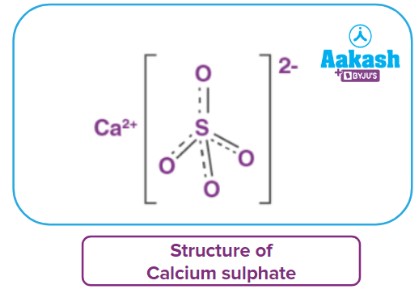
The structure of calcium sulphate is made of Ca2+ and SO42- ions. There exists an ionic bond between the two. Also, calcium sulphate exists in three types of hydrated forms corresponding to different crystallographic structures. Anhydrous calcium sulphate, CaSO4, bassanite or plaster of Paris,  . Calcium sulphate is found naturally in the form of mineral gypsum.
Preparation of Calcium sulphate
- Calcium sulphate is generally present in earth’s crust as gypsum.
- It always exists in one of any hydrated forms, so we shall see how we obtain them.
- Plaster of Paris
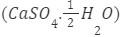 is synthesised from gypsum
 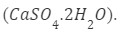 . When gypsum is heated at 373 K, it loses its water molecules to become calcium sulphate hemihydrate (Plaster of Paris).

- When water is added to the dry plaster of Paris, it reforms into gypsum. Gypsum transforms to hemihydrate or anhydrous form depending on the temperature.

- On treating calcium fluoride with sulfuric acid, calcium sulphate is precipitated.

- Calcium carbonate on being treated with dilute sulphuric acid produces anhydrite calcium sulphate.

- Calcium hydroxide on reaction with dilute sulphuric acid also forms calcium sulphate.

Properties of Calcium sulphate
- Calcium sulphate has an orthorhombic crystal.
- On heating above 393 K, all water of crystallisation is removed and anhydrous calcium sulphate, CaSO4 is formed. This is also called ‘dead burnt plaster’.
- Anhydrous form of calcium sulphate has the property of setting with water. Anhydrous calcium sulphate also acts as a desiccant.
- If we mix it with a sufficient quantity of water it forms a plastic kind of mass that gets into a hard solid in 5 to 15 minutes.
- All forms of calcium sulphate are white solids that are poorly soluble in water.
- Calcium sulphate leads to permanent hardness in water.
- The molar mass of anhydrous calcium sulphate is 136.14 g mol-1.
- The molar mass of calcium sulphate hemihydrate is 145.15 g mol-1.
- The molar mass of calcium sulphate dihydrate is 172.17 g mol-1.
- The melting point of calcium sulphate is 1460 °C.
- Gypsum has low thermal conductivity, which is the reason behind using it in making drywalls or wallboards. It is also a natural insulator
Uses of Calcium sulphate
- The calcium sulfate hydrates are used as a permitted coagulant in the processing of cheese-based products such as tofu, paneer etc.
- It is used for immobilising the affected part of organs where there is a bone fracture.
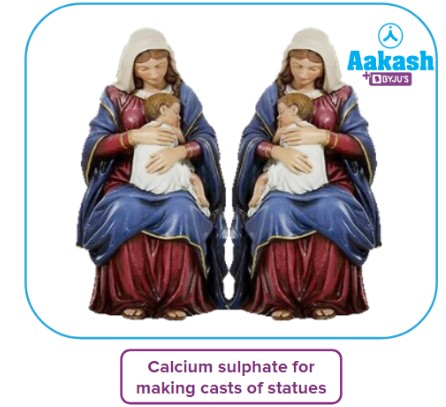
- It is used in making casts for toys, statues and more such stuff.
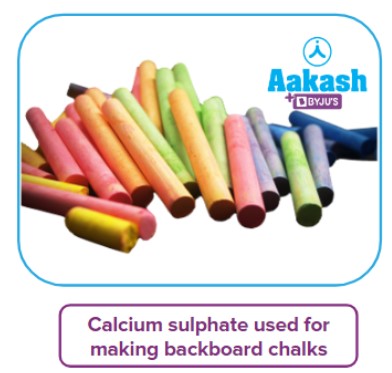
- It is used to make chalks for blackboards.
- It is an ingredient of Portland cement.
- It is used in products like foot creams, shampoo etc.
- It is used for the cultivation of mushrooms.
- Calcium sulphate finds utility in dentistry. It is used for bone regeneration as a graft material and graft binder and also as a barrier in guided bone tissue regeneration.
- It is also known to be an excellent biocompatible material and is fully resorbed following implantation.
- When calcium sulphate is mixed with marl or shale and is roasted, the sulphate liberates sulphur trioxide (SO3) gas, a precursor in the production of sulphuric acid.
- Calcium sulphate is also used in clement clinker production for generating calcium silicate, and sulphur trioxide is channelised for sulphuric acid generation.

- Gypsum plaster is used for 3D printing where water is applied by the inkjet head.
Recommended video - https://www.youtube.com/watch?v=hHFWTSpVVQg
Portland Cement
Portland cement is a type of cement which is the main ingredient of mortar, concrete or stucco. It is obtained by pulverising clinker, consisting of hydraulic calcium silicates to which some calcium sulphate is provided as an underground addition. It is a fine powdery substance, obtained by heating calcium carbonate (limestone) and clay minerals in a kiln to form a clinker, and adding 2-3 % of gypsum (CaSO4.2H2O) to it post grinding.
Portland cement is widely used in construction to make concrete. This concrete is used to build structures such as dams, bridges, buildings, pavements etc.
History of Portland Cement
Portland cement was developed in England in the early 19th century by Joseph Aspdin who patented it. Its name is obtained from its resemblance to Portland stone which was quarried on the Isle of Portland in Dorset, England. It was developed from certain types of hydraulic lime which is basically calcium oxide which hardens on being hydrated. William Aspdin, son of Joseph Aspdin is regarded as the inventor of "modern" Portland cement due to his further developments in 1840.
Composition of Portland Cement
Calcium Oxide or lime (CaO): 60-70%
Silica (SiO2): 20-24%
Alumina (Al2O3): 5-7.5 %
Magnesia (MgO): 2-3%
Ferric Oxide (Fe2O3): 1-2.5%
Sulphur trioxide (SO3): 1-1.5%
Sulphur Oxide (Na2O): 1%
Potassium Oxide (K2O) : 1%
Benefits of Portland Cement
Concrete produced from Portland cement is one of the world's most versatile construction materials, and has changed the world in almost every observable aspect. It is one of the most widely used substances on Earth, and as such, portland cement manufacturing is currently vital to the world's economy, despite being energy-intensive to manufacture and one of the construction industry's largest causes of climate-changing CO2 emissions.
Setting of Cement
Cement on mixing with water forms a plastic-like mass called cement paste. On forming this hydration reaction, gel and crystalline products are obtained. There is the interlocking of the crystals which therefore binds the inert particles of the cement paste aggregates into a compact rock-like material.
The stiffening or hardening of the plastic mass (cement paste) due to the initial gel formation is called the setting of cement. Hardening is the gradual development of strength, which occurs due to crystallisation. Due to the gradual progress of crystallisation in the interior mass of cement, hardening starts post setting.
The overall setting and hardening of cement are due to the forming of interlocking crystals, strengthened by rigid gels formed by the hydration and hydrolysis of the constitutional compounds.
The function of Gypsum 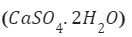
Tricalcium aluminate (Ca3Al2O6), a component of portland cement, combines with water very rapidly forming the hydrated Ca3Al2O6.6H2O. After the initial setting, the paste becomes soft and the added gypsum retards the dissolution of tricalcium aluminate by forming insoluble calcium sulphoaluminate 3 CaO.Al2O3.xCaSO47H2O.
This reaction prevents the high concentration of alumina in the cement solution and hence slows down the early initial setting of cement. This increases the overall strength of concrete formed.
Practice Problem
Q 1. What is the common name for calcium sulphate hemihydrate?
a. Quicklime
b. Plaster of Paris
c. Gypsum
d. Shell
Answer:
1. Quicklime is calcium oxide.
2. Plaster of Paris has the formula 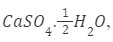 , and is known as calcium sulphate hemihydrate.
3. Gypsum is calcium sulphate dihydrate CaSO4.2H2O.
4. Shells are mainly made of calcium carbonate.
So, option B) is the correct answer.
Q 2. The formula of Gypsum is:
a. CaSO4.2H2O
b. CaSO4.12H2O
c. 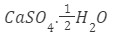
d. 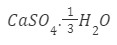
Answer: Gypsum is the dihydrate form of calcium sulphate. Its chemical formula is CaSO4.2H2O. So, option A) is the correct answer.
Q 3. Calcium sulphate on undergoing flame test produces which colour?
a. Blue
b. Pink
c. Purple
d. Brick Red
Answer: Calcium salts contain Ca2+ ions. Hence, it gives a characteristic brick-red flame. So, option D) is the correct answer.
Q 4. Mention two uses of Plaster of Paris.
Answer: It is used in the decorative coating of walls and ceilings. It is also widely used in medicinal treatment for plastering fractured bones to set the fractured bones in the right position.
Frequently Asked Questions - FAQ
Q 1. What are the harmful impacts of Plaster of Paris on the environment?
Answer: Disposal of plaster of Paris artistries and other things made of plaster of Paris into land and water degrades the soil and water quality, and decreases dissolved oxygen of water. It also declines and causes abnormalities in a number of wildlife species present in water.
Q 2. Gypsum is a naturally occurring mineral. How did it form?
Answer: Gypsum minerals are found as gypsum beds which were formed long years back on account of the evaporation of water from the gigantic sea basins of prehistoric times. The mineral gets concentrated and crystallised upon evaporation of water..
Q 3. What is the utility of calcium sulphate during burial services?
Answer: Calcium sulphate hemihydrate (CaSO4.12H2O) is used by executives of funeral houses in order to remake the degraded tissues and fill up the wounds during burial services.
Q 4. How is calcium sulphate beneficial in eliminating pollutants from the environment?
Answer: Gypsum, the dihydrate form of calcium sulphate, is useful in the removal of carcinogenic pollutants such as lead or arsenic from contaminated water. This can be done by different mechanisms such as adsorption, absorption, and surface precipitation where pollutants are adsorbed by mineral surfaces.
Related Topics
|
Calcium Carbonate |
Calcium Hydroxide |
|
Sodium Chloride |
Calcium oxide |
|
Sodium Carbonate |
Electronegativity |

 Call Now
 Let's Chat
 Share
Share