-
Call Now
1800-102-2727


Blue Vitriol-Definition, Structure, Preparation, Physical Properties, Chemical Properties, Uses, Practice Problems, FAQ

The use of a chemical is important for daily life to keep the environment fresh and worth living in while also alleviating some concerns. Copper sulphate, also known as blue vitriol, is widely utilized in agricultural and industrial industries, as well as pharmaceuticals and research, due to its unique and intriguing qualities and a wide variety of applications. It is consequently essential for humans today because they rely heavily on chemicals in their daily lives. Copper compounds are of great use. Students must have seen this in their chemistry lab while doing experiments and practicals.
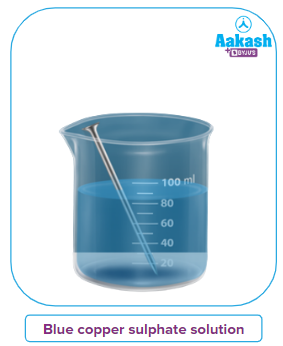
Table of content:
- What is blue vitriol?
- Structure of blue vitriol
- Preparation of blue vitriol
- Physical properties
- Chemical properties
- Uses of Blue vitriol
- Practice problem
- Frequently asked questions-FAQ
What is blue vitriol?
The chemical compound CuSO4 stands for copper(II) sulphate. This salt is made up of a number of different compounds with varying degrees of hydration. the most usually encountered salt,CuSO4.5H2O, is a bright blue pentahydrate. This pentahydrate salt of copper is also known as blue vitriol.
Structure of blue vitriol:
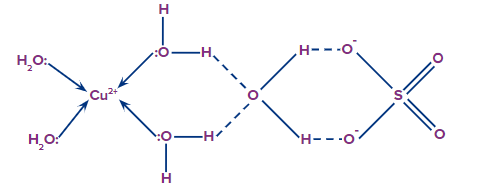
By coordinating covalent connections between Copper and water molecules, copper sulphate and water join to form copper sulphate pentahydrate complex. Only water molecules provide electrons, which are shared by copper and water.
Preparation of blue vitriol:
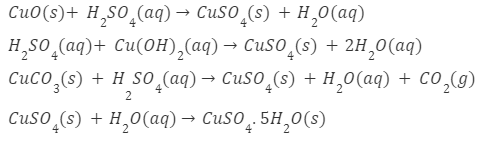
- The preparation of copper sulfate is one of the easiest methods. It can be prepared by heating metallic copper and reacting it with concentrated sulphuric acid which gives copper sulfate as a product and liberates sulfur dioxide gas.

After acquiring water molecules from the atmosphere, the dehydrated copper sulphate solid substance regains its blue colour when allowed to cool in air.

CuSO4.5H2O is known as hydrated copper sulphate or also called blue vitriol.
- Cupric oxide or cupric hydroxide or cupric carbonate is dissolved in dilute H2SO4in the laboratory to prepare copper sulphate and again hydration of that leads to blue vitriol.
Physical Properties of copper sulphate(blue vitriol)
- Copper sulphate (CuSO4) has a molar mass of 159.609 g mol-1, while copper sulphate pentahydrate (CuSO4.5H2O) has a molar mass of 249.685 g mol-1.
- Copper sulphate is a powdered material in the anhydrous form, which is devoid of water molecules, has a silvery-white colour, while the copper sulphate pentahydrate has a blue crystal.
- The one thing that both anhydrous and hydrated copper sulphate have in common is that they disintegrate when heated, hence none has specific boiling points.
- Anhydrous copper sulphate has an orthorhombic crystal structure, whereas hydrous copper sulphate has a triclinic crystal structure.
Chemical properties of copper sulphate:
- Copper sulphate contains copper ions, which combine with chloride ions in hydrochloric acid to produce tetrachlorocuprate. This usually happens in two processes. First, hydrochloric acid dissociates into hydrogen and chloride ions, as indicated below:

Following that, these chloride ions combine with copper ions to form tetrachlorocuprate, where tetrachloro symbolizes four chlorine atoms and the reaction is represented as

- Heating copper sulfate: When copper sulfate is heated to 650℃, it experiences a process known as decomposition, which results in compounds such as cupric oxide, which has the formula CuO and sulfur trioxide, which has the formula SO3

- Copper sulfate is very soluble in water, according to reports. Copper sulfates will have solubility values of 1.055 molal and 1.502 molal at 10℃ and 30℃.
The displacement reaction, in which a highly reactive metal ion displaces a less reactive metal ion, is the most common example of copper sulfate. It can be represented as

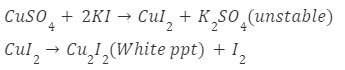
- Action of KI on CuSO4:
When KI is added to a CuSO4 solution, a white cuprous iodide precipitate is formed.
- The effect of alkalies on CuSO4
Copper hydroxide forms a pale blue precipitate of Cu(OH)2 when alkalies are added.

Uses of CuSO4(blue vitriol)
Copper sulphate is commonly found in basic chemical kits used as educational tools. CuSO4 is a chemical compound with numerous applications. The following are some of these applications.
CuSO4.
- Pentahydrate of CuSO4 is employed as a fungicide since it may kill a variety of fungi.
- Benedict's solution and Fehling's solution, which are used to test for reducing sugars, both include copper sulphate.
- It's also used to check for disorders like anaemia in blood samples.
- It's also employed as a dye fixative in the vegetable dyeing process.
- It can also be utilised as a decorative element because it can colour cement, ceramics, and metals.
- It is frequently used in bookbinding glues to keep insects away from the printed paper.
Practice problems:
Q1. There are ________________types of bonds are present in blue vitriol
A. Two
B. Three
C. Four
D. One
Answer: B
Solution: Blue vitriol contains three types of bonds, these are ionic, covalent and coordinate bonds.
Q2. The coordination number of blue vitriol compound comes out to be_______
A. Two
B. Three
C. Four
D. Five
Answer: C
Solution: Sulphate ion coordinates Cu+2 with four water molecules and two additional oxygen atoms. The fifth water molecule is now hydrogen bound and entrenched firmly in the crystal. It's not well-coordinated. Solely four water molecules are coordinated, with the fifth being hydrogen bound only. So, the coordination number comes out to be four.
Q3. The total number of atoms present in blue vitriol are________.
A. 15
B. 17
C. 20
D. 21
Answer: D
Solution: Blue vitriol contain a total of 21 atoms. The chemical formula is CuSO4.5H2O .
Q4. H2S when reacted with copper sulphate gives_________ precipitate.
A. Red
B. Brown
C. White
D. Black
Answer: D
Solution: When H2S is reacted with copper sulphate, black precipitate of copper sulphide is formed.

Frequently asked questions-FAQ
Question 1. What is vitriol?
Solution: Vitriol is the scientific name for a group of chemical compounds made up of metal sulphates.
Question 2. Which acid is considered as ‘oil of vitriol’?
Solution: Oil of vitriol was an old name for concentrated sulfuric acid prepared by dry distillation (pyrolysis) of vitriols in the past. It is a clear, colorless to brownish, dense, oily, corrosive, water-miscible liquid, used chiefly in the manufacture of fertilizers, chemicals, explosives, and dyestuffs and in petroleum refining.
Question 3.Can we use blue vitriol as a fungicide?
Solution: Copper sulphate acts as a fungicide that protects the fruit, vegetable, nut, and field crops against fungal and bacterial diseases. Copper sulfate is also used as algaecide, root killer, and herbicide in both agriculture and non-agricultural settings. It is also used as an antimicrobial and molluscicide.
Question 4. Copper sulphate is used in swimming pools why?
Solution: Athletes' feet and infectious infections have been demonstrated to be eliminated in public swimming pools by adding copper sulphate to the water or putting it into the foundation of the floor. In pools, copper sulphate also suppresses bacterial growth.
Related topics
|
Iron |
Potassium Permanganate |
|
f block elements |
Water |
|
Hydrogen |
Important compounds of copper |

 Call Now
 Let's Chat
 Share
Share