-
Call Now
1800-102-2727


Bleaching Powder - Preparation, Physical and Chemical Properties, Uses, Health Hazards, Practice Problems and FAQ

Swimming pools are a lifeline for all human aquaphiles who enjoy soaking in the cool splash during the hot and humid summer days. Who wouldn't want to spend some leisure time gazing at the poolside beauty or immersing themselves in the cool blue aqua-cover provided by swimming pools?
Behind the clear scene of a pool's blue waters are unseen efforts to keep the water of such a busy swimming pool crystal clear and fresh. So, what is it that consistently restores the pool's clarity and freshness?
It's a peculiar smelling white powder!
Do you know what that peculiar smelling cleaning powder is? Any ideas?
It is, indeed, 'Bleaching powder.'
Bleaching powder is used to remove stains and dirt and maintain the cleanliness of the pool. When it comes to cleaning stains, slippery surfaces, algal growths, and so on, it is almost like a saviour for any household. Not just that, bleaching powder is capable of much more!
But how exactly? Let's explore.
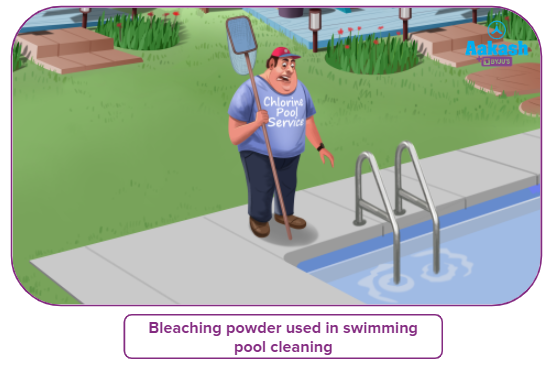
TABLE OF CONTENTS
- Bleaching Powder - Definition and Chemical Formula
- Structure
- Preparation and Storage
- Physical Properties
- Chemical Properties
- Uses
- Health Hazards
- Practice Problems
- Frequently Asked Questions - FAQ
Bleaching Powder - Definition and Chemical Formula
Charles Tennant along with Charles Macintosh developed an industrial method for manufacturing ‘chloride of lime’ in the late 18th century. It was patented in 1799 and was extensively used during World War I for disinfecting wounds and trenches.
This was the first invention of bleaching powder. Calcium hypochlorite CaOCl2 is the main active ingredients of commercially available bleaching powder. It is quite stable at room temperature. It has the tendency to slowly decomposes in moist air, liberating chlorine gas which gives it its characteristic chlorine-like strong and pungent odour.
Chemical Formula:
- The composition of bleaching powder is Ca(OCl)2.CaCl2.Ca(OH)2.2H2O.
- The commercially available bleaching powder generally contains 15-25% of Ca(OH)2 and only about 35% of Cl2 available for oxidation.
- Bleaching powder, also known as chloride of lime, is a solid white powder, although the commercially available samples appear yellowish-white. Bleaching powder is also known by several other names like chlorine powder, chlorinated lime, chloride of lime, etc and is used extensively for water treatment, and as a bleaching agent.
- Bleaching powder, when dissolved in water, forms an aqueous solution, which is basic in nature. Bleaching powder works on the principle of oxidation. The bleaching action of the bleaching powder is caused due to the presence of chlorine in it.
Structure
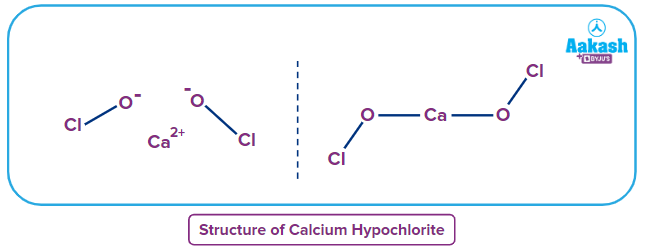
Calcium hypochlorite, which is the main active ingredient of bleaching powder is composed of one Ca2+ ion and two chlorite ions i.e., ClO-.
Each chlorite ion has a charge of -1 whereas the calcium ion has a charge of +2. Therefore, one calcium cation can form ionic bonds with two hypochlorite ions.
Preparation and Storage
Chlorine react with dry slaked lime to give bleaching powder. The principle reaction behind the industrial processes remains the same. Industrially, two types of manufacturing plants are used to prepare bleaching powder.
- Bachmann’s Plant
- Hasenclever Plant
Bachmann’s Plant
The manufacture of bleaching powder is carried out in Bachmann’s plant as follows:
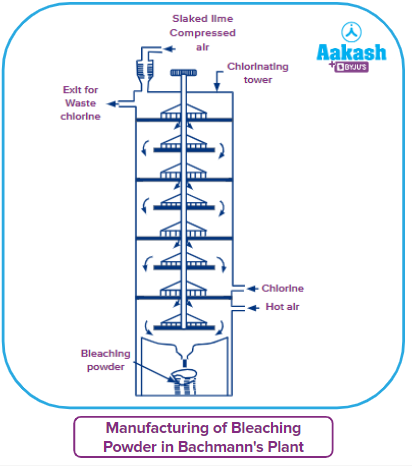
In this plant, there is a vertical cast-iron tower which is packed with a hopper at the up top position, also there are two inlets closer to the base (One is for Cl2 and the other for hot air) along with an exit channel for waste gases at the top. The tower is fitted with shelves placed at varying heights along with rotating rakes. There are eight such shelves. Slaked lime is first poured into the hopper. Gradually it comes in close contact with chlorine gas by moving slowly upward. The resultant product i.e., bleaching powder is then collected in the barrel area, at the base of the tower.
Points to be noted:
- Cl2 used should be dilute.
- Optimum temperature required is 40°C.
2Ca(OH)2(aq) + 2Cl2(g) → Ca(OCl)2(s) + CaCl2(s) + 2H2O(l)
Storage: Bleaching powder is generally stored in an air-tight container so as to prevent contact with air and moisture. On exposure to air, it reacts with CO2 and forms CaCO3 and Chlorine.
Hasenclever Plant
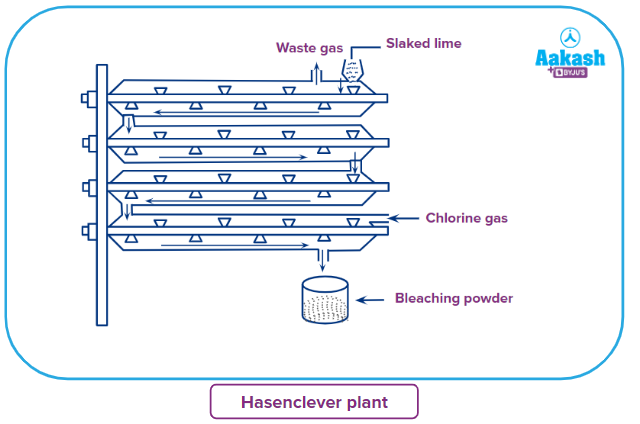
In this plant, a few channelled cylinders are placed horizontally. Dry slaked lime, Ca(OH)2, is passed into the plant system through an inlet at the topmost cylinder. Then, the slaked lime goes ahead through the revolving blades of the shafts. The chlorine gas is passed into the lowermost cylinder through the inlet present on it. The chlorine gas moves up, and in the upper cylinder, it reacts with the dry Ca(OH)2 producing bleaching power. When bleaching powder is formed, it comes out through the outlet present at the bottom of the middle cylinder and is collected in a vessel.
Physical Properties
- Calcium hypochlorite is a white or yellowish-white solid at room temperatures.
- The solubility of calcium hypochlorite in water is 21 g/100 mL.
- It reacts with the water when dissolved.
- Its solubility in hard water is relatively low when compared to its solubility in soft/medium-hard water.
- Ca(OCl)2 has a strong smell of chlorine (because it reacts with the water molecules present in air).
- Calcium hypochlorite has a molar mass of 142.974 g mol-1.
- Its specific gravity is 1.21 g cm-3.
- The compound crystallises in the orthorhombic space group, with Z= 4.
- It decomposes at 448 K.
Chemical Properties
- Calcium hypochlorite acts as a strong base since it readily accepts H+. When dissolved in water, the hypochlorite anion accepts a proton from H2O, liberating an OH- ion.
ClO- + H2O (aq) → HClO + OH-
- Ca(OCl)2 is also a powerful oxidizing agent since it can readily accept an electron.
- As a strong oxidant, it reacts vigorously in combination with carbon compounds and forms explosives in combination with finely divided carbon particles.
- Calcium hypochlorite along with acetylene leads to the creation of explosive chloroacetylenes.
In air, it reacts with carbon dioxide and forms calcium carbonate.
Ca(OCl)2(s) + CO2(g) → CaCO3(s) + Cl2(g)
- Calcium hypochlorite on contact with organic matter, oil, hydrocarbons and alcohols such as methanol or ethanol may cause a violent explosion. Reaction with nitromethane causes a delayed violent reaction.
- On reacting with urea, calcium hypochlorite forms NCl3, which is highly explosive.
- Calcium hypochlorite salt produces highly toxic gaseous chlorine gas when heated or on contact with acids.
- The mixture of damp sulphur with Ca(OCl)2 causes a violent reaction, that ejects molten sulphur.
- Calcium hypochlorite reacts with dilute acids like hydrochloric acid and sulphuric acid, liberating chlorine gas (Cl2).
4HCl (aq) + Ca(ClO)2(s) → CaCl2(s) + Cl2(g) + H2O(l)
H2SO4 (aq) + Ca(ClO)2(s) → CaSO4(s) + Cl2(g) + H2O(l)
So, it is the chlorine gas evolved from bleaching powder that acts as the bleaching agent.
- The bleaching action of chlorine is explained by the reaction:
Cl2(g) + H2O(l) --> HClO(aq) + HCl(aq)
HClO (aq) --> HCl (aq) + O
This nascent oxygen causes the bleaching action.
- It is soluble in cold water but leaves white insoluble lime residues.
- Calcium hypochlorite is used to cleave glycols, α-hydroxycarboxylic acids and keto acids to yield fragmented aldehydes or carboxylic acids.
Uses
- Ca(OCl)2 is used in industrial wastewater treatment, sanitation and cleaning, epidemic prevention and household sanitation facilities, as well as for disinfection and sterilisation of swimming pools, drinking water, cleaning vegetables, and sanitising fishponds.
- As a swimming pool chemical, it is blended with other chemicals less often than other forms of chlorine, due to dangerous reactions with some common pool chemicals. In solution, calcium hypochlorite could be used as a general-purpose sanitiser, but due to calcium residue, sodium hypochlorite (bleach) is usually preferred.
- It is used to disinfect wastewater as well as drinking water due to high chlorine availability.
- It is used to obtain fragmented aldehydes/carboxylic acids by cleaving the bonds in glycols and keto acids.
- It is used to clean old items, jewellery, etc.
- It is used to produce chloroform via the haloform reaction.
Ca(OCl)2 + H2O --> Ca(OH)2 + Cl2
CH3CHO + 3Cl2 --> Cl3CCHO (chloral)
2Cl3CCHO + Ca(OH)2 --> Ca(HCOO)2(calcium formate + 2CHCl3(chloroform)
- It is used in preservation against bacterial decay. For example, putting a small amount of bleaching powder in a flower vase will keep the cut flowers fresh for longer.
- It is used for bleaching linen, and cotton in textile industries, and for bleaching washed clothes in the laundry.
- Calcium hypochlorite can be used to oxidise thiol and sulfide byproducts in organic synthesis and thereby reducing their odour and making them safe to dispose of.
Health Hazards
When exposed to significant levels of calcium hypochlorite, it poses significant health risks. Contact with the eyes or skin can cause severe irritation and burning. Excess bleaching powder inhalation can cause irritation in the nose, throat, and lungs, resulting in coughing and/or shortness of breath and, in severe cases, pulmonary edema. High levels of bleaching powder can be extremely corrosive to respiratory and gastrointestinal tissues, even proving fatal.
Practice Problems
Q1. Generally, what is the percentage of available chlorine in a commercially bought, good sample of bleaching powder is:
A. 23%
B. 35%
C. 65%
D. 56%
Answer: The composition of bleaching powder is Ca(OCl)2.CaCl2.Ca(OH)2.2H2O. The commercially available bleaching powder generally contains 15-25% Ca(OH)2 and only about 35% Cl2 available for oxidation. So, option B) is correct.
Q2. What is the difference between bleaching powder and bleach?
Answer: Bleach is the generic name for any chemical product that is used industrially or domestically to remove the colour from fabric or fibre or to clean or to remove stains in a process called bleaching. It often refers, specifically, to a dilute solution of sodium hypochlorite, also called "liquid bleach" especially while formulating chlorine bleaches, which is a powerful oxidiser and is the active agent in many household bleaches.
Oxidising bleaching agents that do not contain chlorine are usually based on peroxides such as hydrogen peroxide, sodium percarbonate, and sodium perborate. These bleaches are called 'non-chlorine bleach,' 'oxygen bleach' or 'colour-safe bleach.'
Bleaching powder" on the other hand usually means a formulation containing calcium hypochlorite.
Q3. The intermediate formed in the formation of chloroform from ethanaldehye and bleaching powder is?
A. Chloral
B. Acetal
C. Hemiacetal
D. Ether
Answer: Chloral is formed as an intermediate in the formation of chloroform from ethanaldehye and bleaching powder.
Ca(OCl)2 + H2O --> Ca(OH)2 + Cl2
CH3CHO + 3Cl2 --> Cl3CCHO (chloral)
2Cl3CCHO + Ca(OH)2 --> Ca(HCOO)2(calcium formate + 2CHCl3(chloroform)
So, option A) is the correct answer.
Q4. The oxidising nature of bleaching powder in the presence of moisture is due to the formation of
A. Free radical
B. Nascent Oxygen
C. Free electron
D. Hydroxide ion
Answer: Bleaching powder on reacting with moisture produces free chlorine gas. This gas on exposure to air produces nascent oxygen, which attributes to the oxidising nature of bleaching powder. So, option B) is the correct asnwer.
Ca(OCl)2 + H2O --> Ca(OH)2 + Cl2
Cl2(g) + H2O(l) --> HClO(aq) + HCl(aq)
HClO (aq) --> HCl (aq) + O
Frequently Asked Questions - FAQ
Question 1. Is Bleaching powder an acid, base or salt?
Answer: Calcium hypochlorite is the salt of a strong base. Its solution acts as a strong base since it readily accepts H+ . When dissolved in water, the hypochlorite anion accepts a proton from H2O, liberating an OH- ion.
The chemical reaction is given by ClO- + H2O (aq) → HClO + OH-
Question 2. What is the pH of bleaching powder?
Answer: Bleaching powder is considered to be basic in nature. It gives calcium chloride, chlorine and water upon reaction with hydrochloric acid. Bleach is considered to contain about 5% sodium hypochlorite. The pH of bleaching powder is about 11. Hence, it is mildly irritating.
Question 3. How dangerous is bleaching powder?
Answer: The corrosive nature of the hypochlorite moiety makes calcium hypochlorite a dangerous substance that must be stored carefully. It must be stored in a cold, dry environment and must not be exposed to any metals or acids. If any acid comes in contact with calcium hypochlorite, highly toxic fumes of chlorine gas can be produced.
Also, ingestion of the products, breathing of the fumes, or contact with skin or eyes can cause health damage
Question 4. What are the other names of bleaching powder?
Answer: Hypochlorous acid calcium salt, bleaching powder, calcium oxychloride, chloride of lime are some of the other names of bleaching powder.
Question 5. Is Clorox and bleaching powder the same?
Answer: Clorox is a bleach with the major ingredient sodium hypochlorite, whereas bleaching powder is calcium hypochlorite. Clorox bleach has an active sodium hypochlorite concentration between 5% and 6.5%
Question 6. Does bleaching powder purely consist of calcium hypochlorite?
Answer: The composition of bleaching powder is Ca(OCl)2.CaCl2.Ca(OH)2.2H2O. Hence it is a mixture with the main active ingredient calcium hypochlorite.
Related Topics
|
Calcium Oxide |
Alkali Metals |
|
Calcium Hydroxide |
Sodium Chloride |
|
Oxygen |
Calcium Carbonate |

NEET Related Links
JEE MAIN Related Links
JEE Advanced Related Links
JEE Advanced Eligibility Criteria
JEE Advanced Chemistry Syllabus
JEE Advanced Registration Dates
CUET Related Links
Important Topics
Anemometer : Measurement of Wind Speed
Angular Acceleration Atomic Theory Audible and Inaudible Sound Average Speed and Average Velocity Average Velocity Avogadros Number Avogadros Hypothesis Azimuthal Quantum Number Balanced Force Bar Magnet Biconvex Lens Boyles Law Buoyancy Calorimeter Carnot Engine Celestial Bodies Centripetal And Centrifugal Force Concave and Convex Lenses Concave Convex Mirrors Contact and Non Contact Force Controlled Thermonuclear Fusion Convection Currents Convex Lens Convex Mirror Destructive Interference Difference Between Conduction Convection and Radiation Difference Between Electric Field and Magnetic Field Difference Between Heat And Temperature Difference Between Series And Parallel Circuits Differences Between Acceleration And Velocity Distance and Displacement Distance Time Graph Electrical Force : Electric Forces and Their Types Electromagnetic Waves : Definition, Equation and Properties of Electromagnetic Waves Electromagnetism Electron Spin Fluid Flow : Bernoullis Equation Derivation and Fluid Mechanics Fluid Friction : Types and Factors of Fluid Friction Frames of Reference : Inertial and Non- Inertial Frame of Reference Frequency and Wavelength Frictional Force Importance of Hydrosphere Instantaneous Speed and Velocity Introduction to Motion Kinetic and Potential Energy Difference Law Of Conservation of Energy Layers of the Earth Light Energy Light Sources List of physics scientists and Their inventionsLoudness of Sound
Magnetic Dipole Moment Magnetic Field Non - Contact Force Non - Renewable Energy Ohms Law Optics P Wave Physics Symbols Plane Mirrors Poissons Ratio Projectile Motion Properties of Water : Anomalous Expansion of Water Radius of Gyration Reflection of Light Reflection of Waves Relative Density Resonance Reverberation Rolling Friction Rotation and Revolution Screw Gauge Semiconductors and Insulators Sliding Friction Speed Time Graphs Static Friction Stefan Boltzmann Law Stress Tension Tension Force Thermometer: Clinical Laboratory Thermometer Types of Rocks Types of Waves Uniform Motion and Non Uniform Motion Unit of Voltage Uses of Convex Lens Uses Of Convex Mirror Uses of Electromagnet Uses of Optical Fibre Wave Wavelength of Light What is Scattering of Light Working of Electric Bell Conventional and Non-conventional Sources of Energy Buoyant Force Bulk Modulus of Elasticity Bernoulli’s Principle Angular Momentum Difference Between Speed And Velocity ForceUnit of Heat
Difference between Distance and Displacement Simple Microscope Derivation Of Equation Of Motion Thermometer: Clinical & Laboratory Thermometer Difference between Concave and Convex LensDerivation Of Lens Maker Formula
Unit Of Pressure Velocity Uses of Plane Mirror
Wave Theory of Light
Unit of Density Unit of Light Unit of Force Unit of Magnetic Field Unit of wavelength Unit of Viscosity Uses of Electroplating Young's Modulus
What is the Scattering of Light
Lenz Law Space Wave Propagation Schrodinger Wave Equation Relation between Fahrenheit and Celsius Refractive Index Potentiometer Working Pascal Law Oscillatory Motion Optical Instruments Newton's Laws of Motion - First Law Modulation and Demodulation Magnetic Flux Lens Formula and Magnification Kaleidoscope Faradays Law Epsilon Naught Value Energy Bands Electrostatics Electroscope AC Generator Unit of Current Lithosphere Bending Equation Derivation Difference Between Pound and Kilogram Semiconductor Devices OTEC - Ocean Thermal Energy Conversion Hall Effect Rectilinear Propagation of Light Difference Between Ammeter and Voltmeter Coefficient of Linear Expansion Ampere’s Law Cyclone and Thunderstorm Save The Environment From Pollution Particle Nature of Light Types of DC Motor Uses Of Transistor Derivation of Phase Rule Unit of Humidity

 Call Now
 Let's Chat
 Share
Share