-
Call Now
1800-102-2727


Anionic Hydrolysis- Salts, Concept of Hydration and Hydrolysis, Their Types, Practice Problems and FAQs

You know that the sea water tastes salty due to the good amount of dissolved salts and mostly of sodium chloride. It means that the sea water contains sodium ions and chloride ions as present in the crystal salt.
So, the water does not react with these ions and form hydrogen chloride (HCl) and sodium hydroxide (NaOH). You may know that unlike sodium chloride, ammonium chloride reacts with water to form a basic solution by cationic hydrolysis.
You can gargle with water containing sodium chloride or vinegar far soar throat. Can you gargle with sodium acetate ?

Why study this concept?
There are four major categories in which thousands of salt exists in our nature or we use them in our daily life. For example baking soda, washing soda, ammonium nitrate in fertilizers and many more. In this topic, we are going to discuss how these salts formed and some interesting aspects particularly of salts that undergo what is called as anionic hydrolysis.
Table of content
- What are salts?
- Concept of hydration
- Salt Hydrolysis
- Anionic Hydrolysis
- Practice Problems
- Frequently Asked Questions -FAQ
What are salts?
Salts basically consist of positive ion of a base and negative ion of an acid

Cl-in NaCl from HCl (acid) and Na+ in NaCl from NaOH (base)
There are four major categories of salts
|
Acid |
Base |
Salt |
Examples |
|
Strong Acid (SA) |
Strong Base (SB) |
Salt of SASB |
NaCl(HCl+NaOH) |
|
Strong Acid (SA) |
Weak Base (WB) |
Salt of SAWB |
NH4Cl(HCl+NH4OH) |
|
Weak Acid (WA) |
Strong Base (SB) |
Salt of WASB |
CH3COONa(CH3COOH+NaOH) |
|
Weak Acid (WA) |
Weak Base (WB) |
Salt of WAWB |
CH3COONH4(CH3COOH+NH4OH) |
Concept of hydration
The cations and anions of salts produced by the reaction of strong acids and strong bases are hydrated rather than hydrolysed. For example Na+and Cl- in NaCl (HCl+NaOH) get hydrated because they are stable in ionic form and don't want to react further.

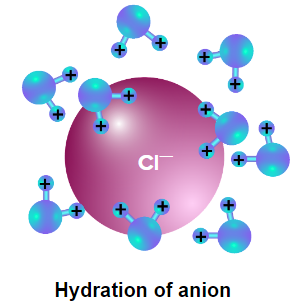
It's really interesting that ion from weak electrolyte (weak acid or weak base) undergoes hydrolysis and ion from strong electrolyte (strong acid and strong base) undergoes hydration rather than hydrolysis.
|
Salt |
Examples |
Hydration of |
Hydrolysis of |
|
Salt of SASB |
NaCl(HCl+NaOH) |
Na+ & Cl- |
nil |
|
Salt of SAWB |
NH4Cl(HCl+NH4OH) |
Cl- |
NH4+ |
|
Salt of WASB |
CH3COONa(CH3COOH+NaOH) |
Na+ |
CH3COO- |
|
Salt of WAWB |
CH3COONH4(CH3COOH+NH4OH) |
Nil |
CH3COO-, NH4+ |
Let's take an example of CH3COONa; CH3COO-- Hydrolysed, Na+- Hydrated
Salt Hydrolysis
Salt Hydrolysis is the chemical reaction of water with cations or anions or both types of ions present in salts.
Salt Hydrolysis can be categorized into two types of hydrolysis.
1. Cationic Hydrolysis
2. Anionic Hydrolysis
We will discuss Anionic hydrolysis here
Anionic Hydrolysis
The anion of salt always comes from acid and if it is from weak acid then it will react with water to give OH-ions. The solution becomes basic in nature. Hence, pH of the solution increases by increasing OH-ions. When the anion of a weak acid is hydrolysed, this is known as Anionic Hydrolysis.
If we consider anion A- from weak acid AH, then
A-(aq)+H2O(l) ⇌ AH(aq)+OH-(aq)
Let's take example of CH3COONa (CH3COOH+NaOH), CH3COO- - Hydrolysed, Na+ - Hydrated
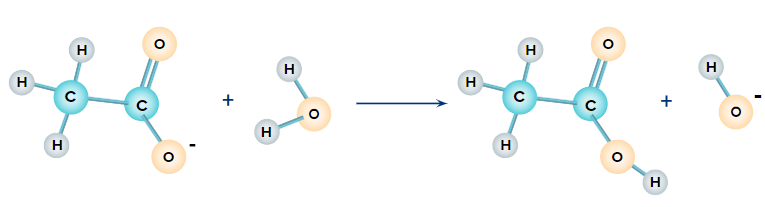
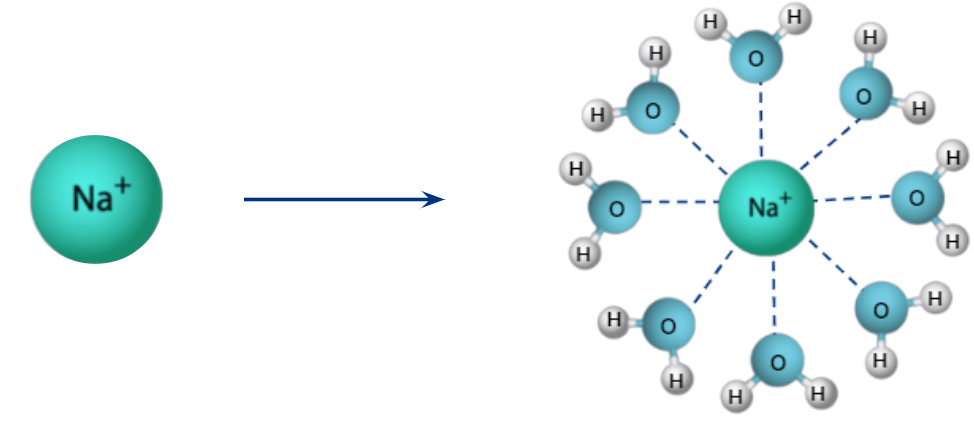
Hydration of Na+ and Hydrolysis of CH3COO-
|
Salt |
Acid |
Nature of acid |
Anion |
Hydrolysis |
|
NaCN |
HCN |
Weak acid |
CN- |
yes |
|
KClO4 |
HClO4 |
Strong acid |
ClO4- |
no |
|
MgSO4 |
H2SO4 |
Strong acid |
SO42- |
no |
|
KNO2 |
HNO2 |
Weak acid |
NO2- |
yes |
|
NaNO3 |
HNO3 |
Strong acid |
NO3- |
no |
|
CH3COONa |
CH3COOH |
Weak acid |
CH3COO- |
yes |
|
CaCO3 |
H2CO3 |
Weak acid |
CO32- |
yes |
|
FeS |
H2S |
Weak acid |
S2- |
yes |
Practice Problems
Q1. Comment for the pH and nature of NaCN salt when added in water whether it is acidic or basic.

|
Ions |
Origin |
Hydrolysis |
|
CN- |
HCN - Weak acid |
Yes, CN-(aq)+H2O(l) ⇌ HCN(aq)+OH-(aq) |
|
Na+ |
NaOH - Strong base |
No |
NaCN is a combination of weak acid and strong base. In this salt, upon reaction with water produce OH- ions. This will increase the concentration of OH- in the solution and hence pH of solution increases. Being a mixture of weak acid and strong base, it is basic in nature.
Q2. Comment for the pH of K2CO3 salt when added in water whether it is acidic or basic.

|
Ions |
Origin |
Hydrolysis |
|
CO32- |
H2CO3 - Weak acid |
Yes, CO32-(aq)+2H2O(l) ⇌ H2CO3(aq)+2OH-(aq) |
|
K+ |
KOH - Strong base |
No |
K2CO3 is a combination of weak acid and strong base. In this salt, upon reaction with water produce OH- ions. This will increase the concentration of OH- in the solution and hence pH of solution increases.
Q3. Comment for the pH of NaClO4 salt when added in water

|
Ions |
Origin |
Hydrolysis |
|
ClO4- |
HClO4 - Strong acid |
No |
|
Na+ |
NaOH - Strong base |
No |
NaClO4 is a combination of strong acid and strong base. In this salt, only hydration of respective ions takes place. Hence, the pH of solution should be approached to 7 and the nature of salt should be neutral.
Q4. Predict whether NaCN salt undergoes anionic hydrolysis or not ?
|
Ions |
Origin |
Hydrolysis |
|
CN- |
HCN - Weak acid |
Yes, CN-(aq)+H2O(l) ⇌ HCN(aq)+OH-(aq) |
|
Na+ |
NaOH - Strong base |
No |
NaCN is a combination of weak acid and strong base. It will undergo anionic hydrolysis as anion is from weak acid and hence, it will react with water and get hydrolysed.
Frequently Asked Questions -FAQ
Question 1. What is the difference between hydrolysis and hydration?
Answer: In hydration, the ions remain as ions in the solutions and hence do not affect the pH of the solution. Whereas in Hydrolysis, ions react with water and release OH- and H+ions as per the nature of salt. Hence in hydrolysis, the pH of the solution varies.
Question 2. What are neutral salts?
Answer: The salt which is formed by a combination of strong acid and strong base is known as neutral salts. For example : A very common example of NaCl, it is a neutral salt.
Question 3. What is the nature of soda which is used to puff the edible cakes?
Answer: Baking soda (NaHCO3) is used to puff the edible cakes. It is a combination of strong base (NaOH) and weak acid (H2CO3). Hence it is a basic salt.
Question 4. Why are ions from strong acid and strong base hydrated rather than hydrolysed?
Answer: Ions from strong acid and strong base are hydrated rather than hydrolysed because they are stable in ionic form and don't want to react further.
Question 5. What is the nature of Fertilizer ammonium nitrate?
Answer: Ammonium Nitrate (NH4NO3) is a combination of weak base (ammonium hydroxide) and strong acid (nitric acid). Hence it is an acidic salt.
Related topics
|
Hydrolysis of salt |
Buffer solutions |
|
Group 2 of S block elements |
Acids, Bases and Salts |
|
Group 1 of S block elements |
Ionization of weak acids and bases |

 Call Now
 Let's Chat
 Share
Share