-
Call Now
1800-102-2727


Amide - Preparation and Chemical Properties: Definition and Nomenclature of Amides, Preparations of Amides, Chemical Properties, Practice Problems and FAQs:

Do you know the first organic compound synthesized from inorganic elements and destroyed the myth between constituents of living and nonliving things? It is urea classified as an amide.
Have you ever been to any agricultural field? You must have observed that to improve the fertility of the soil farmers use fertilizers. made up of amides. Do you know which is the most commonly used fertilizer?
Well, it's again urea. Can you recall any drug which contains amide? An anesthetic drug Lidocaine is made up of amides. Amides have a wide range of applications in every field. Let’s find out what is amides, how it is prepared, and its reaction with other compounds.
Table of content
- Definition of Amides
- Nomenclature of Amides
- Preparation of Amides
- Chemical properties of Amides
- Practice Problems
- Frequently Asked Questions (FAQs)
Definition of Amides
Amides are the ammonium derivatives of carboxylic acids. In amides, the -OH group of carboxylic acid is replaced by an -NH2 group.

Nomenclature of Amides
- Amides are named by changing the name of the acid by dropping the -oic acid in the endings and adding -amide as a suffix.
- If alkyl groups are attached to the nitrogen atom of amide, they are named N-alkyl substituents.
Example:


Preparation of Amides
By Ammonolysis of acid derivatives
Ammonolysis
It is a chemical reaction that involves the use of ammonia as a reactant. Ammonolysis reactions can be carried out with organic or inorganic compounds to produce amines or nitrides, respectively. This reaction is similar to hydrolysis.
From Acid Halides
Amides are prepared by the reaction of ammonia with acid chlorides, acid anhydrides, or esters. In actual practice, the method generally used is the ammonolysis of acid chloride.

From Acid anhydride
Amides are also formed when acid anhydrides react with 1° or 2° amines. Here -NH2 group attacks the carbon atom of the carbonyl group as a nucleophile. This results in the formation of 20 amide and carboxylic acid.

By Partial hydrolysis of nitriles
Amides can also be prepared by partial hydrolysis of nitriles by treatment with conc. HCl.

By thermal decomposition of Ammonium salts
Amides can be produced by thermal decomposition of ammonium salts of carboxylic acids. To obtain an ammonium salt of carboxylic acid, ammonia is reacted with a carboxylic acid. It is an acid-base reaction.

Chemical properties of Amides
Basic character of amides:
Amides are very feebly basic, owing to the presence of lone pair of nitrogen. While reacting with strong inorganic acids, amides produce unstable salts. Although the basicity of amide nitrogens are less than corresponding amine nitrogens owing to delocalisation of lone pair of nitrogen with adjacent carbonyl group.
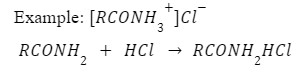
Acid character of amides:
Amides are mildly acidic as well. They react with Na metal to liberate H2 gas and dissolve mercuric oxide to form a covalent mercury compound.

Hydrolysis of amides
Amides undergo hydrolysis when they are heated with aqueous acid or aqueous base to form corresponding carboxylic acid or carboxylate salt of corresponding metal ion respectively, as well to release ammonia gas..
Dehydration of amides
When amides are heated with P2O5 dehydration reaction takes place to form cyanides.

Reduction of amides
Primary as well as secondary amides are reduced by LiAlH4 and Na/C2H5OH to a primary amine and secondary amine respectively.

Reaction with Nitrous Acid
Amides react with HNO2 to form Carboxylic acids and nitrogen gas is evolved.

Hofmann Bromamide Reaction
Amides with no substituents on the nitrogen that is primary amides react with solutions of Br2 or Cl2 in NaOH in aqueous medium which is immensely essential to yield a primary amine with one carbon less through a reaction known as Hoffmann Bromamide Reaction.

Mechanism

Step 1: The OH-ion of the strong base approaches the amide. Water and anion of amide formed due to the deprotonation of amide.
Step 2: The anion formed during the deprotonation of amine now attacks the Br2 in an alpha substitution reaction. Due to the cleavage of the Br-Br bond N-Bromamide is formed along with Br-anion.
Step 3: The base now attacks the N-Bromamide again, resulting in its deprotonation and the formation of water, as well as the generation of bromamide anion.
Step 4: This bromamide anion undergoes rearrangement such that the ethyl group (or any alkyl group) that was previously bonded to the carbonyl carbon now forms bonds with the nitrogen. Simultaneously, the bromide anion forms and leaves the compound. As a result, an isocyanate is formed
Step 5: A nucleophilic addition reaction occurs when water is added to isocyanate, resulting in the formation of carbamic acid.
Step 6: The carbamic acid now contains a negatively charged nitrogen, which is bonded to one hydrogen and the ethyl group, and it has lost its carbon dioxide. The required primary amine is formed when this is protonated by the water.
Practice Problems
Q1. Indicate which nitrogen compound amongst the following would undergo Hoffmann reaction (i.e. reaction with Br2and strong KOH in aqueous medium to furnish the primary amine (R-NH2 )?
a. RCONHCH3
b. RCOONH4
c. RCONH2
d. RCOONH2
Answer: (C)
Hoffmann bromamide reaction involves the reaction of a primary amide with Br2 and KOH to give primary amine (RNH2). Option A is a secondary amide and hence will not undergo this reaction.

Q2. The product formed by the reaction of acetamide with bromine in the presence of NaOH in aqueous medium is:
a. CH3CN
b. CH3CH2OH
c. CH3CHO
d. CH3NH2
Answer: (D)

Q3. Write the amine produced by the Hoffmann degradation of benzamide.

Answer: No. of carbons in the starting amide = 6 + 1 = 7
As Hoffmann bromamide reaction gives the product which has one carbon atom less than the reactant.
Hence, No. of carbons in the amine formed = 7 - 1 = 6

Q 4. Which of the following compounds cannot give Hoffmann bromamide reaction?

Answer: (C)
Hoffmann bromamide reaction is only applicable for primary amides. Secondary and tertiary amides can’t undergo this reaction.
Frequently Asked Questions (FAQs)
Q 1. How amides are different from Amines?
Answer: Amines are organic compounds with a nitrogen atom bonded to a hydrocarbon framework. Amides are compounds that have a nitrogen atom bonded to one side of a carbonyl group.

Q 2. Between Amides and amines which is more basic and why?
Answer: Amines are more basic than amides because the localized nitrogen atom has an unshared electron pair that can be used for protonation. In amides, on the other hand, the electron pair is delocalized to the carbonyl group. Due to the presence of conjugation between the double bond of the carbonyl group and the lone pair of electrons on the nitrogen atom, resonance occurs.

Q 3. Why tertiary amine doesn’t react with anhydrides?
Answer: Amines with replaceable hydrogen atoms form substituted amides when they react with acid chloride or acid anhydride. The process is called acylation. There is absence of replaceable H atom in tertiary amines. Hence, they do not react with acetyl chloride or acetic anhydride, and thus do not undergo acylation.

Q 4. What is primary and secondary amide?
Answer: The number of carbons attached to the nitrogen determines the nomenclature for an amide, just as it does for amines. Nitrogen is attached to a single carbon in a primary (1°) amide; it is attached to two carbons in a secondary (2°) amide; and it is attached to three carbons in a tertiary (3°) amide.

Related Topics
|
Diazonium salt |
Nitro Compounds - Preparation and Reactions |
|
Preparation of amines - Ammonolysis Reaction |
Amines Chemical properties |

 Call Now
 Let's Chat
 Share
Share