-
Call Now
1800-102-2727


Lanthanides

The first Lanthanide was discovered in Ytterby, Sweden, in the late 18th century in 1787. This element was Gadolinite. In 1794, Finnish chemist Johan Gadolin extracted yttria from it, marking the first step in Lanthanide discovery. Over the years, more elements were isolated from similar ores, and chemists realised they formed a special group.
These metals are now called lanthanides, or the “rare earth elements.” They are not actually very rare, but they are difficult to separate from one another. Today, lanthanides are widely used in magnets, lasers, batteries, and even smartphone screens.
About Lanthanides
Lanthanides are a group of 15 chemical elements, starting from lanthanum (La, atomic number 57) to lutetium (Lu, atomic number 71). They are located at the f-block of the periodic table, placed separately at the bottom for convenience..
Lanthanides are metals, usually silvery-white and soft. They are highly reactive, especially at elevated temperatures. Most of them readily form oxides and react with water to produce hydrogen gas. The similarity of chemical and physical properties of the elements, mainly due to lanthanide contraction, makes separating them a challenge and requires special techniques.
Electronic Configuration: The defining feature of lanthanides is the gradual filling of the 4f orbitals. Their general electronic configuration is [Xe] 4f¹–14 5d⁰–1 6s². This configuration leads to very similar chemical behaviour across the series.
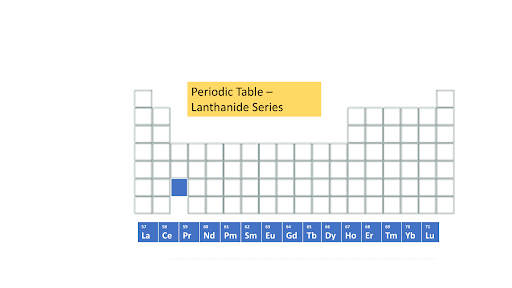
Lanthanid Series in Periodic Table
List of Elements in Lanthanides
The Lanthanide elements include:
|
Element Name |
Symbol |
Major Use |
|
Lanthanum |
La |
Optical lenses (camera, telescope) |
|
Cerium |
Ce |
Catalytic converters in automobiles |
|
Praseodymium |
Pr |
Aircraft engine alloys |
|
Neodymium |
Nd |
Strong permanent magnets (NdFeB) |
|
Promethium |
Pm |
Radioactive batteries (spacecraft) |
|
Samarium |
Sm |
SmCo magnets for precision devices |
|
Europium |
Eu |
Red phosphor in TV and LED displays |
|
Gadolinium |
Gd |
MRI contrast agent |
|
Terbium |
Tb |
Green phosphor in lamps and displays |
|
Dysprosium |
Dy |
Strengthens magnets in high-heat motors |
|
Holmium |
Ho |
Used in laser surgery |
|
Erbium |
Er |
Fiber optic communication amplifiers |
|
Thulium |
Tm |
Portable X-ray machines |
|
Ytterbium |
Yb |
Alloying in stainless steel, stress sensors |
|
Lutetium |
Lu |
PET scan detectors in cancer diagnosis |
Lanthanide Contraction
Lanthanides exhibit the phenomenon of lanthanide contraction. As you move from lanthanum to lutetium, the atomic number increases, but the 4f electrons shield poorly. This poor shielding means that the increasing nuclear charge pulls the outer electrons closer. As a result, the atomic and ionic sizes decrease steadily across the series.
Lanthanide contraction has several consequences:
- The elements become difficult to separate due to their very close ionic radii.
- It affects their basicity, with hydroxides becoming less basic as you move across the series.
- It also influences transition metals in the following period, particularly zirconium and hafnium, which end up having almost identical sizes.
Properties of Lanthanides
The important properties of Lanthanides include:
- Oxidation state: +3 is the most stable oxidation state for all lanthanides. Some elements also show +2 or +4, but these are less stable.
- Magnetic properties: Many lanthanides are strongly paramagnetic due to unpaired 4f electrons. Examples include Neodymium (Nd) and Samarium (Sm).
- Spectral properties: They often show sharp line-like spectra because f–f transitions are shielded from outside influences. This property makes them useful in lasers and optical devices.
- Complex formation: They form complexes due to large ionic size and high charge density, along with the partially filled 4f orbitals.
Periodic Trends in Lanthanides
Despite their similarities, some trends are clear across the series:
- Atomic and Ionic Radii: Both decrease gradually from La³⁺ to Lu³⁺ due to lanthanide contraction.
- Density and Hardness: These generally increase across the series as atoms pack more tightly.
- Electronegativity: Slightly increases from La to Lu, although the change is not dramatic.
- Oxidation State Stability: +3 is dominant, but cerium shows stable +4, and europium and ytterbium can show stable +2.
- Basicity of Hydroxides: Lanthanum hydroxide is strongly basic, while lutetium hydroxide is much less so. The basic strength decreases across the series.
- Melting and Boiling Points: There is no simple trend, as subtle differences in metallic bonding influence these values.
Summary
Lanthanides are 15 f-block elements (La–Lu) with similar chemistry due to 4f orbital filling. A key feature is lanthanide contraction, which steadily reduces atomic size and affects properties like basicity and separation. They mainly show +3 oxidation state, strong magnetism, and sharp spectra. Across the series, radii decrease, density and hardness rise, and hydroxides become less basic.
FAQs
Q1. What are the natural sources of Lanthanides?
Lanthanides are found in three main mineral sources:
- Monazites that contain lighter Lanthanides
- Euxenite that has Lanthanides evenly distributed
- Xenotime, which comprises heavier Lanthanides
Q2. What are the effects of Lanthanides on humans?
While they are less toxic in general, exposure to high quantities of Lanthanides leads to a negative impact on health. It can lead to DNA damage, oxidative stress, inflammation and other issues. The toxicity can also cause organ-level damage.
Q3. Which Lanthanide is radioactive?
Promethium (Pm) is the Lanthanide that is radioactive. It lacks stable isotopes and finds applications in nuclear-powered batteries.


 Call Now
 Let's Chat
 Share
Share