-
Call Now
1800-102-2727


Vascular Tissues

In higher plants, vascular tissues are complex structures which are derived from the procambium (a type of meristematic tissue) and composed of various cell types and elements. They are arranged in the plant body as vascular bundles and are primarily associated with the transport of water, food and nutrients throughout the plant body.
Components of Vascular Tissues
- Xylem
- Phloem
- Cambium
The two major components of vascular tissues are xylem and phloem.
They are linked with two types of cambium, the cork cambium and the vascular cambium. Only vascular cambium is associated with vascular tissues; cork cambium belongs to the protective tissue system.
All the components collectively comprise the vascular tissue system in higher plants.
Xylem
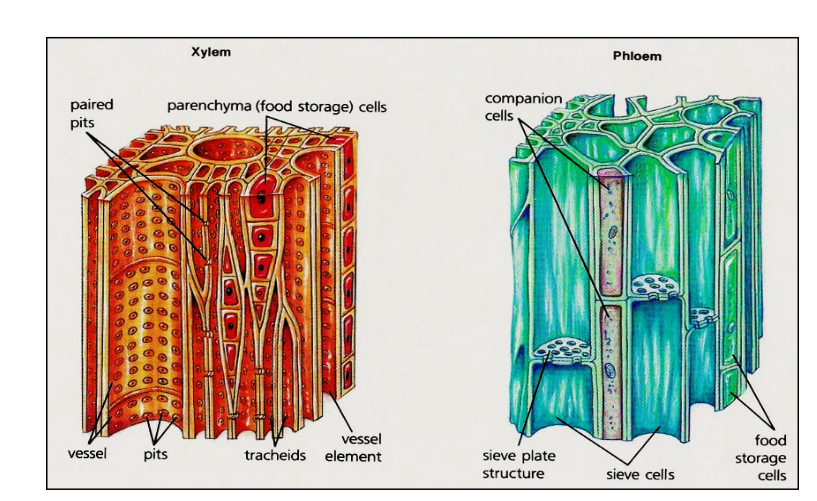
It is the vascular tissue responsible for mineral and water absorption by the roots and its unidirectional distribution throughout the plant body. In growing shoot and root tips, cells divide to give rise to primary xylem tissue; production of a ring of new xylem around the primary one results in the formation of secondary xylem that makes the plant seem wider.
Elements of Xylem:
- Tracheids are elongated cells with tapering ends that create a network of hollow, connected cells for the transport of water. Additionally, it provides mechanical support.
- Xylem vessels are wider than tracheids and are composed of dead cells with lignified cell walls. It allows the free flow of water and minerals from roots to leaves. They possess single, multiple or mesh-like perforations in their end walls adjoining other vessel elements.
- Xylem parenchyma are living cells which serve as the structural component and assist in water and mineral conduction.
- Xylem fibres are sclerenchymatous tissues providing mechanical support.
The specialised water-conducting components of xylem tissue- tracheids and xylem vessels are collectively known as tracheary elements.
Functions of Xylem:
- Responsible for the unidirectional distribution of water from the root to the leaves.
- Conducts water and minerals absorbed by roots to the aerial parts, but does not absorb them.
Phloem
It is the vascular tissue responsible for the multidirectional ‘translocation’ of food and nutrients throughout the plant. It helps transport the food produced during photosynthesis to different plant tissues. Apical meristematic tissues produce the primary phloem, and the vascular cambium forms the secondary phloem.
Elements of Phloem:
- Sieve tubes transport sugar and nutrients throughout the plant, and assist in the exchange of materials between the cells. They congregate to form the sieve element. Lateral walls have perforations and associated callose, thus forming a sieve plate that links two axially linked elements of a sieve vessel.
- Companion cells are nucleated cells that help the sieve elements in carrying out their metabolic functions. They remain connected to sieve elements via plasmodesmata.
- Phloem parenchyma stores food and assists in lateral transport; fibres provide mechanical strength.
- Phloem fibres act as the structural element.
Functions of Phloem:
- Translocates food mainly in the form of sucrose (along with amino acids and other solutes).
- Translocates amino acids and other compounds primarily to roots, fruit, seeds, storage organs and growth organs. Sieve tubes, with the help of the companion cells, transport food in all directions.
- ATP is required to move sucrose into the phloem tissue, which increases the solute pressure in the tissue which causing water to move into it. The resulting tension helps the unloading of materials from the phloem to the other tissues with the application of lower pressure.
Cambium
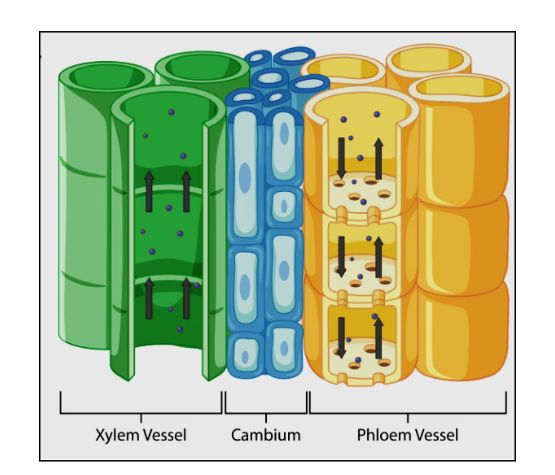
Cambium is the layer of meristematic tissue found in the region between xylem and phloem, and is of two types.
Cork Cambium
- It is a tissue found in the epidermis of vascular plants.
- A single-cell layer produces the cork and phelloderm cells.
- Cork cambium is also known as phellogen.
- It is the source of the protective tissue periderm, which grows in the place of the epidermis destroyed by the secondary growth.
- It can be found in the stems and trunks of woody plants.
Vascular Cambium
- It is a tissue found in the roots and stems of plants that controls secondary growth.
- It is found in the space between the phloem and xylem tissues.
- Vascular cambium is responsible for secondary growth, not primary growth.
- Vascular cambium is a secondary meristem that forms after the tissue differentiation of the main plant body has occurred.
Frequently Asked Questions (FAQs)
Q1. What is the main difference between xylem and phloem?
Xylem conducts water and minerals unidirectionally from roots to leaves, while phloem translocates food (mainly sucrose) in multiple directions to growing and storage tissues.
Q2. Why is vascular cambium important in plants?
Vascular cambium is a secondary meristem that produces secondary xylem and phloem. It helps plants (especially woody plants) to increase in thickness (secondary growth).
Q3. How is cork cambium different from vascular cambium?
Cork cambium (phellogen) produces protective tissues like cork and phelloderm, whereas vascular cambium produces secondary vascular tissues (xylem and phloem).


 Call Now
 Let's Chat
 Share
Share