-
Call Now
1800-102-2727


Types of Cymose Inflorescence

In flowering plants, flowers may grow alone or in groups or clusters. The way flowers are arranged on a stem is called inflorescence. The stem that holds these flowers is known as the peduncle.
Inflorescence is grouped into two major types, racemose and cymose. Racemose is an indeterminate type; the main axis keeps growing. Cymose is a determinate type; the main axis ends in a flower.
In racemose, young buds are near the tip of the axis.
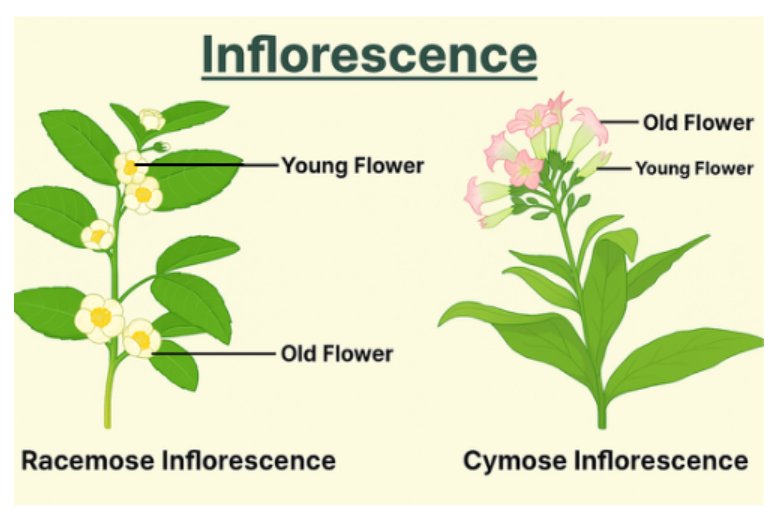
In cymose, young buds form below the older terminal flower.
What Is Cymose Inflorescence?
A cymose inflorescence is one where the main stem ends in a flower. After the first flower forms, stem growth comes to a stop.
Then, new flowers grow from lateral or side branches near the base. This process repeats with each side branch forming another terminal flower.
The flowers usually develop in a basipetal succession (older flowers at the top/centre, younger toward the base/sides). In some forms like cymose heads, blooming may follow a centrifugal pattern.”
Cymose inflorescence is Primarily classified into three main types: monochasial, dichasial, and polychasial. Special modifications (like cymose capitulum or sympodial cyme) exist in some plants. These are based on how the side branches continue the flower sequence.
Monochasial Cyme (Uniparous Cyme)
The main axis ends in a flower and stops growing. Then, only one lateral branch develops below this flower and repeats the cycle.
Each branch bears one terminal flower and then produces another branch.
This type is further divided into the following forms:
Helicoid Cyme
- Side branches grow on the same side repeatedly.
- A spiral or helix-like shape forms as the plant grows.
- Examples: Drosera, Begonia
Scorpioid Cyme
- Side branches form on alternate sides, left and right.
- This creates a zigzag appearance along the axis.
- Examples: Gossypium (cotton), Helleborus, and Solanum nigrum.
Sympodial Cyme
- Successive lateral branches give an apparent straight axis
- Axis appears curved or zigzag at first, then becomes straight.
- Found in many species with uneven stem growth.
Dichasial Cyme (Biparous Cyme)
The main stem ends with a terminal flower, like in a monochasial cyme. However, two side branches grow from below the main flower.
Each of those side branches again ends in a flower and branches. The structure becomes forked and symmetrical in appearance.
Examples: Jasmine, Ixora, Saponaria.
Polychasial Cyme (Multiparous Cyme)
The central flower forms first at the end of the main axis. From the base of this flower, more than two branches emerge. Each branch also produces a terminal flower, continuing the pattern.
The oldest flower stays in the centre of the cluster. This gives a round or umbrella-like shape in some plants.
Examples: Calotropis, Hamelia patens, Nerium.
Cymose Capitulum (Cymose Head)
It is a special modification of cymose inflorescence, where the main axis is flattened into a disc, e.g., Mimosa, Acacia. Flowers are directly attached to this disc and lack flower stalks.
Older flowers bloom in the centre, and younger ones form around them. This is called a centrifugal arrangement.
Examples: Mimosa, Acacia, Albizzia.
Key Features of Cymose Inflorescence
- The main stem always ends in a flower.
- Growth is limited after the terminal flower appears.
- Flowers bloom in a definite order, older at the centre or top.
- Flowers bloom in a definite order: usually basipetal (older flowers above/at the centre, younger toward the base/sides).
- In some modified forms, a centrifugal pattern is seen.
- Side branches continue the cycle by producing new terminal flowers.
Summary
Cymose inflorescence means the main flower stem stops growing after making a flower. New flowers grow from side branches below the first flower. The flowers bloom from top to bottom. There are three main types of cymose inflorescence: monochasial, dichasial, and polychasial. Special modifications include cymose capitulum. Each type has a different branching style. This pattern helps in classifying and understanding how flowers grow in many plant species.
Frequently Asked Questions (FAQs)
Q1. How many main types of cymose inflorescence are there?
A. There are four main types of cymose inflorescence.
Monochasial Cyme (Uniparous Cyme)
Dichasial Cyme (Biparous Cyme)
Polychasial Cyme (Multiparous Cyme)
Cymose Capitulum (Cymose Head)
Q2. What is a dichasial cyme?
A. A dichasial cyme has two side branches growing from one flower stem. Both branches end in flowers and then produce more branches.
Q3. What kind of plants have cymose inflorescence?
A. Cymose inflorescence includes
Jasmine
Ixora
Calotropis


 Call Now
 Let's Chat
 Share
Share