-
Call Now
1800-102-2727


Connective Tissue: Its Components, Loose Connective Tissue, Practice Problems and FAQs

We all look at high rising buildings and wonder about the construction. You all know that cement helps to connect the bricks of these buildings. Can you make a tall building without cement? Not possible.
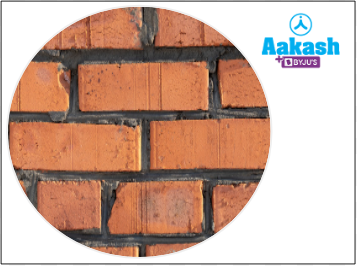
Fig: Cement
Similarly, in our body many types of tissues are present and they are working in a coordinated manner like bricks in the building. So there must be a special tissue that helps in connecting other tissues in our body. It is called connective tissue which connects different parts of the body. A complex body is composed of various structures that are connected to one another too.
The most common example of connective tissue is the blood. It is the fluid connective tissue which transports various substances, such as nutrients, hormones, and oxygen from one part of the body to another. Our body has many other types of connective tissues like bone, cartilage etc. Bone provides the structural framework to the human body. Let’s understand more about connective tissues in this article.
Table of contents:
- Connective tissue
- Components of connective tissue
- Types of connective tissues
- Loose connective tissue
- Practice Problems
- FAQs
Connective tissue
It is the most abundant tissue which is distributed widely in the complex animal. The primary function of connective tissue is to link and support other tissues and organs of the body. They are of different types from soft tissues to specialised tissues.

GIF: Connective tissue
Components of connective tissue
It possesses three components as follows:
- Ground substance
- Connective tissue cells
- Fibres
Ground substance
It is a non-living, amorphous and transparent semi-fluid. It possesses mainly carbohydrates and proteins. The most common mucopolysaccharide present is hyaluronic acid.
Connective tissue cells
They are the living component. They are of various types depending on the type of connective tissue. Examples include fibroblasts, adipose cells, plasma cells, mast cells, macrophages, reticular cells, lymphocytes etc.
Fibroblasts
They are spindle-shaped cells and produce fibres and matrices.
Adipose cells
They are spherical cells which store fats.
Plasma cells
They help in the production of antibodies and assist in immune response.
Mast cells
They produce histamine, heparin and serotonin. They are involved in inflammatory responses.
Macrophages
They help in ingesting bacteria, foreign substances and cell debris.
Reticular cells
They help in the formation of reticular fibres and are phagocytic in nature.
Lymphocytes
They are small and spherical cells. They are involved in immune response.
Fibres
They are of three types as follows:
Collagen fibres
They are the white fibres. They are made up of collagen proteins. They are unbranched and inelastic. They occur in bundles. On boiling in water they change to elastin protein.
Elastic fibres
They are the yellow fibres. They are formed of elastin protein. They are elastic and branched. They show resistance to boiling.
Reticular fibres
They are made up of reticulin proteins. They are branched and inelastic. They are delicate and form a reticulum or network.
Types of connective tissue
The three types of connective tissues are as follows:
- Loose connective tissue
- Dense connective tissue
- Specialised connective tissue
Loose connective tissue
In a semi-fluid ground substance, the cells and fibres are loosely arranged. It acts as a binding tissue. There are two types of loose connective tissue as follows:
- Areolar tissue
- Adipose tissue
Areolar tissue
It is primarily found under the skin. It acts as a supporting agent of the epithelium. It occurs beneath the epithelia of many visceral organs, walls of veins and arteries. It fixes the skin with the muscles. It possesses three types of cells as follows:
Macrophages
They are large amoeboid cells which are phagocytic in nature. They phagocytose and destroy microbes, foreign particles and cell debris.
Fibroblasts
They are irregularly shaped cells which secrete collagen and elastin proteins. Collagen fibres help in tissue repair. The fibres of the tissue leave spaces called areolae between them, hence the name areolar tissue.
Mast cells
These cells secrete histamine, serotonin, heparin and matrix. Heparin prevents blood clotting. Histamine is involved in allergic and inflammatory responses. It attracts the phagocytes to the tissue injury sites.
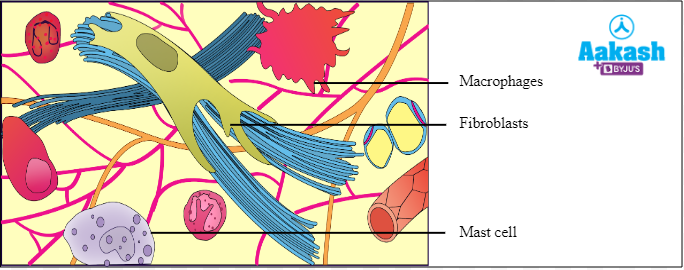
Fig: Areolar tissue
Functions of areolar tissue
- It allows the migration of wandering cells towards the areas of infections and repair.
- It binds parts together.
- It provides strength, elasticity and support to the body parts.
- It allows the diffusion of materials
Adipose tissue
It is subcutaneous tissue made up of adipocytes. These cells store fats. The excess nutrients are converted to fats and stored in adipose tissues. Adipocytes possess fat globules which displace the nucleus and cytoplasm to the periphery. The blubber of whales, hump of camels and yellow bone marrow contains adipose tissue. It forms a shock absorbing cushion around the heart, kidneys, etc. It prevents heat loss from the body.
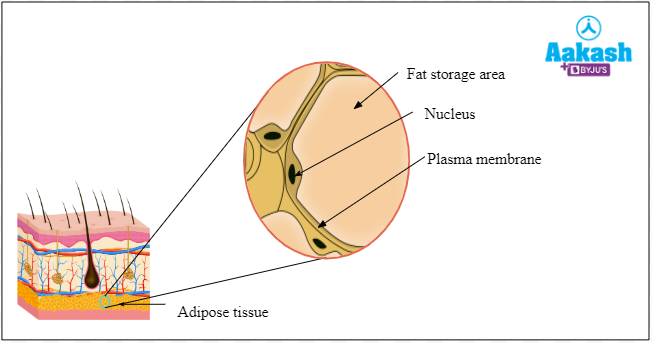
Fig: Adipose tissue
Functions of adipose tissue
- It stores fats.
- It acts as a shock absorbing cushion normally around the heart, kidneys, eye balls etc.
- It prevents heat loss from the body.
- It gives features to the body.
Practice Problems
Q1. From the given options, which type of connective tissue provides a framework to support epithelium?
A. Areolar tissue
B. Adipose tissue
C. Dense regular connective tissue
D. Dense irregular connective tissue
Solution: Areolar tissue is mostly located beneath the skin. It functions as an epithelial supporter. It consists of macrophages, mast cells and fibroblasts. It occurs beneath the epithelia of many visceral organs, walls of veins and arteries. It fixes the skin with the muscles. Hence, the correct option is a.
Q2. Excess nutrients that are not required by the body cells immediately are converted into ____________.
A. Areolar tissue
B. Adipose tissue
C. Dense regular connective tissue
D. Dense irregular connective tissue
Solution: Adipocytes make up the subcutaneous tissue. Fats are stored in these cells. Excess nutrients are converted to fats, which are then deposited in adipose tissues. Hence, the correct option is b.
Q3. Identify the figure and recognise the correct labelling of the given figure.
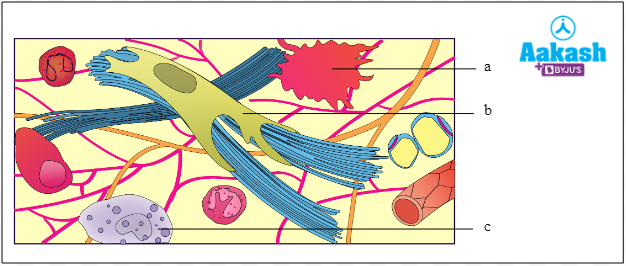
Answer: In the given image, ‘a’ represents macrophages, ‘b’ represents fibroblasts and ‘c’ represents mast cells.
- Macrophages are large amoeboid cells which are phagocytic in nature.
- Fibroblasts are irregularly shaped cells which secrete collagen and elastin fibres.
- Mast cells secrete histamine, serotonin, heparin and matrix.
Q4. Areolar connective tissue joins ______________.
A. fat body with muscles
B. integument with muscles
C. bones with muscles
D. bones with bones
Solution: Areolar tissue connects the integument to the muscles and is a form of connective tissue. An integument is nothing more than a layer of skin. It acts as a support structure for the epithelium. Hence, the correct option is b.
Q5. What role does ground substances play in connective tissue?
Answer: Ground substance is a gel-like matrix in which all other connective tissue elements are embedded. Ground substance connects all the elements of connective tissue.
Q6. Differentiate between collagen fibres and elastic fibres.
Answer: The difference between collagen fibres and elastic fibres are enlisted below:
|
Collagen fibres |
Elastic fibres |
|
They are the white fibres. |
They are the yellow fibres. |
|
They are made up of collagen proteins. |
They are formed of elastin protein. |
|
They are unbranched and inelastic. |
They are elastic and branched. |
Q7. Where is the loose connective tissue located?
Answer: The loose connective tissue is commonly found under the skin. It is also present in the bone marrow, lymph nodes and spleen.
FAQs
Q1. How does connective tissue insulate?
Answer: Adipose tissue is a loose connective tissue which cushions the body organs and insulates them. They also provide reserve energy fuel in the form of fat. It prevents loss of heat from the body.
Q2. How do humans use blubber?
Answer: Blubber is used extensively by people for fuel and food. It provides energy rich food. It forms a part of the traditional diets of the Eskimos.
Q3. What is the common use of heparin?
Answer: Heparin injection is used as an anticoagulant. It will be able to decrease the clotting ability of the blood. This helps prevent the formation of harmful clots in blood vessels. This medicine is also called a blood thinner.
Q4. Why is elastin considered as good for skin?
Answer: Elastin allows the skin to stretch and then regain its normal shape. It functions in coordination with collagen. They are found in the connective tissue.

NEET Related Links
JEE MAIN Related Links
JEE Advanced Related Links
JEE Advanced Eligibility Criteria
JEE Advanced Chemistry Syllabus
JEE Advanced Registration Dates
CUET Related Links
Important Topics
Anemometer : Measurement of Wind Speed
Angular Acceleration Atomic Theory Audible and Inaudible Sound Average Speed and Average Velocity Average Velocity Avogadros Number Avogadros Hypothesis Azimuthal Quantum Number Balanced Force Bar Magnet Biconvex Lens Boyles Law Buoyancy Calorimeter Carnot Engine Celestial Bodies Centripetal And Centrifugal Force Concave and Convex Lenses Concave Convex Mirrors Contact and Non Contact Force Controlled Thermonuclear Fusion Convection Currents Convex Lens Convex Mirror Destructive Interference Difference Between Conduction Convection and Radiation Difference Between Electric Field and Magnetic Field Difference Between Heat And Temperature Difference Between Series And Parallel Circuits Differences Between Acceleration And Velocity Distance and Displacement Distance Time Graph Electrical Force : Electric Forces and Their Types Electromagnetic Waves : Definition, Equation and Properties of Electromagnetic Waves Electromagnetism Electron Spin Fluid Flow : Bernoullis Equation Derivation and Fluid Mechanics Fluid Friction : Types and Factors of Fluid Friction Frames of Reference : Inertial and Non- Inertial Frame of Reference Frequency and Wavelength Frictional Force Importance of Hydrosphere Instantaneous Speed and Velocity Introduction to Motion Kinetic and Potential Energy Difference Law Of Conservation of Energy Layers of the Earth Light Energy Light Sources List of physics scientists and Their inventionsLoudness of Sound
Magnetic Dipole Moment Magnetic Field Non - Contact Force Non - Renewable Energy Ohms Law Optics P Wave Physics Symbols Plane Mirrors Poissons Ratio Projectile Motion Properties of Water : Anomalous Expansion of Water Radius of Gyration Reflection of Light Reflection of Waves Relative Density Resonance Reverberation Rolling Friction Rotation and Revolution Screw Gauge Semiconductors and Insulators Sliding Friction Speed Time Graphs Static Friction Stefan Boltzmann Law Stress Tension Tension Force Thermometer: Clinical Laboratory Thermometer Types of Rocks Types of Waves Uniform Motion and Non Uniform Motion Unit of Voltage Uses of Convex Lens Uses Of Convex Mirror Uses of Electromagnet Uses of Optical Fibre Wave Wavelength of Light What is Scattering of Light Working of Electric Bell Conventional and Non-conventional Sources of Energy Buoyant Force Bulk Modulus of Elasticity Bernoulli’s Principle Angular Momentum Difference Between Speed And Velocity ForceUnit of Heat
Difference between Distance and Displacement Simple Microscope Derivation Of Equation Of Motion Thermometer: Clinical & Laboratory Thermometer Difference between Concave and Convex LensDerivation Of Lens Maker Formula
Unit Of Pressure Velocity Uses of Plane Mirror
Wave Theory of Light
Unit of Density Unit of Light Unit of Force Unit of Magnetic Field Unit of wavelength Unit of Viscosity Uses of Electroplating Young's Modulus
What is the Scattering of Light
Lenz Law Space Wave Propagation Schrodinger Wave Equation Relation between Fahrenheit and Celsius Refractive Index Potentiometer Working Pascal Law Oscillatory Motion Optical Instruments Newton's Laws of Motion - First Law Modulation and Demodulation Magnetic Flux Lens Formula and Magnification Kaleidoscope Faradays Law Epsilon Naught Value Energy Bands Electrostatics Electroscope AC Generator Unit of Current Lithosphere Bending Equation Derivation Difference Between Pound and Kilogram Semiconductor Devices OTEC - Ocean Thermal Energy Conversion Hall Effect Rectilinear Propagation of Light Difference Between Ammeter and Voltmeter Coefficient of Linear Expansion Ampere’s Law Cyclone and Thunderstorm Save The Environment From Pollution Particle Nature of Light Types of DC Motor Uses Of Transistor Derivation of Phase Rule Unit of Humidity

 Call Now
 Let's Chat
 Share
Share