-
Call Now
1800-102-2727


Testes: Male Reproductive System, Male Primary Sex Organ, Structure and Function of Testes, Testicular Anomalies, Practice Problems, FAQs

Have you ever wondered why we share similarities with both our parents? That’s because we receive chromosomes from both of them. As human beings, we repoduce by the process of sexual reproduction. This kind of reproduction involves fusion of the male and female gametes coming from both the parents. This is called fertilisation. It is a a chance phenomenon and a very critical event in the lives of all sexually reproducing organims. As these gametes carry chromosomes from both our parents, we share characteristics with both of them.
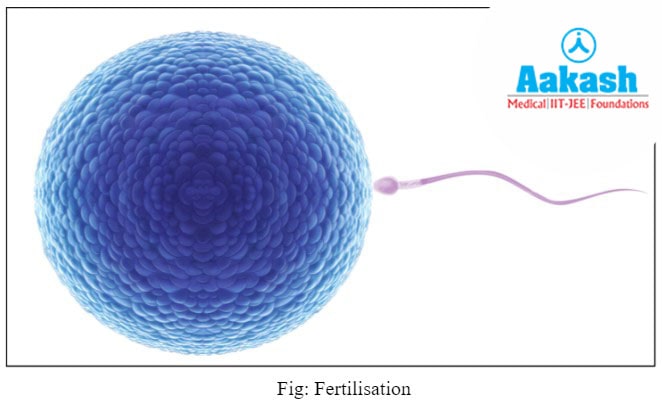
These gametes are special cells which carry only half the amount of genetic material compared to other cells of our body. This indicates that they are formed as a result of meiotic cell division in the body. But do you know which part of our body gives rise to these special cells? Gametes are formed due to meiotic division in the cells of special organs known as gonads.
But just like other internal organs in the human body, are the gonads in males and females also the same? Well, no. The main difference in the anatomy of males and females is the difference in their gonads or primary sex organs that give rise to the gametes.
In this article we will focus on the male gonads and their structure and function to understand where the male gametes are exactly produced.
Table of contents
- Male reproductive system
- Testes
- Function of testes
- Testicular anomalies
- Practice Problems
- FAQs
Male reproductive system
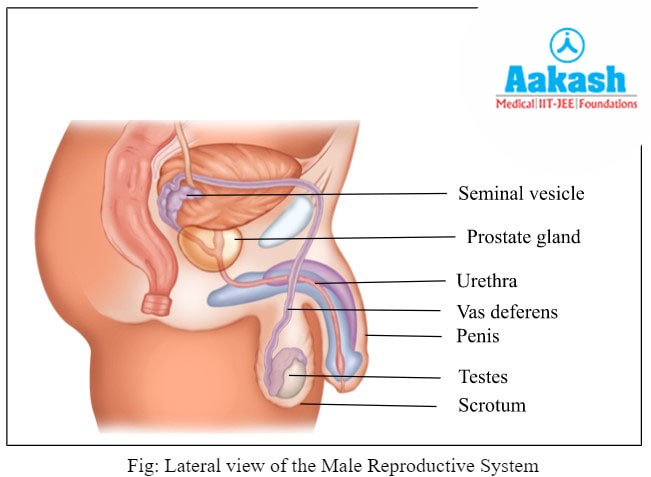
The various organs of the male reproductive system located in the pelvic region can be broadly classified as - primary and secondary sex organs.
Primary sex organs are the testes. Secondary sex organs include - External genitalia, Male accessory glands and Male accessory ducts.
External genitalia
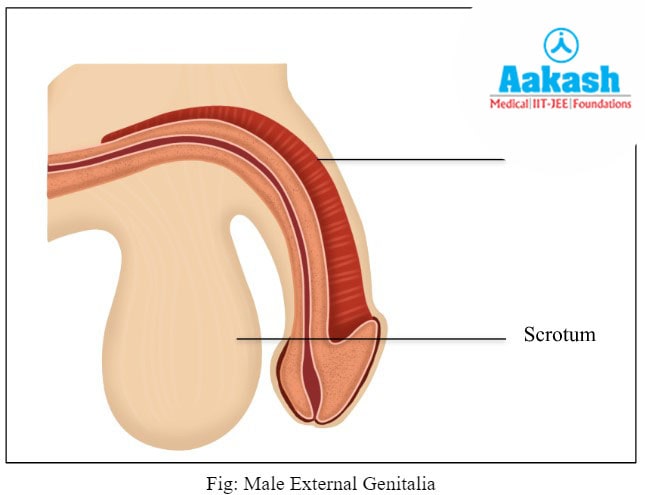
This includes the penis and the scrotum.
Penis is a pendulous organ that lies in front of the scrotum. It is the copulatory organ that helps in inseminating the female partner at the time of sexual intercourse.
Scrotum is a hyperpigmented pouch of skin. It is internally divided into two separate sacs by a scrotal septa. Each scrotal sac carries one testis. The scrotum helps in maintaining a low temperature that is required for the production and viability of male gametes (sperms).
Male accessory glands
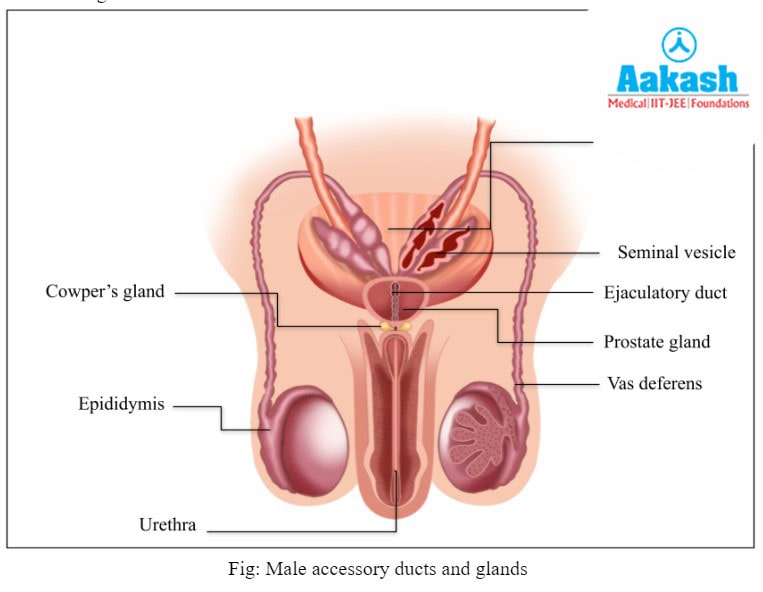
These glands are associated with the male reproductive system and secrete the seminal plasma. There are 3 types of male accessory glands-
(i) Prostate gland - It is an unpaired, chestnut shaped gland located at the base of urethra. The secretion is slightly alkaline and nourishes the sperm and increases its motility.
(ii) Bulbourethral/ Cowper’s glands- These are small, pea- sized, paired glands. These pea-sized glands lie on either side of the urethra. These glands secrete mucus that lubricates penis and reduces damage to sperms.
(iii) Seminal vesicles- These are paired glands located behind the urinary bladder. The secretion is alkaline in nature and consists of calcium, fructose, prostaglandins and clotting factors. It forms 60% of the seminal plasma.
Male accessory ducts
These ducts help in maturation and transfer of sperms from their site of formation to the outside. The ducts include-
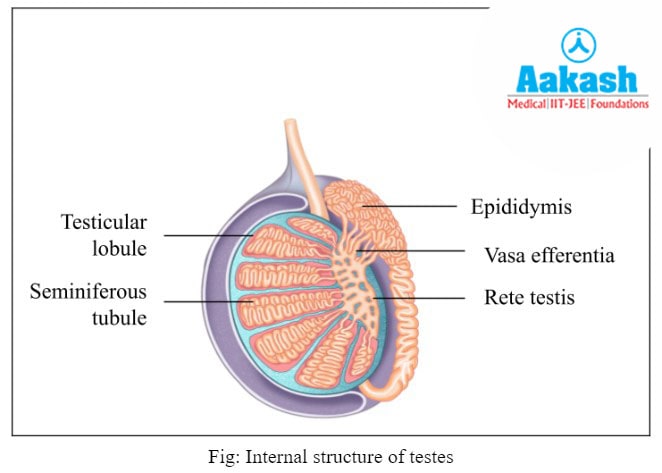
(i) Rete testis and vasa efferentia- Carry the sperm outside of testes
(ii) Epididymis- temporarily stores sperm until they are motile
(iii) Vas deferens- carries sperm from epididymis to ejaculatory duct
(iv) Ejaculatory duct- carries sperms to the urethra
(v) Urethra- carries sperms to the outside. It is the common duct for sperms and urine, thus also called the urogenital duct.
Testes - Primary male sex organs
They are oval, paired structures located inside the scrotal sacs. They are the site for synthesis of sperms and also produce the male sex hormones. Therefore, they are the primary male sex organs. Each testis measures 4-5 cm in length and 2-3 cm in width. They are located outside the abdominal cavity in the scrotal sacs because the temperature required for production of sperms is 2- 2.5℃ lower than the normal body temperature, and the scrotal sacs help to achieve the same.
Scrotum consists of two types of muscles, namely the dartos muscle and the cremaster muscles. These muscles help in thermoregulation of the testes. When the temperature outside is low, the two muscles contract thereby bringing the testes closer to the body. On the other hand, if the temperature outside is high, the muscles relax and the testes hang down away from the body.
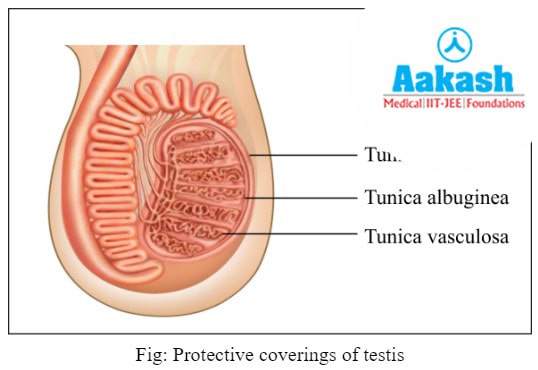
Protective coverings of the testis
Each testis is surrounded by 3 layers of tunicae-
(i) Tunica vaginalis- Outermost covering of the testes
(ii) Tunica albuginea- Middle fibrous layer that lies beneath the tunica vaginalis
(iii) Tunica vasculosa- Innermost covering consisting of a network of capillaries supported by a delicate connective tissue which lines the tunica albuginea.
Internal structure of testes
Tunica albuginea also extends inside the testes dividing each testis into approximately 250 compartments. These compartments are called testicular lobules.
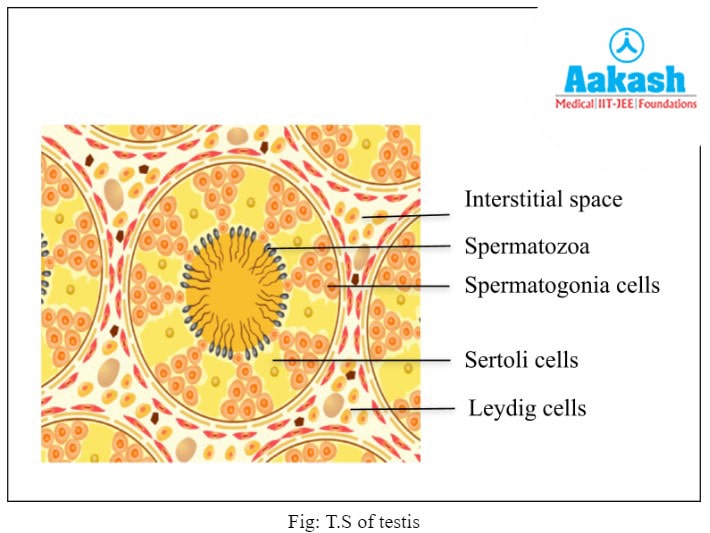
Each testicular lobule has 1 to 3 highly coiled seminiferous tubules. Each seminiferous tubule is lined by a single layer of germinal epithelium which is composed of two types of cells- the large, pyramidal sertoli cells and the cuboidal spermatogonial cells.
The region inside the testicular lobules and outside the seminiferous tubules is called the interstitial space. Leydig cells and small blood vessels are present in this interstitial space.
Function of testes
Testes are the primary male sex organs because of the two major functions they perform:
(i) production of sperms or spermatogenesis
(ii) synthesis and secretion of male sex hormones
Spermatogenesis
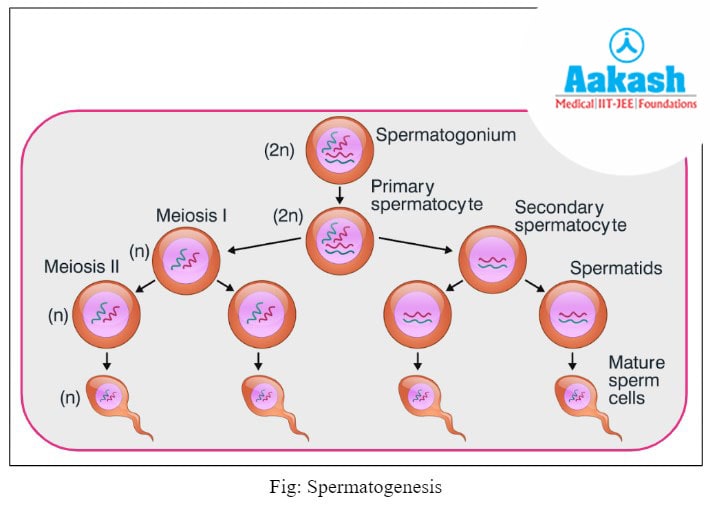
Inside the seminiferous tubules, spermatogonia or the sperm mother cells divide mitotically to produce two types of cells - type A spermatogonia and type B spermatogonia. Of these two, type A cells remain as sperm mother cells, while the type B cells mature into primary spermatocytes that undergo meiotic division to produce the male gametes or sperms. Sperms contain half of the genetic material of the male parent. One of the sperms fuses with the female gamete (ovum) during fertilisation to give rise to a zygote.
Secretion of Hormones
The Leydig cells in the interstitial spaces secrete the male sex hormone, testosterone. This hormone is responsible for spermatogenesis, development of secondary sexual character in males (like deepening of voice, facial hair growth, etc.), development of the secondary sex organs, and libido.
The sertoli cells, also called as sustentacular cells, provide nourishment to the developing spermatozoa. Thus they are also called nurse cells. After spermiogenesis (process of formation of spermatozoa from spermatids), the heads of immature spermatozoa get embedded in the sertoli cells until maturation. The sertoli cells also secrete AMH (anti mullerian hormone). This hormone averts the development of female ducts in the foetus thereby preventing the development of the female reproductive tracts. Thus, it allows development of the male ducts. In addition to AMF, sertoli cells also secrete ABP (androgen binding protein). It binds to testosterone and concentrates the male sex hormone thereby enhancing its function. Inhibin is another hormone released by sertoli cells. This hormone inhibits the synthesis and release of FSH from the pituitary.
These cells also form the blood - testis barrier that regulates the entry of various substances in the seminiferous tubules.
Testicular anomalies
We are now well aware of the location and function of the testes. But sometimes testes show certain abnormalities that hinders its function. Some of the testicular anomalies are given below-
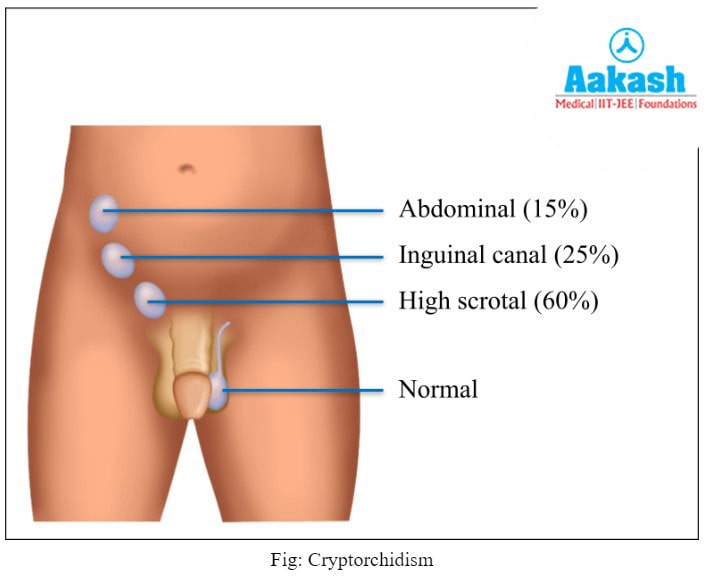
(i) Cryptorchidism- one or both testes fail to descend in the scrotum, rather remain in the abdominal cavity. This condition is also called undescended testes. This can lead to infertility as sperms will not be produced because the required temperature is not achieved. 15% of cryptorchidism is abdominal, 25% inguinal and 60% cases are high scrotal. It can be corrected surgically.
(ii) Synorchidism - congenital fusion of the two testes. It can be corrected surgically.
(iii) Hypogonadism- the testes do not produce enough testosterone. This can lead to fatigue, hair loss, erectile dysfunction (inability to keep erection long enough for sex or insemination) low sperm volume and, reduced libido (sex drive). Genetic disorders such as klinefelter syndrome, or other conditions like testicular injury, chemotherapy or radiotherapy (done to treat testicular cancer), pituitary disease could be the causes of male hypogonadism.
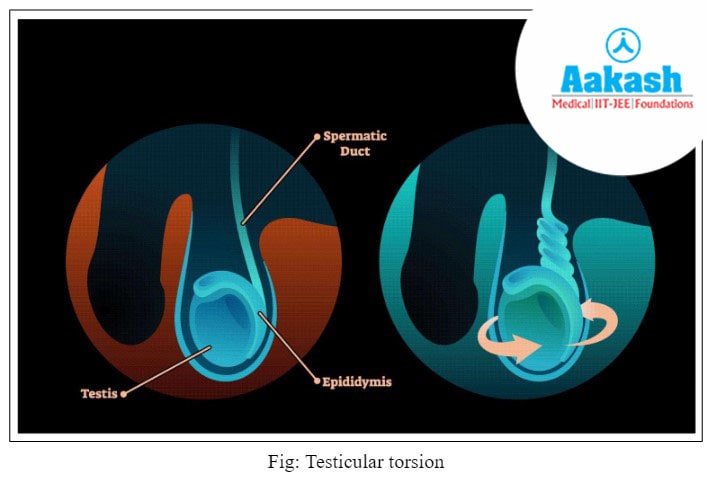
(iv) Testicular torsion - the testes become twisted and the blood supply is cut off. It requires immediate medical attention.
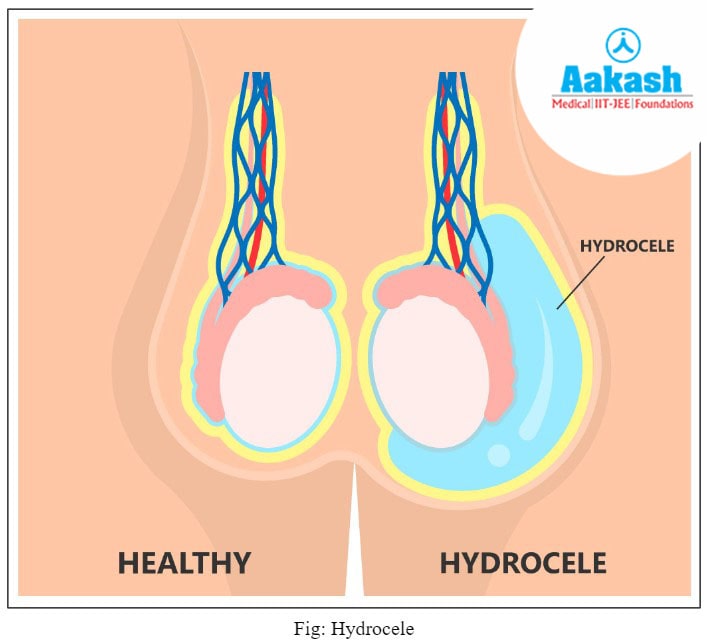
(v) Hydrocele - swelling in the testes caused due to fluid accumulation around the testes. It generally does not possess any threat and is painless and disappears without any treatment.
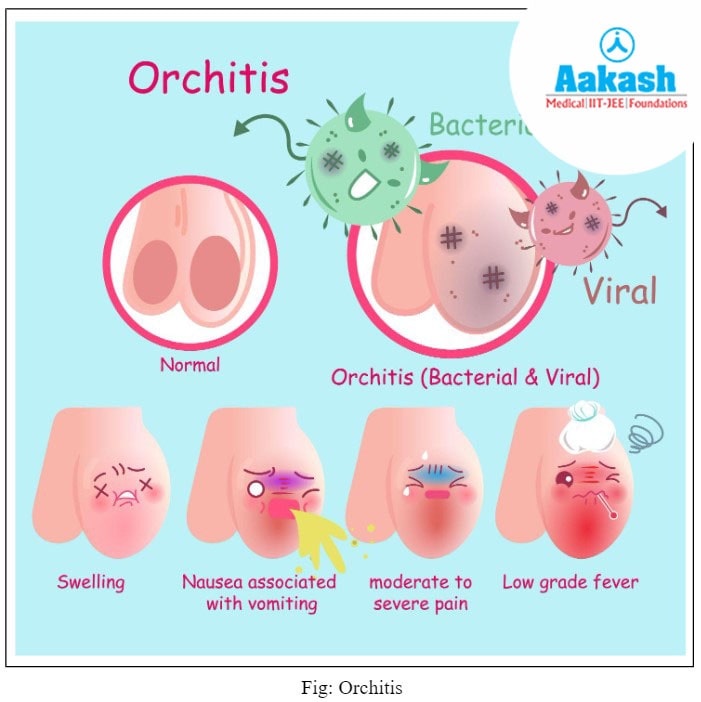
(vi) Orchitis - inflammation of the testes due to bacterial or viral infections.
(vi) Infertility - inability to impregnate the female partner. It can be caused due to multiple reasons, and one of them include inability of testes to produce enough healthy sperms.
Practice Problems
Q1. Which of the following is not correct with respect to testis in adult men?
a. Oval in shape
b. Each testis has 1-3 highly coiled lobules
c. Made of 250 testicular compartments
d. Lie inside scrotum
Solution: Testes are paired, oval organs present outside the abdominal cavity, inside the scrotum. Each testis is divided into 250 compartments called the testicular lobules. Each testicular lobule has 1-3 highly coiled seminiferous tubules.
Hence, the correct option is b.
Q2. Which of the following is correct?
a. The male accessory ducts include the ureters.
b. Spermatozoa undergo meiosis
c. Epididymis ascends to the abdomen
d. Testes contain haploid cells
Solution: Testes is the site for production of sperms or male gametes. Spermatogonial cells (sperm mother cells) mature into primary spermatocytes inside the seminiferous tubules which undergo meiosis to produce sperms. Since sperms are produced as a result of meiosis, they contain half the number of chromosomes as the parent cell. Sperms are haploid cells.
Ureters are tubes that arise from the kidneys, and carry urine to the urinary bladder. These tubes are a part of the excretory system.
Epididymis is a highly coiled duct on the dorsal side of both testes, it stores the sperms temporarily until maturation. It leads into the vas deferens that ascends into the abdomen, loops over the urinary bladder and unites with the duct of seminal vesicles to form the ejaculatory duct.
The male accessory ducts include rete testis, vasa efferentia, vas deferens, ejaculatory duct and urethra.
Hence, the correct option is d.
Q3. Semen consists of
a. Secretions from seminal vesicle only
b. Secretions from the seminiferous tubule only
c. Sperms and seminal plasma
d. Calcium, glucose and prostaglandins
Solution: Semen is the fluid that consists of sperms secreted from seminiferous tubules and seminal plasma secreted from the 3 male accessory glands (prostate gland, seminal vesicles and cowper’s gland).
Hence, the correct option is c.
Q4. Which of the following hormones is not secreted by testes?
a. Inhibin
b. Progesterone
c. Testosterone
d. Androgen Binding Protein
Solution: Testes are the male primary sex organs. They produce sperms and also release hormones, like, testosterone, AMF, ABP, Inhibin.
Hence, the correct option is b.
FAQs
Q1. How many sperms are produced by the testes?
Solution: The normal volume of semen is 1.5 - 5 ml per ejaculate. Each ejaculate contains around 250-300 million sperms. Thus each ml of semen contains 50-60 million sperms. This is considered to be the normal count of sperm in semen.
Q2. Can any male have three testes?
Solution: Polyorchidism is a rare condition. More than one testicle is present in a hemiscrotum. It can be associated with other conditions like, hydrocele, testicular torsion, inguinal hernia, etc.
Q3. Can testes be removed?
Solution: Surgical removal of testes is called orchiectomy. It is done in cases of any infection, cancer or undescended testes. Although removal of one testes does not affect the sex life as it produces enough testosterone. Removal of both testes leads to infertility and such people can not have their own children.
Q4. What are the common symptoms of testicular cancer?
Solution: The common symptoms of testicular cancer include a long term dull or sharp pain, swelling, tenderness in one or both testes, frequent urination and abdominal pain.

 Call Now
 Let's Chat
 Share
Share