-
Call Now
1800-102-2727


Sycon

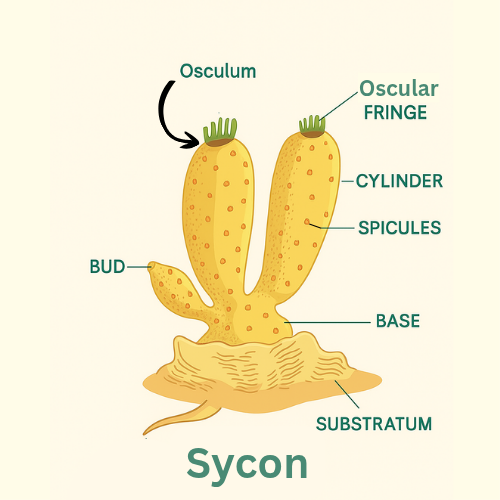
Sycon is commonly seen in shallow seas across the globe. The sedentary marine sponge lives attached to rocks, coral, or shells of marine animals. It likes temperate waters and avoids living in deep seas. This sponge does not move and lives in still or quiet water.
| Taxonomic Rank | Classification |
| Kingdom | Animalia |
| Phylum | Porifera |
| Class | Calcarea |
| Order | Heterocoela |
| Family | Sycettidae |
| Genus | Sycon |
There are around 8500 sponge species in Porifera, all of which have porous bodies and are mostly marine. Sycon is part of Calcarea, where sponges have calcium carbonate skeletons.
External Structure and Appearance
Sycon has a small, cylindrical body with a height of 2.5 to 7.5 cm. Its body looks like a thin tube or a water vessel. Some Sycons resemble pineapples or Q-tips due to their surface spicules. The body is firm but slightly flexible. Each branch ends in a circular opening called the osculum.
The surface has tiny openings called ostia, which are inhalant pores. The osculum is bordered by radiating spicules arranged in a crown-like fringe. These spicules help protect the sponge from foreign particles and predators.
Internal Structure and Canal System
Sycon has a syconoid type of canal system, which is more advanced than the asconoid type. Water flows into the body through ostia. It then enters the incurrent canals, which lie between the radial canals.
Water moves from the incurrent canal to the radial canal through prosopyles. The radial canals are lined with choanocytes, which are also called collar cells. These cells have a flagellum surrounded by a collar made of microvilli. They help in water movement and food capture.
From the radial canal, water enters the spongocoel through openings called apopyles. The spongocoel is the central cavity of the sponge. Finally, water leaves the body through the osculum.
Microscopic Features
The body wall has two functional cell layers: the outer pinacoderm and the inner choanoderm. These two are separated by a gelatinous matrix called mesohyl, containing spicules and amoeboid cells. The outer layer is made of pinacocytes, which are flat cells.
The choanoderm lines the radial canals and contains choanocytes. These cells help move water and trap food particles. The spicules that form the skeleton are produced by scleroblasts and may be triradiate or tetraradiate in shape.
Nutrition and Digestion
Sycon is a filter feeder. Water brings food particles through the ostia. These include plankton and organic matter. Choanocytes trap the food using their collars. The food is taken into the cell and passed to amoebocytes.
Digestion is intracellular and mainly holozoic. Some sponges harbour symbiotic algae or cyanobacteria that can photosynthesise. Enzymes secreted within choanocytes and amoebocytes mainly digest proteins and organic matter captured from the water. The nutrients are then carried to other cells. Waste is removed from the body through the water current.
Respiration and Excretion
Gas exchange happens by simple diffusion. Oxygen moves from the water into the cells, and carbon dioxide leaves the cells. Food is broken down to release energy called ATP. They carry out respiration and excretion entirely by simple diffusion, without vacuoles.
Reproduction
Sycon reproduces asexually and sexually. Asexual reproduction occurs mainly by budding. Gemmule formation is absent in Sycon. In sexual reproduction, sperm and eggs come from archaeocytes in the mesenchyme.
Sperms are carried by water and are caught by choanocytes. The choanocyte brings the sperm to the egg. Fertilization happens inside the sponge, and the young develop there before the larva leaves through the osculum to swim away and settle somewhere else.
Summary
Sycon is a small marine sponge found in shallow, calm seas. It has a tube-like body with pores and a crown-like osculum. It feeds by filtering water and reproduces both sexually and asexually. Its simple structure allows water circulation that facilitates intracellular digestion, gas exchange, and removal of waste products.
Frequently Asked Questions (FAQs)
Q1 What type of water does Sycon prefer?
A. Sycon grows in shallow, calm, and slow-moving seawater.
Q2. What are the ostia in Sycon?
A. Ostia are tiny pores on the body that allow water to enter the sponge.
Q3. What is the role of spicules in Sycon?
A. Spicules provide support to the body and protect it from harm.


 Call Now
 Let's Chat
 Share
Share