-
Call Now
1800-102-2727


Sexual Reproduction: Overview, Phases, Menstrual and Oestrus Cycle, Practice Problems and FAQs

You know about reproduction. Reproduction in prokaryotes is quite simple, right?

Fig: Reproduction in prokaryotes
Prokaryotes, for example, bacteria reproduce by splitting a single cell into two daughter cells. This method of reproduction is referred to as asexual reproduction.
Do you think reproduction is simple in eukaryotes as well?
Can humans reproduce by splitting a single human into two newborns? Sounds funny, right?
Being a lot more complex than prokaryotes, reproduction in eukaryotes is also a highly complex process. It involves fusion of male and female gametes from male parent and female parent respectively or by a single parent. Such type of reproduction is known as sexual reproduction. Let’s take a deep dive into the details of sexual reproduction.
Table of Contents
- Overview of Sexual Reproduction
- Phases of Life in Sexually Reproducing Organisms
- Reproductive Cycles in Mammals
- Practice Problems of Sexual Reproduction
- FAQs of Sexual Reproduction
Overview of Sexual Reproduction
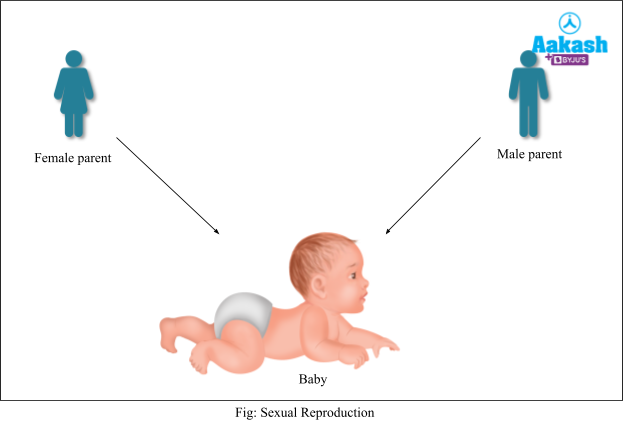
Sexual reproduction is defined as a type of reproduction which involves fusion of male and female gametes either produced by different parents of opposite sex or by single parent. As compared to asexual reproduction, it is elaborate, complex and slow process. Since this type of reproduction involves fusion of gametes from two different parents, the progeny is not genetically identical to the parents.
Phases of Life in Sexually Reproducing Organisms
Before an organism becomes capable of reproduction, it undergoes various changes which eventually makes it capable of sexual reproduction. After a certain period, individuals again undergo some changes making them again incapable of reproduction. In order to understand better, life of a sexually reproducing organism is divided into three phases as follows:
Juvenile Phase or Vegetative Phase
It is an initial phase of growth wherein organisms undergo growth and development until they attain reproductive maturity.
Reproductive Phase
Phase of an organism’s life when they are capable of sexual reproduction and giving birth to their young ones or offsprings is known as reproductive phase.
Senescent Phase
Phase of an organism’s life when they grow old and lose their ability to reproduce sexually is known as senescent phase.
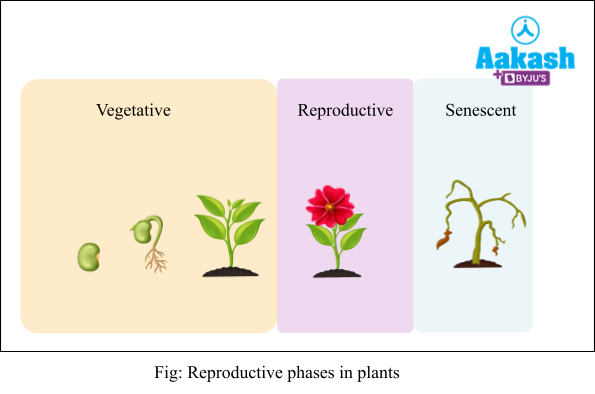
These phases differ depending on the type of organism.
Reproductive Phases in Plants
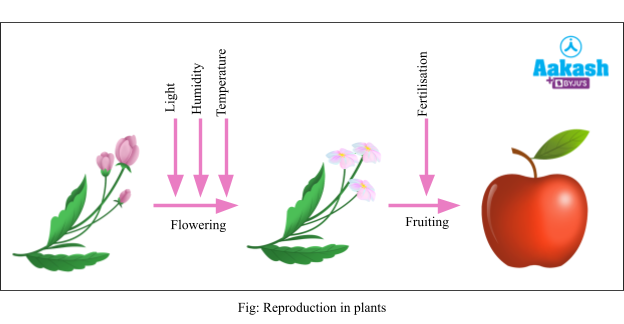
Reproduction in plants starts with bud formation. This bud blooms into flowers which get fertilised in order to form fruits and seeds. Flowering in plants is influenced by various factors such as light, temperature and humidity.
Types of Plants on the Basis of Duration of Flowering Pattern
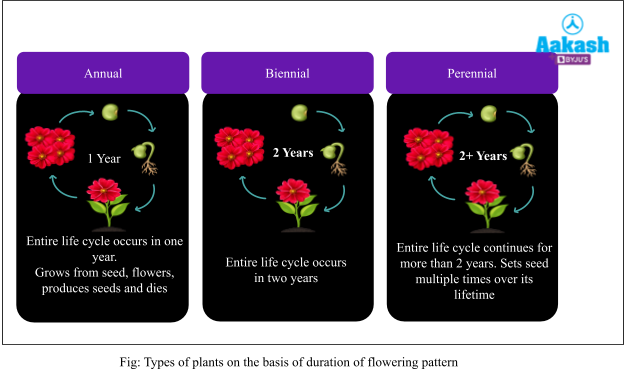
Depending upon the flowering pattern in plants, plants can be classified into three types as follows:
- Annual Plants - In them the entire reproductive life cycle occurs within the duration of one year, hence, flowering in these plants occurs in a year. Examples include mustard plant, rice etc.
- Biennial Plants - In them, the entire reproductive life cycle occurs within the duration of two years, hence, flowering occurs once in two year in such plants. Examples include parsley, carrot etc.
- Perennial Plants - In them, the entire reproductive life cycle occurs within the duration of more than two years. Examples include Asparagus, strawberries etc.
Plants with Unusual Flowering Phenomenon
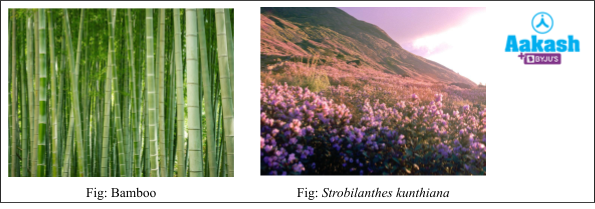
There are some plants which usually exhibit unusual flowering phenomena. Bamboo plants flower once in 50 -100 years. They produce flowers in huge quantities and die. Similarly, Strobilanthes kunthiana, commonly known as Neelakuranji, produces flowers once in every 12 years. Beautiful flowers of Neelakurinji turn the hills of Kerala, Karnataka and Tamil Nadu into blue stretches.
Reproductive Phases in Humans
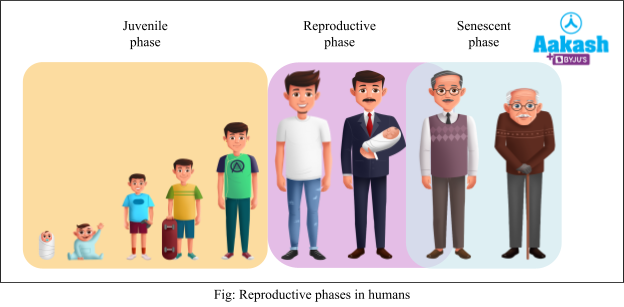
Reproductive phases in humans can be divided into three phases as follows:
Juvenile Phase or Vegetative Phase
It is an initial phase of growth and maturation of reproductive organs in humans.
Reproductive Phase
During this phase, humans become capable of reproduction. It involves morphological as well as physiological changes.
Senescent Phase
In this phase, humans lose their ability to reproduce, although men remain reproductively active throughout their life.
Reproductive Phases in Animals
Types of Breeders
Based on the duration of active reproductive phase, animals can be divided into the following types:
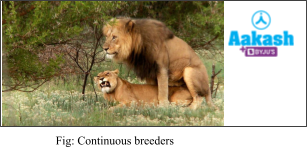
Continuous Breeders
Animals which are capable of reproducing throughout their lives are known as continuous breeders. Examples include primates, lions, cats etc.
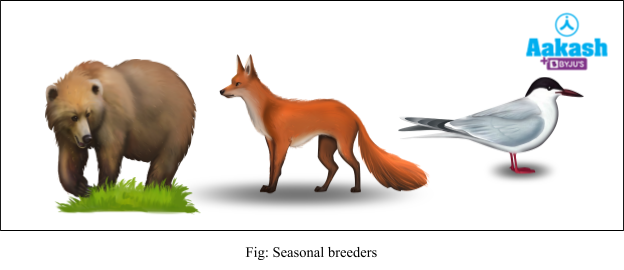
Seasonal Breeders
Animals which are capable of reproducing only during a certain favourable phase of their lives are known as seasonal breeders. Examples include bears, Arctic terns, foxes etc.
Heat Period
A certain period during the reproductive phase in animals when the female is fertile and ready to mate or receive male is known as heat period. For example, a cow comes on heat every 21 days on an average.
Reproductive Cycles in Mammals
Regulation of reproductive phase in mammalian females involves various hormonal changes or cycles. There are two types of mammalian reproductive cycles as explained below:
Oestrous Cycle
Oestrous cycle constitutes cyclic changes that constitute the cyclic changes that occur in the hormone production, the structures of the uterus and ovaries of the female reproductive system in non primate animals like cows, sheep, rats, deer, tigers, dogs etc. Oestrous cycle can be classified into following types:
Polyoestrous Cycle
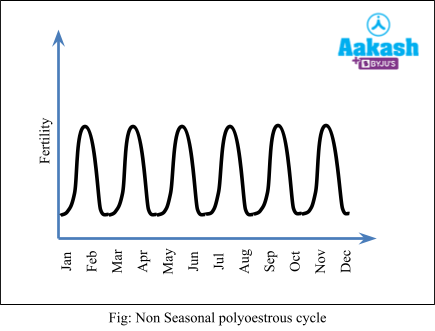
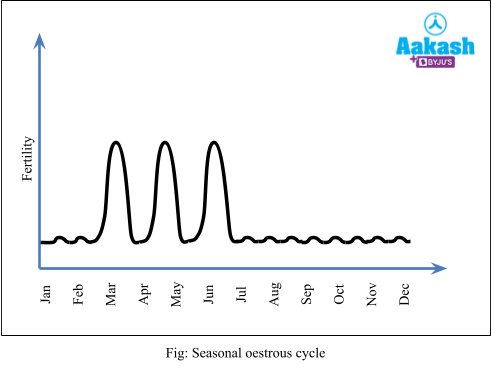
If oestrous cycle occurs multiple times in a year, it is termed as polyoestrous cycle. Examples include mice, cattle etc. Polyoestrous cycle can be further of two types:
- Non Seasonal Polyoestrous Cycle - In this type, there occurs multiple oestrous cycles throughout the year.
- Seasonal Polyoestrous Cycle - In this type, there occur a few oestrous cycles during a specific period of the year.
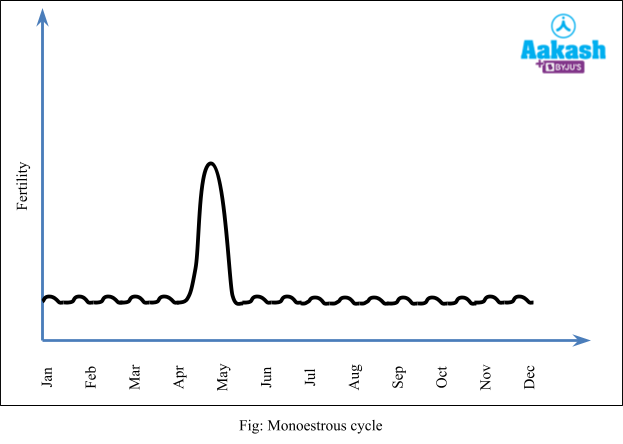
Monoestrous Cycle
If an oestrous cycle occurs only once in a year, it is termed as monoestrous cycle. Examples include foxes, dogs etc.
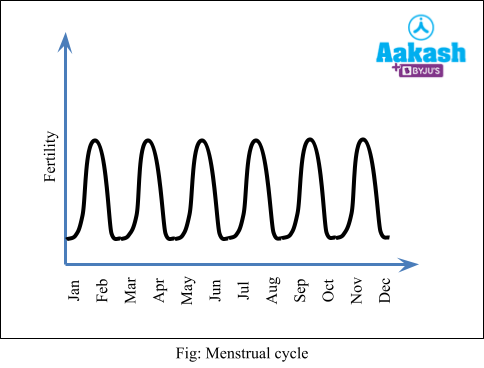
Menstrual Cycle
Menstrual cycle constitutes the cyclic changes that occur in the hormone production, the structures of the uterus and ovaries of the female reproductive system. It helps in pregnancy. Examples include primate animals like apes, monkeys and humans.
Practice Problems of Sexual Reproduction
Ques:- A species ‘X’ was kept in observation in order to study its behavioural pattern. It was observed that it mated only once throughout the year. Which of the following is the right category of reproductive cycle for species X?
A. Menstrual cycle
B. Polyoestrous cycle
C. Monoestrous cycle
D. None of the above
Solution: Regulation of reproductive phase in mammalian females involves various hormonal changes or cycles. Oestrous cycle constitutes cyclic changes that constitute the cyclic changes that occur in the hormone production, the structures of the uterus and ovaries of the female reproductive system in non primate animals like cows, sheep, rats, deer, tigers, dogs etc. If an oestrous cycle occurs only once in a year, it is termed as monoestrous cycle. Examples include foxes, dogs etc. Hence, the correct option is c.
Ques:- An organism is undergoing various morphological and physiological changes. It is showing active reproductive behaviour. It has become capable of producing young ones. The organism is in which of the following phases of life cycle?
A. Juvenile phase
B. Reproductive phase
C. Senescence phase
D. None of the above
Solution: Phase of an organism’s life when they are capable of sexual reproduction and giving birth to their young ones or offsprings is known as reproductive phase. It involves numerous morphological and physiological changes. Hence, the correct option is b.
Ques:- Which of the following is a correct match?
A. Monkey - Menstrual cycle
B. Gorilla - Oestrous cycle
C. Cats - Menstrual cycle
D. Pigs - Menstrual cycle
Solution: Menstrual cycle constitutes the cyclic changes that occur in the hormone production, the structures of the uterus and ovaries of the female reproductive system. It helps in pregnancy. Examples include primate animals like apes, monkeys and humans. Among the following options, a monkey is a primate which undergoes menstrual cycle. Hence, the correct option is a.
Ques:- Find the correct definition of heat period among the following?
A. A certain period during the reproductive phase when the female is fertile and ready to mate is known as heat period
B. A certain period during which an organism growing and attaining reproductive maturity is known as heat period
C. A certain period during which an organism is not capable of reproduction is known as heat period
D. None of the above
Solution: Animals are not fertile throughout the reproductive phase. A certain period during the reproductive phase when the female is fertile and ready to mate is known as heat period.
Hence, the correct answer is a.
FAQs of Sexual Reproduction
Ques:- Why are young ones produced by sexual reproduction not identical to the parents?
Answer: Sexual reproduction is defined as a type of reproduction which involves fusion of male and female gametes either produced by different parents of opposite sex or by single parent. Since the genetic information from two different parents are fused, the young ones possess totally different genetic information which is a mixture of genetic information from two different reproductive cells. This results is morphological and genetic variation in the progeny of sexual reproduction.
Ques:- What is the difference between a non seasonal oestrous cycle and menstrual cycle?
Answer: Although both cycles occur multiple times throughout the year, organisms with menstrual are sexually active throughout the year while non seasonal oestrous animals are sexually active only during the fertile part of the reproductive cycle.
Ques:- What are the three phases of life in sexually reproducing organisms?
Answer: Before an organism becomes capable of reproduction, it undergoes various changes which eventually makes it capable of sexual reproduction. Life of a sexually reproducing organism is divided into three phases as follows:
- Juvenile phase or vegetative phase - It is an initial phase of growth wherein organisms undergo growth and development until they attain reproductive maturity.
- Reproductive phase - Phase of an organism’s life when they are capable of sexual reproduction and giving birth to their young ones is known as reproductive phase.
- Senescent phase - Phase of an organism’s life when they grow old and lose their ability to reproduce sexually is known as senescent phase.
Ques:- Mention different types of breeders along with examples?
Answer: Based on the duration of actively reproductive phase, animals can be divided into the following types:
- Continuous breeders - Animals which are capable of reproducing throughout their lives are known as continuous breeders. Examples include primates, lions, cats etc.
- Seasonal breeders: Animals which are capable of reproducing only during a certain favourable phase of their lives are known as seasonal breeders. Examples include bears, Arctic terns, foxes etc.

 Call Now
 Let's Chat
 Share
Share