-
Call Now
1800-102-2727


Neural and Endocrine Regulation of Digestion: Intrinsic and Extrinsic Neural Regulation, Endocrine Regulation, Practice Problems and FAQs

We all take a variety of food materials every day. It is needed for the proper growth and development in organisms. You all know that the food we take will get digested in our digestive system. That means, these food materials will break down into small molecules which can be easily absorbed. This process of digestion and absorption are not under our control.
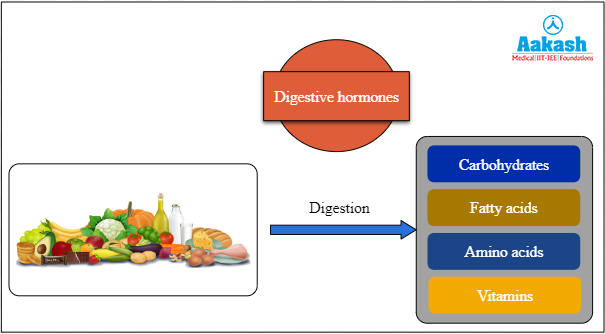
Fig: Digestion of food
In humans and other animals, this digestion and absorption of food molecules is done with the help of enzymes. But do you know who controls this process of digestion and absorption? Yes, it is under neural and hormonal control. Let’s take a deep dive into the details of neural and hormonal control of digestion and absorption in depth in this article.
Table of contents
- Neural regulation
- Intrinsic neural regulation of digestion
- Extrinsic neural regulation of digestion
- Endocrine regulation of digestion
- Practice Problems
- FAQs
Regulation of digestion
The various activities of the gastrointestinal tract are coordinated by the endocrine and nervous systems in human beings.
Neural regulation of digestion
The digestion is under the control of both intrinsic and extrinsic regulation.
Intrinsic neural regulation of digestion
The gastrointestinal tract is innervated by an intrinsic neural system. It consists of two plexus (a a network of interlacing nerves) as follows:
Auerbach’s plexus
Network of nerve cells and fibres in the muscularis layer of the alimentary canal is called Auerbach’s plexus. Myentric or auerbach’s plexus controls gastrointestinal movements.
Meissner’s plexus
Network of nerve cells and fibres in the submucosal layer of the alimentary canal is called Meissner’s plexus. It controls gastrointestinal secretions and local blood flow.
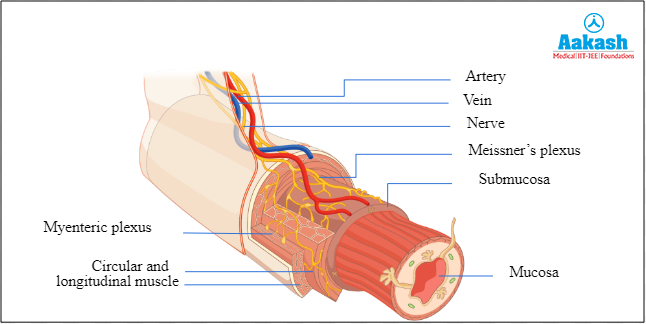
Fig: Neural regulation of digestion
Extrinsic neural regulation of digestion
The extrinsic innervations of the gut consists of parasympathetic and sympathetic nerves which can modify the activity of the intrinsic neural system. It occurs in response to the reflex activity initiated from the gastrointestinal tract and other parts of the body.
Secretion of saliva
The vagus nerve stimulates secretion of saliva from the mouth. Stimulation occurs by sight, smell or presence of food. Vagus nerve arises from the 10th cranial nerve (medulla oblongata). It can control swallowing and other movements of the alimentary canal.
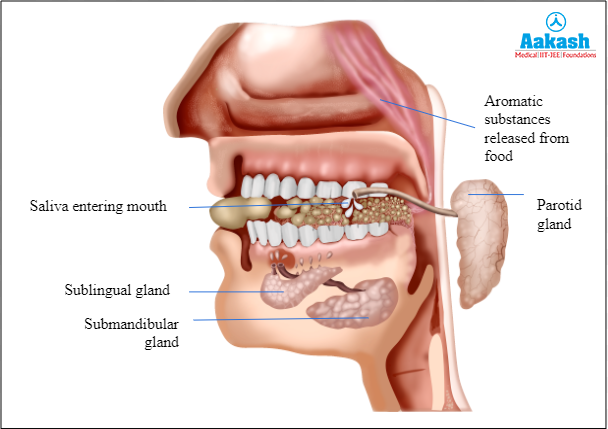
Fig: Secretion of saliva
Endocrine regulation of digestion
Hormones are described as chemical messengers. They are secreted in small quantities in the body. They control and coordinate various activities in the body. The process of digestion is also coordinated by several digestive hormones. They act on specific targets. They have a stimulatory or inhibitory effect on the target.
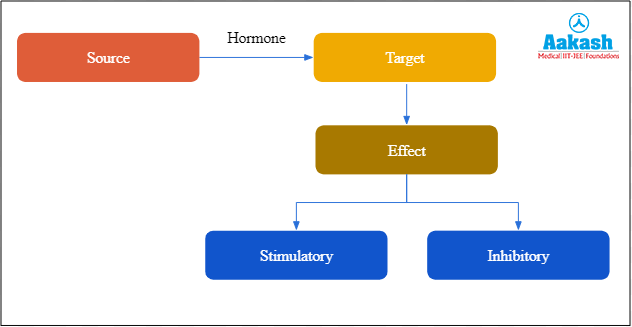
Fig: Action of hormones
Role of different hormones
There are various hormones that play a role in regulating the process of digestion. These are normally local hormones. They are a large group of signalling molecules which do not normally circulate in the blood. They are produced by nerve and gland cells. They bind to either the neighbouring cells or the same type of cell which produced them. They can be activated and inactivated quickly. These hormones are discussed in depth below:
Gastrin
It is a hormone in the stomach.
Source
The source of gastrin hormone is the gastrin cells or G cells of the stomach.
Target
The target organ of gastrin is also the stomach. It stimulates the secretion of gastric juices. It also stimulates gastric motility.
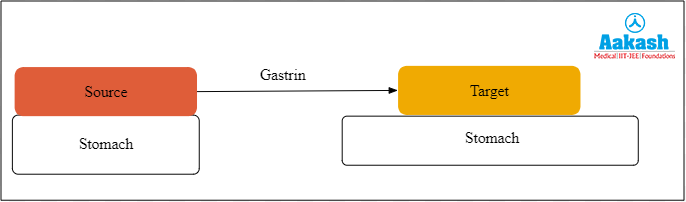
Fig: Gastrin hormone
Enterogastrone or Gastric Inhibitory Peptide (GIP)
It is another local hormone produced in the duodenum.
Source
The source of enterogastrone is duodenum.
Target
The target organ is the stomach. It inhibits the secretion of gastric juices. It also inhibits gastric motility.
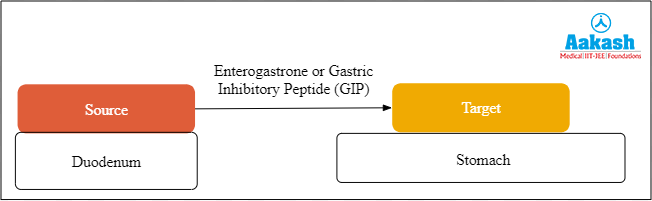
Fig: Enterogastrone hormone
Secretin
It is also a local hormone produced in the stomach.
Source
The source of secretin is the duodenum part of the small intestine.
Target
The target organs are pancreas, liver and stomach. It stimulates the release of bicarbonate ions into the pancreatic juice. It stimulates the secretion of bile also. Gastric secretion and motility are both inhibited by this particular hormone.
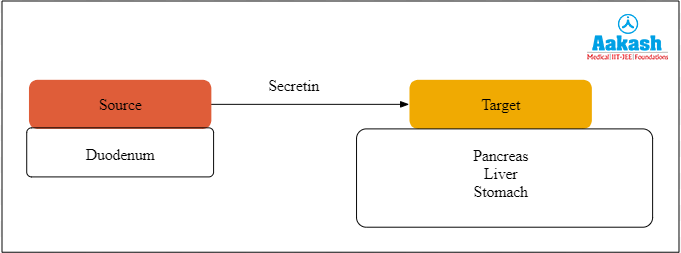
Fig: Secretin hormone
Cholecystokinin Pancreozymin (CCK-PZ)
It is a local hormone secreted in the small intestine.
Source
The source of this hormone is the small intestine.
Target
The target organs are pancreas and gallbladder. It stimulates the release of pancreatic juice. It stimulates the release of bile.
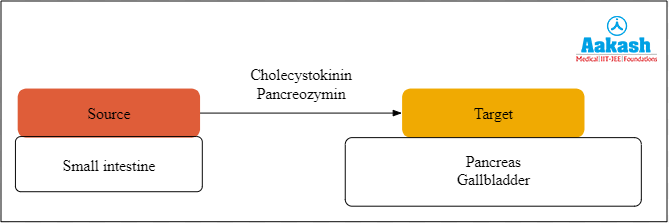
Fig: Cholecystokinin Pancreozymin
Serotonin
It is also produced in the stomach.
Source
The source of serotonin is the stomach. It is present in the enterochromaffin cells of the gastrointestinal mucosa and also within neurons in the enteric nervous system.
Target
The target organ of serotonin is also the stomach. It causes mainly the contractions of the stomach muscles.
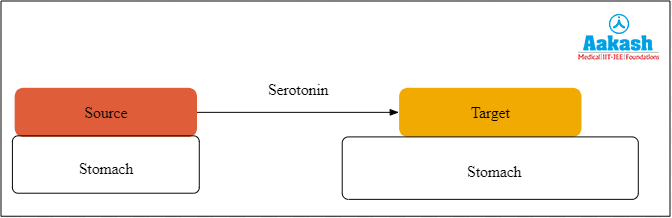
Fig: Serotonin hormone
Somatostatin
It is a hormone secreted in the stomach and duodenum.
Source
It is secreted by the D cells in the gastric and intestinal mucosa. It is also secreted by the islets of Langerhans of the pancreas, as well as enteric neurons
Target
It targets the stomach, small intestine, gallbladder, and the liver. It inhibits gastric secretion. It inhibits intestinal absorption also. It inhibits contraction and secretion of bile too.
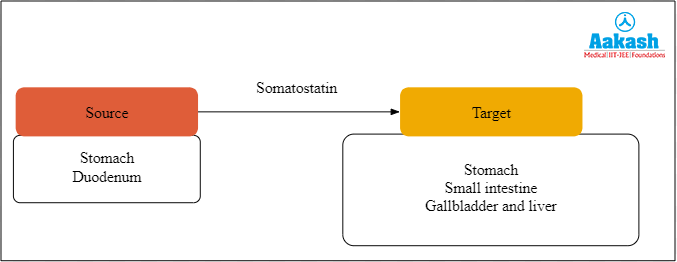
Fig: Somatostatin hormone
Histamine
It is a neurotransmitter secreted in the stomach.
Source
It is present in the enterochromaffin-like (ECL) cells).
Target
The target organ of histamine is also the stomach. It stimulates parietal cells to release HCl.
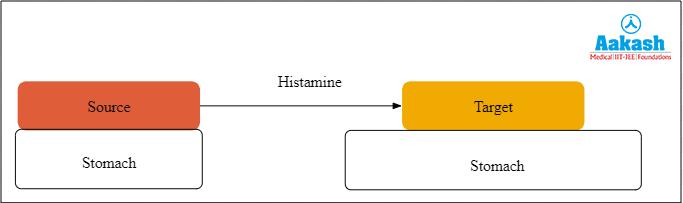
Fig: Histamine hormone
Villikinin
It is secreted in the small intestine.
Source
It is normally secreted by the epithelium of the entire small intestine.
Function
It accelerates the movement of villi.
Duocrinin
It is secreted in the duodenum.
Source
It is normally secreted by the entire epithelium of the small intestine.
Function
It accelerates the movement of villi.
Enterokinin
It is secreted in the small intestine
Source
It is normally secreted by the entire epithelium of the small intestine.
Function
It will stimulate the crypts of Lieberkuhn and help in releasing the enzymes into the intestinal juice.
Vasoactive Intestinal Peptide (VIP)
It is secreted in the small intestine.
Source
It is secreted by the epithelium of the entire small intestine.
Function
It dilates the peripheral blood vessels of the gut. It also inhibits gastric acid secretion.
Practice Problems
- Which nerve stimulates the secretion of saliva?
- Vagus nerve
- Optic nerve
- Olfactory nerve
- Facial nerve
Solution: The vagus nerve stimulates secretion of saliva. Stimulation occurs through sight, smell or presence of food. Vagus nerve arises from the 10th cranial nerve. Hence, the correct option is a.
2. Identify the hormone secreted by the gastric mucosa?
- Secretin
- Cholecystokinin
- Gastrin
- Duocrinin
Solution: The source of gastrin hormone is the G cells of the gastric mucosa. The target organ of gastrin is also the stomach. It stimulates the secretion of gastric juices. It also stimulates gastric motility. Hence, the correct option is c.
3. Identify the correct statement(s) about functions of secretin.
Statement I: It releases bicarbonates into the pancreatic juice.
Statement II: Promotes the secretion of bile.
Statement III: It inhibits gastric secretion and motility.
- Only statement I
- Only statement II
- Only statement III
- All of the above
Solution: The source of secretin is the S cells of the duodenum part of the small intestine. The target organs are pancreas, liver and stomach. It stimulates the release of bicarbonate ions into the pancreatic juice. It stimulates the secretion of bile also. Gastric secretion and motility are both inhibited by this hormone.
4. In which layer of the alimentary canal, Auerbach’s plexus is present?
- Mucosal layer
- Muscularis layer
- Serosa layer
- Submucosa layer
Solution: Network of nerve cells and fibres present in the muscularis layer of the alimentary canal is called Auerbach’s plexus. myenteric or Auerbach’s plexus controls gastrointestinal movements. On the other hand, the network of nerve cells and fibres present in the submucosal layer of the alimentary canal is called Meissner’s plexus. It controls gastrointestinal secretions and local blood flow. Hence, the correct option is b.
FAQs
- Which nerves innervate the gastrointestinal tract?
Answer: The vagus nerve innervates the upper part of the digestive tract, whereas the pelvic nerve innervates the lower part of the digestive tract.
- How does the endocrine system regulate the working of the digestive system?
Answer: The endocrine system regulates the working of the digestive system through hormones. Hormones are described as chemical messengers. They are secreted in small quantities in the body. They control and coordinate various activities in the body. The process of digestion is also coordinated by several digestive hormones. They act on specific targets. They have a stimulatory or inhibitory effect on the target.
- Which two organs of the gastrointestinal tract are involved in the endocrine function?
Answer: The stomach and the small intestine are involved in the endocrine function. The stomach secretes hormones like gastrin, serotonin and somatostatin. It secrete neurotransmitters like histamine. On the other hand, The small intestine secretes enterogastrone, secretin, cholecystokinin and somatostatin hormones.
- How is digestive tract motility regulated?
Answer: The motility of the digestive tract is regulated by the network of nerve cells and fibres. It is also under the influence of hormones.

 Call Now
 Let's Chat
 Share
Share