-
Call Now
1800-102-2727


Biomass, Primary Productivity, Secondary Productivity, Practice Problems and FAQs

You all know about the importance of plants. We have studied a lot about plants in lower classes. Have you ever thought what would happen if all the plants on Earth disappeared one day? Of course, our beautiful planet would look barren then. We would also lose our important source of oxygen and food. Carbon dioxide would no longer be removed out of the air, and as it traps heat, our Earth might warm up fast. Almost every living thing on Earth would eventually run out of food and die. Why is it happening like this?
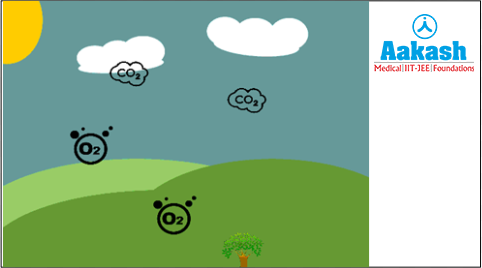
Fig: Role of plants in our environment
In almost all ecosystems, photosynthesizers are the main ‘source’ of energy flow into food webs (networks of organisms that eat one another). The ultimate source of energy is sunlight in any ecosystem and only producers like green plants are able to fix this as chemical energy. If organisms carrying out photosynthesis were removed, the flow of energy would be cut off because of this reason. This will result in the shortage of food for other dependant organisms. In this way, photosynthesizers lay the foundation for every light-receiving ecosystem. Let us understand more about the concept of productivity associated with food webs in this article.
Table of contents
- Biomass
- Productivity
- Primary productivity
- Secondary productivity
- Practice Problems
- FAQs
Biomass
Biomass is the mass of living organisms in an area. It is considered as the renewable organic material which comes from plants and animals. The sunlight is converted to chemical energy to form carbohydrates, proteins, nucleic acids etc., which together form the biomass.
Importance of sunlight in ecosystems
Sunlight is the ultimate source of energy for all ecosystems. Ecosystem is a self-sustained stable unit formed by the interactions between the living and nonliving factors. Sunlight is trapped and utilised by the photosynthetic producers like green plants, algae, some bacteria, etc., to prepare food. Only 50% of the total incident solar radiation is photosynthetically active radiation (PAR).
Ecosystem is an open system where both energy and matter are exchanged with its surrounding environment. It takes input in the form of solar energy and inorganic nutrients as matter. It gives out waste (degraded) materials and heat (energy).
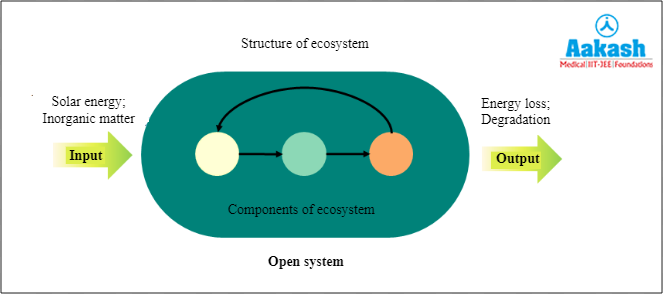
Fig: Ecosystem is an open system
Trophic levels
The living organisms in an ecosystem are arranged at different levels at which they obtain their food. These are known as trophic levels. The producers form the lowest trophic level as they can prepare their own food.Examples include green plants, algae, etc. Consumers or heterotrophs are directly or indirectly dependent on the producers for food.
Biomass feedstocks
Plants, wastes and wood are the most common biomass materials which are used for energy. These are commonly called biomass feedstocks. Biomass energy is considered as a non-renewable energy source.
Productivity
Productivity is one of the major functions performed by an ecosystem. Productivity of an ecosystem refers to the rate at which organic matter or biomass is produced per unit area. It is expressed as gm–2 yr –1 or (kcal m–2) yr –1. It is used to compare productivity in different ecosystems. It is of two types as follows:
- Primary productivity
- Secondary productivity
Primary productivity
The production of organic matter (biomass) through photosynthesis by the producers is called primary productivity. In other words, the amount of biomass produced per unit area over a certain period of time by plants during photosynthesis is termed as primary productivity.
Types of primary productivity
Primary productivity is of two types as follows:
- Gross primary productivity (GPP)
- Net primary productivity (NPP)
Gross primary productivity (GPP)
It is the rate of production of organic matter during photosynthesis in simple words. More scientifically, it is the rate at which energy captured or organic matter is synthesised by the producers per unit area and unit time. It is equal to the total photosynthesis. It indicates the assimilatory power of producers in converting the light energy into living matter. Plants use some of the GPP in respiration (R).
Net primary productivity (NPP)
It is the organic matter available for the heterotrophs like herbivores and decomposers for consumption. It is considered as the rate at which energy or organic matter is stored by producers in their bodies per unit area and time. It is always the energy or biomass left after meeting the cost of maintenance or respiration of producers.
It is represented in the following way:
GPP – R = NPP
Where GPP is the gross primary productivity
NPP is the net primary productivity
R is the respiratory and other losses
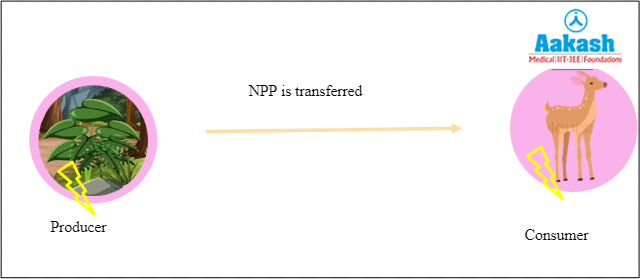
Fig: Transfer of energy from producers to consumer
Secondary productivity
Secondary productivity is the rate of formation of new organic matter by the consumers. It depends on the loss while transferring the energy and organic matter from the previous trophic level plus the consumption due to respiration. Respiratory loss is about 20% for autotrophs. It is about 30% for herbivores and upto 60% for carnivores. Hence normally the net productivity decreases with each trophic level in a food chain. As shown in the image, the consumers like deer, respire and grow to increase their biomass.
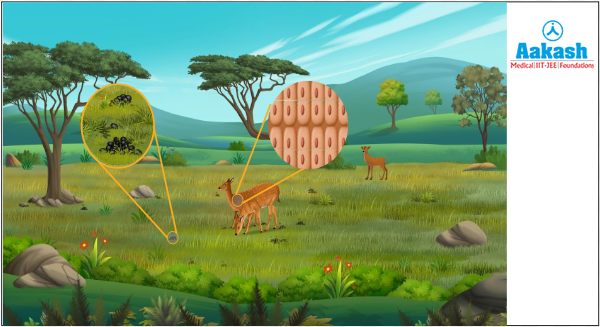
Fig : Secondary productivity
Factors deciding the productivity
The productivity depends on the following factors:
Photosynthetic capacity of the producers
An ecosystem with more producers will show more productivity, if the availability of resources like water, light, nutrients etc., are not compromised.
Prevailing environmental conditions
Availability of light, seasons, local climate etc., affect productivity.
Solar radiation
Duration of sunlight energy affects productivity. Of the incident solar radiation, only 50% is considered as PAR.
Temperature
The enzyme activity is affected by temperature. Photosynthesis and other metabolic processes occur with the help of enzymes.
Soil moisture
Availability of water can affect photosynthesis and metabolic activities.
Variation in magnitude of productivity
Plant productivity varies in different ecosystems due to the availability of nutrients, sunlight, temperature and photosynthetic ability of plants.
Variation of productivity in different ecosystems
Deserts have maximum availability of sunlight but these regions lack rain and humidity which decrease the productivity here. Aquatic system has limited availability of sunlight with increasing depth of water. This leads to less productivity in aquatic ecosystems compared to the terrestrial ecosystems.
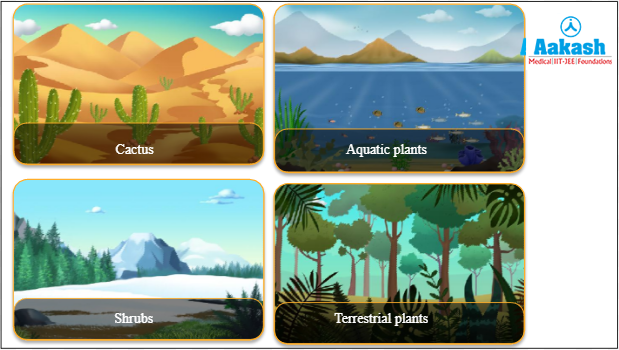
Fig: Variation in plant productivity in different ecosystems
Plant productivity varies due to different environmental factors as shown below. As Arctic and Alpine regions receive less sunlight and low temperatures, these regions show less productivity, whereas temperate and tropical forests receive maximum sunlight and productivity is comparatively more here. Availability of rain and presence of humidity also increases productivity in these regions. Net primary productivity is highest in the tropical regions compared to the temperate regions.
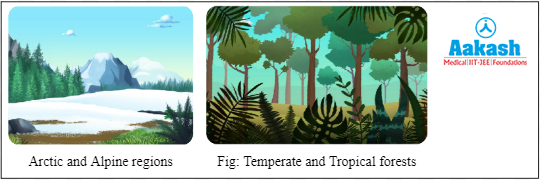
Fig: Difference in vegetation
Annual net productivity of the biosphere
The annual net productivity of the whole biosphere is approximately 170 billion tons of dry weight of organic matter. Oceans contribute to 32% of the total productivity which is around 55 billion tons. Maximum productivity occurs in coral reefs which is followed by estuaries and sugar cane fields. On land the maximum primary production rate is found in tropical rain forests followed by tropical deciduous forests, temperate forests, savannah, temperate grasslands and desert shrubs.

Fig: Coral reef
Practice Problems
Q 1. Which of the following shows minimum productivity?
a. Grasslands
b. Coral reefs
c. Estuaries
d. Open oceans
Answer: Productivity, denotes the rate of production of biomass in the ecosystem. Although in the ocean, there are lots of nutrients but the productivity is less because the light is only available in the photic zone (uppermost layer of the body of water that normally receives sunlight) of ocean and deeper down light does not penetrate. Hence, the ocean has lesser productivity. Maximum productivity occurs in coral reefs which is followed by estuaries and sugar cane fields. On land the maximum primary production rate is found in tropical rain forests followed by tropical deciduous forests, temperate forests, savannah, temperate grasslands and desert shrubs. Hence the correct option is d.
Q 2. Which one of the following statements is correct regarding net primary productivity?
a. NPP/GPP ratio is fixed over all latitudes
b. NPP is higher than GPP
c. NPP is lower than GPP
d. NPP is maximum in polar region
Answer: Net primary productivity (NPP) is the organic matter available for consumption by the heterotrophs. GPP – R = NPP. Plant productivity varies in different ecosystems due to availability of nutrients and photosynthetic ability of plants. When we deduct the respiratory losses from GPP, then only we get NPP. So, NPP is always lower than GPP. Hence the correct option is c.
Q 3. What is the energy that is stored at the consumer level is known as?
a. gross primary productivity
b. net primary productivity
c. secondary productivity
d. net community productivity
Answer: Producers in the ecosystem capture the sunlight and convert it into biomass. Productivity is the rate at which sunlight is captured by the producers for the synthesis of energy- rich organic compounds. Productivity is of different types, such as primary productivity
gross primary productivity, net primary productivity and secondary productivity. Secondary productivity is the rate of assimilation of food energy at the level of consumers. This is transferred to the next trophic level. Hence the correct option is c.
Q 4. Which of the following ecosystems has the highest gross primary productivity (GPP)?
a. Coral reefs
b. Mangroves
c. Grasslands
d. Deserts
Answer: Gross primary productivity (GPP) is the amount of carbon fixed during photosynthesis by all producers in the ecosystem. In aquatic ecosystems, coral reefs show the highest GPP, aquatic phototrophs and phytoplankton contribute to the productivity of this ecosystem. Coral reefs are large underwater structures composed of the skeletons of colonial marine invertebrates called corals. In terrestrial ecosystems, tropical rainforests have the highest productivity followed by marshes, mangroves, grasslands etc. Ecosystems with the lowest levels of primary productivity include deserts, tundra, the open ocean etc. Hence the correct option is a.
Fig: Coral reef
Q 5. What is primary productivity?
Answer: The amount of biomass produced per unit area over a certain period of time by plants during photosynthesis is primary productivity. It is expressed as gm–2 yr –1 or (kcal m–2 ) yr –1. It is used to compare productivity in different ecosystems.
Q 6. Discuss the different types of primary productivity?
Answer: Primary productivity includes gross primary productivity (GPP) and net primary productivity (NPP).
- Gross primary productivity (GPP) - It is the rate of production of organic matter during photosynthesis. Plants use some of the GPP in respiration (R).
- Net primary productivity (NPP) - It is the organic matter available for consumption by heterotrophs. GPP – R = NPP.
Plant productivity varies in different ecosystems due to availability of nutrients and photosynthetic ability of plants.
Q 7. State the variation in plant productivity due to different environmental factors?
Answer: Plant productivity varies due to different environmental factors. As Arctic and Alpine regions receive least sunlight, low temperatures therefore there is less productivity, whereas temperate and tropical forests receive maximum sunlight and show more productivity comparatively. Availability of rain and presence of humidity also increases productivity here. Net primary productivity is maximum in the tropics and average in temperate. Deserts have maximum sunlight available, but lack of rain and humidity decrease productivity. Aquatic ecosystem has limited sunlight available with increasing water depth. Hence it has less productivity than terrestrial ecosystems.
FAQs
Q 1. Which are considered the least productive ecosystems?
Answer: The ecosystems with the lowest levels of primary productivity consist of the lakes, streams, deserts, the tundra and the open ocean. These ecosystems include habitats with extreme temperature differences and limited precipitation. This results in very low productivity.
Q 2 . Why does productivity increase in terrestrial ecosystems?
Answer: The productivity of the terrestrial ecosystem increases due to the following reasons:
- Increase in moisture availability
- Length of growing season
- Availability of sunlight
- Temperature
Q 3. What is considered as tertiary productivity?
Answer: The amount of new biomass produced by meat‐eating animals or carnivores in a given period of time is considered as tertiary productivity.
Q 4. Where net primary productivity is the highest?
Answer: The highest net primary productivity in the terrestrial environments is shown by marshes, swamps and tropical rainforests.
Related Topics
|
The Ecosystem - Components, Structure and Functions, Practice Problems and FAQs |
|
Decomposition, Practice Problems and FAQs |
|
Nutrient cycling: Carbon cycle and Phosphorus cycle, Practice Problems and FAQs |

 Call Now
 Let's Chat
 Share
Share