-
Call Now
1800-102-2727


Primates - How they differ from other mammals

Primates belong to an order in the Mammalia class. They include lemurs, tarsiers, monkeys, apes, and humans. Over 300 species exist, making primates the third most diverse mammalian order. The word “Primates” comes from Latin primat, meaning highest rank. Carl Linnaeus named them as ‘Primates’ because he regarded them as the top animals.
Evolution and Diversity
Primates first arose about 55–85 million years ago. Their ancestors, Plesiadapiformes, adapted to tree life in tropical forests. Many primate traits evolved for arboreal life, including big brains, flexible hands, and keen vision. The smallest primate is the mouse lemur (Microcebus berthae), weighing about 35 g. The largest primate is the gorilla, weighing over 140 kg.
Special Differences from Other Mammals
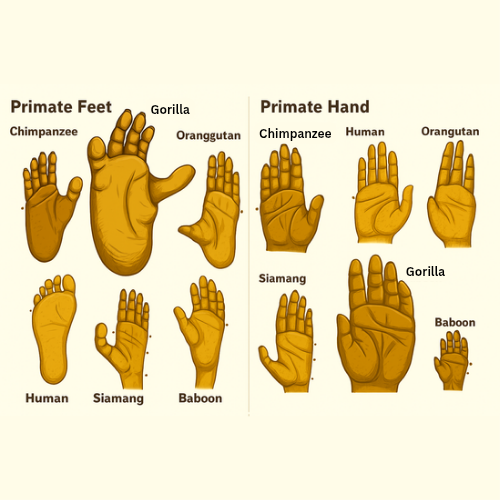
1. Brain Size and Structure
- Primates have proportionally larger brains than other land mammals.
- Their brains have a unique groove called the Calcarine sulcus, which separates visual areas.
- Vision is more developed in primates, while most other mammals rely more on smell.
2. Digits and Nails
- Unlike other mammals that have claws or hooves, primates usually have flat nails.
- Some primates still have claws but often retain a flat nail on the big toe.
- All primates are pentadactyl, meaning they have five fingers on each limb.
3. Grasping Ability
- Most primates have a grasping foot.
- The big toe (hallux) is separate and forms a pincer grip with other toes.
- Opposable thumbs are found in Old World monkeys, apes, humans, and some lemurs and lorises.
4. Tactile Sensitivity
- Primates possess Meissner’s corpuscles, which are special nerve endings in hands and feet.
- These allow high tactile sensitivity, a feature not found in other placental mammals.
5. Tails and Body Development
- Most primates have tails, but apes and humans lack tails.
- They grow slowly, reach maturity later, and have longer lifespans than mammals of similar size.
6. Sexual Dimorphism
Many species show differences between males and females (sexual dimorphism).
These differences include:
- Fat and muscle distribution
- Canine tooth size
- Pelvic width
- Hair patterns
- Colouration
Habitat and Diet
Habitat and Distribution
Primates are mainly found in Central and South America, Africa, and southern Asia. Some species also live in southern Mexico (North America) and Japan (northern Asia).
They inhabit a wide range of environments such as:
- Tropical forests
- Savannas
- Temperate forests
- Mountains
- Deserts
- Coastal regions
Locomotion and Lifestyle
Most primates are arboreal and they live in trees.
Some are partially or fully terrestrial, including:
- Humans
- Gorillas
- Baboons
Arboreal primates move by leaping or swinging between branches.
Terrestrial ones use knuckle-walking or bipedalism for movement.
Feeding Habits
Primates are omnivores, eating both plant and animal matter.
Their diet includes:
- Animal-based items: insects, crustaceans, spiders, birds’ eggs
- From plants (reproductive): fruits, flowers, seeds, nuts, rhizomes, tubers
- From plants (vegetative): leaves, stems, grasses, bark, gums
This diverse diet allows primates to adapt to various environments.
Classification of Primates
Primates are grouped into two suborders:
- Strepsirrhines (wet-nosed), including lemurs, galagos, and lorisids.
- Haplorhines (dry-nosed), including tarsiers, monkeys, apes, and humans.
Threats and Conservation
Endangered Status
- More than one-third of primate species are vulnerable or critically endangered.
- Almost 60% face extinction risk.
- Population decline is seen in 75% of primates.
Regional Endangerment Statistics
- Madagascar: 87% of primate species are endangered
- Asia: 73%
- Africa: 37%
- South and Central America: 36%
Critically Endangered Species
Some examples of highly threatened primates include:
- Sumatran orangutan
- Silky sifaka
- White-headed langur
- Delacour’s langur
- Tonkin snub-nosed monkey
- Cross River gorilla
Major Threats
- Deforestation due to logging and urban development
- Hunting for food, medicine, or pest control
- Land clearing for agriculture
- Urbanisation and timber extraction
- Retaliatory killing of crop-raiding primates
Reproductive Challenge
Primates reproduce slowly, with:
- Delayed sexual maturity
- Long intervals between births
This leads to slow population recovery after a decline.
Summary
Primates are mammals such as lemurs, tarsiers, monkeys, apes, and humans. They have flat nails, unique thumbs, and strong eyesight. Many live in forests and eat both animal and plant matter. Traits like Meissner’s corpuscles give them great touch. Due to habitat loss and slow reproduction, many species are at risk.
FAQs
Q1. How many species of primates exist?
A. There are more than 300 species of primates known today.
Q2. What are some examples of primates?
A. Common primates include monkeys, apes, lemurs, tarsiers, and humans. Other examples are gorillas, chimpanzees, baboons, and gibbons.
Q3. How are primates classified into suborders?
A. Primates are divided into two suborders based on nose structure and traits. Strepsirrhines have wet noses; Haplorhines have dry noses and complex brains.

NEET Related Links
JEE MAIN Related Links
JEE Advanced Related Links
JEE Advanced Eligibility Criteria
JEE Advanced Chemistry Syllabus
JEE Advanced Registration Dates
CUET Related Links
Important Topics
Anemometer : Measurement of Wind Speed
Angular Acceleration Atomic Theory Audible and Inaudible Sound Average Speed and Average Velocity Average Velocity Avogadros Number Avogadros Hypothesis Azimuthal Quantum Number Balanced Force Bar Magnet Biconvex Lens Boyles Law Buoyancy Calorimeter Carnot Engine Celestial Bodies Centripetal And Centrifugal Force Concave and Convex Lenses Concave Convex Mirrors Contact and Non Contact Force Controlled Thermonuclear Fusion Convection Currents Convex Lens Convex Mirror Destructive Interference Difference Between Conduction Convection and Radiation Difference Between Electric Field and Magnetic Field Difference Between Heat And Temperature Difference Between Series And Parallel Circuits Differences Between Acceleration And Velocity Distance and Displacement Distance Time Graph Electrical Force : Electric Forces and Their Types Electromagnetic Waves : Definition, Equation and Properties of Electromagnetic Waves Electromagnetism Electron Spin Fluid Flow : Bernoullis Equation Derivation and Fluid Mechanics Fluid Friction : Types and Factors of Fluid Friction Frames of Reference : Inertial and Non- Inertial Frame of Reference Frequency and Wavelength Frictional Force Importance of Hydrosphere Instantaneous Speed and Velocity Introduction to Motion Kinetic and Potential Energy Difference Law Of Conservation of Energy Layers of the Earth Light Energy Light Sources List of physics scientists and Their inventionsLoudness of Sound
Magnetic Dipole Moment Magnetic Field Non - Contact Force Non - Renewable Energy Ohms Law Optics P Wave Physics Symbols Plane Mirrors Poissons Ratio Projectile Motion Properties of Water : Anomalous Expansion of Water Radius of Gyration Reflection of Light Reflection of Waves Relative Density Resonance Reverberation Rolling Friction Rotation and Revolution Screw Gauge Semiconductors and Insulators Sliding Friction Speed Time Graphs Static Friction Stefan Boltzmann Law Stress Tension Tension Force Thermometer: Clinical Laboratory Thermometer Types of Rocks Types of Waves Uniform Motion and Non Uniform Motion Unit of Voltage Uses of Convex Lens Uses Of Convex Mirror Uses of Electromagnet Uses of Optical Fibre Wave Wavelength of Light What is Scattering of Light Working of Electric Bell Conventional and Non-conventional Sources of Energy Buoyant Force Bulk Modulus of Elasticity Bernoulli’s Principle Angular Momentum Difference Between Speed And Velocity ForceUnit of Heat
Difference between Distance and Displacement Simple Microscope Derivation Of Equation Of Motion Thermometer: Clinical & Laboratory Thermometer Difference between Concave and Convex LensDerivation Of Lens Maker Formula
Unit Of Pressure Velocity Uses of Plane Mirror
Wave Theory of Light
Unit of Density Unit of Light Unit of Force Unit of Magnetic Field Unit of wavelength Unit of Viscosity Uses of Electroplating Young's Modulus
What is the Scattering of Light
Lenz Law Space Wave Propagation Schrodinger Wave Equation Relation between Fahrenheit and Celsius Refractive Index Potentiometer Working Pascal Law Oscillatory Motion Optical Instruments Newton's Laws of Motion - First Law Modulation and Demodulation Magnetic Flux Lens Formula and Magnification Kaleidoscope Faradays Law Epsilon Naught Value Energy Bands Electrostatics Electroscope AC Generator Unit of Current Lithosphere Bending Equation Derivation Difference Between Pound and Kilogram Semiconductor Devices OTEC - Ocean Thermal Energy Conversion Hall Effect Rectilinear Propagation of Light Difference Between Ammeter and Voltmeter Coefficient of Linear Expansion Ampere’s Law Cyclone and Thunderstorm Save The Environment From Pollution Particle Nature of Light Types of DC Motor Uses Of Transistor Derivation of Phase Rule Unit of Humidity

 Call Now
 Let's Chat
 Share
Share