-
Call Now
1800-102-2727


Plastids

Plastids are specialized double-membrane organelles found in plant and algal cells. They play essential roles in food production, nutrient storage and pigmentation of flowers, fruits and leaves. Plastids contain their own DNA, allowing them to synthesize certain proteins. It also enables autonomous replication through binary fission.
Hence, plastids are semi-autonomous organelles capable of performing cellular functions independently. There are different types of plastids with distinct roles, such as photosynthesis, nutrient storage and pigment production.
Types of Plastids
Plastids are grouped by the work they do or the pigments they contain. The main types of plastids are:
- Chloroplasts
- Chromoplasts
- Gerontoplasts
- Leucoplasts
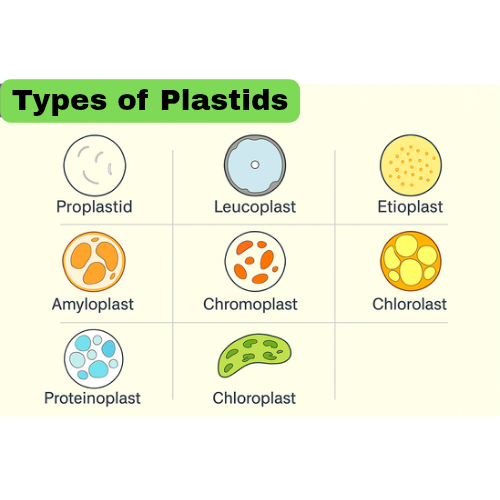
Alt-text: Types of plastids
Chloroplasts
Chloroplasts are the most common plastids found mostly in the mesophyll cells of leaves. These plastids contain a green pigment called chlorophyll, which is essential for photosynthesis. This pigment captures sunlight, enabling the conversion of carbon dioxide and water into organic compounds and energy for the plant.
Structurally, chloroplasts are lens or oval shaped organelles enclosed by a double membrane. Inside, they contain stacks of thylakoids called grana. The grana trap light for the initial stages of photosynthesis. The surrounding fluid, known as the stroma, is the site for subsequent biochemical reactions.
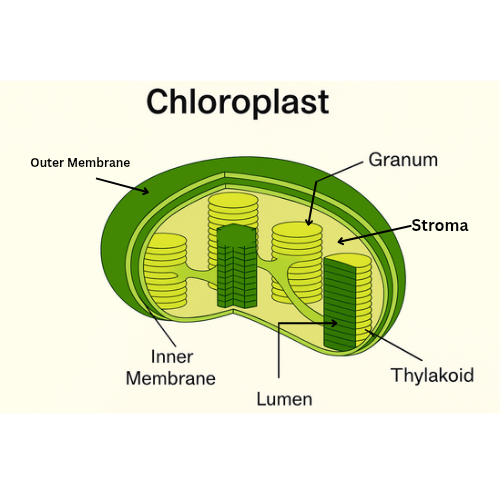
Alt-text: Chloroplast
Chromoplasts
Chromoplasts are plastids that store red, orange, and yellow carotenoids. They are found in flowers, fruits, and ageing leaves. These plastids form when chloroplasts change during fruit ripening or leaf ageing. These organelles may arise directly from proplastids or other plastids, depending on the tissue.
Chromoplasts help attract insects for pollination and animals to spread seeds. They are the reason behind bright colours in plant parts and make them appealing.
Gerontoplasts
Gerontoplasts are old or ageing chloroplasts that form when a leaf stops making food through photosynthesis. This happens mostly in autumn when leaves change colour. They mark the breakdown of active parts inside the chloroplast and, hence, are seen in leaves that are no longer green. This is usually the final stage in the life of a chloroplast.
Leucoplasts
Leucoplasts are colourless plastids with no pigment. They are found in parts of the plant that do not perform photosynthesis, such as roots, seeds, and underground parts like tubers. Leucoplasts mainly help in storing food and are essential during growth or seed germination. They store starch, proteins, and fats for the plant to use later.
There are three main types of leucoplasts:
- Amyloplasts – store starch in places like roots and tubers
- Proteinoplasts – store proteins, mainly in seeds
- Elaioplasts – store fats and oils used for energy
Functions of Plastids
Plastids perform many roles inside plant cells. Each type of plastid has its specific role.
- Photosynthesis: Chloroplasts convert sunlight into food for the plant.
- Pigment Storage: Chromoplasts store colours that attract insects or animals.
- Nutrient Storage: Leucoplasts keep starch, protein, and fats for later use.
Together, these plastids help plants grow, reproduce, and stay healthy.
Inheritance of Plastids
Plastids are passed from one parent to the next. This is called uniparental inheritance.
- In flowering plants (angiosperms), plastids come from the female cell and hence are usually maternal, but some species show biparental inheritance.
- In non-flowering plants (gymnosperms), they usually come from the male pollen and hence are paternal.
- In algae, plastids also come from only one parent.
The uniparental inheritance is common and steady in most plants. However, in hybrids, the pattern may sometimes be different.
Summary
Plastids are double-membrane organelles found in plant and algal cells. They help in food making, storage, and giving colour to plant parts. The main types are chloroplasts, chromoplasts, gerontoplasts, and leucoplasts. Each has a specific role in plant growth and survival. Plastids are inherited from one parent and are semi-autonomous in nature.
FAQs
Q1. What is the endosymbiotic theory of plastid origin?
Plastids originated when a eukaryotic cell engulfed a photosynthetic prokaryote, which became a permanent organelle. Evidence includes double membranes, circular DNA, 70S ribosomes, binary fission and similarity to cyanobacterial genes.
Q2. How do plastids change during fruit ripening?
Chloroplasts differentiate into chromoplasts during fruit ripening, causing the fruit to change colour.
Q3. How do plastids develop in seedlings during greening?
In darkness, seedlings have colourless proplastids or leucoplasts. They develop into chloroplasts containing chlorophyll upon light exposure.


 Call Now
 Let's Chat
 Share
Share