-
Call Now
1800-102-2727



Plasmolysis, Practice Problems and FAQs
Going on a picnic is one of the best things which makes us relaxed. Some prefer forests, some others prefer the beaches. Have you ever been to a seashore and played in the sea water? It is really fun to play with the waves. After the picnic, just observe the skin of your fingers and toes. Does it look like what it was before? Some changes will be there. Right? What is it? The skin will have wrinkles. How did it happen?
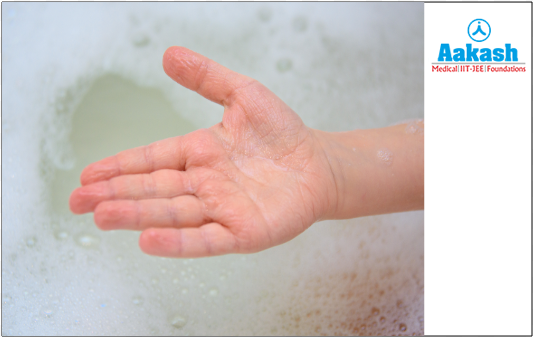
Fig: Wrinkles on the palm and fingers
It happened because of the salt water in the sea. While playing in the sea water, water inside our skin cells goes outside and it creates wrinkles on the skin. The same process happens when we have a long bath. We know that there is a process called osmosis, where the water moves from its higher concentration to lower concentration through a semipermeable membrane. Do you think osmosis has any connection with what happened with your skin? Obviously yes. Here the salt water has less water content than the skin cells and as a result water will move from the cell to the salt water through the semipermeable membrane of the skin. Here the solution outside the cell is responsible for the water loss and it will lead to the shrinkage of plasma membrane and protoplast. Hence this process can be also called plasmolysis. So in this article we are going to discuss more about plasmolysis.
Table of contents
- Transport in plants
- Types of solution
- Plasmolysis
- Deplasmolysis
- DPD and plasmolysis
- Significance of plasmolysis
- Practice Problems
- FAQs
Transport in plants
Long distance and short distance transport is happening inside a plant body. Water is essential for the transport of materials. The exchange of water between the cell and the environment or the movement of water from one cell to the other is called short distance transport.
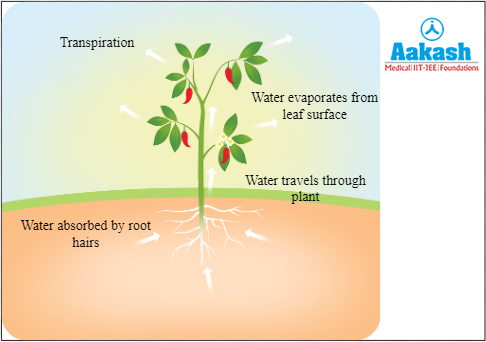
Fig: Transport in plants
Types of short distance transport
The three major process involved in the short distance transport are as follows:
- Diffusion - It is the movement of molecules from higher to lower concentration.

Fig: Diffusion
- Osmosis - It is the movement of water from its higher concentration to a region of lower concentration through a semipermeable membrane.
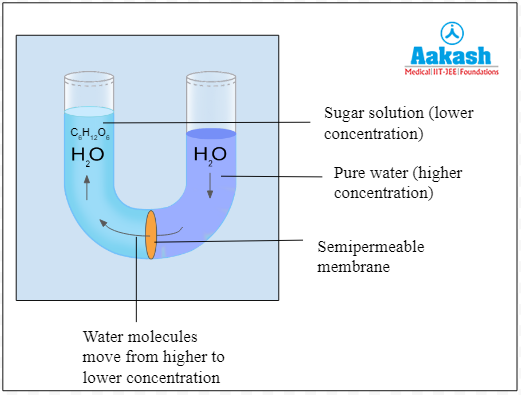
Fig: Osmosis
- Imbibition - It is the adsorption of water molecules by the hydrophilic cell walls of plants.
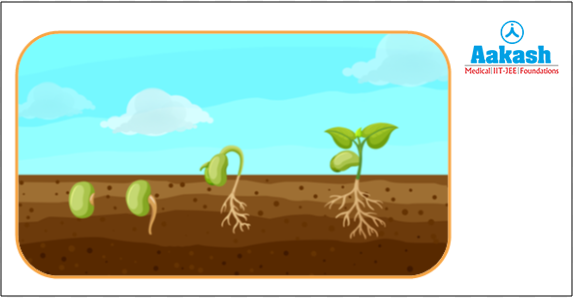
Fig: Seeds germinating by imbibing water
Types of solutions
If we consider the process of osmosis, the movement of water molecules entirely depends on the concentration of solution surrounding the cell. There are three types of solutions on the basis of the concentration of solutes inside and outside the cell. The types of solutions are as follows:
- Isotonic solution
- Hypotonic solution
- Hypertonic solution
Isotonic solution
Iso means the same and tonic means concentration of the solution, hence isotonic solution is the solution which has the same solute concentration on the inside and outside the cell. So no net movement of water occurs if a cell is surrounded by an isotonic solution.
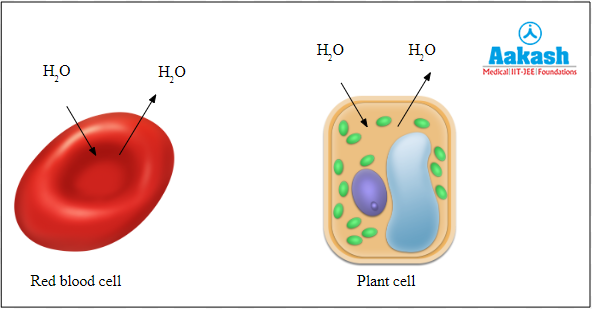
Fig: Cell placed in isotonic solution
Hypotonic solution
Hypo means less and tonic means concentration of the solution, hence hypotonic solution is the solution which has a relatively lower solute concentration than that of the cell sap. So the water will move from outside to the inside of the cell, that means endosmosis will occur. This will result in the formation of turgid cells.
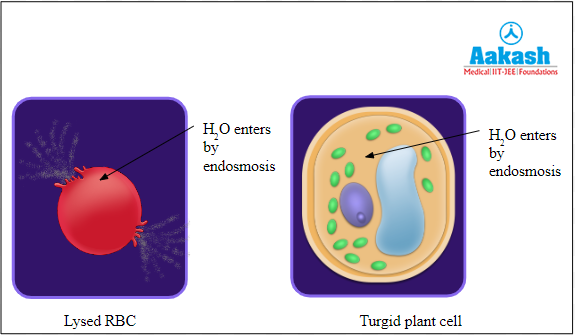
Fig: Effect of hypotonic solution on animal cells and plant cells
Hypertonic solution
Hyper means more and tonic means concentration of the solution, hence a hypertonic solution is the solution which has a relatively higher solute concentration than that of the cell sap. So the water moves from the cell to outside, that means exosmosis will occur and as a result the cells will shrink.
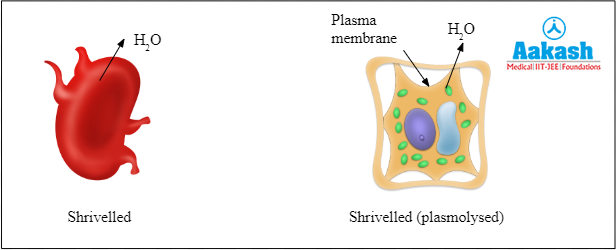
Fig: Cells placed in hypertonic solution
Plasmolysis
When a cell is placed in a hypertonic solution, the water will move out of the cell due to exosmosis. This process which causes the shrinkage of the cell is called plasmolysis. In scientific terms it is the shrinkage of the protoplast of a living cell from its cell wall due to exosmosis under the influence of a hypertonic solution. Hypertonic solution occupies the space between the cell wall and the shrunken protoplast.
Steps of plasmolysis
The process of plasmolysis has three major steps. These are as follows:
- Incipient plasmolysis
- Evident plasmolysis
- Final plasmolysis
Step 1: Incipient plasmolysis
When a cell is placed in a hypertonic solution, the first process happens is the losing of water from the cell. This will result in the shrinkage of cells. Here the cell wall can be recognised.
Step 2: Evident plasmolysis
When the whole amount of water leaves the cell, it will attain a maximum amount of contraction. At this stage the cytoplasm will get separated from the cell wall and become a spherical shape.
Step 3: Final plasmolysis
In this step, the complete detachment of cytoplasm happens and it will locate in the middle of the cell. Now the cell can be called a plasmolysed cell.
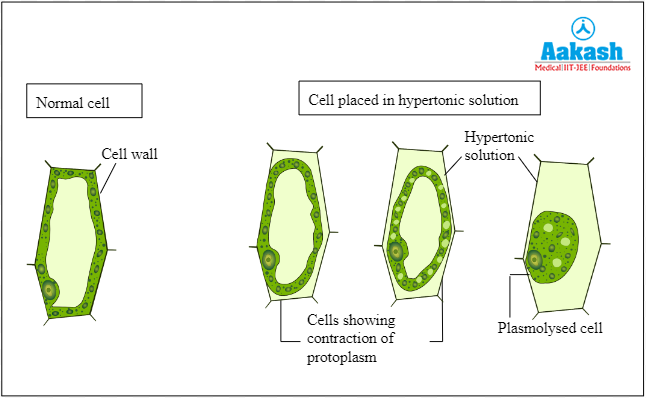
Fig: Plasmolysis
Types of plasmolysis
The space between the cell wall and plasma membrane, differs in a normal cell and plasmolysed cell. This space will be more in a plasmolysed cell. Based on the final structure of cytoplasm inside a plasmolysed cell, there are two types of plasmolysis and they are as follows:
- Concave plasmolysis
- Convex plasmolysis
Concave plasmolysis
In this type of plasmolysis, the protoplast will turn into a ‘half-moon’ shaped structure inside the cell. This occurs when the protoplasm and the plasma membrane shrinks due to the loss of water. This shrinkage will make them detach from the cell wall. Concave plasmolysis can be reversed when the cell is kept inside the hypotonic solution. When the cell is kept inside the hypotonic solution, the water will enter the cell and give the protoplasm and plasma membrane their original shape and structure.
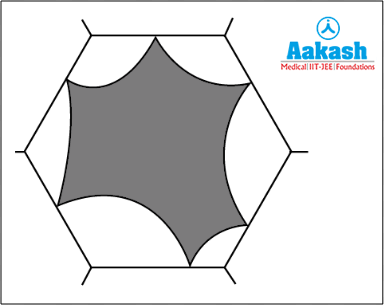
Fig: Concave plasmolysis
Convex plasmolysis
In this type of plasmolysis, the plasma membrane and protoplasm will detach completely from the cytoplasm, due to the loss of water. As a result the cell wall collapsed and the cell got destroyed. This plasmolysis is a permanent process. It can not be reversed, just like in concave plasmolysis. Convex plasmolysis happens when the wilting of plants happens and it dies due to lack of water. When compared to convex plasmolysis, concave plasmolysis is more complicated.
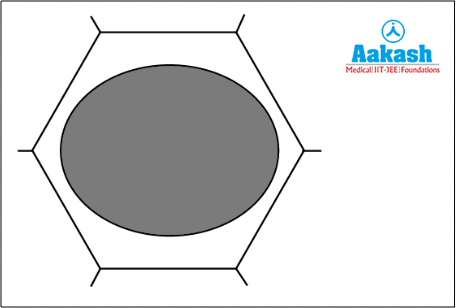
Fig: Convex plasmolysis
Examples of plasmolysis
Many daily life scenarios like, making of pickles, jams etc., and addition of excess fertilisers to soil which leads to the death of a plant are examples of plasmolysis. When a blood cell is placed in a hypertonic solution, these will shrink and it is due to plasmolysis. The deposition of salt on the land by the ocean water during extreme coastal flooding is also an example of plasmolysis.
Making of pickles
While making pickles by using vegetables and fruits, we add excess salt in the medium. This will make the medium hypertonic. As a result the water inside the microbes present in the medium will move from their body to the medium or we can say plasmolysis of the microbial cells happens. This will make them dehydrated and prevent growth, thereby preserving the food items. Shrivelling occurs most often in sweet or sour pickles. The presence of salt, vinegar and sugar in the solution at the beginning of the pickling process causes this shrivelling of vegetables and fruits. This increases the shelf life of the pickles.
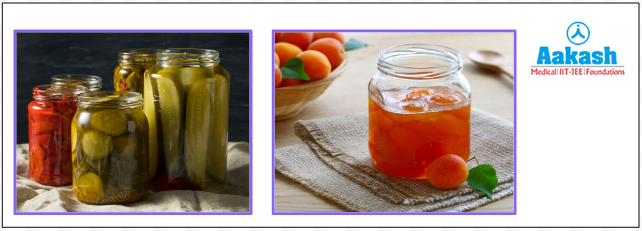
Fig: Pickles
Addition of excess fertilisers
A perfect concentration of the fertilisers must be added to the soil for cultivation, otherwise it will affect the growth of plants. Excessive addition of fertilisers will make the soil hypertonic. This will result in the plasmolysis of the root hair cells. Hence the root hair cells will not be able to absorb more water needed for their growth and eventually lead to the death of the plant.
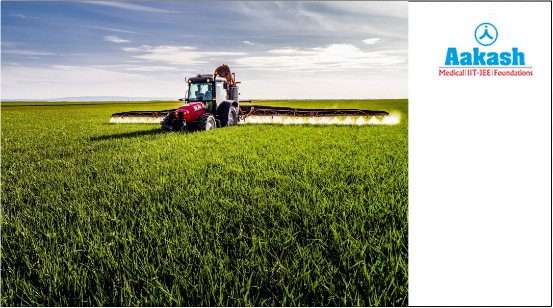
Fig: Applying excess fertilisers in agricultural field
Deplasmolysis
The reverse process of plasmolysis is called deplasmolysis in simple words. It is the swelling up of a plasmolysed protoplast due to endosmosis under the influence of a hypotonic solution or water.
When a plasmolysed cell is placed in a hypotonic solution, the water will move from the outside to inside of the cell. Here the concentration of solution is more in the cell than the outside solution. Water always moves from its higher concentration to the lower concentration. Hence the water moves from outside to inside, which is called the endosmosis. This results in the unshrinking of the protoplasm. As a result, the protoplast starts exerting turgor pressure on the cell wall. This will not result in the rupture of the cell, because of the rigidity of the cell wall.
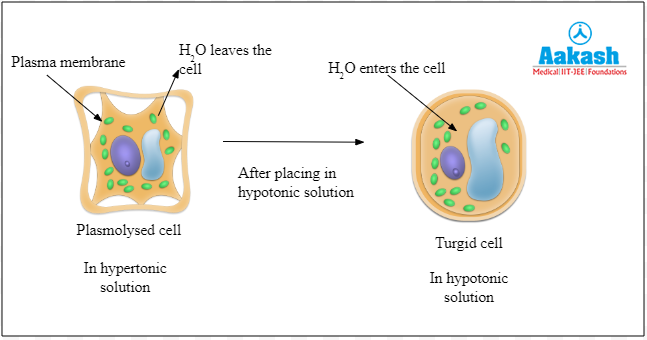
Fig: Deplasmolysis
DPD and plasmolysis
The potential ability of molecules for the diffusion is called diffusion pressure in simple words. It is the pressure exerted by the tendency of molecules of gases, and liquids to diffuse from the area of their higher concentration to the area of lower concentration. It is directly proportional to the concentration of molecules.
Pure water has more kinetic energy and hence it has more diffusion pressure. When we add more solute molecules, it will reduce the diffusion pressure of the pure water. This difference between the diffusion pressure of pure water or solvent and solution is called the diffusion pressure deficit or DPD.
Water potential is considered as the difference between the free energy of water molecules in pure water and solution. It is represented by Ψw whereas diffusion pressure deficit or DPD is considered as the difference in diffusion pressure between a solution and pure solvent.
DPD is always in positive magnitude. The water potential of a solution decreases, when the concentration of the solute increases in the solution. When this happens in a cell, it will take up more water and this will result in the increase in the osmotic pressure or OP. Until the cell becomes turgid, it will take up more water.
Hence DPD is dependent on the osmotic pressure and turgor pressure. The equation to calculate the DPD is:
DPD = Osmotic pressure (OP) - Turgor pressure (TP)
DPD in a turgid state
In a turgid state, the osmotic pressure is equivalent to the turgor pressure. We know that the DPD = OP - TP. Since, OP and Tp are the same, the value of DPD will be zero.
OP = TP
DPD = OP - TP
DPD = 0
DPD in a plasmolysed state
In the plasmolysed state, the turgor pressure is zero. Hence the DPD is equal to the osmotic pressure.
TP = 0
DPD = OP - TP
DPD = OP - 0
DPD = OP
Significance of plasmolysis
The following are the major significances of plasmolysis:
- Salting of pickles, fishes and meat to increase their shelf life.
- Preparation of jams and jellies by adding sugar.
- The weeds can be killed from the tennis courts.
- By salting the growth of plants can be prevented on the cracks of walls.
- To identify the cell is living or not as the living cells will show plasmolysis.
- For planning the required amount of fertilisers in an agricultural land.
- To measure the OP of a cell.
Practice Problems
Q1. Given below are the statements related to different types of solutions. Find out the false statements from the following.
A) Isotonic solution is the solution which has the same solute concentration on the inside and outside the cell.
B) When a cell is placed in a hypotonic solution, it will turn into a flaccid condition.
C) Water moves from outside to inside the cell when it is placed in a hypertonic solution.
D) The movement of water from inside the cell to outside is called endosmosis.
E) During exosmosis the cells will shrink.
a. A and C
b. C and D
c. D and E
d. B and E
Solution: If we consider the process of osmosis, the movement of water molecules entirely depends on the concentration of solution surrounding the cell. There are three types of solutions on the basis of the concentration of solutes inside and outside the cell. The types of solutions are isotonic solution, hypotonic solution and hypertonic solution. Iso means the same and tonic means concentration of the solution, hence isotonic solution is the solution which has the same solute concentration on the inside and outside the cell. So no net movement of water occurs if a cell is surrounded by an isotonic solution. Hypo means less and tonic means concentration of the solution, hence hypotonic solution is the solution which has a relatively lower solute concentration than that of the cell sap. So the water will move from outside to the inside of the cell, i.e., endosmosis will occur. This will result in the formation of turgid cells. Hyper means more and tonic means concentration of the solution, hence a hypertonic solution is the solution which has a relatively higher solute concentration than that of the cell sap. So the water moves from the cell to outside, that means exosmosis will occur. As a result the cells will shrink. Hence the correct option is b.
Q2. Find the correct order of steps in the process of plasmolysis.
A. Incipient plasmolysis → Evident plasmolysis → Final plasmolysis
B. Incipient plasmolysis → Final plasmolysis → Evident plasmolysis
C. Evident plasmolysis → Incipient plasmolysis → Final plasmolysis
D. Final plasmolysis → Evident plasmolysis → Incipient plasmolysis
Solution: When a cell is placed in a hypertonic solution, the water will move out of the cell due to exosmosis. This process which causes the shrinkage of the cell is called plasmolysis. The space between the cell wall and the shrunken protoplast is occupied by the hypertonic solution. The process of plasmolysis has three major steps. They are incipient plasmolysis, evident plasmolysis and final plasmolysis.
- Step 1 - It is the incipient plasmolysis. When a cell is placed in a hypertonic solution, the first process happens is the losing of water from the cell. This will result in the shrinkage of cells. Here the cell wall can be recognised.
- Step 2 - It is the evident plasmolysis. When the whole amount of water leaves the cell, it will attain a maximum amount of contraction. At this stage the cytoplasm will get separated from the cell wall and become a spherical shape.
- Step 3 - It is the final plasmolysis. In this step, the complete detachment of cytoplasm happens and it will locate in the middle of the cell. Now the cell can be called a plasmolysed cell. Hence the correct option is a.
Q3. Excess addition of fertilisers will make the plant wilt and die. This is due to _____________.
A. Diffusion
B. Plasmolysis
C. Active transport
D. Imbibition
Solution: When a cell is placed in a hypertonic solution, the water will move out of the cell due to exosmosis. This process which causes the shrinkage of the cell is called plasmolysis. It is considered as the shrinkage of the protoplast of a living cell from its cell wall due to exosmosis under the influence of a hypertonic solution. The space between the cell wall and the shrunken protoplast is occupied by the hypertonic solution. Many daily life scenarios like, making of pickles, jams etc., and addition of excess fertilisers to soil which leads to the death of a plant are examples of plasmolysis. While adding fertilisers to the soil, a perfect concentration should be followed or else it will affect the growth of plants. Excessive addition of fertilisers will make the soil hypertonic. This will result in the plasmolysis of the root hair cells. Due to this the root hair cells will not be able to absorb more water needed for their growth and eventually lead to the death of the plant. Hence the correct option is b.
Q4. Assertion: Deplasmolysis is the reverse process of plasmolysis.
Reason: In deplasmolysis, the water moves from the outside to inside of the cell.
Which of the following statements are correct about the assertion and reason given above.
A. Both the assertion and the reason are true and the reason is the correct explanation of the assertion
B. Both the assertion and the reason are true, but the reason is not the correct explanation of the assertion
C. The assertion is true, but the reason is false
D. Both the assertion and the reason are false
Solution: The reverse process of plasmolysis is called deplasmolysis. It is the swelling up of a plasmolysed protoplast due to endosmosis under the influence of a hypotonic solution or water.
When a plasmolysed cell is placed in a hypotonic solution, the water will move from the outside to inside of the cell. Here the concentration of solution is more in the cell than the outside solution. Water always moves from the higher concentration of water to the lower concentration. Hence the water moves from outside to inside, which is called the endosmosis. This results in the unshrinking of the protoplasm. Due to this the protoplast starts exerting turgor pressure on the cell wall. This will not result in the rupture of the cell, because of the rigidity of the cell wall. Here both the assertion and the reason are true and the reason is the correct explanation of the assertion. Hence the correct option is a.
FAQs
Question 1. What is cytorrhysis?
Answer: Due to the loss of internal or positive pressure, the complete collapse of a plant cell happens. This will cause permanent and irreparable damage to the cell wall and it is called cytorrhysis.
Question 2. Can plasmolysis occur in dead cells?
Answer: Plasmolysis is the process of losing water from the cell due to contraction or shrinkage of protoplasm, when the cell is placed in a hypertonic solution. In a dead plant, the protoplasm is already shrunken and the process of plasmolysis can not take place. This method is used to differentiate a dead cell from a living cell.
Question 3. What is a turgid cell?
Answer: When a cell is kept in a dilute solution, the pressure inside the cell rises and it reaches a condition where the cell can not take any more water. This condition of a cell is called turgid. Such a cell will be swollen and hard. The hydrostatic pressure works against osmosis.
Question 4. Who defined the term plasmolysis?
Answer: De Vries defined the term plasmolysis. He defined this term while inventing the method to determine the turgor pressure of a plant using the hypertonic solution.
YOUTUBE LINK: https://www.youtube.com/watch?v=bxU7GaPo1_k
Related Topics
|
Plant water relations: Plasmolysis and Imbibition, Practice problems and FAQs |
|
Difference between diffusion and osmosis, difference between active and passive transport, difference between endosmosis and exosmosis |
|
Definition of osmosis, Practice Problems and FAQs |
|
Diffusion: Definition, Types, Significance, Practice Problems and FAQs |

 Call Now
 Let's Chat
 Share
Share