-
Call Now
1800-102-2727


Photosynthesis In Higher Plants

Photosynthesis is an anabolic, endergonic physiochemical process that uses light energy to synthesise organic compounds. It occurs in green leaves of the plants, thus, predominantly seen in autotrophic plants. The event is important in generating the primary food source in the world, alongside helping the green plants to release oxygen into the atmosphere.
Photosynthesis occurs in two major steps-
Light Phase: Chlorophyll captures sunlight, leading to the splitting of water molecules to generate oxygen, ATP, and NADPH through light-dependent reactions.
Dark Phase: Carbon dioxide is assimilated through the light-independent Calvin Cycle (C3), producing glucose as the end product.
Chemical Equation of Photosynthesis
The following overall chemical equation represents photosynthesis:
6CO₂ + 12H₂O → C₆H₁₂O₆ + 6O₂ + 6H₂O
Site of Photosynthesis
Photosynthesis takes place mainly in the green parts of the plant (mostly the leaves), which contain mesophyll cells loaded with a large number of chloroplasts. There is a clear division of labour within the chloroplasts-
- The membrane system (comprising thylakoids stacked as grana) is responsible for the photochemical phase (light phase), where synthesis of ATP and NADPH occurs.
- The matrix (stroma) is responsible for the biosynthetic dark phase and has enzymes for the reduction of carbon dioxide into glucose.
|
Chloroplast Grana (thylakoids): light reaction Stroma: dark reaction |
Pigments Required for Photosynthesis
- Pigments (chlorophyll a, chlorophyll b, xanthophyll, carotenoids) are embedded in thylakoid membranes.
- The chief pigment is chlorophyll a
- The accessory pigments are chlorophyll b, xanthophyll, and carotene.
Photosystem
- Pigments are organised on the inner side of the thylakoid membrane.
- A photosystem has:
- Reaction centre → made of chlorophyll a.
- Antenna complex / Light-harvesting complex (LHC) → made of other pigments.
- Reaction centre: site where actual photochemical reactions occur.
- Antenna pigments capture light energy and transfer it to the reaction centre.
Types of Photosystems
| Photosystem | Reaction Centre | Absorption Peak | Role in Photophosphorylation |
| PS I | P700 (chlorophyll a) | 700 nm | Works in cyclic & non-cyclic photophosphorylation |
| PS II | P680 (chlorophyll a) | 680 nm | Works in non-cyclic photophosphorylation only |
Light-Harvesting Complex (LHC)
- Made of 250–400 pigments: chlorophyll b, carotenoids, and xanthophylls.
- Present in both PS I and PS II.
- Function: Absorbs different wavelengths of light and passes energy to chlorophyll a.
Events of Photosynthesis in Higher Plants
The process comprises the following steps:
Light Phase
It is the photochemical phase of photosynthesis involving the absorption of light, the splitting of water, the release of oxygen, and the generation of the high-energy intermediates ATP and NADPH.
Photophosphorylation
Photophosphorylation is the process of phosphorylation in the presence of light; light energy is used to add an inorganic phosphate group (Pi) to ADP (adenosine diphosphate), converting it into ATP (adenosine triphosphate). There are two main types of photophosphorylation.
Non-Cyclic Photophosphorylation
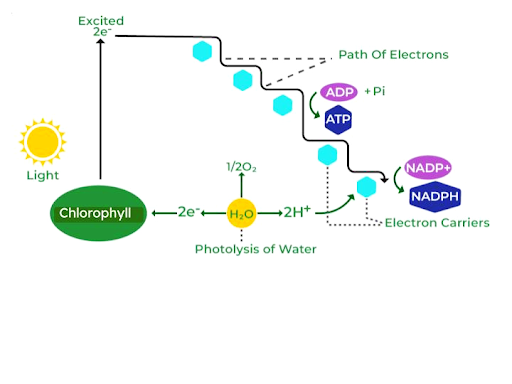
- PS II absorbs pigments, leading to the excitation of the photocentre P680.
- Excited electrons are transferred to the primary electron acceptor, leaving P680 in an oxidised state.
- Photolysis of water releases electrons, protons and oxygen; electrons replace those lost from P680.
- Electrons move through the chain, releasing energy and pumping H+ across the thylakoid membrane.
- Low-energy state electrons reach Photosystem I (PS I), excite electrons in the photocentre P700, and transfer to another primary electron acceptor.
- Electrons from PS I, along with protons from the thylakoid space, reduce NADP+ to form NADPH (in which form energy is stored).
- ATP synthase (a protein complex) utilises the flow of protons back into the stroma to synthesise ATP from ADP and inorganic phosphate- this is the process of photophosphorylation.
- The electrons leaving PS I combine with the protons and electrons (formed during photolysis).
Cyclic Photophosphorylation:
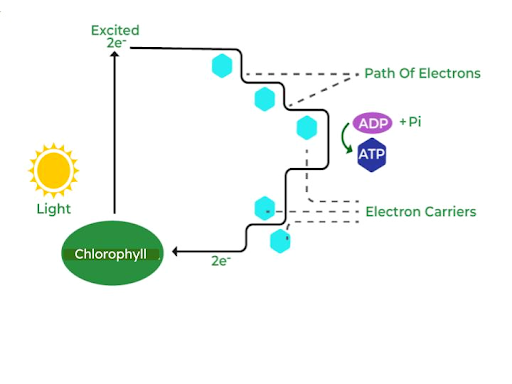
- Electrons follow a cyclic pathway and return to the reaction centre of PS I after being transferred to the electron transport chain.
- During high demand for ATP and a limited requirement for NADPH, this cyclic flow occurs.
- The cyclic flow of electrons generates ATP through the phosphorylation of ADP.
- Electrons are cycled back to PS I, leading to the continuous production of ATP without reduction of NADP+.
Photolysis of Water
- Photolysis, or splitting of water, is an important step in the light-dependent phase.
- It takes place in the thylakoid membrane, mainly in PS II.
- PSII absorbs light energy in the P680 reaction centre, leading to the excitation of electrons and their release.
- Released electrons replace those lost in PS II and enter the electron transport chain, resulting in ATP production.
- Simultaneously, water molecules are split into oxygen, protons, and electrons, with oxygen being released as a byproduct into the atmosphere.
Dark Phase
It is the biosynthetic phase of photosynthesis, involving the generation of glucose using the products of the light reaction (ATP, NADPH) and assimilating carbon dioxide through the Calvin Cycle.
Calvin Cycle (C3 Cycle)
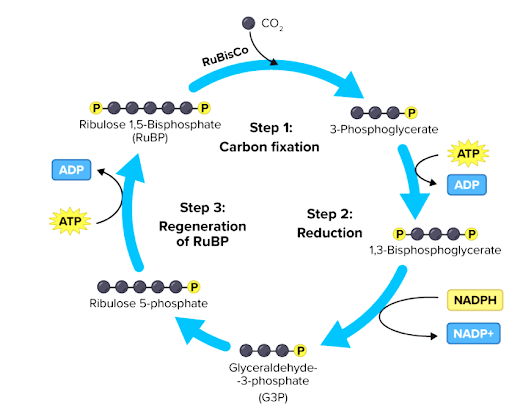
Carbon Fixation:
- Ribulose bisphosphate (RuBP) is a 5-C compound that reacts with carbon dioxide in the presence of Ribulose-1,5-bisphosphate carboxylase oxygenase (RuBisCO)
- The reaction produces two molecules of 3-phosphoglycerate (3-PGA), each containing 3-C atoms.
Reduction Phase:
- Each 3-PGA undergoes a reaction involving phosphorylation (using ATP) and reduction (using NADPH) to convert to glyceraldehyde-3-phosphate (G3P).
- Twelve molecules of 3-PGA are converted into 12 molecules of 1,3-diphosphoglycerate and then reduced to glyceraldehyde-3-phosphate (G3P).
Regeneration of RuBP:
- To maintain the continuity of the Calvin Cycle, some of the G3P molecules produced are used to regenerate RuBP.
- Ten molecules of G3P carry out a series of complex reactions and are converted into 6 molecules of 5C-compound, RuBP.
Formation of Glucose:
- For every three molecules of carbon dioxide entering the Calvin Cycle, one molecule of G3P is produced.
- Two G3P (3C + 3C) combine to make one molecule of glucose (6C).
- Therefore, to produce one glucose molecule, the cycle must turn six times (fixing 6 CO₂).
Energy Requirement per glucose:
- 18 ATP and 12 NADPH are consumed.
C4 Pathway or Hatch- Slack pathway
- The C4 Cycle is an adaptive mechanism to avoid photorespiration.
- Mechanism of carbon fixation in plants like maize, sugar cane, pearl millet and amaranth.
- The plants show the presence of two types of photosynthetic cells, i.e., mesophyll cells and bundle sheath cells (Kranz anatomy).
- The chloroplasts are dimorphic, granal (in mesophyll cells) and are agranal (in bundle sheath cells).
- Phosphoenolpyruvate (PEP) is the carbon dioxide acceptor, and the reaction is catalysed by the enzyme phosphoenolpyruvate carboxylase (PEP-case).
- The first stable product is the 4C- 4C-compound oxaloacetic acid (OAA).
- OAA converts into malic acid and is transported to bundle sheath cells, where it is decarboxylated into pyruvic acid.
- Carbon dioxide is liberated, which is used for the Calvin cycle in the bundle sheath cells.
- Pyruvic acid is transported back to the mesophyll cell to regenerate PEP, utilising two molecules of ATP for each pyruvate.
Factors Influencing Photosynthesis
The key factors that influence the process of photosynthesis are as follows:
Light
- 10% of the incident sunlight is used.
- Light is directly proportional to CO2 fixation at low intensities.
- Excessive light causes the breakdown of chlorophyll, resulting in a decrease in photosynthesis.
Carbon dioxide
Carbon dioxide concentrations in the atmosphere are very low (0.03 to 0.04%); thus, an increase in CO2 concentration of up to 0.05% can increase the rate of photosynthesis.
Temperature
- Dark reactions or light-independent reactions are enzymatic and are temperature-controlled.
- C3 plants have a lower temperature optimum, whereas C4 plants react to higher temperatures and have higher photosynthesis rates.
Water
Excess water stress can lead to the closing of stomata, reducing carbon dioxide accessibility.
Less CO₂ entry → lower photosynthesis.
Summary
Photosynthesis is the process by which green plants use light energy to make food. It occurs mainly in leaves, inside chloroplasts. Light reactions take place in the thylakoid membranes. And dark reactions (Calvin Cycle) occur in the stroma. Factors like light, carbon dioxide, temperature, and water affect the rate of photosynthesis. Overall, photosynthesis provides food and oxygen, making it vital for life on Earth.
Frequently Asked Questions
Q1. What are the differences between C3 and C4 plants?
The key differences are:
- C3 → first product is 3-PGA; photorespiration is high.
- C4 → first product is OAA; photorespiration is negligible.
Q2. Write the differences between cyclic and non-cyclic photophosphorylation.
The key difference is:
- Cyclic → Only ATP, no O₂, no NADPH.
- Non-cyclic → ATP + NADPH + O₂ are formed.


 Call Now
 Let's Chat
 Share
Share