-
Call Now
1800-102-2727


Peroxisomes

Microbodies are single-membrane-bound, small vesicular bodies. They are found in the cytoplasm of eukaryotic cells. They are often formed as dilatations of the Endoplasmic Reticulum. Peroxisomes are microbodies containing oxidative enzymes (like urate oxidase, peroxidase, catalase, etc.) involved in the formation and disintegration of hydrogen peroxide.
What are Peroxisomes?
Peroxisomes are small cell organelles found in eukaryotes, loaded with enzymes involved in a variety of metabolic reactions. Peroxisomes are a type of microbodies. Peroxisomes are morphologically similar in size to lysosomes but differ in function (oxidation vs digestion). They are self-replicating like mitochondria and plastids (in plants). They are assembled similarly and are major sites of oxygen utilisation.
Note: Glyoxysomes are a specialized peroxisome found in plants that convert fats to sugars during seed germination.
Structure of Peroxisomes
Peroxisome comprises a single phospholipid membrane enclosing a matrix containing various enzymes. Peroxisomes can grow in size by incorporating phospholipids and proteins that are often imported post-translationally. Peroxisomes stand out under an electron microscopic view, because in some cells, a higher concentration of the matrix enzymes depicts a crystalloid protein core.
Peroxisomes lack DNA and ribosomes. They do not contain their own genome. Thus, the proteins and enzymes in them are imported from the cytosol after synthesis on free ribosomes.
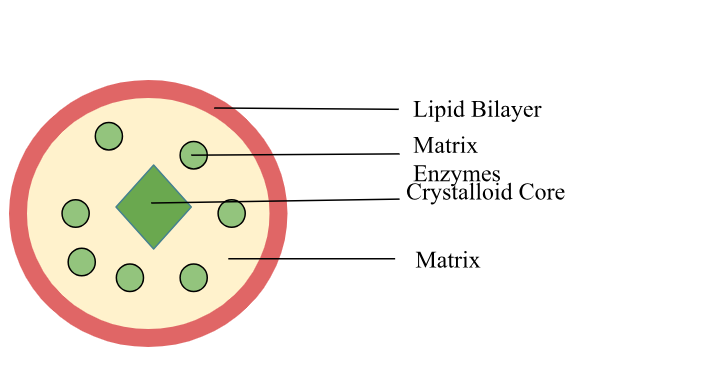
Diagrammatic Representation of Peroxisomes
Peroxisomes are unusually diverse cell organelles, and remarkably adaptable. For example:
- Yeast grown on sugar has smaller peroxisomes
- Yeast grown on methanol (or fatty acids) has numerous large peroxisomes that help to oxidise methanol (or break down fatty acids to acetyl-CoA).
Reactions within Peroxisomes
- In an oxidation reaction, enzymes like urate oxidase use molecular oxygen to remove a hydrogen atom from specific organic substances to produce hydrogen peroxide.
RH2 + O2 → R + H2O2 [R = organic substance]
- In the peroxidation reaction, the enzyme catalase uses the H2O2 generated to oxidise a variety of compounds like formic acid, formaldehyde, alcohol, etc.
H2O2 + R’H2 → R’ + 2H2O
[If excess H2O2 accumulates in the body, a similar reaction occurs in the presence of catalase: 2H2O2 → 2H2O + O2]
- β-oxidation of fatty acid molecules to produce acetyl-CoA. Thereafter, peroxisomes transport Acetyl-CoA to the cytosol for other biochemical reactions. In yeast and plants, this reaction occurs exclusively in peroxisomes; in mammals, it also occurs in the mitochondria.
Peroxisome Functions
Some of the important functions of the peroxisomes are-
- Helps in the formation and breaking down of H2O2.
Peroxidation reaction (breaking down of hydrogen peroxide) helps in the detoxification of various harmful molecules in the bloodstream, mostly in the liver and kidneys.
- Long-chain fatty acids are broken down into acetyl-CoA, which is utilised for the production of energy.
- Peroxisomes convert fatty acids stored in the germinating seeds to sugar, facilitating the growth of the young plants. The process, known as the glyoxylate cycle, uses two molecules of acetyl-CoA (from fatty acid oxidation) to produce succinic acid, which eventually converts to glucose. It occurs only in plants and some fungi, not in animals.
- Peroxisomes catalyse the first reactions in the formation of the phospholipid plasmalogen (which maintains the myelin sheath of neurons).
- Along with the chloroplasts, peroxisomes carry out photorespiration in the leaves.
- Peroxisomes are involved in photorespiration along with mitochondria and chloroplasts, preventing energy loss during photosynthesis.
Summary
Peroxisomes are small, membrane-enclosed organelles in eukaryotic cells. They contain enzymes that take part in various metabolic reactions, such as those of energy metabolism. Their key function involves oxidative reactions, where they generate hydrogen peroxide (H2O2).
Frequently Asked Questions (FAQs)
Q1. What are peroxisomal disorders?
Peroxisomal disorders are genetic diseases that affect peroxisomal functions. They are characterised by abnormal oxidation. There can be a toxic accumulation of very long-chain fatty acids. Zellweger syndrome, Phytanic acid accumulation, etc., are some common peroxisomal disorders.
Q2. How can peroxisomes be self-replicating, lacking their genetic material?
The proteins (membrane proteins and internal enzymes) required by peroxisomes are synthesised on free ribosomes in the cytosol and then imported into the peroxisome. The organelle incorporates these proteins, eventually grows in size, and divides into two smaller daughter peroxisomes through fission.


 Call Now
 Let's Chat
 Share
Share