-
Call Now
1800-102-2727


Structure and Types of Neuron, Nerves, Myelinated and Non myelinated Nerve Fibres, Practice Problems and FAQs

As you are reading through this sentence, stop and think how is this entire process of looking at the letters and recognising them, connecting them to form words, joining the words to form a sentence and then finally understanding the meaning of the sentence being coordinated in your body? Do you know the answer? Well, at a broader level the nervous system of your body is helping you achieve this function, but at the basic level the work is done by the structural and functional units of our nervous system, that is, the neurons.
Everything that humans do, from designing skyscrapers to composing symphonies is not the product of simple cellular interactions but is a result of complex interactions between these basic structures, the neurons.
Just like a single ant could never build an anthill, similarly a single neuron cannot think or feel or remember. The neuron's power is the result of its connection to other neurons. Each neuron is connected to as many as a thousand of its neighbours. These trillions of connections provide a plane filled upon which the complex activity of the brain takes place. Each neuron can turn its neighbour on and off depending on the signal it sends.
In this article we will focus on the structure of neurons and the different types of neurons that are present in our body.
Table of contents
- What is a neuron?
- Neuron structure
- Nerve
- Types of neurons
- Functions of neurons
- Practice problems
- FAQs
What is a Neuron?
“Neurons are the fundamental unit of the nervous system specialised to transmit information to different parts of the body.”
Neurons are the building blocks of the nervous system. They receive and transmit signals to different parts of the body. This is carried out in both physical and electrical forms. There are several different types of neurons that facilitate the transmission of information.
Neuron Structure
A neuron varies in shape and size depending upon their function and location. Each neuron possesses a cell body and nerve process of two types - shorter processes are called dendrites and the longer ones are called axons.
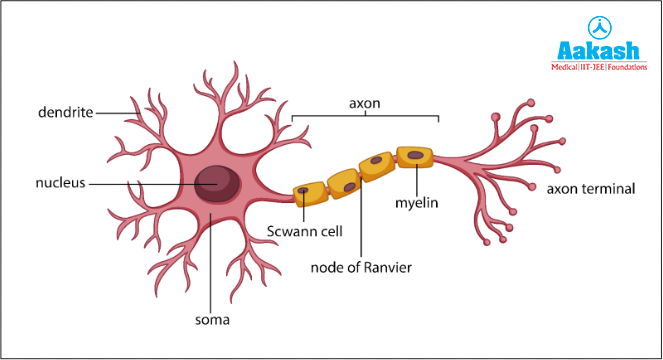
Fig: Structure of a neuron
Cell Body
Each neuron has a cell body with a nucleus, Golgi body, endoplasmic reticulum, mitochondria and other components. It is the broader round, polygonal or stellate (star-shaped) part of the neuron. The nucleus is large and has one or more prominent nucleoli. The cytoplasm is granular and is known as neuroplasm.
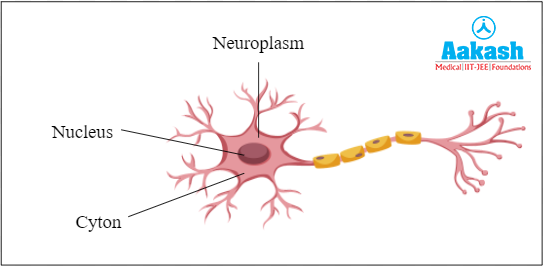
Fig: Cyton
The cytoplasm also contains Nissl granules or Nissl bodies which are basophilic structures of angular, conical or rhomboidal shapes. These granules are pieces of granular endoplasmic reticulum which may or may not have free ribosomes. They help the neuron to synthesise proteins and enzymes.
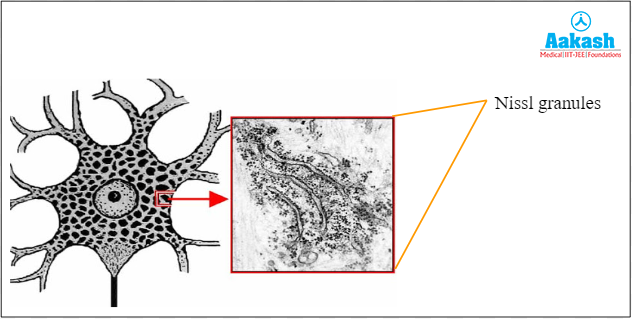
Fig: Nissl granules
The cell body also contains neurofibrils which are bundles of fine protein filaments known as neurofilaments which are 7-10 nm in diameter. They are believed to be helpful in impulse transmission. Apart from these microtubules and actin microfilaments are present which help in maintaining shape and polarity of the neuron.
Most mature neurons do not have centrioles, which explains their inability to divide and be replaced once lost. But, centrioles have been observed in some mature neurons but they do not help the cells to divide. It is believed that these centrioles might be involved in the microtubular organisation of the neuron.
Ageing neurons possess lipofuscin granules which are yellowish brown granules that appear as a byproduct of metabolism in ageing neurons.
Dendrons and dendrites
Dendrons are short but highly branched protoplasmic processes that arise from the cyton. The branches arising from the dendrons are called dendrites. Dendrites contain Nissl granules, smooth endoplasmic reticulum, actin microfilaments, neurofibrils, abundant microtubules, Golgi vesicles, mitochondria, etc. The surface bears knob-like outgrowths known as gemmules or spines which are the points at which the dendrites receive impulses from the axon at the synapse. Dendrites receive messages from other neurons and allow the transmission of messages to the cell body. Dendrons are devoid of any close-covering sheath.
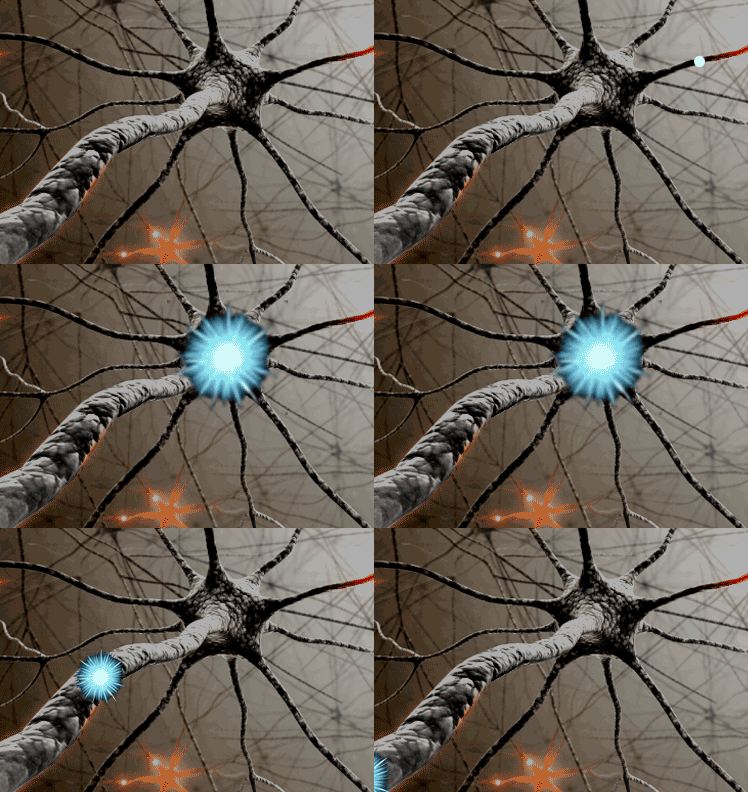
GIF: Dendrites transmitting impulses to cyton
Axon
Axon is a long fibre-like process that develops from the cyton and carries an electrical impulse from the cell body to the axon terminals that passes the impulse to another neuron. The area of origin of the axon is known as the axon hillock and is conical in shape.
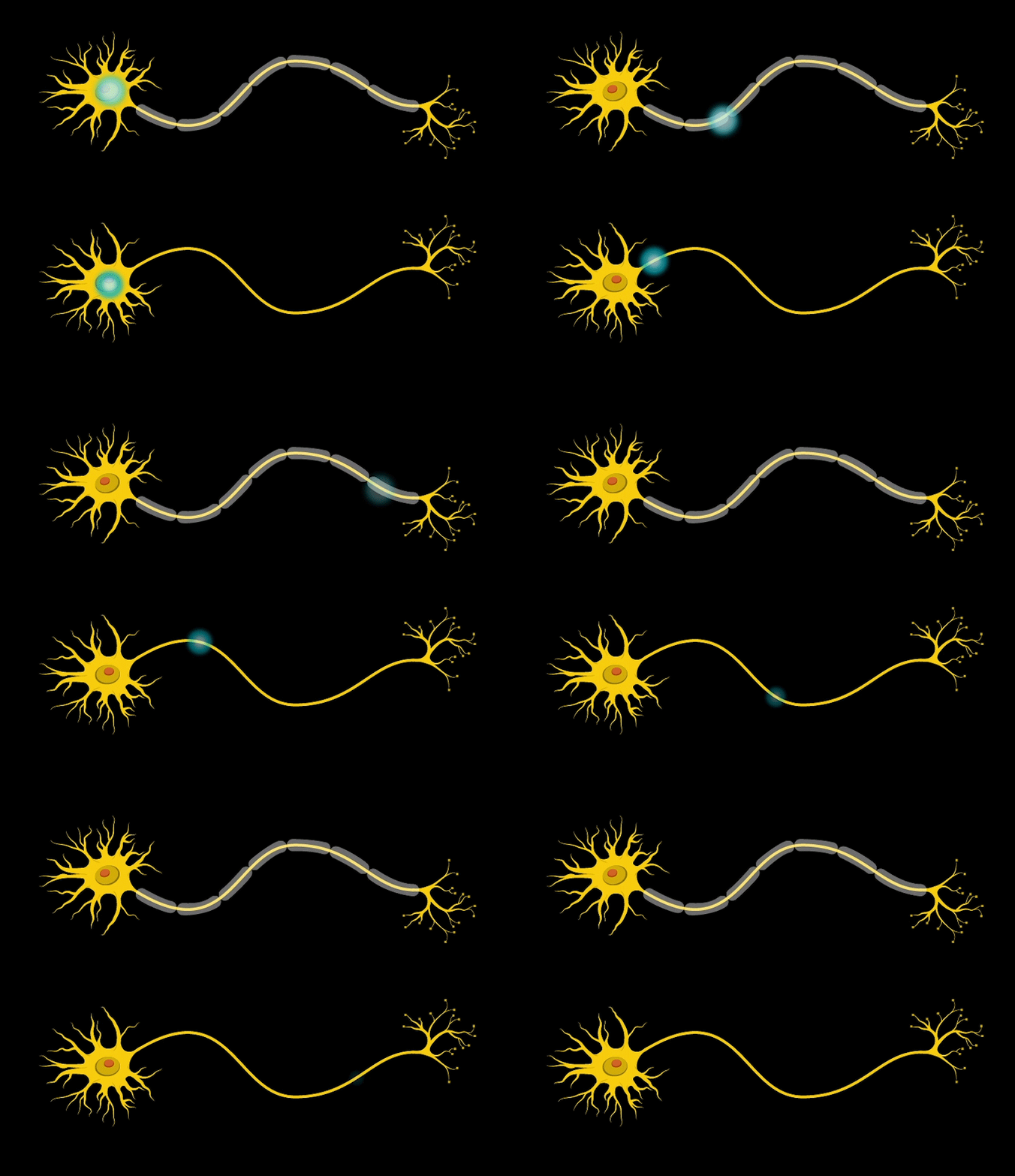
GIF: Axon transmitting impulse away from the cyton
The cytoplasm of the axon is called axoplasm and is rich in microtubules, neurofibrils, mitochondria, parts of endoplasmic reticulum and lysosomes but lacks Nissl granules, Golgi bodies and ribosomes. The axoplasm receives most of its constituents due to a slow bidirectional cytoplasmic streaming from the cyton. This is known as the axoplasmic flow.
Axons may give rise to lateral branches called collaterals. Both the axon and the collaterals end in very fine processes known as neuron endings or terminal arborisations which have expanded tips to form end plates (when in contact with muscles or glands) or synaptic knobs. This terminal area of the neuron is known as the output zone and arrival of impulse in this zone determines the stimulation or inhibition of the next neuron, muscle, gland or other cells.

Fig: Synaptic knobs and axon terminals
Axon is always ensheathed and the sheathed axon is called a nerve fibre. There exists a space of 15-20nm between the axolemma (cell membrane of axon) and the sheath covering it. This space is known as periaxonal space. Depending on the type of sheath, nerve fibres can be myelinated or non myelinated.
Myelinated nerve fibre
These nerve fibres are covered by an outer neurilemma and an inner medullary sheath or myelin sheath. The myelin sheath is made up of a shining white lipid rich substance known as myelin. The myelin sheath is secreted by the Schwann cells which form an outer sheath known as the neurilemma. Schwann cells are tubular and nucleated and the nucleated area appears as a bulge.
The myelin sheath helps in insulating the nerve fibre to prevent interference and impulse dilution. The areas of the myelinated nerve fibre which lack the myelin sheath are known as nodes of Ranvier and the area of nerve fibre between two adjacent nodes is called internode. The nodes are the points from which collaterals emerge and they also possess ion channels for the conduction of impulse.
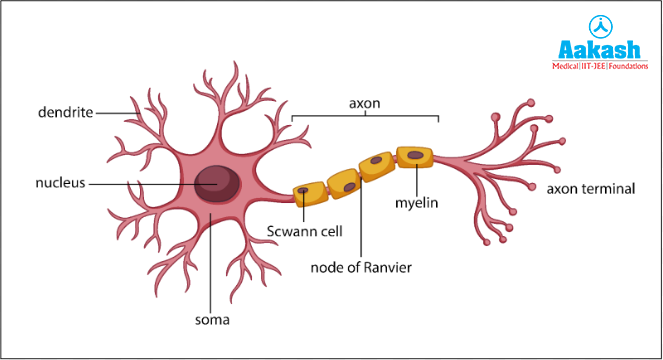
Fig: Myelinated nerve fibre
In myelinated nerve fibre the nerve impulses travel by jumping from one node to another. This is known as saltatory transmission and is 50 times faster and more efficient than in non-myelinated nerves.
Myelinated nerve fibres are found in the white matter of the central nervous system and in most nerves of the peripheral nervous system.
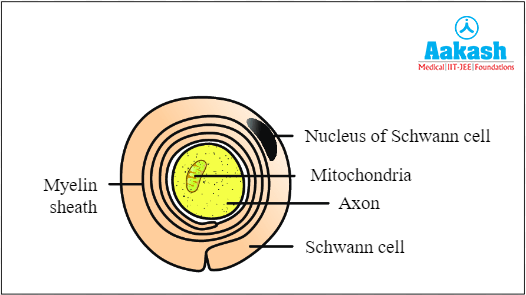
Fig: Cross section of myelinated nerve fibre
Non Myelinated nerve fibre
These nerve fibres lack the myelin sheath. These are covered only by the neurilemma which is formed by end to end joining of the Schwann cells. The impulse transmission along non myelinated nerve fibres is slower.
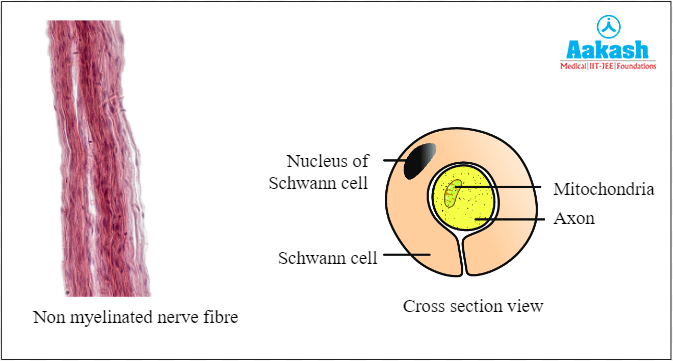
Fig: Non myelinated nerve fibre
Synapse
Synapse is the point of contact between two neurons for the transmission of impulses from the axon terminals of a presynaptic neuron to the dendrites of a postsynaptic neuron. The two neurons may be separated by a fine gap known as the synaptic cleft. The mode of transmission of impulses across a synapse can be electric or chemical.
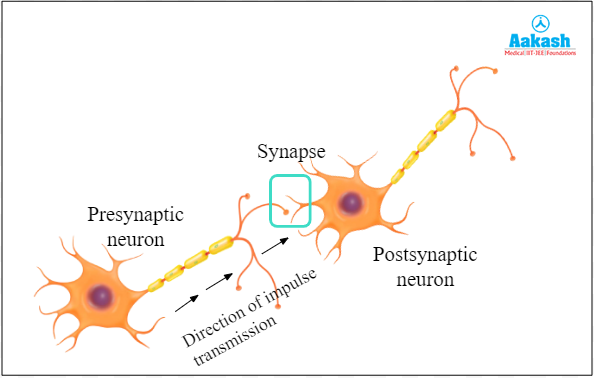
Fig: Synapse
Electrical synapses
When two neurons are connected by a gap junction, it results in an electrical synapse. These gaps include ion channels that help in the direct transmission of a positive electrical signal. These are much faster than chemical synapses. In electric synapses, the electric current from one neuron flows directly into the other neuron and the mechanism of impulse conduction across electrical synapses is very similar to impulse conduction along a single axon.
Chemical synapses
In chemical synapses, the distance between the two neurons is more. The action potential is carried along the axon to a postsynaptic ending that initiates the release of chemical messengers known as neurotransmitters. Some examples of neurotransmitters are acetylcholine, adrenaline, noradrenaline, domaine, serotonin, gamma amino butyric acid (GABA), histamine, etc. The nerve endings possess some special vesicles known as synaptic vesicles in which these neurotransmitters are stored. Synaptic vesicles release these chemicals in the synaptic cleft. The neurotransmitters bind to the receptors present on the membrane of the dendrites of the next or postsynaptic neuron. These neurotransmitters excite the postsynaptic neurons that generates an action potential in them and an impulse is generated.
Nerve
A nerve is a complex of several bundles of nerve fibres enclosed along with blood vessels within a common sheath of connective tissue. Each nerve fibre is enclosed within a sheath of connective tissue known as endoneurium. Each such nerve fibre enclosed within and endoneurium join together to form a bundle called a fasciculus or fascicle. A multilayered coat of connective tissue known as the perineurium covers each fasciculus. A nerve is composed of many such fasciculi embedded in areolar tissue and covered by a sheath of white fibrous connective tissue known as epineurium.
Nerves can be of three types -
- Afferent or sensory nerves which have sensory nerve fibres that carry impulses from the receptors to the central nervous system.
- Efferent or motor nerves which have motor nerve fibres that carry impulses from the central nervous system to the effector muscles or glands.
- Mixed nerves which contain both sensory and motor nerve fibres.
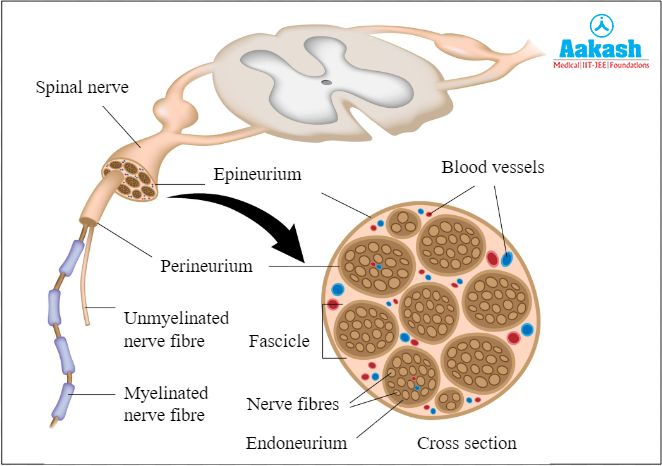
Fig: Nerve
Types of neurons
On the basis of processes
On the basis of the number of processes arising from the cyton, neurons can be of five types - Apolar, unipolar, bipolar, pseudounipolar and multipolar.
Apolar neuron
Such neurons are without any nerve processes, neither dendron nor axon. Such neurons are found in neuroblasts or immature embryonic nerve cells.
Unipolar neurons
It is a neuron with a single process which is generally an axon but can also be a dendron. These are seen in invertebrates and in the embryonic stage of vertebrates.

Fig: Unipolar neuron
Bipolar neurons
These neurons have two processes arising from the cyton or cell body. Generally an axon and a dendron arise from the cyton but at times two dendrons may also arise. These neurons occur in olfactory cells, retina and the sensory cells of the ear.
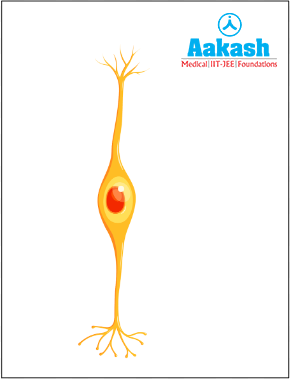
Fig: Bipolar neuron
Pseudounipolar neurons
Cyton gives rise to a single process which bifurcates to form an axon and a dendron. Examples include sensory neurons of spinal ganglia.

Fig: Pseudounipolar neuron
Multipolar neurons
The neuron possesses more than two processes, usually a single axon and multiple dendrites. These are the most commonly occurring neurons in the grey matter of the central nervous system (brain and spinal cord) and the ganglia of the autonomic nervous system.
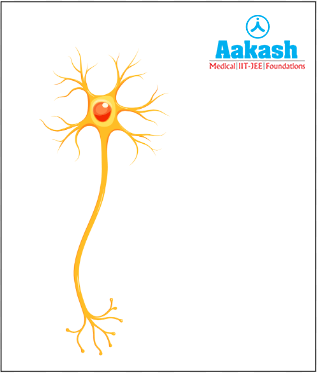
Fig: Multipolar neuron
On the basis of functional arrangements
On the basis of their function and the direction in which they carry the impulses, neurons can be sensory, motor or interneurons.

Fig: Types of neurons based on function
Sensory Neurons
Sensory neurons are the ones which receive stimuli from the receptors and transmit them to the brain or spinal cord. Some sensory processes pick up stimuli from the different sensory organs and others are connected to various parts of the body for detecting mechanical, thermal, chemical or other stimuli. Sensory neurons are generally pseudounipolar in nature.
Motor Neurons
These are multipolar neurons that transmit impulses from the central nervous system (brain and spinal cord) to the effector organs such as muscles or glands in order to elicit a response in them.
Interneurons
They are multipolar in structure. Their axons connect only to the nearby sensory and motor neurons. They help in passing signals between two neurons.
Functions of neurons
The important functions of neurons are:
- Neurons help in coordination and control of various functions of the body parts.
- All conscious activities are mediated via nerve tissue.
- The sensations of smell, taste, vision, hearing, pain, pleasure are obtained with the help of the neurons.
- Information about changes in the internal environment is brought to the central nervous system via neurons and the instructions from the CNS are taken to the related effectors to bring about changes that would help to maintain homeostasis or steady state in the body.
- Neurons make us aware of our surroundings and help us to receive stimuli from the environment and respond to them.
Practice problems
1. Choose the correct statement:
- Non myelinated nerve fibres have no sheath around the axolemma
- Myelinated nerve fibres have an inner neurilemma and an outer myelin sheath.
- Non myelinated nerve fibres have a medullary sheath covering them but lack a myelin sheath.
- Myelinated nerve fibres are covered by an outer myelin sheath and an inner neurilemma.
Solution: Myelinated nerve fibres are covered by an outer neurilemma and an inner medullary sheath or myelin sheath. The myelin sheath is made up of a shining white lipid rich substance known as myelin. The myelin sheath is secreted by the Schwann cells which form an outer sheath known as the neurilemma.
Non myelinated nerve fibres lack the myelin sheath. These are covered only by the neurilemma which is formed by end to end joining of the Schwann cells.
Thus, the correct option is d.
2. The fasciculi of the nerves are enclosed within the
- Endoneurium
- Perineurium
- Epineurium
- Neurilemma
Solution: A nerve is a complex of several bundles of nerve fibres enclosed along with blood vessels within a common sheath of connective tissue. Each nerve fibre is enclosed within a sheath of connective tissue known as endoneurium. Many nerve fibres form a bundle called a fasciculus or fascicle which is enclosed within a multilayered coat of connective tissue known as the perineurium. A nerve is composed of many such fasciculi embedded in areolar tissue and covered by a sheath of white fibrous connective tissue known as epineurium.
Thus, the correct option is b.
3. The transmission of impulses across non-myelinated nerve fibres is faster because
- The impulses jump from one Node of Ranvier to another.
- The impulses jump directly from the cyton to the axon terminals
- The impulses travel along all along the neurilemma.
- The impulses jump from one internode to the next.
Solution: The myelin sheath helps in insulating the nerve fibre to prevent interference and impulse dilution. The areas of the myelinated nerve fibre which lack the myelin sheath are known as nodes of Ranvier and the area of nerve fibre between two adjacent nodes is called internode. In myelinated nerve fibre the nerve impulses travel by jumping from one node to another. This is known as saltatory transmission and is 50 times faster and more efficient than in non-myelinated nerves.
Thus, the correct option is a.
4. Which of these neurons possesses a single nerve process that bifurcates to form an axon and a dendron?
- Unipolar
- Bipolar
- Pseudounipolar
- Apolar
Solution: In pseudounipolar neurons the cyton gives rise to a single process which bifurcates to form an axon and a dendron. Examples include sensory neurons of spinal ganglia.
Thus, the correct option is c.
FAQs
- What are neuroglial cells?
Answer: Neuroglial cells are the non-neuronal packing cells present in central nervous system, ganglia and retina. The Schwann cell found around the axons is a type of neuroglial cells. These cells help in myelin formation, transport of materials to neurons, maintaining ionic balance across the neuron membrane, phagocytosis, etc.
- How many neurons does the human brain have?
Answer: The human brain is expected to have around 86 billion neurons out of which 69 billion are present in the cerebellum of the brain and around 16 billion neurons are present in the cortex region of the cerebellum.
3. How many neurons do we lose in a day?
Answer: A person can lose upto 10,000 neurons in a day. This is alarming because it is popularly believed that neurons do not divide and regenerate. But recent studies have shown that some neurons do undergo cell division, although it is very rare and definitely at a much slower rate than their loss. But even after losing many neurons in a day, we do not lose our sensibilities or neural abilities because remaining neurons build new branches of nerve fibres and new synapses between them in order to compensate for the losses.
4. What is neuralgia?
Answer: Neuralgia is a sharp pain along one or more nerves developed due to irritation or nerve damage.
Youtube link- https://www.youtube.com/watch?v=DT1sDdKPvys

NEET Related Links
JEE MAIN Related Links
JEE Advanced Related Links
JEE Advanced Eligibility Criteria
JEE Advanced Chemistry Syllabus
JEE Advanced Registration Dates
CUET Related Links
Important Topics
Anemometer : Measurement of Wind Speed
Angular Acceleration Atomic Theory Audible and Inaudible Sound Average Speed and Average Velocity Average Velocity Avogadros Number Avogadros Hypothesis Azimuthal Quantum Number Balanced Force Bar Magnet Biconvex Lens Boyles Law Buoyancy Calorimeter Carnot Engine Celestial Bodies Centripetal And Centrifugal Force Concave and Convex Lenses Concave Convex Mirrors Contact and Non Contact Force Controlled Thermonuclear Fusion Convection Currents Convex Lens Convex Mirror Destructive Interference Difference Between Conduction Convection and Radiation Difference Between Electric Field and Magnetic Field Difference Between Heat And Temperature Difference Between Series And Parallel Circuits Differences Between Acceleration And Velocity Distance and Displacement Distance Time Graph Electrical Force : Electric Forces and Their Types Electromagnetic Waves : Definition, Equation and Properties of Electromagnetic Waves Electromagnetism Electron Spin Fluid Flow : Bernoullis Equation Derivation and Fluid Mechanics Fluid Friction : Types and Factors of Fluid Friction Frames of Reference : Inertial and Non- Inertial Frame of Reference Frequency and Wavelength Frictional Force Importance of Hydrosphere Instantaneous Speed and Velocity Introduction to Motion Kinetic and Potential Energy Difference Law Of Conservation of Energy Layers of the Earth Light Energy Light Sources List of physics scientists and Their inventionsLoudness of Sound
Magnetic Dipole Moment Magnetic Field Non - Contact Force Non - Renewable Energy Ohms Law Optics P Wave Physics Symbols Plane Mirrors Poissons Ratio Projectile Motion Properties of Water : Anomalous Expansion of Water Radius of Gyration Reflection of Light Reflection of Waves Relative Density Resonance Reverberation Rolling Friction Rotation and Revolution Screw Gauge Semiconductors and Insulators Sliding Friction Speed Time Graphs Static Friction Stefan Boltzmann Law Stress Tension Tension Force Thermometer: Clinical Laboratory Thermometer Types of Rocks Types of Waves Uniform Motion and Non Uniform Motion Unit of Voltage Uses of Convex Lens Uses Of Convex Mirror Uses of Electromagnet Uses of Optical Fibre Wave Wavelength of Light What is Scattering of Light Working of Electric Bell Conventional and Non-conventional Sources of Energy Buoyant Force Bulk Modulus of Elasticity Bernoulli’s Principle Angular Momentum Difference Between Speed And Velocity ForceUnit of Heat
Difference between Distance and Displacement Simple Microscope Derivation Of Equation Of Motion Thermometer: Clinical & Laboratory Thermometer Difference between Concave and Convex LensDerivation Of Lens Maker Formula
Unit Of Pressure Velocity Uses of Plane Mirror
Wave Theory of Light
Unit of Density Unit of Light Unit of Force Unit of Magnetic Field Unit of wavelength Unit of Viscosity Uses of Electroplating Young's Modulus
What is the Scattering of Light
Lenz Law Space Wave Propagation Schrodinger Wave Equation Relation between Fahrenheit and Celsius Refractive Index Potentiometer Working Pascal Law Oscillatory Motion Optical Instruments Newton's Laws of Motion - First Law Modulation and Demodulation Magnetic Flux Lens Formula and Magnification Kaleidoscope Faradays Law Epsilon Naught Value Energy Bands Electrostatics Electroscope AC Generator Unit of Current Lithosphere Bending Equation Derivation Difference Between Pound and Kilogram Semiconductor Devices OTEC - Ocean Thermal Energy Conversion Hall Effect Rectilinear Propagation of Light Difference Between Ammeter and Voltmeter Coefficient of Linear Expansion Ampere’s Law Cyclone and Thunderstorm Save The Environment From Pollution Particle Nature of Light Types of DC Motor Uses Of Transistor Derivation of Phase Rule Unit of Humidity

 Call Now
 Let's Chat
 Share
Share