-
Call Now
1800-102-2727


Neural Control and Coordination

Neural control and coordination refers to the detection, processing and response to the stimuli through the combined action of the nervous system and the endocrine system. The ultimate goal here is to maintain homeostasis within the body. For instance, muscles require more oxygen while exercising. The needs are met by increasing the breathing and heart rate.
What is Neural Control and Coordination?
Neural control and coordination are the mechanisms to respond to the changing requirements of the body. It is achieved through the coordinated action of the nervous and endocrine systems.
The role of the nervous system is to:
- Detect changes (stimuli) in the environment
- Process the information
- Respond through muscles or glands
The endocrine system deals with releasing hormones that control important long-term activities like growth, development, and metabolism.
Neural Systems in Organisms
The neural systems differ in complexity and structure among different organisms. Here is how they vary:
- In lower invertebrates like Hydra, the nervous system is just a nerve net, a simple network of neurons.
- In insects, the system is more advanced. They have a brain, nerve cords, and ganglia that control body functions.
- In humans, the neural system is highly evolved with complex central and peripheral systems.
Human Nervous System
It is divided into the Central Nervous System and the Peripheral Nervous System.
| Feature | Central Nervous System (CNS) | Peripheral Nervous System (PNS) |
|---|---|---|
| Definition | The main control centre of the body | Connects the CNS to the rest of the body |
| Components | Brain and spinal cord | Cranial nerves, spinal nerves, and ganglia |
| Location | Located inside the skull and vertebral column | Located outside the CNS (throughout the body) |
| Protection | Protected by skull (brain), vertebral column (spinal cord), and meninges | Not protected by bones or meninges |
| Function | Processes, analyzes, and stores information; sends commands | Transmits information to and from the CNS |
Structure and Function of a Neuron
A neuron is the structural and functional unit of the nervous system.
Parts of a neuron:
- Cell body (Cyton) contains the nucleus and cell organelles
- Dendrites are short extensions that receive signals
- Axon is a long fibre that carries impulses away from the cell body to the target, which can be another neuron or muscle.
Function:
- Neurons carry electrical signals called nerve impulses.
- These impulses are generated due to ionic (sodium and potassium ions) changes across the neuron membrane.
Generation and Conduction of Nerve Impulse
Here is how electrical changes are generated in the neuron to transmit the signal:
- The neuron stays polarised when inactive.
- On stimulation, depolarization occurs, which involves the movement of sodium ions into the cell membrane of a neuron. It starts a nerve impulse.
- The action potential propagates along the axon as successive Na⁺ channels open. It reaches the axon terminal, where the nerve impulse must head to another neuron, muscle or gland by crossing the synapse (covered in the next section).
- Once an action potential passes, the K⁺ channels open to restore the resting membrane potential, with the Na⁺/K⁺ pump maintaining ion gradients.
Synapse and Neurotransmitters
A synapse is the junction between two neurons or a neuron and a muscle or gland.
Two types:
- Electrical Synapse – signal passes directly
- Chemical Synapse – signal passes using neurotransmitters (e.g., acetylcholine, dopamine)
Chemical synapse:
- The signal reaches the axon terminal
- Neurotransmitters are released into the synaptic cleft
- They bind to receptors on the next cell and transmit the impulse
Reflex Action and Reflex Arc
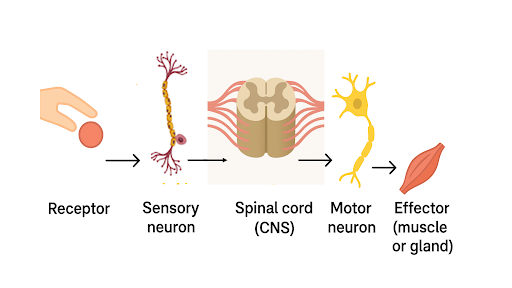
A reflex is a quick, automatic response to a stimulus without thinking. It is a practical example of neural control and coordination. A common instance of reflex action is pulling your hand away as soon as you touch a hot object.
Reflex Arc Pathway:
Receptor → Sensory neuron → Spinal cord (CNS) → Motor neuron → Effector (muscle or gland)
Alt-text: Reflex Arc
Human Brain – Control Centre
The processing of the information to act in a certain way occurs in the brain, which is protected by the skull. The brain has three main parts.
- The forebrain controls thinking, memory, learning, and movements. It also controls hunger, thirst, emotions, and body temperature. It passes sensory messages.
- The midbrain connects the front and back parts of the brain. It controls eye movement and hearing reflexes.
- The hindbrain controls balance and coordination. This happens through the cerebellum. The pons connects different parts of the brain. The medulla controls automatic actions. These include breathing and heartbeat.
The brain is enveloped by three thin layers called meninges for additional protection. These layers are:
- Dura mater, the strong outer layer.
- Arachnoid, the middle layer.
- Pia mater, the thin inner layer with blood vessels.
Spinal Cord
The spinal cord, a part of the CNS and protected by meninges, is also important in neural control and coordination. Here is how:
- Extends from the brain down the back
- Transmits signals between the brain and the body
- Controls reflex actions independently
Nervous Coordination in the Human Eye
The eye is the sense organ for vision. It converts light into nerve impulses. The optic nerve carries impulses from the retina to the visual center in the occipital lobe of the cerebrum.
Nervous control:
- Eye muscles (controlled by cranial nerves) adjust the lens shape and pupil size.
- Visual information is processed in the brain to form images.
Nervous Coordination in the Human Ear
The ear is the sense organ for hearing and balance.
Nervous control:
- The auditory nerve carries signals to the brain for sound interpretation.
- The vestibular nerve sends balance information to the cerebellum and other parts of the brain.
FAQs
Q1. What is homeostasis?
A. It is the body’s process of maintaining a stable internal environment.
Q2. What is Ganglia?
Ganglia are clusters of neurons located in the peripheral nervous system. They connect sensory and motor neurons, thus allowing processing and transmission of signals.
Q3. Which cells generate myelin sheath?
Myelin sheath is formed by Schwann cells in the peripheral nervous system and oligodendrocytes in the central nervous system.


 Call Now
 Let's Chat
 Share
Share