-
Call Now
1800-102-2727


Nephron: Structure and Types, Juxtaglomerular Apparatus (JGA), Significance of Nephron, Common Diseases of Nephron, Practice Problems, and FAQs

You must have seen water purifiers at home, in schools, shopping malls, etc. What are they used for? They are used to filter and remove waste materials from water. Did you know that a similar machine works inside our body too? Can you name it? Yes, the kidneys! Our body generates a lot of nitrogenous wastes due to metabolic reactions and these wastes mix with the circulating blood. But can we allow these wastes to accumulate in the body? No, we cannot because these wastes are toxic for the body when allowed to accumulate in the body. Thus, we need a purifier that can purify the blood and filter out the wastes which can be eliminated from the body. This job is done by the kidneys.
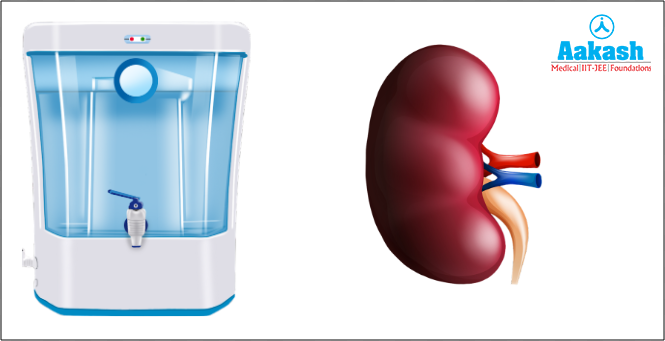
Fig: Purifier system
Have you noticed that each water purifier comes with a filter attached to it which acts as its functioning unit. Similarly, kidneys have millions of coiled structures known as nephrons which individually filter the blood and serve as their functioning units.
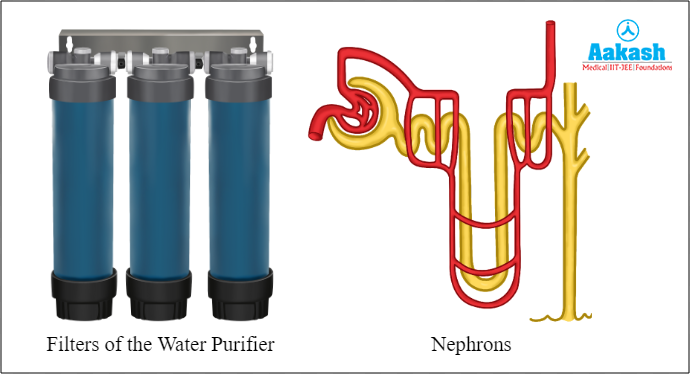
Fig: Functional units
In this article we are going to discuss the nephrons in detail and try to understand their structure and the different types of nephrons.
Table of contents
- Nephron
- Structure of nephron
- Types of Nephrons
- Cortical nephron vs Juxtamedullary nephron
- Juxtaglomerular apparatus (JGA)
- Significance of nephron
- Nephrotic syndrome
- Practice Problems
- FAQs
Nephron
Nephron is the structural and functional unit of the kidneys. Each kidney has about one million nephrons. Nephrons are long and coiled structures made up of two parts - renal tubules and the glomerulus. The nephrons are held together in the kidney with the help of connective tissues. The term ‘nephron’ is derived from the Greek word ‘nephros’ which stands for the kidney.
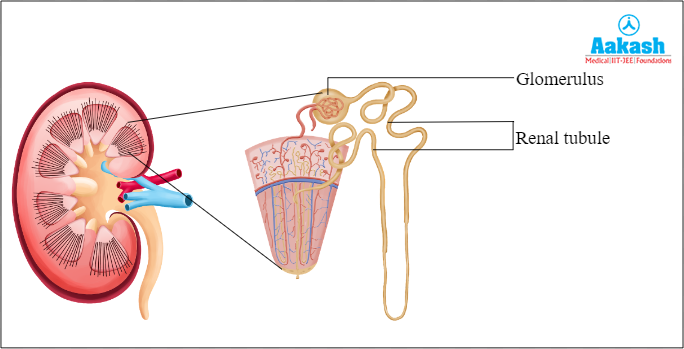
Fig: Nephron
Structure of nephron
Each nephron consist of two parts
- The glomerulus
- The renal tubule
Glomerulus
Glomerulus is a tuft of capillaries that resembles a ball of thread. The term ‘glomerulus’ is derived from the Latin word ‘glomer’ which stands for a ball of thread. This structure lies in the cup shaped cavity of the Bowman’s capsule. It is the site of ultrafiltration, which is the first step in urine production. A fine branch of the renal artery called the afferent arteriole branches into the capillaries which form the glomerulus. The glomerular capillaries join to form an efferent arteriole which is narrower in diameter compared to the afferent arteriole. Blood enters the glomerulus through the afferent arteriole and leaves through the efferent arteriole.
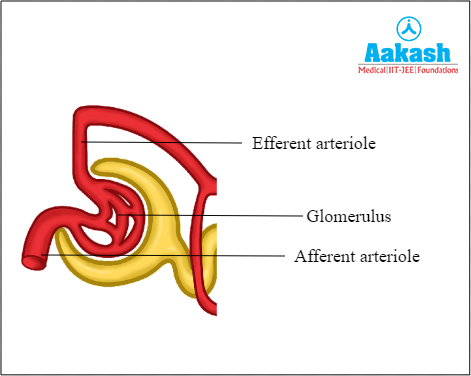
Fig: Glomerulus
Functions of glomerulus
The glomerulus helps in ultrafiltration of blood. As the afferent arteriole is wider than the efferent arteriole, a huge amount of hydrostatic pressure is created when blood flows through the glomerulus. This causes the liquid part of blood along with dissolved solutes, such as water, glucose, amino acids, urea, uric acid creatinine, and other small molecules up to 40kDa to filter out of the glomerulus and enter into the Bowman’s capsule. The corpuscles and larger proteins remain in th e glomerular capillaries and leave through the efferent arteriole. This process of filtering out the fluid and soluble parts of the blood under huge pressure is known as ultrafiltration. The fluid that enters the Bowman’s capsule is known as glomerular filtrate.
Renal tubule
It begins with a double-walled cup-like structure called Bowman’s capsule and its other end opens into the collecting duct. It is differentiated into the Bowman’s capsule, Proximal Convoluted Tubule (PCT), Henle’s loop and the Distal Convoluted Tubule (DCT). As the glomerular filtrate passes through the renal tubule, useful substances and water are reabsorbed from the renal tubule into the blood flowing through the capillaries surrounding the tubule based on the blood pressure and composition of the body. This process is known as selective reabsorption.
Bowman’s capsule
It is a double-walled cup-like structure that lies at the proximal end of the renal tubule. The cavity of this capsule holds the glomerulus. The outer or parietal layer of the Bowman’s capsule is composed of flattened epithelial cells. The inner or visceral layer is formed of special podocyte cells or foot cells and lies in close proximity to the glomerulus. The foot cells have numerous feet-like processes called pedicels. They also possess thousands to millions of 2 nm wide pores known as the slit pores. The endothelial cells of the glomerulus also possess 50-100 nm wide pores known as fenestrae.
Thus the filtering membrane is composed of the visceral layer of Bowman’s capsule, the basement membrane and the endothelial lining of glomerulus. The permeability of the glomerular membrane is around 100-500 times more than that of usual capillaries. The filtering membrane helps in ultrafiltration of blood.
The Bowman’s capsule along with its glomerulus is called the renal corpuscle or Malpighian body or Malpighian corpuscle. It lies in the cortex of the kidney which is the darker and dotted outer portion of the kidney.
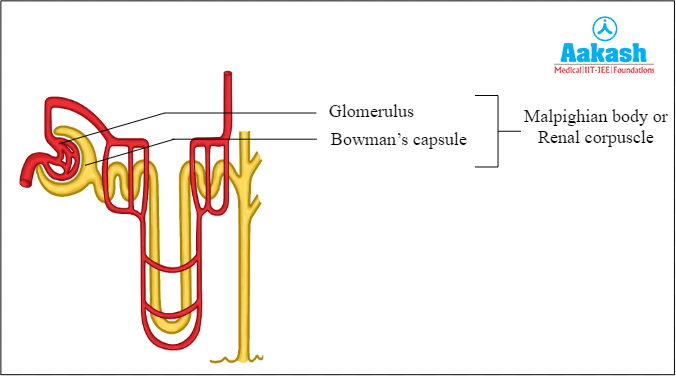
Fig: Malpighian tubule
Proximal convoluted tubule (PCT)
The lower part of the Bowman’s capsule leads into PCT. PCT is present in the cortex. It is a highly coiled structure that is surrounded by peritubular blood capillaries which branch out from the efferent arteriole. It is lined by brush-bordered cuboidal epithelium. It performs active absorption and secretion of useful substances from the Glomerular filtrate that enters the renal tubule after ultrafiltration.
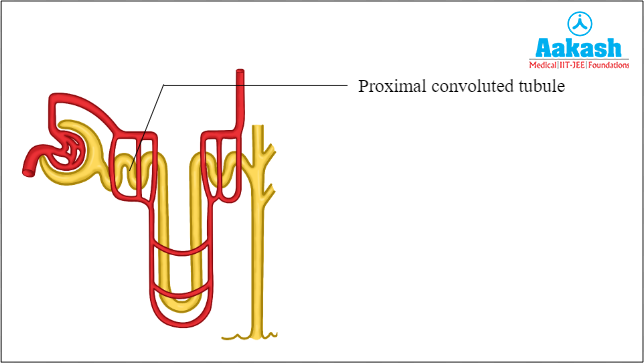
Fig: Proximal convoluted tubule
Loop of Henle
It is a hair-pin-like tubular structure. It is a part of the nephron which descends into the renal medulla. It is made up of two parallel limbs, descending and ascending. The ascending limb of Henle’s loop is continuous to the distal convoluted tubule (DCT), which is another highly coiled tubular structure. The Henle’s loop also participates in selective reabsorption from the glomerular filtrate.
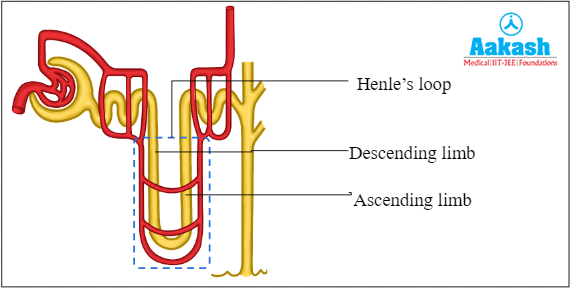
Fig: Loop of Henle
Distal convoluted tubule
The ascending limb continues in the distal convoluted tubule (DCT) which is characterised by the highly coiled tubular structure. It also lies in the renal cortex and ends into a short and straight collecting tubule which opens into the collecting duct. It selectively reabsorbs water, sodium ions, amino acids, etc from the glomerular filtrate.
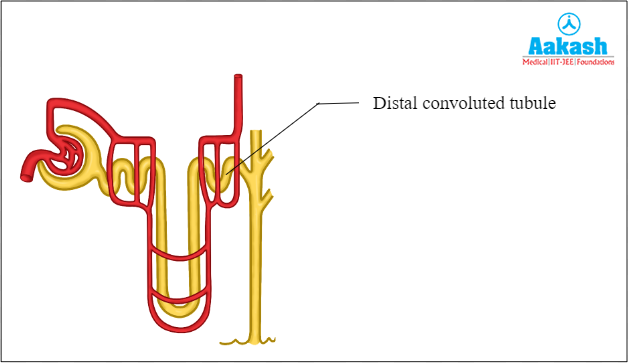
Fig: Distal convoluted tubule
Collecting duct
The collecting tubules of many nephrons open into a straight tube called a collecting duct. It enters the medulla and joins with other collecting ducts to form the ducts of Bellini.
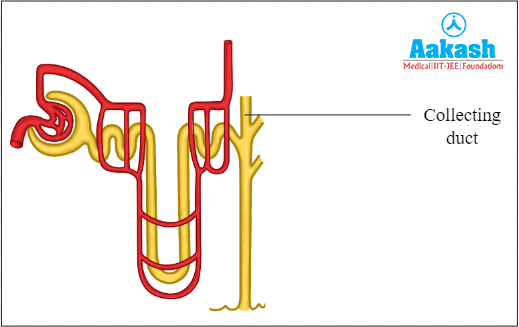
Fig: Collecting duct
Many collecting ducts run along the pyramids of the renal medulla and converge and open into the renal pelvis through the calyces. Urine formed in the nephrons is transported to the ducts of Bellini by the collecting ducts and from there it passes through the calyces into the renal pelvis. From the pelvis, the urine moves to the ureter which carries it to the urinary bladder.
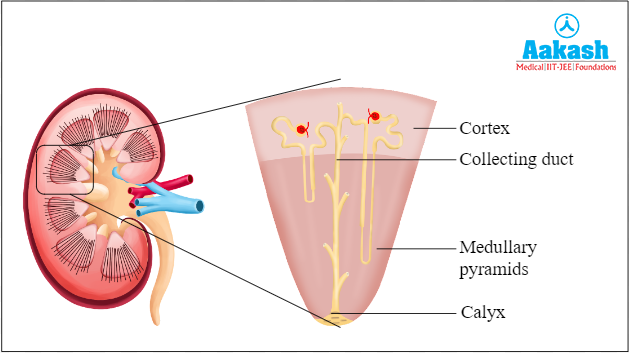
Fig: Medullary pyramid
Vasa recta
The efferent arteriole emerging from the glomerulus forms a fine capillary network around the renal tubule known as the peritubular capillaries.
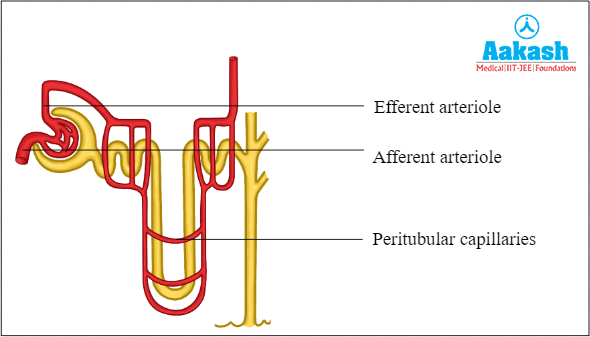
Fig: Peritubular capillaries
A minute vessel of this network runs parallel to the Henle’s loop and forms a U-shaped vasa recta. It is absent or highly reduced in cortical nephrons. The peritubular capillaries of the kidney join to form the renal venules which further join to form the renal vein which carries the blood free of nitrogenous wastes to the heart.
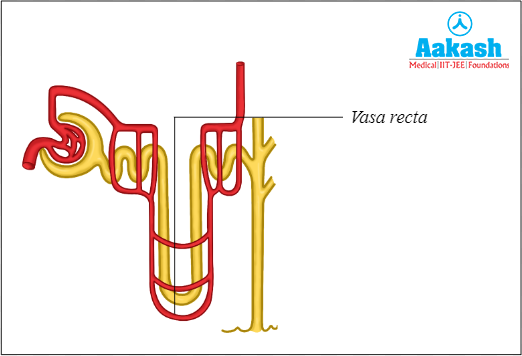
Fig: Vasa recta
Types of Nephrons
Nephrons are divided into two types:
- Cortical nephrons
- Juxtamedullary nephrons
Cortical nephrons
Cortical nephrons are those that majorly lie in the renal cortex and only penetrate the outer renal medulla shortly as they contain a tiny, short loop of Henle. In the human kidney, 85% of the total nephrons are cortical nephrons. Cortical nephrons thus play a major role in controlling the plasma volume when the body does not need to conserve water.
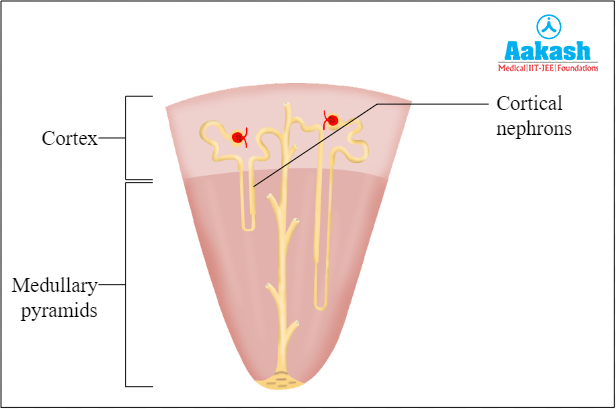
Fig: Cortical nephron
Juxtamedullary nephrons
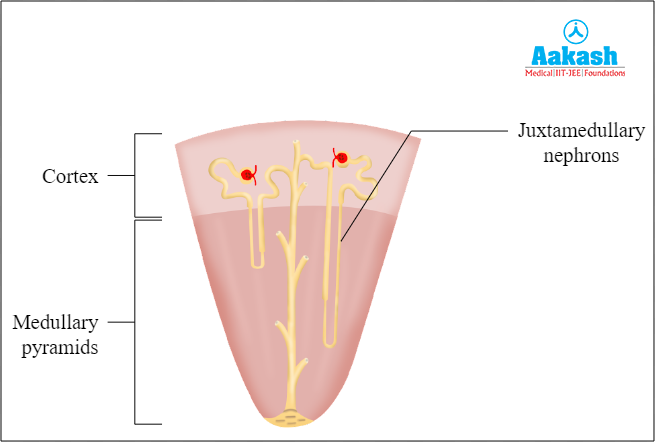
The Henle’s loop of the juxtamedullary nephron is long and extends deep into the renal medulla. Out of the total nephrons in the kidney, only 15% of nephrons are juxtamedullary nephrons. These nephrons lie both in the renal medulla and the renal cortex. Their glomeruli lie close to the inner margin of the cortex and the long loop of Henle in the renal medulla. These nephrons have a large glomerulus, which boosts the glomerular filtration rate of the nephron. Juxtamedullary nephrons are primarily responsible for diluting or concentrating urine. More water absorbed by the vasa recta may result in more concentrated urine, whereas less water reabsorption may result in diluted urine.

Fig: Juxtamedullary nephron
Cortical nephron vs Juxtamedullary nephron
Differences
|
Cortical nephrons |
Juxtamedullary nephrons |
|
Henle’s loop is short |
Henle’s loop is long |
|
Extends very little into the medulla |
Extends deep into the medulla |
|
Contains a reduced vasa recta |
Contains a large network of vasa recta |
|
Contains small glomerulus |
Contains large glomerulus |
|
Constitute 85% of the total nephrons in the kidney |
Constitute 15% of the total nephrons in the kidney |
|
Fig: Cortical nephron |
Fig: Juxtamedullary nephron |
Similarities
There are some similarities between cortical and juxtamedullary nephrons that are described below:
- Cortical nephron and juxtamedullary nephron are two types of nephrons present in the kidney.
- Both types of nephrons contain several structures, such as glomerulus, Bowman’s capsule, proximal convoluted tubule, the loop of Henle, distal convoluted tubule, and a collecting duct.
- The renal cortex contains the glomerulus, Bowman's capsule, and the proximal and distal convoluted tubules of both cortical and juxtamedullary nephrons.
- The Henle loop and collecting duct of the cortical and juxtamedullary nephrons both extend to the renal medulla.
- Both the juxtamedullary nephron and the cortical nephron filter blood to produce urine.
Juxtaglomerular apparatus (JGA)
A special region, formed because the compact arrangement of the nephrons allows close contact between the afferent arteriole and the ascending limb of the nephron where it continues to be the distal convoluted tubule. At this region, the cells of the ascending limb are modified to form the macula densa and the ones in the afferent arteriole form the juxtaglomerular cells. Together they form the juxta glomerular apparatus (JGA). The cells of the macula densa monitors NaCl levels in the tubular fluid and influences the juxtaglomerular cells which releases the hormone renin, which helps in blood pressure regulation and also regulates the glomerular filtration rate (GFR).

Fig: Juxtaglomerular apparatus
Significance of nephron
- The chief function of nephron is to regulate the level of water and other soluble substances in the blood. This can be regulated by filtering the blood, reabsorbing what is required, and excreting the remaining amount as urine.
- Nephrons are responsible for the elimination of waste products from the body.
- It also regulates blood volume and blood pressure, and blood pH, and controls levels of electrolytes and metabolites in the blood.
Nephrotic syndrome
Nephrotic syndrome is a disease in which the glomeruli are typically damaged. It is the most common presentation of glomerulonephritis which is an inflammation of the glomeruli caused due to drug reactions or microbial infections. This causes release of RBCs, WBCs, albumin protein in the urine as the permeability of the glomerulus increases. The condition of nephrotic syndrome causes swelling in the feet and ankles. It also increases the risk of other health problems.
There are two types of glomerulonephritis:
- Acute glomerulonephritis
- Chronic glomerulonephritis
Acute glomerulonephritis
This type of glomerular disease occurs suddenly, such as from a viral infection.
Chronic glomerulonephritis
This type of glomerular disease develops from several conditions, such as high blood pressure.
Symptoms of nephrotic syndrome
The common signs and symptoms of nephrotic syndrome are listed below:
- Edema around the eyes, ankles, and feet
- Excess amount of protein is present in the urine and that forms foamy urine
- The blood vessels are not able to filtrate properly due to which fluid retention occurs that ultimately leads to weight gain
- Fatigue
- Loss of appetite
- Blood in the urine
- High blood pressure
- Anaemia
Causes of nephrotic syndrome
Nephrotic syndrome is caused when the damage occurs in the glomeruli in the kidneys. Glomerulonephritis can be the underlying cause for the nephrotic syndrome which in turn can be triggered by the following conditions:
- Bacterial and viral infection
- Autoimmune diseases, such as lupus and goodpasture
- Cancer
- Vasculitis
Practice Problems
- Which of the following is present in the cortical part of the kidneys?
- Proximal convoluted tubule
- Malpighian corpuscles
- Distal convoluted tubules
- All of the above
Solution: The kidney is divided into two zones, an inner medulla, and an outer cortex. Cortex occupies the peripheral zone of the kidneys. The malpighian corpuscle, proximal convoluted tubule, and distal convoluted tubule are situated in the cortical part of the kidney, and the Henle’s loop is found in the medulla. Hence, the correct option is d.
- Juxtaglomerular apparatus is formed at the location of contact of
- ascending limb of the renal tubule and afferent arteriole
- proximal convoluted tubule and efferent arterioles
- proximal convoluted tubule and afferent arterioles
- distal convoluted tubule and efferent arterioles
Solution: A special region, formed because of the compact arrangement of the nephrons allows the afferent arteriole and the ascending limb of the nephron where it continues to be the distal convoluted tubule to come in close contact with each other. At this region, the cells of the ascending limb are modified to form the macula densa and the ones in the afferent arteriole form the juxtaglomerular cells. Together they form the juxta glomerular apparatus (JGA). Hence, the correct option is a.
- Which of the following is absent in the medulla?
- Loop of Henle
- Juxtaglomerular apparatus
- Collecting duct
- Vasa recta
Solution: Juxtaglomerular apparatus (JGA) is a special sensitive region formed in the cortex region of the kidney. It is formed because of cellular modifications in the the ascending limb of the nephron where it continues to be the distal convoluted tubule and the afferent arteriole at the location of their contact. The compact arrangement of the nephrons allows them to come in close contact. JGA regulates blood pressure. Hence, the correct option is b.
- What is Bowman’s capsule?
Answer: Renal tubule begins with a double-walled cup-like structure called Bowman’s capsule. The two walls are - Outer parietal, and Inner visceral. Both walls are single-layered and have the support of a basement membrane.
Glomerulus + Bowman’s capsule = Malpighian body
The Bowman’s capsule is found in the cortex region of the kidney. So, the nephrons begin in the cortex and the renal tubules extend into the medulla of the kidneys.
FAQs
1. What is osmoregulation?
Answer: The process of maintaining a steady osmotic pressure and concentration of the blood is known as osmoregulation.
2. In which part of the nephron is maximum water reabsorbed?
Answer: The proximal convoluted tubule is responsible for reabsorption of maximum amount of water as the glomerular filtrate passes through the renal tubule.
3. How are nephrons adapted in camels?
Answer: The nephrons in the camel have a well-developed Henle’s loop. The juxtamedullary nephrons are 35% in camels. This is because camels do not readily find water and to maintain the water level they have to excrete less water.
4. Is the blood carried by the afferent arteriole deoxygenated?
Answer: The blood carried by the afferent arteriole is oxygenated but has a high concentration of urea. The blood leaving the kidneys via the renal vein is deoxygenated but is free of nitrogenous wastes.

 Call Now
 Let's Chat
 Share
Share