-
Call Now
1800-102-2727


Muscle Tissue: Its Functions, Properties and Types, Skeletal, Smooth and Cardiac Muscles, Practice Problems and FAQs

We all enjoy the movement of the judoka, a person who practises judo. You also have seen people in gyms, they will be doing various exercises there. But have you ever wondered how people can perform these types of movements?
GIF: Exercise

In human beings different types of muscles are present and they allow movement of different parts of the body. Our visceral organs also show various types of movements. Most of these movements won’t be under our control. For example, the heart continuously beats because of the presence of cardiac muscles that do not require voluntary control. Similarly, the alimentary canal passes food through it. This occurs due to peristalsis which is done with the help of smooth muscles. In this article we will discuss in depth about these muscles that are responsible for different types of movements.
Table of contents
- Structure of muscle tissue
- Properties of muscle tissue
- Functions of muscle tissue
- Types of muscle tissue
- Skeletal muscle
- Smooth muscle
- Cardiac muscle
- Practice Problems
- FAQs
Muscle tissue structure
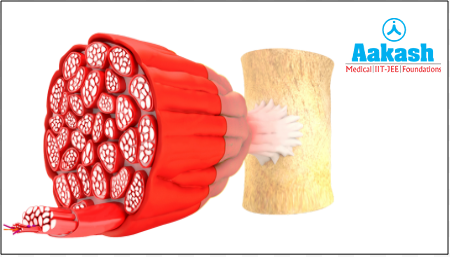
It is composed of many long, thin and cylindrical cells called muscle fibres. They are unbranched cells. They are arranged parallel to each other. They possess numerous mitochondria. Sarcoplasm is the cytoplasm of muscle fibres. It possesses a large number of myofibrils. Endoplasmic reticulum is called sarcoplasmic reticulum. Sarcoplasm possesses fine threads called myofibrils. The cell membrane of muscle fibre is called sarcolemma.
Fig: Muscle tissue

Properties of muscle tissue
Muscle tissues shows the following properties:
Contractility
The cells of muscle tissue can shorten and return to their original relaxed state. This contraction occurs in a definite direction. It occurs mainly in their long axis.
Electrical excitability
Muscle tissue can conduct or transmit electrical impulses or action potentials like nervous tissue. They respond to stimuli.
Functions of muscle tissue
- Muscle helps in body movements and locomotion.
- In response to stimulus, they contract (shorten) and relax (lengthen). In this way, the muscle fibres generate movements.
- They help in facial expressions.
- Muscles of the uterus help in childbirth.
- They help in defence.
- They support bone and other structures of the body.
- They are responsible for heartbeat.
- They help in peristalsis also.
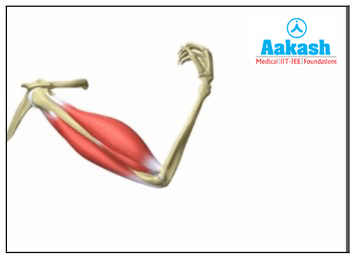
GIF: Movement of muscle
Types of muscle tissue
Muscle tissues are divided into three types according to structure and function as follows:
- Skeletal muscle
- Smooth muscle
- Cardiac muscle
Skeletal muscle
Characteristics |
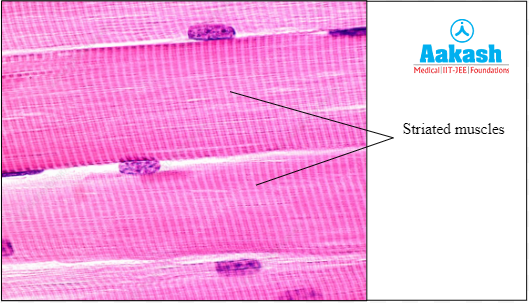
Skeletal muscle tissue is closely associated with skeletal bones. Each muscle is covered by a connective tissue sheath called epimysium. Muscle fibres are striated. Muscle fibres are arranged parallel to one another. Muscle fibres are arranged normally in bundles which are called fasciculi. Each fasciculus is surrounded by perimysium which is made up of connective tissue. Endomysium is a connective tissue sheath that surrounds each muscle fibre. They are multinucleated. Muscle fibre contains numerous mitochondria and glycogen granules. They are voluntary muscles. They constitute more than 80% of the soft tissues of the body. Fig: Muscle fibres are arranged parallel to each other |
Location |
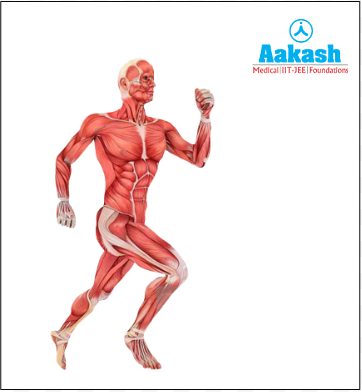
Skeletal muscle tissue is muscular tissue that is seen attached to bones. They are found in the limbs, body wall, tongue, pharynx etc. |
Function |
Skeletal muscle tissue helps in locomotion and movement. |
Image |
|
Smooth muscle
Characteristics |
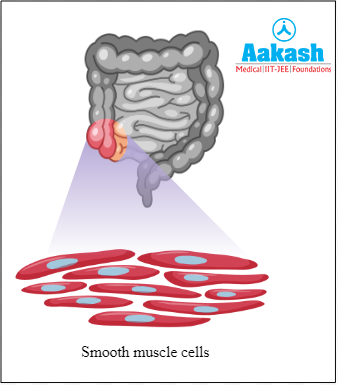
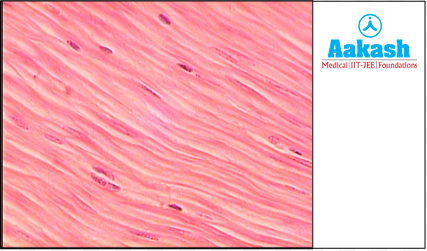
They are also called visceral muscles. In smooth muscle tissue, striations are absent. Smooth muscle fibres are long, narrow and spindle shaped. They taper at both ends. Cell junctions hold the smooth muscle cells together. Smooth muscle fibres are arranged in a connective sheath. They possess a single nucleus. They are enclosed by plasma membranes and are involuntary muscles. |
Location |
It is found in the wall of internal organs like blood vessels, stomach and intestines. Fig: Smooth muscle tissue of intestine |
Function |
|
Image |
|
Cardiac muscle
Characteristics |
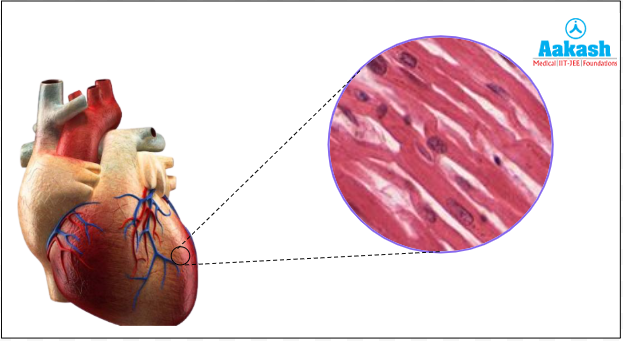
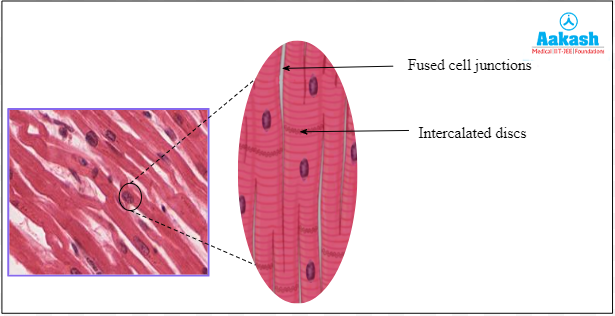
Cardiac muscle is a contractile tissue. Cardiac muscle fibres are striated. They consist of short, cylindrical fibres. Cell junctions fuse the plasma membrane of adjacent cardiac muscle cells. At some fusion points, communication junctions or intercalated discs are present. Intercalated discs receive signals from one cell and pass to the other cell. Muscle fibres normally contain more glycogen granules and mitochondria. These fibres are innervated by cranial nerves and autonomic nervous systems. They are supplied with blood vessels. |
Location |
It is only present in the heart.
|
Function |
|
Image |
|
Practice Problems
Q 1. How many types of muscles are there on the basis of location?
a. Two
b. Three
c. Four
d. Five
Answer: On the basis of location, muscles are classified into three types:
- Visceral muscles - Present in the wall of internal organs like blood vessels, stomach and intestines.
- Cardiac muscles - They are present in the heart.
- Skeletal muscles - They are seen attached to bones. They are found in the limbs, body wall, tongue, pharynx etc. Hence, the correct option is b.
Q 2. Muscle fibre has a cytoplasm which is known as _____________.a
a. Sarcoplasm
b. Sarcolemma
c. Myofibril
d. Sarcoplasmic reticulum
Answer: Sarcoplasm is the cytoplasm of muscle fibre. Large number of myofibrils are present in this. Hence, the correct option is a.
Q 3. Which of the following muscles is tapered at both ends?
a. Smooth muscle
b. Cardiac muscle
c. Skeletal muscle
d. None of the above
Answer: Smooth muscle fibres have a long, narrow, spindle-shaped form. They are tapered at each end. Hence, the correct option is a.
Q 4. Which of the following muscles is voluntary?
a. Smooth muscle
b. Cardiac muscle
c. Skeletal muscle
d. None of the above
Answer: Skeletal muscles are voluntary muscles, that means they are not under the control of the nervous system. Hence, the correct option is c.
Q 5. Write the differences between smooth, cardiac and skeletal muscles.
Answer:
|
Skeletal muscle |
Smooth muscle |
Cardiac muscle |
|
They are long and cylindrical |
They are long and spindle shaped |
They are short and cylindrical |
|
They possess blunt ends |
They possess tapering ends |
They possess truncate ends |
|
They are multinucleated |
They are uninucleate |
They are uninucleate |
|
Intercalated discs are absent |
Intercalated discs absent |
Intercalated discs present |
|
They are striated |
They are non striated |
They are striated |
|
They have numerous mitochondria |
They have less mitochondria |
They have numerous mitochondria |
|
They show rapid contractions |
They show slow contractions |
They show rapid contractions |
|
They are unbranched |
They are unbranched |
They are branched |
|
They are voluntary muscles |
They are involuntary muscles |
They are involuntary muscles |
|
They seen attached to skeletal system |
They are associated with the viscera |
They are present in the heart |
|
Fig: Skeletal muscle |
Fig: Smooth muscle |
Fig: Cardiac muscle tissue |
Q 6. What are the characteristics of smooth muscle?
Answer: The characteristics of smooth muscle are as follows:
- They are spindle shaped and long with tapering ends.
- They are non-striated and uninucleated.
- They are unbranched.
- They are involuntary.
- They are commonly seen associated with the viscera.
FAQs
Q 1. How much water concentration is there in muscle tissue?
Answer: The muscle tissue is composed of around 79 percent of water.
Q 2. Why are muscle cells long?
Answer: The muscle cells are long so that they can contract and relax with other cells.
Q 3. How do muscle cells change their shape?
Answer: Muscle is a soft tissue, and its cells contain actin and myosin protein filaments that move past one another, causing the cell to contract and change its length and form.
Q 4. In how much time do muscle cells develop?
Answer: Muscle development is a slow process and it takes around three to four weeks to see a visible change.
Related Topics
|
Epithelial tissue: Its characteristics, Simple epithelium, Compound epithelium, Intercellular junctions, Practice Problems and FAQs |
|
Specialised connective tissue: Cartilage and its types, Functions of cartilages, Practice Problems and FAQs |
|
Neural tissue: Neuron - its parts and functions, Neuroglial cells, Practice Problems and FAQs |

 Call Now
 Let's Chat
 Share
Share