-
Call Now
1800-102-2727


Multiple Allelism, Practice problems and FAQs

What is your blood group? You must be aware of the ABO blood grouping system based on which human beings can possess any one of the four blood groups - A, B, AB or O. But do you know what determines these blood groups? The type of blood group a person has is determined by the antigen present on his or her red blood cells (RBCs). What are these antigens you ask? We will get into the details later in this concept page but aren’t you curious to know what decides what antigen will be present on the RBCs of a person? Well, like all other characteristics that we possess, the blood group and consequently the antigens on the surface of our RBCS are influenced by our genes.
Now whenever we speak of genes and genetics, what immediately comes to our minds are the laws of inheritance proposed by the ‘Father of Genetics’ Gregor Mendel. According to the first law of inheritance by Mendel, every trait is influenced by a pair of alleles of which one is dominant and the other is recessive. But did you know that this law is not universal? There are many characters whose inheritance do not follow the laws of inheritance proposed by Mendel. An example of one such character is our blood group which is determined by more than one allele and the phenomenon is known as multiple allelism. In this article we will learn more about multiple allelism by taking the inheritance of blood groups as an example.
Table of contents
- What is multiple allelism
- Multiple allelism characteristics
- Multiple allelism examples
- Practice problems
- FAQs
What is multiple allelism
Alternative forms of a gene that lie at the same locus on the homologous chromosomes are known as alleles or allelomorphs. Each chromosome has a single allele and the two alleles and thus, a diploid cell contains two alleles, one each on one of the homologous chromosomes and a haploid cell contains only one allele. Some genes have more than two alternate forms, that is, some genes can have multiple alleles.
Multiple allelism is the phenomenon in which a single trait is influenced by multiple, that is more than two, alleles.
Multiple alleles arise due to different variants of a gene in a population, each of which have different nucleotide sequences or variations brought about by mutations. But two alleles having different nucleotide sequences can still express the same phenotype.
Characteristics of Multiple Alleles
- Multiple alleles are more than two forms of the same gene.
- All the alleles are mutants of the wild type allele.
- These alleles express different alternative traits of the same character.
- The wild-type allele is mostly dominant over the mutant alleles.
- The various mutant alleles may be dominant, recessive or can show codominance, incomplete dominance, etc.
- The different alleles of a gene lie at the same locus of the gene with only one allele being present on one chromosome at a time.
- Thus, a diploid organism has two alleles whereas the haploid gametes carry a single allele.
- The two alleles in a diploid organism can be the same (homozygous condition) or different (heterozygous condition).
Multiple Alleles Examples
The most common examples of multiple alleles are the coat colour of rabbits, A, B, AB and O blood groups in humans and the eye colour in Drosophila.
Blood Groups in Humans
Human beings have three different alleles, IA, IB, and i, which determine their ABO blood groups. These alleles are various mutants of the gene I which regulates the type of antigen (sugar polymer) that is expressed on the plasma membrane of the red blood cells in our blood plasma.
Antigen A has N-acetyl galactosamine in the terminal position of its glycosphingolipid. Antigen B has a terminal galactose. A person with blood group A expresses the A antigen on the surface of the RBCs in his/her blood and possesses anti B antibodies in the blood plasma. A person with blood group B expresses the B antigen on the surface of the RBCs in his/her blood and possesses anti A antibodies in the blood plasma. An individual with AB blood group will have both the A and B antigens on the RBCs and neither anti A nor anti B antibodies in the plasma. However, an individual with blood group O has neither antigen A nor antigen B on the surface of his/her RBCs but has both anti A and anti B antibodies in the plasma.
Fig: RBCs of different types of blood groups
The allele IA expresses the antigen A on the RBCs, IB expresses antigen B and i does not express any antigen. Being diploid organisms, humans have only two of these three alleles. Both IA and IB are dominant over the allele i but they individually show codominance, that is both the alleles are dominant and simultaneously express themselves with equal vigour.
There can be the following different combinations between the alleles which can determine the blood group of an individual.
|
Allele from Parent 1 |
Allele from Parent 2 |
Genotype of offspring |
Blood type of offspring |
|
IA |
IA |
IAIA |
A |
|
IA |
IB |
IAIB |
AB |
|
IA |
i |
IAi |
A |
|
IB |
IA |
IAIB |
AB |
|
IB |
IB |
IBIB |
B |
|
IB |
i |
IBi |
B |
|
i |
i |
ii |
O |
Let us understand the inheritance of blood groups with the help of an example. When a homozygous individual with A blood group (IAIA) mates with another homozygous individual with B blood group (IBIB), all offspring of such a couple will have AB blood group (IAIB).
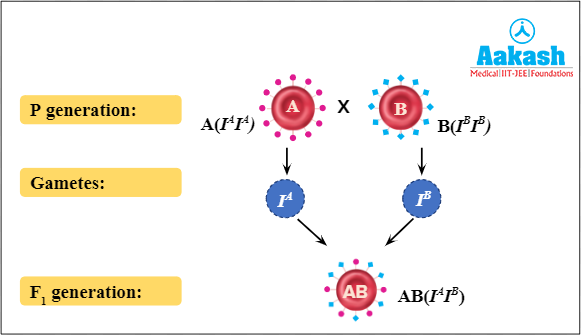
Fig: F1 generation showing progeny having all offspring with AB blood group
If two individuals with AB blood group cross, each of them will produce two types of haploid gametes - 50% of which will carry the IA allele and the rest 50% will carry the IB gene. By drawing a Punnett square for such a cross we can deduce that the offspring of such a couple may have blood groups A (IAIA), AB (IAIB)or B (IBIB) in the ratio 1:2:1.
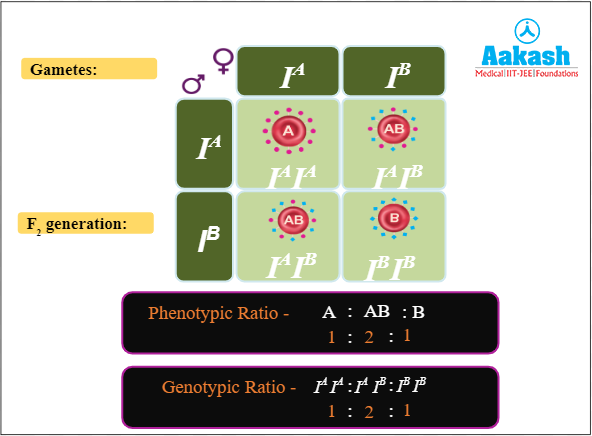
Fig: F2 generation showing progeny having blood group A, AB and B
The different combinations of the blood groups of parents and offsprings can be summarised using the following table.
|
Parents |
Offspring |
Not possible |
|
O x O |
O |
A, B, AB |
|
O x A |
O, A |
B, AB |
|
A x A |
O, A |
B, AB |
|
O x B |
O, B |
A, AB |
|
B x B |
O, B |
A, AB |
|
A x B |
O, A, B, AB |
_ |
|
O x AB |
A, B |
O, AB |
|
A x AB |
A, B, AB |
O |
|
B x AB |
A, B, AB |
O |
|
AB x AB |
A, B, AB |
O |
Coat Colour in Rabbit
The coat colour of rabbits is determined by the C gene. The four common alleles of C gene are C, Cch, Ch and c. The wild grey colour of the coat is due to the expression of the dominant allele C, silver grey colour is due to CchCch, light grey due to CchC or CchCh, Himalayan colour (white fur with coloured extremities is due to ChCh or Chc while albinos are formed when both the recessive alleles are present, that is, cc.
Eye Colour in Drosophila
It has more than 15 alleles. The wild or normal is the allele for red eye colour represented for W or w+. The allele for white eye colour is w which is recessive to all other alleles. The alleles for other eye colours traits are intermediate between the two and show various types of codominance and incomplete dominance. The important alleles are wi (ivory), wbf (buff), wh (honey), wch (cherry), wbl (blood), we (eosin), ww (wine), etc.
Practice problems
1. Which of the following statements is true regarding multiple alleles?
a) They are present on non-sister chromatids
b) They are present on different chromosomes
c) They are present at different loci on the same chromosome
d) They are present at the same locus of the chromosome
Solution: Multiple alleles are alternative forms of a gene that appear at the same locus of a chromosome. The different alleles of a gene lie at the same locus of the gene with only one allele being present on one chromosome at a time. Thus, a diploid organism has two alleles whereas the haploid gametes carry a single allele. The two alleles in a diploid organism can be the same (homozygous condition) or different (heterozygous condition). Thus, the correct option is d.
2. In which of the following blood groups, the blood plasma of the individual will have no anti A or anti B antibodies?
a) O
b) AB
c) B
d) A
Solution: An individual with AB blood group will have both the A and B antigens on the RBCs and neither anti A nor anti B antibodies in the plasma. Since an individual with AB blood type has no immune proteins to attack the A or B antigens during the transfusion of foreign blood coming from an individual having A, B or O blood types, thus it can receive blood from all blood groups. This is why people with AB blood types are known as universal recipients. Thus, the correct option is b.
3. Which of the following blood types can be transfused to a patient with blood group B?
a) AB and B
b) AB and A
c) AB and O
d) B and O
Solution: A person with blood type B contains B type of antigen on the surface of his or her RBCs and has anti A type of antibody. Thus, if they receive blood from a person with blood type A or AB, the antibodies in his plasma will start attacking the A antigen and cause agglutination of blood, leading to obstruction of blood flow. Thus, he can receive blood from another person with blood type B whose blood will also have the B antigen on the surface of the RBCS, or from a person with O blood group whose RBCs will not have any antigen on their surface. Thus, the correct option is d.
4. Two alleles of a gene are situated on
a) any two chromosomes
b) two non-homologous chromosomes
c) two homologous chromosomes
d) the same chromosomes
Solution: In a diploid organism, two alleles of a gene are present at the same locus of the homologous chromosomes, with only one allele being present on one of the members of the homologous pair. Thus, the correct option is c.
FAQs
1. Is eye colour an example of multiple allelism?
Answer: Yes, eye colour is an example of multiple alleles as there are more than two alleles of the involved genes which influence this character. To date, researchers have discovered around 150 genes that influence eye colour and each of these genes exist in multiple allelic forms.
2. What is codominance between multiple alleles?
Answer: When more than two contrasting alleles of the same gene lack a dominant recessive relationship and each allele expresses themselves equally in a heterozygous condition, they are said to be codominant.
3. Is skin colour an example of multiple allelism?
Answer: No, skin colour is an example of polygenic inheritance. A polygene is a gene, a single dominant allele of which expresses only a unit of the trait. Both the dominant alleles of the same polygene express two units of the trait. The dominant alleles of other polygenes have similar but cumulative effects. All the dominant alleles of the different polygenes influencing the same character must be present for the full expression of the trait. At least three polygenes are involved in the inheritance of human skin colour.
4. What is the convention for designating multiple alleles?
Answer: There are two conventions for designating the various alleles. One of them is to use capital letter for wild type dominant allele with or without superscript. The second is to use small letter based on the most recessive allele and using different superscripts over it to indicate the various traits of alleles. For the most dominant type allele, a + sign is used as a superscript.
Youtube link- https://youtu.be/XRGtE4YzwSc

 Call Now
 Let's Chat
 Share
Share