-
Call Now
1800-102-2727


Microbes in Household Products: Bacteria and Fungi , Benefits and Production

Aloo paratha and curd is one of the most common breakfast combinations for Sunday mornings. Do you know how curd is made?
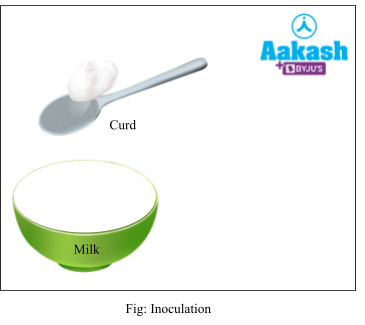
Curd is made by adding small amounts of curd in a bowl of milk. This small amount of curd is termed as inoculum. What does the inoculum contain which turns the whole milk into curd?
It actually contains a group of microorganisms which turn the milk into curd. But what are microorganisms and how do they help in preparing these delicious foods?
Microorganisms are living creatures not visible to the naked eye. Bacteria, fungi, protozoa, viruses and viroids are examples of the microbes present around us. These little creatures are present everywhere and just like humans, some of them are good and some of them are bad. Let us know in detail about some of these good microorganisms which help us in preparing products which we often use in the household.
Table of Contents
Bacteria in Household Products
Curd and Lactic Acid Bacteria (LAB)
Introduction
Lactic acid bacteria constitute a group of bacteria used to produce curd out of milk. There are different strains of Lactobacillus involved in production of curd like Lactobacillus lactis, Lactococcus lactis, Lactobacillus bulgaricus etc. These bacteria have the ability to thrive in an acidic environment. In the absence of oxygen or anaerobic condition, these bacteria derive energy from lactic acid fermentation.
Formation of Curd
In a bowl of warm milk, a spoonful of curd is added. This spoonful of curd is referred to as inoculum or starter culture. The process of adding inoculum in the milk is termed as inoculation.
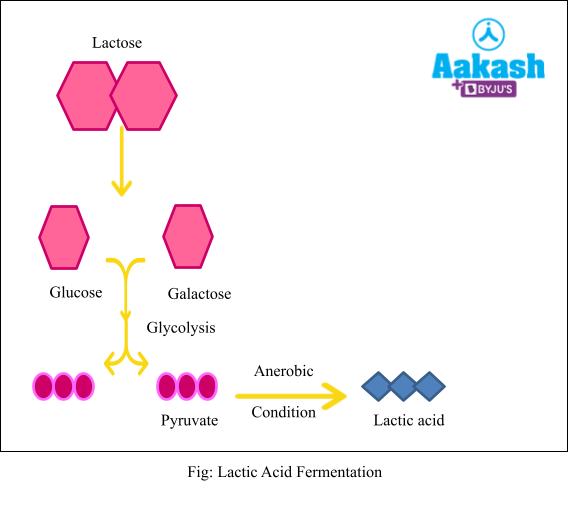
The inoculum contains millions of bacteria which feed upon the lactose sugar present in the milk. Lactose is a disaccharide which is converted to glucose and galactose (monosaccharides) by the Lactic Acid Bacteria. Glucose is converted to pyruvate as it enters the pathway of glycolysis. In the absence of oxygen, pyruvate is converted to lactic acid by the process of lactic acid fermentation.
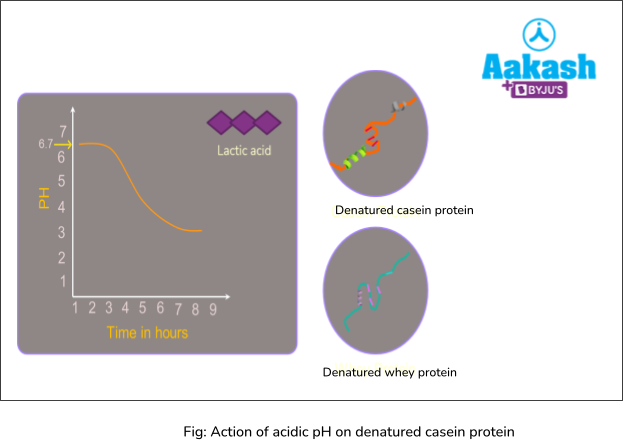
Lactic acid is produced in abundance by the LAB as it feeds upon the milk sugar. This results in a decrease in the pH of milk turning it acidic. Acidic environment in milk causes the protein- casein present in milk to denature. This denatured protein develops certain new bonds using hydrophobic and electrostatic interactions and hydrogen bonds which results in coagulation or curdling of milk, hence, forming curd.
Benefits of Curd
Curd has higher nutritional value as compared to milk. It has a higher amount of vitamin B12 and various probiotics which improves gut health. It is easier to digest and can be consumed by lactose intolerant people. It has enhanced texture and flavour.
Lactic Acid Fermentation Products
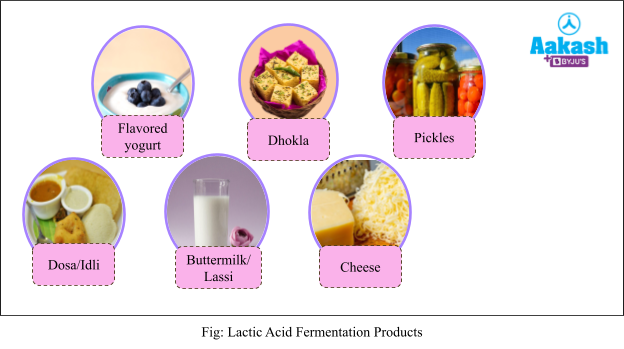
LAB is also used in making dosa, idli, lassi, cheese, pickles and dhokla.
Cheese and Propionibacterium shermanii
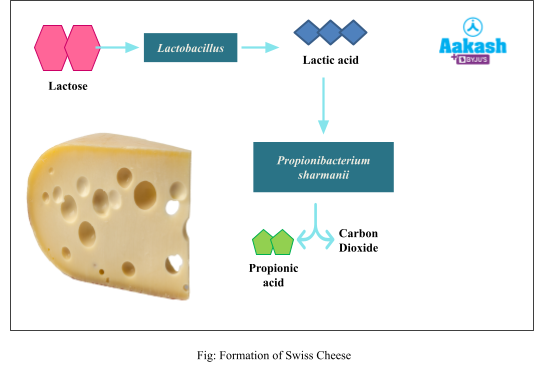
Formation of cheese involves multiple bacteria. While the Lactobacillus helps in lactic acid fermentation, another bacterium Propionibacterium shermanii uses lactic acid, a product of lactic acid fermentation to produce CO2 and propionic acid. Formation of CO2 is the reason for the holes in Swiss cheese.
Fungi in Household Products
Bread and Yeast
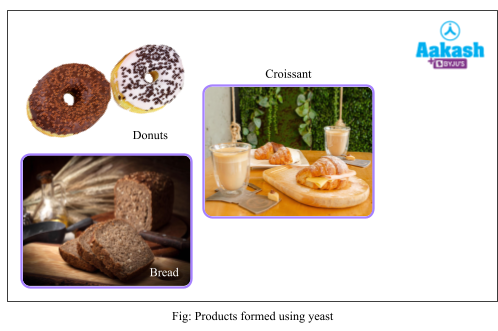
Bread and various other bakery products like pizza, donuts, croissants, bagels, etc. are formed with the help of yeast.
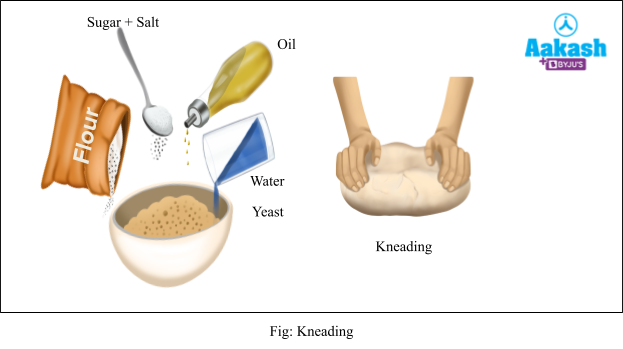
Wheat, oil, sugar, salt, water and yeast are added and kneaded to make a dough.
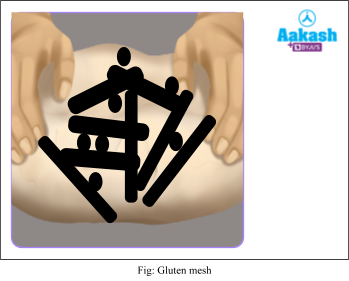
A protein, called gluten, is present in wheat flour which when needed forms a meshwork. The structure and chewiness of bread comes from this meshwork.
Yeast gets tangled up in this meshwork where it utilises sugar to produce alcohol and carbon dioxide.
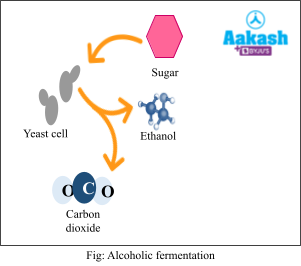
Carbon dioxide makes the dough fluffy and hence the dough rises. This carbon dioxide escapes when the bread is baked leaving the bread soft and porous.
Blue cheese and Penicillium roqueforti
Introduction
Blue cheese, also known as Roquefort cheese, is produced in France using goat’s milk and fungi- Penicillium roqueforti. The fungi appears as blue strings on the cheese which is where it gets its name from.
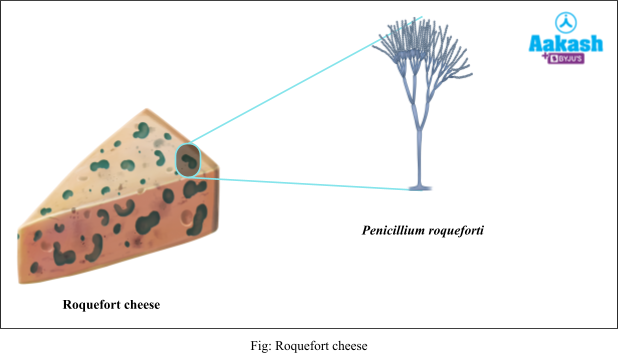
Process of Blue Cheese Production
In pasteurised milk, lactic acid bacteria along with an enzyme- rennet is added. This enzyme forms a gel-like structure by hydrolysing the casein protein. Denatured proteins eventually form solid mass called Curd. The curd and liquid are separated from each other.
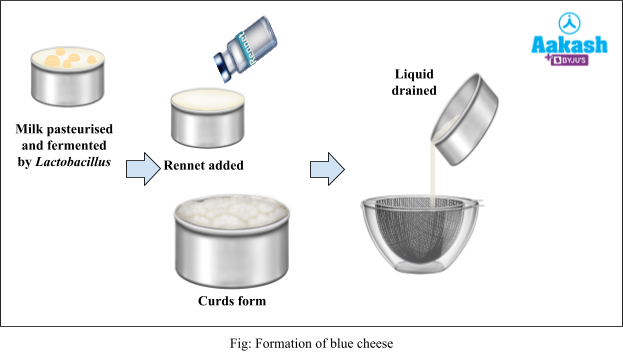
Penicillium roqueforti is added to the solid part obtained and allowed to ripen it. It is kept for 60-90 days and thus, blue cheese is obtained.

Camembert cheese and Penicillium camemberti
Camembert cheese is made from cow’s milk using the mould Penicillium camemberti. It is known for its smooth and gooey texture. The fungi releases hydrolytic enzymes digesting and softening the cheese from inside thereby leading to the texture.
Toddy and Yeast
Introduction
Microorganisms are used for production of various beverages like beer, wine etc. Toddy is one such beverage obtained from sap of sugar palm trees. It is one of the traditional drinks of South India.
Process of Producing Toddy
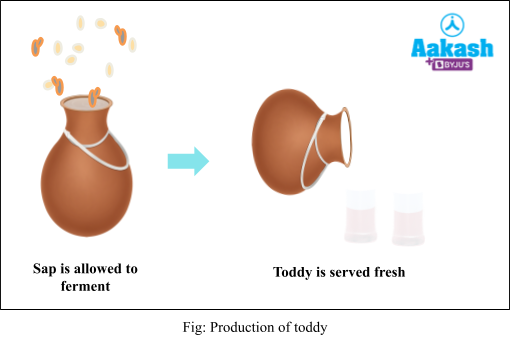
A cut is made at the base of the leaf by climbing up on the sugar palm tree. Pots are tied near the cut and sap is collected.
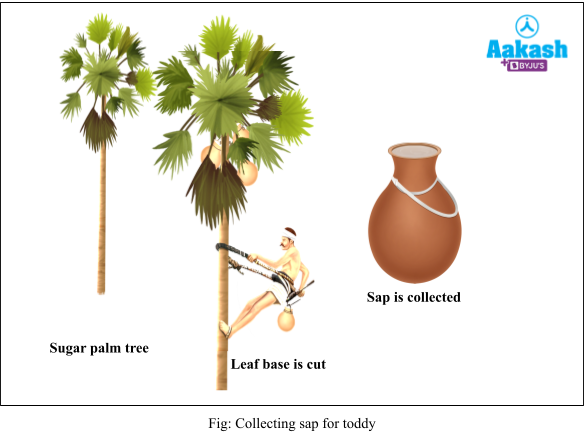
Sap is fermented naturally since yeast is already present on the tree. After a few hours, the fermented drink is ready to be served.
Practice problems of Microbes
Question 1. Below mentioned are the products and the microorganism associated with its production. Find the correct match.
a. Toddy- Lactobacillus
b. Bread- Penicillium notatum
c. Curd- Saccharomyces cerevisiae
d. Cheese- Propionibacterium shermanii
Solution: Formation of cheese involves multiple bacteria. While the Lactobacillus helps in lactic acid fermentation, another bacterium Propionibacterium shermanii uses lactic acid, a product of lactic acid fermentation to produce CO2 and propionic acid. Formation of CO2 is the reason for the holes in Swiss cheese.
Hence, the correct option is d.
Question 2. Kritika kneaded a dough for pizza and left it. After a few hours, it rose and the quantity seemed to increase. Which of the following must be the reason for the same?
a. Due to the production of carbon dioxide by yeast.
b. Due to production of oxygen by Lactobacillus
c. Due to production of carbon monoxide by yeast.
d. Due to production of oxygen by yeast.
Solution: While preparing dough, wheat, oil, sugar, salt, water and yeast are added and kneaded. A protein, called gluten, is present in wheat flour which when needed forms a meshwork. The structure and chewiness of bread comes from this meshwork. Yeast gets tangled up in this meshwork where it utilises sugar to produce alcohol and carbon dioxide. Carbon dioxide makes the dough fluffy and hence the dough rises. This carbon dioxide escapes when the bread is baked leaving the bread soft and porous.
Hence, the correct option is a.
Question 3. Aman wanted to have curd for breakfast so a night before, he added a spoon of curd to cold milk and kept it in the refrigerator. In the morning, he saw that curd was not produced. What mistake did Aman make?
a. He added less curd.
b. He added curd to a smaller amount of milk.
c. He added curd to cold milk and then stored it in a refrigerator.
d. None of the above
Solution: A spoon of curd added to milk, to make curd, is actually an inoculum containing millions of bacteria which use substrates in milk in order to divide and form curd. It is very important to inoculate milk at the right temperature and further store it at room temperature so as to provide the right environment for the culture to thrive and hence form curd. Aman introduced the inoculum in cold milk and further kept at very low temperature i.e., in the refrigerator. Thus, the inoculum didn't get the optimum environment to thrive and form curd.
Hence, the correct option is c.
Question 4. ‘X’ is a fungus. It is an important microorganism used in production of bread and various alcoholic beverages. It is also used in producing various bakery products like pizza, donuts, croissants, bagels etc. Identify X from the given options.
a. Lactobacillus
b. Penicillium notatum
c. Saccharomyces cerevisiae
d. Propionibacterium shermanii
Solution: Saccharomyces cerevisiae, commonly known as yeast, is a fungi used in making bread and various other bakery products like pizza, donuts, croissants, bagels etc. It is also used in production of beverages like beer and wine as it undergoes alcoholic fermentation.
Hence, the correct option is c.
FAQs of Microbes
Question 1. Explain the formation of curd.
Answer: In a bowl of warm milk, a spoonful of curd is added. This spoonful of curd is referred to as inoculum or starter culture. The process of adding inoculum in the milk is termed as inoculation. The inoculum contains millions of bacteria which feed upon the lactose sugar present in the milk. Lactose is a disaccharide which is converted to glucose and galactose (monosaccharides) by the Lactic Acid Bacteria. Glucose is converted to pyruvate as it enters the pathway of glycolysis. In the absence of oxygen, pyruvate is converted to lactic acid by lactic acid fermentation. Lactic acid is produced in abundance by the LAB as it feeds upon the milk sugar. This results in a decrease in the pH of milk turning it acidic. Acidic environment in milk causes the protein- casein and whey present in milk to denature. This denatured protein develops certain new bonds using hydrophobic and electrostatic interactions and hydrogen bonds which results in coagulation or curdling of milk, hence, forming curd.
Question 2. What is Toddy? How is it made?
Answer: Toddy is one of the traditional drinks of South India obtained from sap of sugar palm trees. A cut is made at the base of the leaf by climbing up on the sugar palm tree. Pots are tied near the cut and sap is collected. Sap is fermented naturally since yeast is already present on the tree. After a few hours, the fermented drink is ready to be served.
Question 3. Which microorganism is involved in the production of blue cheese? Explain the process briefly.
Answer: Blue cheese, also known as Roquefort cheese, is produced in France using goat’s milk and fungi- Penicillium roqueforti.
In pasteurized milk, lactic acid bacteria along with an enzyme- rennet is added. This enzyme forms a gel-like structure by hydrolyzing the casein protein. Denatured proteins eventually form solid mass called Curd. The curd and liquid are separated from each other. Penicillium roqueforti is added to the solid part obtained and allowed to ripen. It is kept for 60-90 days and thus, blue cheese is obtained.
Question 4. Name some household products which are produced with the help of Lactic Acid Bacteria.
Answer: Lactic acid bacteria is used in making curd, dosa, idli, lassi, cheese, pickles and dhokla.

 Call Now
 Let's Chat
 Share
Share