-
Call Now
1800-102-2727


Methods of Birth Control

To slow down a booming population, countries all around the world implement family planning programmes. It involves educating couples about topics like frequency of conception, spacing between children, using different methods of birth control, etc. Some cultures deliberately limit access to birth control due to moral views, but it is a major event to practise family planning.
What is Birth Control?
Birth control is also known as fertility control or contraception. It refers to different methods implemented by sexually active individuals or couples to prevent unwanted pregnancy, thus limiting the number of offspring.
Methods of Birth Control
Birth control methods are mostly used before or during intercourse, and can broadly be classified into
1. Natural Methods[a]
- Withdrawal Method: Coitus interruptus is the practice of ending sexual intercourse before ejaculation. It is not considered a birth control method by medical professionals because the method would be ineffective if the male fails to withdraw correctly in a timely manner.
- Fertility Awareness: It involves determining the most fertile days of the female menstrual cycle and avoiding unprotected intercourse during those days. It has a failure rate between 12% to 25%.
- Lactational Amenorrhoea Method: After delivering a baby, a woman who exclusively breastfeeds the infant (<6 months old) and has no menstruation experiences a period of postpartum infertility. Intercourse during this phase has a failure rate of 2% in the six months following delivery.
- Abstinence: Avoidance of all sexual activity is 100% effective in preventing pregnancy.
2. Surgical Methods
- Vasectomy: In males, the two vas deferens are cut and tied, thus preventing sperm entry to the urethra.
- Tubectomy[b]: In females, the fallopian tubes are cut/sealed or tied to block the passage of eggs through the fallopian tubes into the uterus.
3. Barrier Methods
- Male Condoms: It is a sheath of latex, rubber, or polyurethane, put on the erect penis, just before intercourse. The condom physically blocks the ejaculated sperm from entering the body of the sexual partner. Male condoms are the most used barrier method, because it is inexpensive, easy to use, and has few adverse effects.
- Female Condoms[c]: Female condom, also known as ‘internal condom’, is a nitrile, latex, or polyurethane sheath with an outer and inner ring. The inner ring at the closed end of the sheath helps to insert the condom inside the vagina, and the rolled outer ring remains outside the vagina, covering parts of the external genitalia. It also prevents Sexually Transmitted Diseases.
- Cervical Caps[d]: A cervical cap is a rubber cup stretched over a collapsible metal spring coil, designed to fit snugly over the cervix, thus preventing sperm from entering the uterus. It can be worn for a maximum of 48 hours.
- Diaphragm: The diaphragm is slightly larger than the cervical caps, functioning similarly. It can be worn for a maximum of 24 hours.
- Contraceptive Sponges with spermicide: Sponges with spermicide are designed to be inserted over the cervix to function effectively. Contraceptive sponges can be inserted 24 hours before coitus, and can be left for at least 6 hours afterwards. Allergic reactions have been reported.
4. Intra-Uterine Devices (IUDs)[e]
IUDs are small, T-shaped devices containing either levonorgestrel (LNG-20, Progestasert) or copper (Cu7, Cu-T). Once inserted, the female body recognizes the IUD as a foreign element and an immune response is triggered.
As a result, there is inflammation in the uterus, which subsequently creates a toxic environment for the sperm and makes the uterus unsuitable for implantation. Using IUDs is one of the most widely accepted birth control methods in India.
5. Hormonal or Medicinal Methods
Emergency Contraceptives: Emergency contraceptive pills (also referred to as ‘morning after pills’) are medications used after unprotected sex to prevent pregnancy. They work primarily by preventing ovulation and/or fertilization.
There are various options like levonorgestrel, mifepristone, ulipristal, etc., but they are most effective within 72 hours after intercourse. [Insertion of copper IUDs can also act as a highly effective method even after 5 days of intercourse].
Oral Contraceptives[f]: Contraceptive pills taken orally can be either
- Combination pills: containing estrogen and progestin. They mostly come in 28-day packs with 21 active pills and 7 inactive pills (without any hormones). Bleeding occurs in the inactive week, which is the response of the body to the absence of the hormones.
- Mini pills: or Progestin-only pills contain 28 active pills that must be taken at the same time every day to prevent pregnancy.
- Saheli[g]: is the world’s first non-steroidal contraceptive pill developed by CDRI, Lucknow, in 1986. It contains the Selective Oestrogen Receptor Modulator (SERM) known as Centchroman. It achieves contraception through localized action in the uterus, creating unsuitable conditions in the endometrium that prevent the implantation of the embryo.
Subcutaneous implants[h]: A Subcutaneous contraceptive implant is a small rod, placed in the arm at the subdermal level. The implant releases progestin, preventing ovulation and therefore pregnancy.
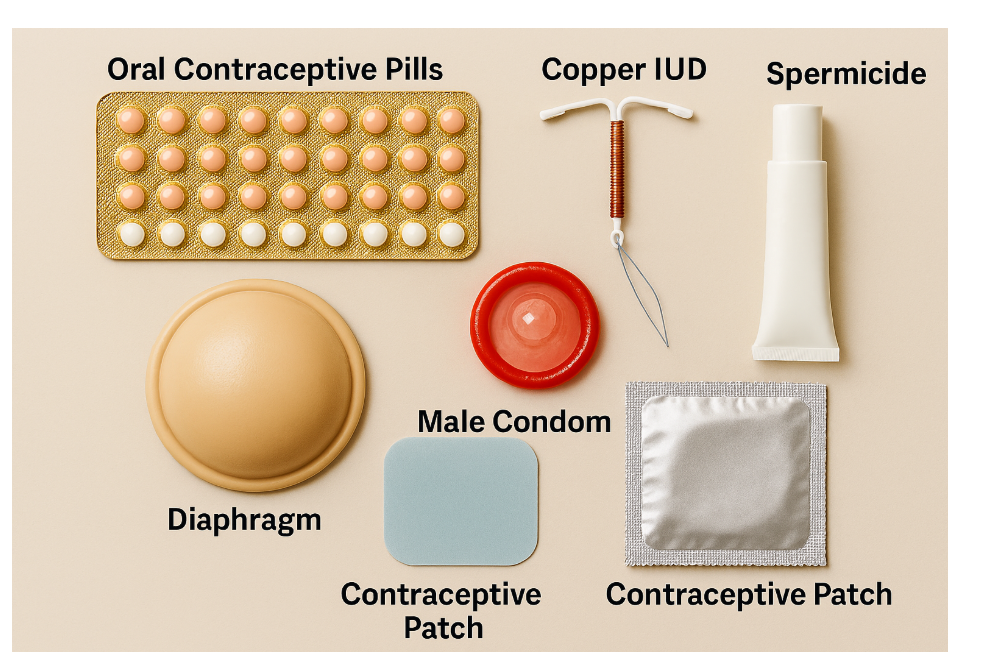
Types of birth control methods
Summary
Birth control methods help couples plan families and prevent unwanted pregnancies. Different options like natural, surgical, barrier, hormonal, and IUDs give people the choice to select what suits them best. Using them responsibly not only supports family planning but also helps in controlling population growth and promoting better reproductive health.
Frequently Asked Questions (FAQs)
Q1. How do copper IUDs differ from hormonal IUDs in the mechanism of action?
Hormonal IUDs alter the endocrine system of the body to primarily thicken cervical mucus and thin the endometrium, to prevent ovulation and/or implantation. In contrast, copper IUDs do not interfere with the natural hormone cycle of the female body but create a localized inflammatory reaction within the uterus, creating a toxic environment for the sperm.
Q2. Can a woman get pregnant even if she is on birth control?
The birth control devices and medications are not 100% effective. Thus, a woman can get pregnant, even when she is on birth control.
Q3. Are surgical birth control methods reversible?
Surgical birth control methods like vasectomy and tubal ligation are permanent and not easily reversible. Performing reversing surgeries is complex and ineffective.


 Call Now
 Let's Chat
 Share
Share