-
Call Now
1800-102-2727


The Leaf: Types, Phyllotaxy, Modifications, Practice Problems, and FAQs

Who does not love being surrounded by greenery at all times! It is popularly believed that looking at green plants soothes and calms our eyes. When we talk about green plants, the part of the plant that first comes to our mind is the leaf of the plant.
You must be aware that the green colour of leaves is due to the presence of the green pigment called chlorophyll. Can you tell how the presence of chlorophyll makes the leaves so special?
Well, due to the presence of chlorophyll, leaves act as the kitchen of the plant. The green pigment absorbs the light energy from the sun and uses it to prepare organic food from inorganic raw materials such as carbon dioxide and water.
But, do leaves help in photosynthesis only? Apart from being green, are leaves of all plants identical? Is the arrangement of leaves on the branches identical for all plants? The straight answer to this question is that no they are not. Leaves vary a lot in terms of the leaf blade, their arrangement on the branches and the various structures that they are modified into for performing specialised functions. In this article, we are going to discuss these aspects of a leaf.
Table of contents:
- What is a leaf?
- Types of leaves
- Phyllotaxy
- Modifications of leaves
- Practice Problems
- FAQs
What is a leaf?
Leaf is a chlorophyll containing flat structure which grows laterally on a stem and develops at the node of a stem. Buds arise from the axil of leaves and later develop into new branches or shoots.
The leaf is attached to the stem through the leaf base. Stipules are two lateral leaf-like appendages located on either side of the leaf base. Petiole or stalk of the leaf, also known as mesopodium, connects the leaf lamina with the stem or branch. Leaf blade or lamina is the flattened green part of the leaf which is the primary site for photosynthesis.
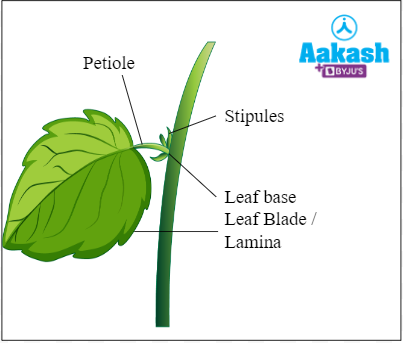
Fig: Structure of the leaf
Through the centre of the leaf runs a prominent vein called midrib. From the midrib arise numerous veins and even smaller veinlets. The midrib, veins and veinlets possess vascular bundles.
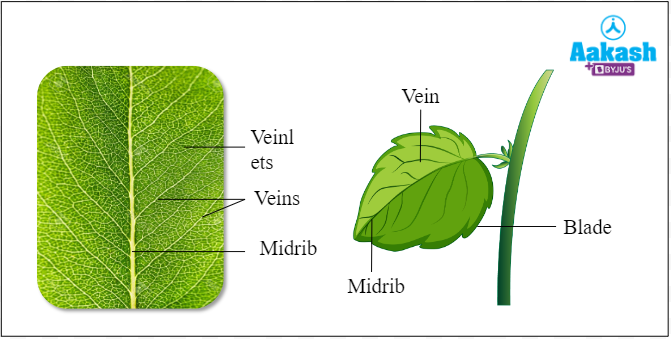
Fig: Midrib, veins and veinlets
Types of leaves
Based on the structure of the leaf blade, leaves are categorised as simple and compound.
Simple leaf
In a simple leaf, the leaf blade is not broken into lobes or leaflets as the incisions of the lamina do not touch the midrib.
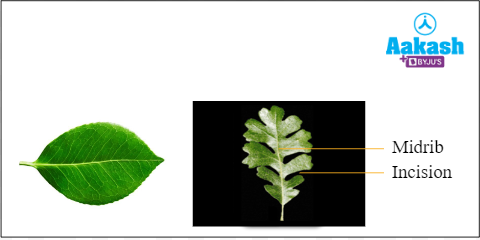
Fig: Simple Leaf
A bud is present in the axil of the petiole in simple leaves, called the axillary or lateral bud.
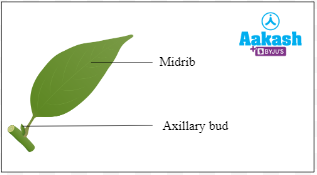
Fig: Simple leaf showing axillary bud
Compound leaf
In compound leaf, the leaf blade is divided into leaflets as the incisions of the lamina reach up to the midrib, breaking it into a number of leaflets.
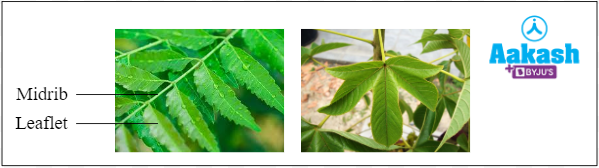
Fig: Compound Leaf
Axillary bud is present in the axil of the petiole, but not in the axil of leaflets.
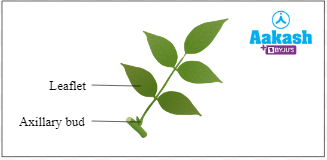
Fig: Compound leaf showing axillary bud
Based on leaflet arrangement, compound leaves are further divided as pinnately compound and palmately compound leaves.
Pinnately compound leaves
In pinnately compound leaves, the midrib forms the common axis known as rachis along which the leaflets grow.. Example: Neem leaves.
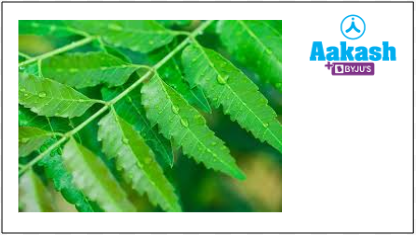
Fig: Neem leaves
Pinnately compound leaves can be of the following types -
- Unipinnate or simple pinnate - the leaflets or pinnae are directly borne on the rachis, e.g, rose and neem.
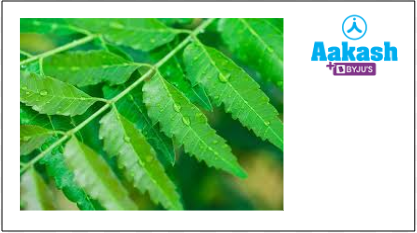
Fig: Unipinnate leaf
- Bipinnate - The leaflets are divided to second order and arise on secondary axes on the rachis, e.g, Acacia, Mimosa, etc.
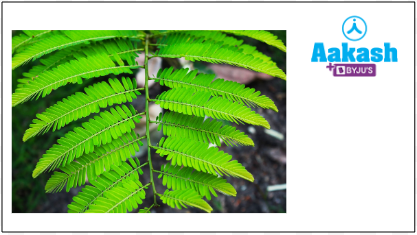
Fig: Bipinnate leaf
- Tripinnate - The leaflets are borne on the tertiary axes which arise from the secondary axes of the rachis, e.g, Moringa.
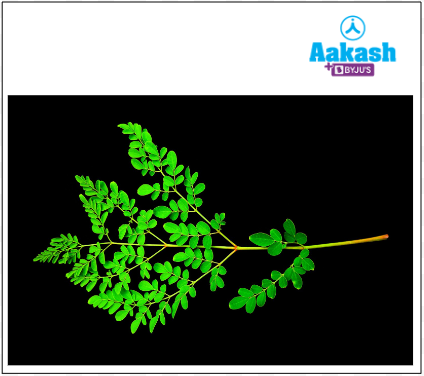
Fig: Tripinnate leaf
- Decompound - decompound leaves are more than thrice pinnate, e.g, coriander, carrot, etc.
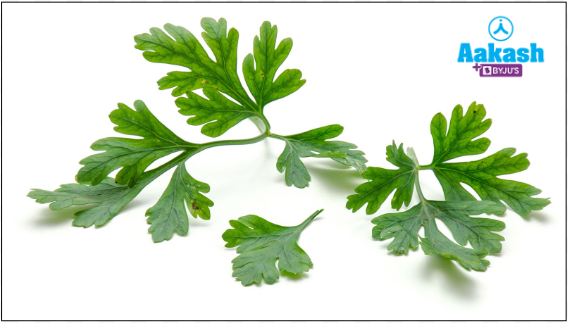
Fig: Decompound leaf
Palmately compound leaves
In palmately compound leaves, the leaflets are attached to a common point, i.e., tip of the petiole. The leaflets may be petiolate or sessile. Example: Silk cotton leaves.
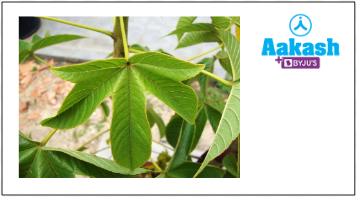
Fig: Silk cotton - Palmately compound Leaf
Palmately compound leaves can be of the following types -
- Unifoliate - Only a single leaflet is attached to the tip of the petiole, e.g, Citrus.
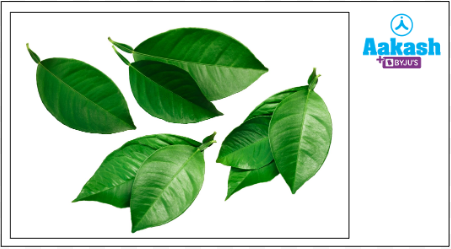
Fig: Unifoliate leaves
- Bifoliate - A pair of leaflets is borne on the rachis, e.g, Balanitis.
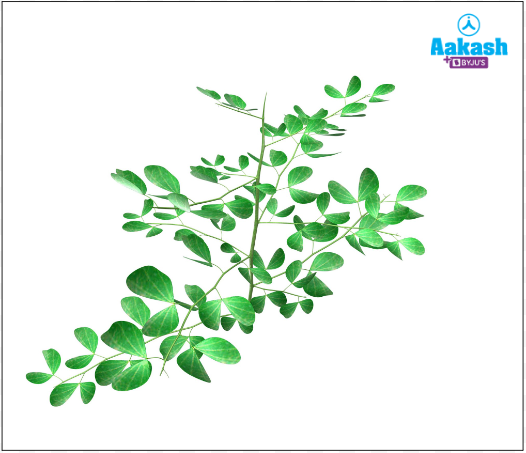
Fig: Bifoliate leaves
- Trifoliate - There are three leaflets borne on the tip of the rachis, e.g, Clover, Oxalis, etc.

Fig: Trifoliate leaf
- Quadrifoliate - These are four leaflets on the tip of the rachis, e.g, Marsilia.

Fig: Quadrifoliate leaf
- Multifoliate - The tip of the petiole bears more than four leaflets, e.g, Bombax.
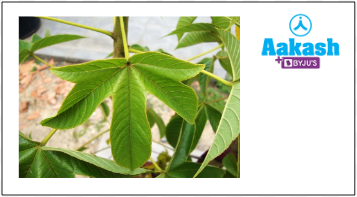
Fig: Multifoliate leaf
Phyllotaxy
The pattern of arrangement of leaves on the stem or branch.is known as phyllotaxy.
Types of phyllotaxy
Alternate
In this type of phyllotaxy, only a single leaf arises at each node. Examples: Hibiscus, mustard sunflower etc.
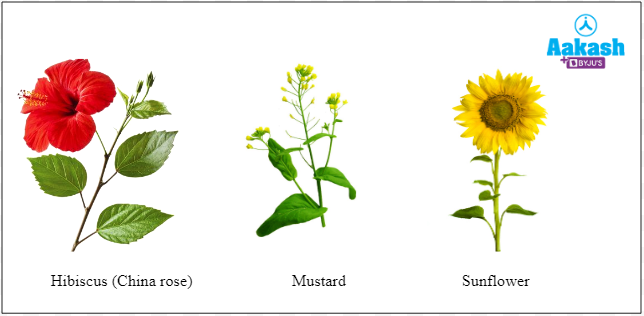
Fig: Alternate phyllotaxy
Opposite
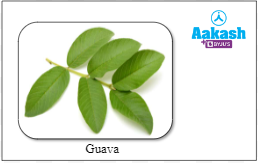
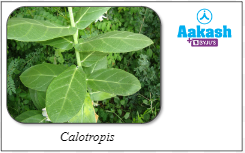
In opposite phyllotaxy, each node possesses two leaves lying opposite to each other. Based on the arrangement, opposite phyllotaxy can further be classified as -.
|
Opposite superposed |
Opposite decussate |
|
The paired leaves at each node lie exactly above the pair at a lower node. |
The paired leaves at one node lie at right angles to the pair above or below them. |
|
Example - guava |
Example - Calotropis |
|
Fig: Opposite superposed phyllotaxy |
Fig: Opposite decussate phyllotaxy |
Whorled
In whorled phyllotaxy, more than two leaves arise from a single node. Example: Alstonia
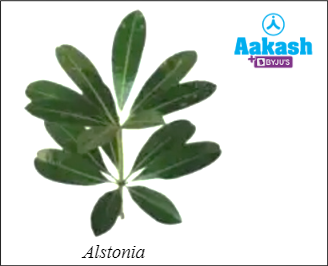
Fig: Whorled phyllotaxy
Modifications of leaves
Leaves of a plant primarily contribute to preparation of food by photosynthesis but in some special cases, leaves may be modified to form different structures that can help in doing additional functions such as protecting the plant, reducing transpiration, storing food, providing support, trapping and digesting insects for nutrition, etc.
Tendrils
The leaves are modified as thin, thread-like coiled structures which coil around a support and help in climbing. The tendrils respond to touch and twine around objects.
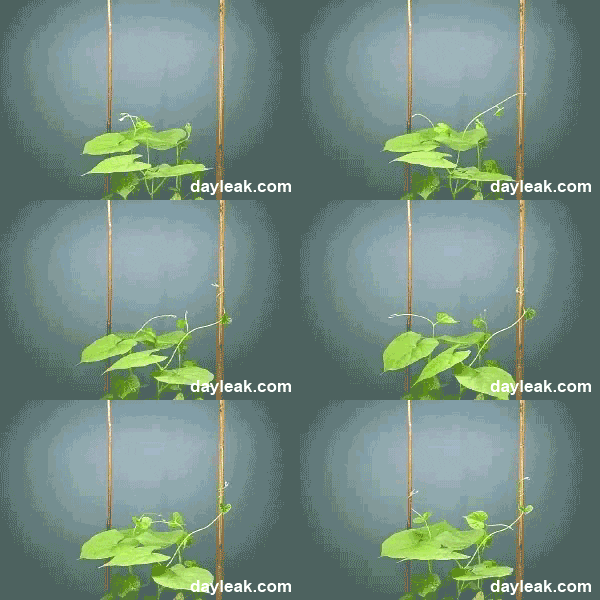
GIF: Tendrils coiling around a support
In garden peas, the terminal leaflets are modified into tendrils.
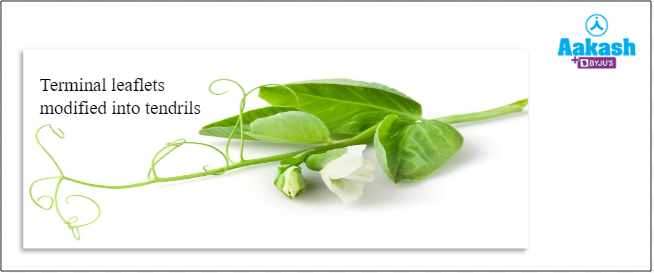
Fig: Pea plant
In Gloriosa superba, the leaf tip is modified into tendrils. In wild pea, Lathyrus aphaca, the whole leaf is modified into tendrils. In plants such as Tropaeolum and Nepenthes, the petiole coils around support like a tendril. The stalks of leaflets, entire rachis, tip of rachis, stipules and even petioles can be modified into tendrils
Spines
Spines are hard, stiff, and pointed vasculated structures that are modifications of either an entire leaf or leaf parts. In xerophytic plants, the leaves are reduced to sharp pointed structures called spines. This is a modification to conserve water and reduce its loss of water via transpiration by reducing the area of exposed leaf surface. Spines also provide protection against grazing animals. In such plants, the stems are modified into flat green structures which can perform photosynthesis.
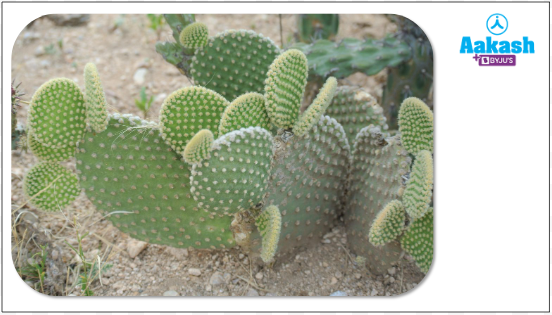
Fig: Cactus
Leaflet hooks
The upper three leaflets of Bignonia are modified into curved, stiff, hook-like structures to help the plant adhere to support for climbing.
Storage leaves
Some leaves are modified to store food. The edible parts of garlic and onion are the fleshy scale leaves that are modified to store food. The outer scale leaves are dry and generally discarded. In succulents such as Aloe, the leaves store mucilaginous substances.
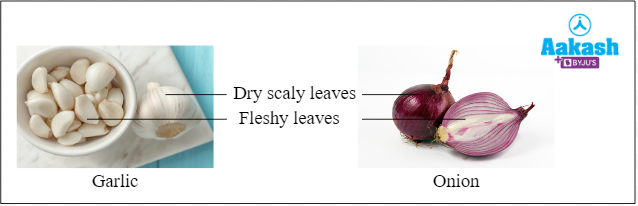
Fig: Leaves modified for storage of food
Phyllode (Modified leaf stalk)
Phyllodes are modified petioles which are green, flattened and capable of performing photosynthesis. Phyllodes are found in plants such as Australian acacia in which the leaves are small and short-lived.
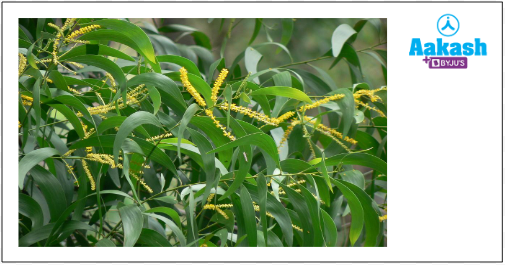
Fig: Australian acacia
Carnivorous leaves
Leaf lamina of insectivorous plants gets modified to trap insects. These plants are photoautotrophic but grow in soil which lacks nitrogen. Thus, they trap insects and eat them to fulfil their nitrogen requirement. Examples: Venus flytrap (leaf lamina is bilobed and hinged to trap insects), Pitcher plant (leaf lamina is modified as a pitcher).
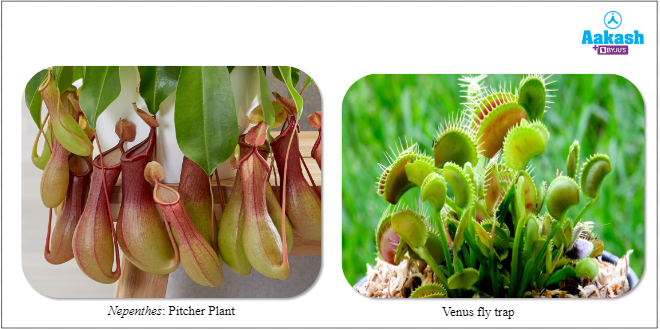
Fig: Insectivorous plants
In Utricularia, some of the leaf segments are modified into small bladders which are specialised to trap small animals such as water fleas.
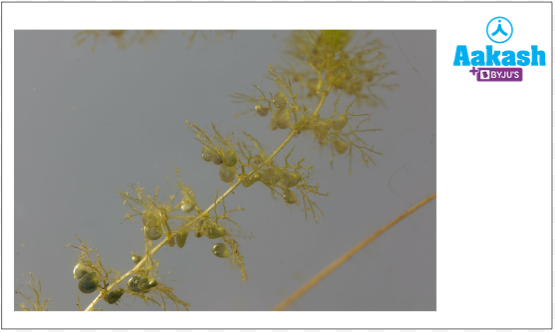
Fig: Bladders of Utricularia
Floral leaves and sporophylls
The floral parts such as sepals, petals, stamens and carpels are also modified leaves. Stamens and carpels are known as sporophylls as they are modified spore-bearing leaves.
Practice problems
Q1. Phyllode is the modification of
A. Petiole
B. Leaf margin
C. Lamina
D. Leaf base
Solution: Phyllodes are modified petioles which are green, flattened and capable of performing photosynthesis. The leaves of such plants are reduced to spines to minimise loss of water by transpiration.
Thus, the correct option is a.
Q2. Phyllotaxy refers to the
a) Types of leaf modifications
b) Mode of leaf arrangement on stem
c) Arrangement of sepals and petals in a flower
d) Types of arrangements of leaf veins
Solution: The pattern of arrangement of leaves on a stem or branch is called phyllotaxy. There are three types of phyllotaxy, i.e, alternate, opposite and whorled.
Thus, the correct option is b.
Q3. Tendrils in wild pea plant are the modification of
a) Stipules
b) Axillary buds
c) Leaves
d) Lateral buds
Solution: In wild pea plants (Lathyrus aphaca), tendrils are modifications of entire leaves. They coil around erect and stiff supports and help in climbing. In garden pea plants (Pisum sativum), the terminal leaflets are modified into tendrils. Stipules are modified into tendrils in Smilax.
Thus, the correct option is c.
Q4. In Alstonia ______ leaf/leaves is/are present on each node
A. single
B. two
C. more than two
D. Both b and c are correct
Solution: In Alstonia, more than two leaves arise from each node and form a whorl. Such an arrangement is called whorled phyllotaxy.
Thus, the correct option is c.
FAQs
Q1. How does phyllotaxy help in photosynthesis?
Answer: The function of the arrangement of leaves (phyllotaxy) is to increase a plant's ability to carry on photosynthesis by positioning the leaves in such a way as to maximise the surface area available to intercept sunlight. Leaves may be either caulescent (on obvious stems) or acaulescent (with no obvious stems).
Q2. How is a thorn different from a spine?
Answer: Thorns are modified stems whereas spines are modified leaves. The stiff, pointed and sharp structures seen in a Citrus plant is a thorn but the ones seen in Opuntia are spines.
Q3. Does a rose plant have thorns or spines?
Answer: The sharp pointed structures on the stem of the rose plant are neither thorns nor spines. Those are pointed and stiff extensions of the epidermis known as prickles and do not possess vascular tissues.
Q4. What are cataphylls?
Answer: Cataphylls are scale leaves which are small in size and are stalkless, thin, brownish reduced forms of a leaf.
YOUTUBE LINK: https://www.youtube.com/watch?v=yQtNQMmmYYI

 Call Now
 Let's Chat
 Share
Share