-
Call Now
1800-102-2727


Overview of the Human Neural System, Practice Problems and FAQs

Whenever you burn your finger or fracture your bone, you can sense the pain at the site of the injury. Now imagine if your body couldn’t sense pain. Would it have been a boon or a bane? For a split second you might feel that it would have been great to not feel pain at all, but did you ever think that pain is one of the first responses through which our body lets us know that something is not alright? If our body did not have a system of sensing pain, it could have been disastrous as many of our ailments would go unnoticed.
And not just pain, our ability to sense everything that goes on in our external as well as internal environment is crucial for our survival. It helps us to be aware of ourselves and our surroundings and respond accordingly. But do you know how this intricate process, of receiving and perceiving different stimuli from the environment and eliciting unique responses to each one of them, is carried out? It is carried out by certain specialised organs such as the brain and the spinal cord and a huge network of nerves all around the body. Together these structures form a highly advanced nervous system in humans. The design and functioning of the human nervous system is considered to be most advanced amongst all animals.
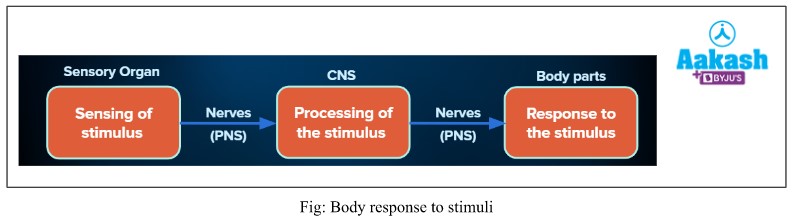
Table of contents
- Introduction to Human neural system
- Central nervous system
- Peripheral nervous system
- Neuron
- Types of nerves
- Practice problems
- FAQs
Introduction to human neural system
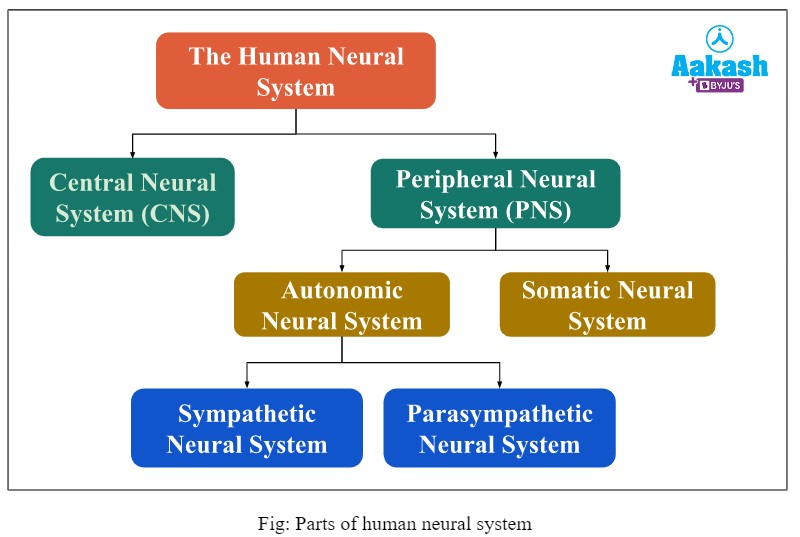
One of the most complex organ system to ever evolve, the human nervous system consists of two parts, namely:
- Central Nervous System (consists of the brain and spinal cord)
- Peripheral Nervous System (includes all the nerves of the body)
The basic structural and functional unit of the nervous system is the neuron or nerve cell which is mainly involved in transmitting impulses for the conduction of information across the different parts of the body. Apart from the neurons, the nervous system also consists of glial cells which support the functioning of the neurons.
Specialised cells in our body, known as receptors are capable of receiving the stimuli and converting them to impulses. These receptors remain in contact with the neurons which carry the stimuli impulses to the brain or spinal cord and once the information is processed by the brain or spinal cord, another set of neurons bring the impulses to the effector organs such as muscles or glands which can generate a response to the stimuli by showing movement or release of hormones, enzymes, etc.
Neuron
A neuron is the structural and functional unit of the nervous system and are specialised cells which are capable of conducting electrochemical signals. Each neuron has a cell body or cyton and two types of nerve process - shorter processes known as dendrites and longer processes known as axons. The different parts of a neuron are discussed below.
Fig: Structure of a neuron

Cell Body
The cell body consists of a granular cytoplasm, known as the neuroplasm, which bears a nucleus, Golgi body, endoplasmic reticulum, mitochondria and other components. It is the broader part of the neuron which can be round, polygonal or stellate (star-shaped) in shape. The neuroplasm contains Nissl granules which help in protein synthesis and are pieces of granular endoplasmic reticulum containing ribosomes.
Fig: Cyton

Fig: Nissl granules

The cell body also contains neurofibrils which help in impulse transmission and microtubules and actin microfilaments which help in maintaining shape and polarity of the neuron.
Most mature neurons do not have centrioles and hence cannot divide. However, some mature neurons may show the presence of centrioles which do not help in cell division but might be involved in the microtubular organisation of the neuron.
Dendrons and dendrites
Dendrons are short but protoplasmic processes, arising from the cyton, which further branch to form finer dendrites. These structures receive impulses from the adjacent neurons across a synapse (the junction between the axon of one neuron and dendrites of the next one) and transmit them to the cell body.
GIF: Dendrites transmitting impulses to cyton

Axon
A long fibre-like process develops from the cyton from a conical shaped axon hillock and is known as the axon. It carries electrical impulses from the cell body to the axon terminals from where it passes on to another neuron across the synapse. Each axon has terminal branches at the end which terminate into a bulb-like structure called synaptic knobs. Synaptic knobs possess synaptic vesicles containing chemicals called neurotransmitters that help in conduction of impulses across the synaptic clefts.
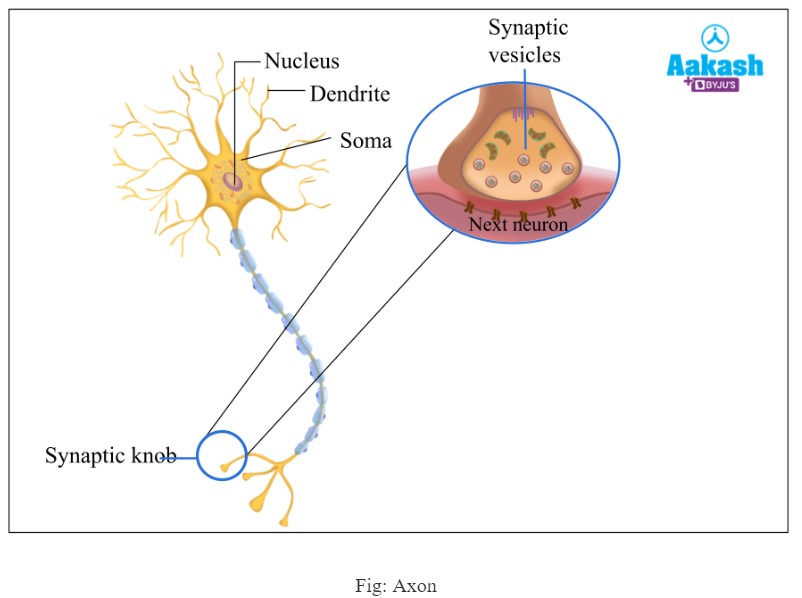
GIF: Axon transmitting impulse away from the cyton

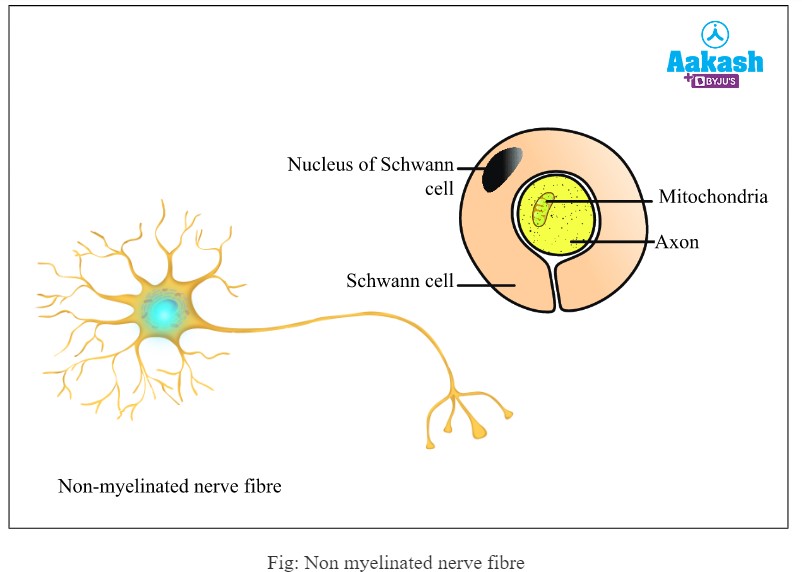
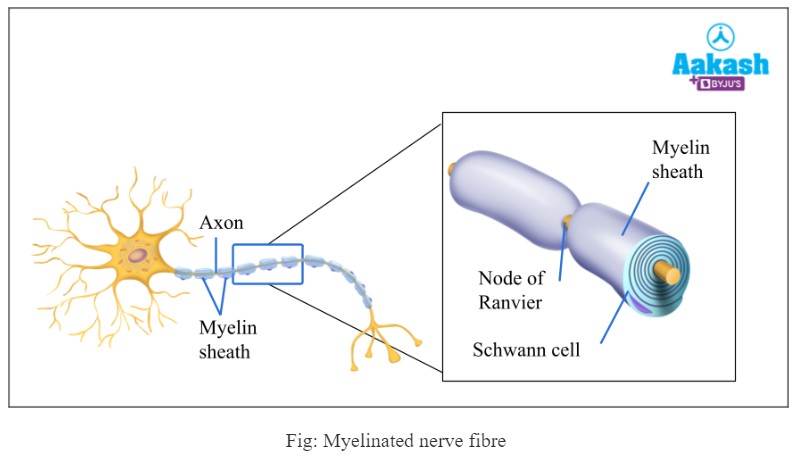
Axon is always covered in a sheath and the sheathed axon is called a nerve fibre. Nerve fibres can be myelinated or non myelinated, depending on the type of sheath. Non-myelinated nerve fibres are covered only by the neurilemma which is formed by the end to end joining of the Schwann cells.
Myelinated nerve fibres have an outer neurilemma and an inner medullary sheath or myelin sheath formed by secretions of the Schwann cells. The myelin sheath helps in insulation of the nerve fibres and prevents interference and impulse dilution. The myelinated nerve fibres have areas where the myelin sheath is absent and such areas are known as the Nodes of Ranvier. The region between two nodes is known as the internode.
Impulse conduction in myelinated nerve fibres is 50 times faster than that in non-myelinated fibres as the impulses jump from one node to the next. The white matter of the central nervous system and most nerves of the peripheral nervous system are composed of myelinated nerve fibres.
Synapse
The point of contact between the axon terminals of a presynaptic neuron and the dendrites of a postsynaptic neuron that helps in transmission of impulses is known as the synapse. The two neurons may be separated by a fine gap known as the synaptic cleft.
Fig: Synapse

Types of neurons based on function
Sensory Neurons
Sensory neurons carry impulses received by the receptors to the brain or spinal cord.
Motor Neurons
These neurons transmit impulses from the central nervous system (brain and spinal cord) to the effector organs such as muscles or glands.
Interneurons
These neurons help in transmitting signals between two neurons and connect the nearby sensory and motor neurons.
Fig: Types of neurons based on function

Nerve
Several bundles of nerve fibres along with blood vessels are enclosed within a common sheath of connective tissue to form a nerve.
Nerves can be of three types -
- Afferent or sensory nerves carrying sensory nerve fibres which transmit impulses from the receptors to the central nervous system.
- Efferent or motor nerves carrying motor nerve fibres which transmit impulses from the central nervous system to the effector muscles or glands.
- Mixed nerves which contain both sensory and motor nerve fibres.
Fig: Nerve

Central Nervous System
Central Nervous System (CNS) is the control centre for all activities of the body and is the site for processing information. It lies in the central or main axis of the body and is composed of the brain and the spinal cord.
Brain
The brain is the most important organ of the human nervous system which not only controls our entire body but also helps us in learning, memorising, thinking analytically, deciding, discovering, problem solving and a lot more. The brain is located within the skull which provides frontal, lateral and dorsal protection. The human brain is composed of three major parts:
Forebrain
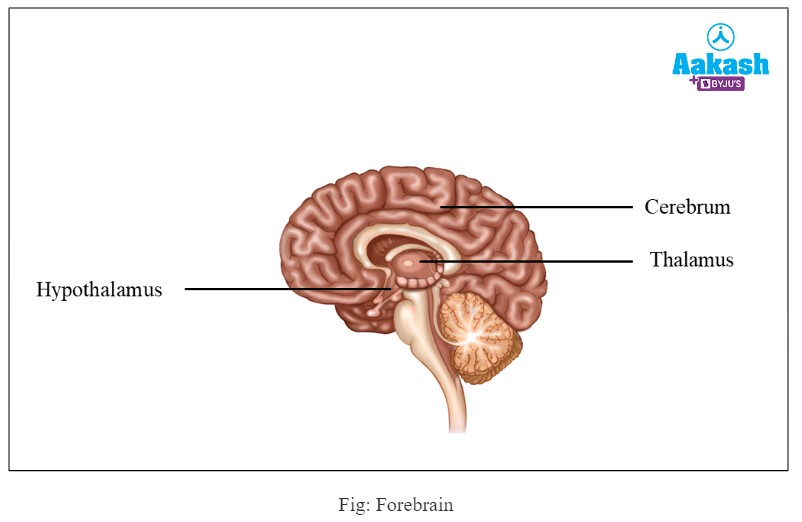
It is the anterior part of the brain which comprises the cerebrum, hypothalamus and thalamus. It occupies a major part of the brain and is responsible for processing all the sensory information collected by the sense organs, controlling body temperature, hunger, thirst, etc and the functions of the pituitary gland.
Midbrain
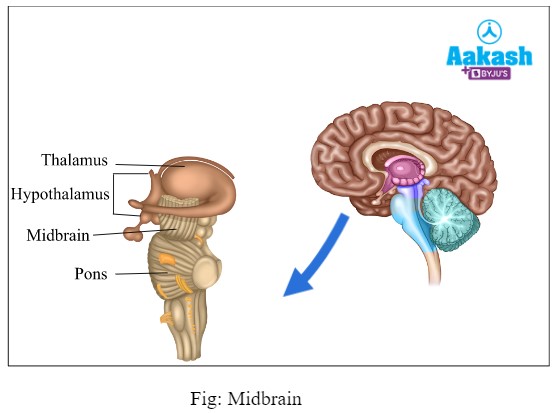
It is a small central part of the brainstem which consists of a dorsal part called tectum and ventral part called tegmentum. It is located between the diencephalon (thalamus and hypothalamus) of the forebrain and pons of the hindbrain. It helps to relay impulses to and fro between the cerebrum, cerebellum, pons, and medulla.
Hindbrain
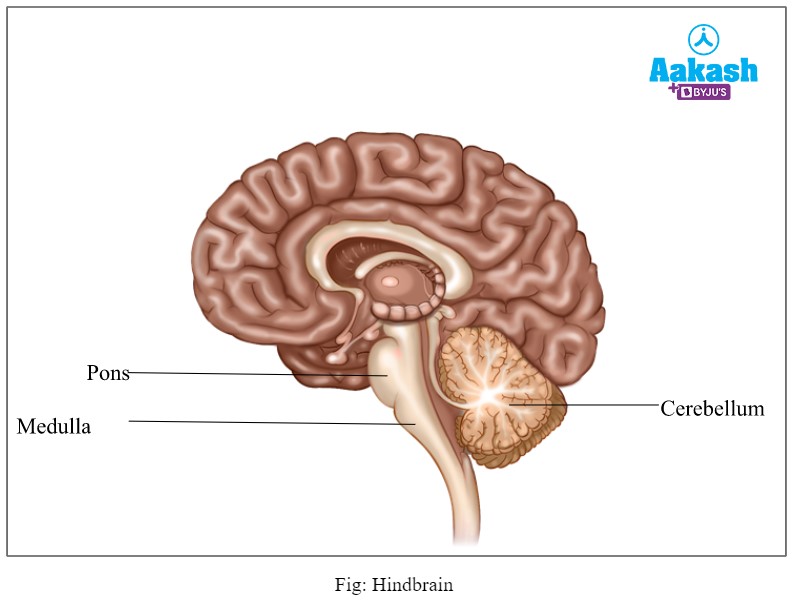
The hindbrain is composed of cerebellum, medulla and pons and occupies the central part of the brain. The cerebellum helps in maintaining balance and coordinating muscular movements, pons help to connect the cerebrum with the cerebellum and also serves as the centre for regulation of respiration and the medulla oblongata controls all the internal organs and the vital involuntary functions of the body such as breathing, heartbeat, etc.
Spinal Cord
It is a long, nearly cylindrical but somewhat dorsoventrally flattened spindle shaped structure which has a diameter of 2-2.5 cm. It extends from the first cervical vertebra to the first ot second lumbar vertebra. In the spinal cord, the grey matter is arranged on the inner side and white matter on the outer side. Grey matter consists of cell bodies of neurons whereas the white matter consists of the myelinated axons.
This arrangement of neurons is exactly opposite to the arrangement of neurons in the brain where the outer cortex has the grey matter formed of the cell bodies of neurons and the inner medulla has the white matter formed of myelinated axons. It arises from the base of the medulla oblongata and runs through the central hollow space of the vertebral column which protects it.
It conducts sensory and motor impulses to and from the brain. The spinal cord is also responsible for controlling reflex actions and providing nerve connections to a large number of body parts.
Cerebral Meninges
These are the protective coverings made of connective tissues, which cover the brain and spinal cord. Meninges consist of three layers of tissue -
- The outermost layer known as dura mater.
- A very thin middle layer known as arachnoid.
- An inner layer, which is in contact with the brain tissue, known as pia mater.
A fluid called cerebrospinal fluid lies in the spaces between the meninges and protects the brain from shocks and mechanical injuries.

Peripheral Nervous System
Peripheral Nervous System (PNS) develops laterally from the central nervous system and connects different parts of the body with the CNS. It is composed of all the nerves that arise from or arrive to the CNS. We carry out both voluntary and involuntary actions with the help of peripheral nerves.
Classification of the peripheral nervous system is as follows:
Somatic neural system (SNS)
It is the neural system that controls the voluntary actions in the body by transmitting impulses from CNS to skeletal muscle cells. It consists of the somatic nerves which can be of two types - cranial nerves and spinal nerves.
Cranial nerves
These nerves connect different parts of the face, neck and torso to the brain. There are 12 pairs of cranial nerves in humans.
Fig: Cranial nerves

Spinal nerves
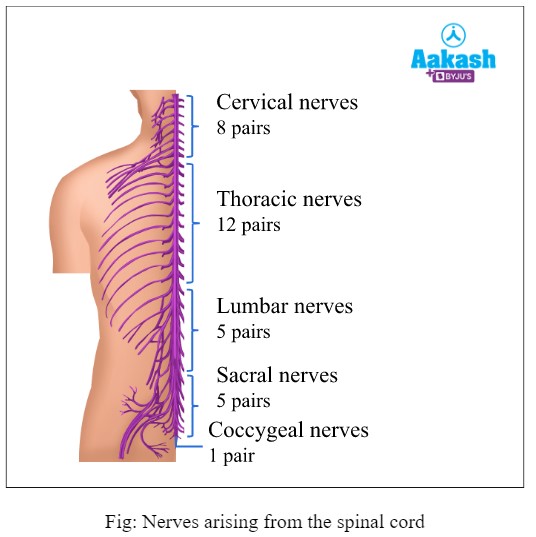
These are nerves arising from the spinal cord and are 31 pairs in number. There are 8 pairs of cervical spinal nerves, 12 pairs of thoracic spinal nerves, 5 pairs of lumbar spinal nerves, 5 pairs of sacral spinal nerves and 1 pair of coccygeal spinal nerves.
Autonomic neural system (ANS)
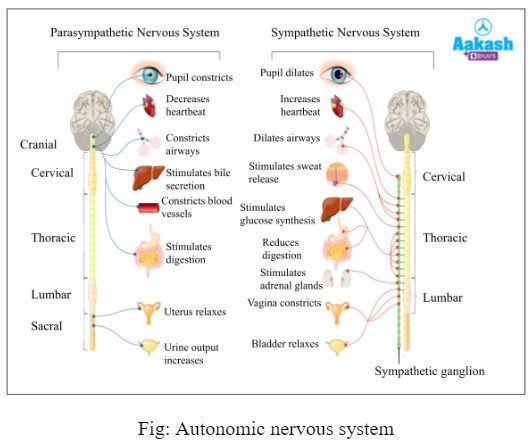
The nerves of the autonomic neural system help to regulate involuntary actions such as digestion, respiration, salivation, etc. It consists of a complex of nerves, ganglia and plexuses that connect the CNS to the involuntary parts of the body such as smooth muscles, visceral organs and glands. Each organ or gland of the body is supplied by a segment of autonomic nervous system made of two neurons (myelinated preganglionic and non-myelinated postganglionic neurons) and a ganglion (mass of cell bodies).
The autonomic neural system can be further divided into:
- Sympathetic nervous system - The nerves of the sympathetic nervous system help the body to prepare for stressful conditions. Thus these nerves can bring about an increase in heart beat, dilation of pupils, etc.
- Parasympathetic nervous system - The nerves of the parasympathetic nervous system help the body to restore back to its normal state, once the stress is over.
Practice problems
1. Which of the following is not a part of the somatic nervous system?
- Cranial nerves
- Spinal cord
- Spinal nerves
- both b and c
Solution: The brain and the spinal cord are parts of the central nervous system and the peripheral nervous system consists of all the nerves arising from or arriving at the CNS. The somatic nervous system is a part of the peripheral nervous system and consists of cranial nerves which arise from the brain and spinal nerves which arise from the spinal cord. Thus, the correct option is b.
2. The myelin sheath is secreted by the
- Schwann cells
- Synaptic knobs
- Nissl granules
- Dendrites
Solution: The myelinated nerve fibres have an outer layer of neurilemma which is formed by the tubular and nucleated Schwann cells and an inner layer of an insulating sheath known as the myelin or medullary sheath that is secreted by the Schwann cells. Thus, the correct option is a.
3. Which of the following transmit impulses from the brain to an effector organ?
- Sensory neurons
- Interneurons
- Motor neurons
- Sensory nerves
Solution: The sensory neurons carry impulses of stimuli received by the receptors to the central nervous system (brain and spinal cord). The motor neurons transmit impulses from the brain or spinal cord to the effector organs such as muscles or glands to help them respond to the stimuli. The interneurons connect the nearby sensory and motor neurons. The sensory nerves are formed by a collection of several bundles of sensory neuron fibres along with blood vessels, wrapped in a covering of connective tissue. Thus, the correct option is c.
4. The number of thoracic spinal nerves in the human body is -
- 12
- 24
- 16
- 8
Solution: The spinal nerves arise from the spinal cord in pairs, innervating both the right and left sides of the body. There are 31 pairs of spinal nerves out of which 8 pairs are cervical, 12 pairs are thoracic, 5 pairs are lumbar, 5 pairs are sacral and 1 pair is coccygeal with respect to their sites of origin. Thus, there are 12 pairs or 24 thoracic spinal nerves and the correct option is b.
FAQS
- Which is the longest nerve in the body?
Answer: The sciatic nerve is the longest nerve in the human body. The roots of this nerve start just outside the spinal cord in the lower back and runs down the pelvis into the back of each leg.
- Which is the smallest nerve of the body?
Answer: The trochlear nerve or Cranial nerve pair IV is the smallest nerve in the body. It arises from the midbrain and innervates the superior oblique muscle of the eyeball.
- Does our brain feel pain?
Answer: Specialised receptors in our body known as nociceptors are responsible for sensing the stimuli of pain. The brain does not have any nociceptors and hence does not feel any pain. This is why neurosurgeons can perform surgery on the brain even if the patient is awake. However headache is caused due to activation of nociceptors of the dura mater and pia mater.
- Why does the spinal cord not extend up to the coccyx region of the vertebral column?
Answer: The spinal cord does not extend up to the coccyx region of the vertebral column because it stops growing at the age of 4-5 years but the vertebral column continue to grow till adulthood.
YOUTUBE LINK: https://youtu.be/DT1sDdKPvys
Related Topics
|
Human ear |
|
Eye: Location, Protection, Structure, Mechanism of vision, Adaptation and Accommodation |
|
Synapse and Transmission of impulses |
|
Reflex action and reflex arc |
|
Cranial Nerves |
|
Central neural system: Brain, Spinal cord |

NEET Related Links
JEE MAIN Related Links
JEE Advanced Related Links
JEE Advanced Eligibility Criteria
JEE Advanced Chemistry Syllabus
JEE Advanced Registration Dates
CUET Related Links
Important Topics
Anemometer : Measurement of Wind Speed
Angular Acceleration Atomic Theory Audible and Inaudible Sound Average Speed and Average Velocity Average Velocity Avogadros Number Avogadros Hypothesis Azimuthal Quantum Number Balanced Force Bar Magnet Biconvex Lens Boyles Law Buoyancy Calorimeter Carnot Engine Celestial Bodies Centripetal And Centrifugal Force Concave and Convex Lenses Concave Convex Mirrors Contact and Non Contact Force Controlled Thermonuclear Fusion Convection Currents Convex Lens Convex Mirror Destructive Interference Difference Between Conduction Convection and Radiation Difference Between Electric Field and Magnetic Field Difference Between Heat And Temperature Difference Between Series And Parallel Circuits Differences Between Acceleration And Velocity Distance and Displacement Distance Time Graph Electrical Force : Electric Forces and Their Types Electromagnetic Waves : Definition, Equation and Properties of Electromagnetic Waves Electromagnetism Electron Spin Fluid Flow : Bernoullis Equation Derivation and Fluid Mechanics Fluid Friction : Types and Factors of Fluid Friction Frames of Reference : Inertial and Non- Inertial Frame of Reference Frequency and Wavelength Frictional Force Importance of Hydrosphere Instantaneous Speed and Velocity Introduction to Motion Kinetic and Potential Energy Difference Law Of Conservation of Energy Layers of the Earth Light Energy Light Sources List of physics scientists and Their inventionsLoudness of Sound
Magnetic Dipole Moment Magnetic Field Non - Contact Force Non - Renewable Energy Ohms Law Optics P Wave Physics Symbols Plane Mirrors Poissons Ratio Projectile Motion Properties of Water : Anomalous Expansion of Water Radius of Gyration Reflection of Light Reflection of Waves Relative Density Resonance Reverberation Rolling Friction Rotation and Revolution Screw Gauge Semiconductors and Insulators Sliding Friction Speed Time Graphs Static Friction Stefan Boltzmann Law Stress Tension Tension Force Thermometer: Clinical Laboratory Thermometer Types of Rocks Types of Waves Uniform Motion and Non Uniform Motion Unit of Voltage Uses of Convex Lens Uses Of Convex Mirror Uses of Electromagnet Uses of Optical Fibre Wave Wavelength of Light What is Scattering of Light Working of Electric Bell Conventional and Non-conventional Sources of Energy Buoyant Force Bulk Modulus of Elasticity Bernoulli’s Principle Angular Momentum Difference Between Speed And Velocity ForceUnit of Heat
Difference between Distance and Displacement Simple Microscope Derivation Of Equation Of Motion Thermometer: Clinical & Laboratory Thermometer Difference between Concave and Convex LensDerivation Of Lens Maker Formula
Unit Of Pressure Velocity Uses of Plane Mirror
Wave Theory of Light
Unit of Density Unit of Light Unit of Force Unit of Magnetic Field Unit of wavelength Unit of Viscosity Uses of Electroplating Young's Modulus
What is the Scattering of Light
Lenz Law Space Wave Propagation Schrodinger Wave Equation Relation between Fahrenheit and Celsius Refractive Index Potentiometer Working Pascal Law Oscillatory Motion Optical Instruments Newton's Laws of Motion - First Law Modulation and Demodulation Magnetic Flux Lens Formula and Magnification Kaleidoscope Faradays Law Epsilon Naught Value Energy Bands Electrostatics Electroscope AC Generator Unit of Current Lithosphere Bending Equation Derivation Difference Between Pound and Kilogram Semiconductor Devices OTEC - Ocean Thermal Energy Conversion Hall Effect Rectilinear Propagation of Light Difference Between Ammeter and Voltmeter Coefficient of Linear Expansion Ampere’s Law Cyclone and Thunderstorm Save The Environment From Pollution Particle Nature of Light Types of DC Motor Uses Of Transistor Derivation of Phase Rule Unit of Humidity

 Call Now
 Let's Chat
 Share
Share