-
Call Now
1800-102-2727


Structure and Function of Human Ear, Practice problems and FAQs

Have you ever wondered how sound makes its way from the source all the way to your brain? We have been taught since we were children that ears help us to hear. But how? As kids we never bothered with the whys and hows. But now that we know that sound is nothing but a form of energy that travels in the form of waves, don’t you wonder how the ears convert these waves into sounds that we can perceive and identify separately?
In fact, this is not all that the ear does for us. You will be amazed to know that the ears also help us to maintain body balance! Ever felt dizzy and out of balance after spinning for sometime? Did you know that this is caused because the fluids in our ears get disoriented when we spin? You must be wondering how can fluids in the ear make our head dizzy and throw us out of balance? And how do the ears perform two completely different functions such as hearing and balancing the body. To find the answers to these questions, we first need to understand the structure of the ear and that is exactly what we are going to do in this article.
Table of contents
- Structure of human ear
- Mechanism of hearing
- Maintenance of equilibrium
- Practice problems
- FAQs
Structure of Ear
The ear is a sensitive organ of the human body. It is mainly concerned with detecting, transmitting and transducing sound. Maintaining a sense of balance is another important function performed by the human ear. Ears are also known as mechanoreceptors as they convert mechanical energy of sound waves into sensory signals. Our ears are sensitive sound within a range of 20 - 20,000 Hz.
The human ear consists of three parts:
- External ear
- Middle ear
- Internal ear
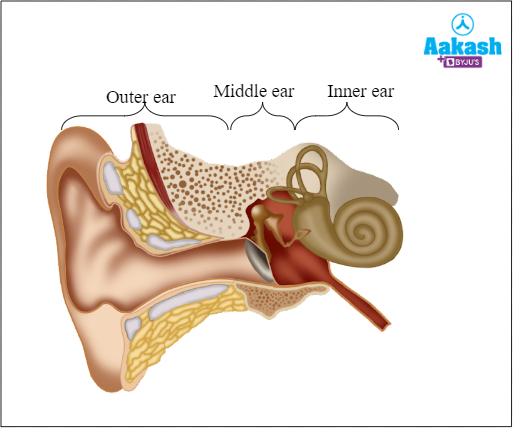
Fig: Structure of human ear
Outer Ear
The outer or external ear anatomy comprises the following parts –
- Pinna is the outermost funnel shaped, oval, projecting part that consists of elastic cartilage covered by skin and having muscles which are vestigial in humans. Human pinna has a soft ridge called helix, lower flexible lobule and a depression called concha. It helps to collect sound and waves and direct those to inner parts of the ear.
- External auditory canal or meatus is a tubular canal connecting the pinna present on the outer side to the tympanic membrane or eardrum on the inner side. It is S-shaped and protects the tympanum from being directly hit by any solid object. It is covered with skin having hair on the outer part and ceruminous or wax glands on the inner part which secrete cerumen or ear wax. Hair and wax helps to trap particulate matter, microbes and other irritants. Wax also protects the external ear from infection during swimming and keeps the tympanum moist and lubricated.
- Tympanic membrane or eardrum is an oval, tight and stretchable membrane that covers the opening of the temporal bone at the end of the external auditory canal. It is made up of fibrous connective tissue and is covered by stratified epithelium on the outer side and mucous membrane on the inner side. The middle of the inner side has an elevated part known as umbo. The tympanum vibrates when sound waves hit it. Rupturing of the tympanum can render an individual deaf.

Fig: External ear
Middle Ear
The cavity of the middle ear is connected to the inner ear with the help of a partition which has two membrane covered apertures - the upper oval window (fenestra ovalis) and the lower round window (fenestra rotunda).
The middle ear contains three tiny bones,collectively called the ear ossicles - malleus (hammer), incus (anvil) and stapes (stirrup), connected to each other in the same order. Malleus is hammer-shaped and attached to the umbo of the tympanic membrane. It is the largest bone of the ossicles. Incus is an anvil-shaped bone, present between the malleus and stapes and acts as a pivot point in the transmission of impulses. Stapes is the smallest bone of the body and resembles a stirrup. It is attached to the oval window by means of annular ligaments. The ear ossicles amplify the sound waves with the help of a lever system and transmit it to the inner ear via the round and oval window.
The eustachian tube is the connection between the middle ear and the pharynx and helps to equalise pressure between the air in middle ear and external air entering the pharynx. This helps to equalise air pressure on either side of the eardrum and allows it to vibrate freely.
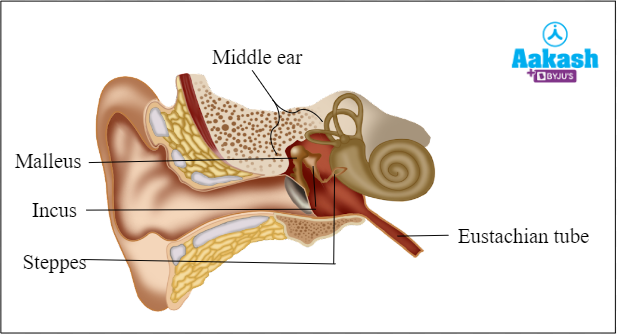
Fig: Middle Ear
Inner Ear
The inner ear anatomy consists of the following parts –
The inner ear is called the labyrinth. It is composed of a membranous labyrinth present inside the bony labyrinth. A fluid known as perilymph surrounds the bony labyrinth. The membranous labyrinth is filled with the endolymph. The cochlea possesses auditory receptors which help in hearing and vestibular apparatus helps to maintain the equilibrium of the body.

Fig: Inner ear
Cochlea (Auditory organ)
The cochlea is a coiled portion of the membranous labyrinth, which looks like a snail. It is a spirally coiled tube having two and three quarters turns and is connected to the sacculus by a short duct named ductus reuniens. The cochlea is made up of three canals, upper vestibular canal or scala vestibuli, middle cochlear duct or scala media and the lower tympanic canal or scala tympani. Two thin membranes separate these canals. The basilar membrane separates the scala media from the scala tympani whereas the Reissner’s membrane separates scala media from scala vestibuli.
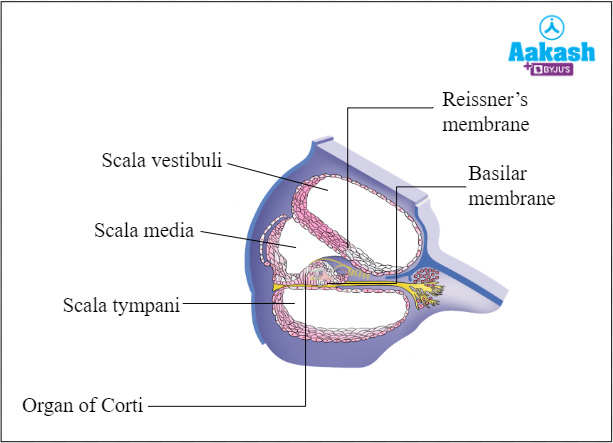
Fig: Cochlea
The scala vestibuli and scala tympani are filled with the perilymph. They are continuous distally through a narrow passage called helicotrema and are connected to the oval window (scala vestibuli) and round window (scala tympani) on the proximal end.
The scala media is filled with endolymph and possesses the organ of Corti which is an auditory organ that lies on the basilar membrane. Organ of corti has three types of structures - rods of Corti (pillar cells), columnar sensory hair cells and membranous reticular lamina. The pillar cells form a tunnel and support a flat reticular lamina on which the sensory hair cells are fixed. Each organ of Corti possesses around 18000 hair cells each of which possesses a tuft of approximately 100 hair or stereocilia. Stereocilia project from the hair cells and extend till the cochlear duct. Supporting cells, known as Deiter’s cells, are present between the single outer row of hair cells and the 3-4 inner rows of hair cells. There is another membrane called the tectorial membrane into which the outer sensory hair cells are embedded.
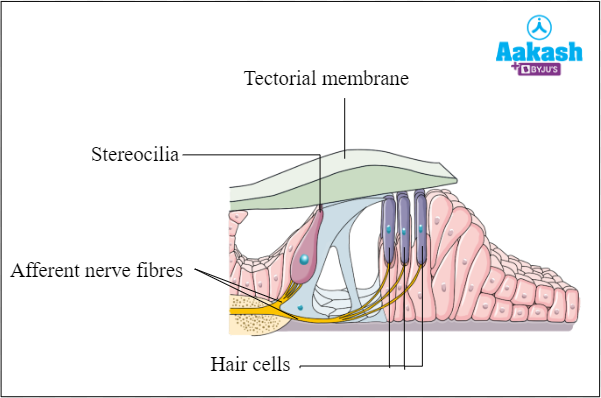
Fig: Organ of Corti
Eight different types of specialised sensory hair cells are present to detect sounds vibrations of different pitch, amplitude and intensity. These sensory cells are also known as phonoreceptors. The sensory cells are innervated with afferent nerve fibres from the cochlear nerve. The cell bodies of these nerve fibres occur in the spiral ganglion region of the cochlea.
Vestibular apparatus
Vestibular apparatus lies above the cochlea and helps to maintain the equilibrium. It is a part of the membranous labyrinth. The vestibular apparatus is composed of three semicircular canals and a central sac called otolith which possesses two chambers, saccule and utricle.
Otolith
It is the central sac of membranous labyrinth which is suspended into the bony labyrinth by connective tissue. It has an upper larger chamber named utricle and a lower smaller chamber named saccule. These two chambers are connected through a utriculo-saccular duct. From the posterior end of sacculus develops an elongated duct called ductus endolymphaticus. The duct ends in a blind sac called saccus endolymphaticus. Ductus or canalis reuniens is a short tube which arises from the lower end of the sacculus and connects it with the cochlear duct. These ducts help in continuous circulation of endolymph in the inner ear.
Saccule and utricle have a sensory spot named macula which has supporting cells and conical and flask shaped hair cells, which are sensory. The sensory cells bear a number of stereocilia or non motile hair and one motile cilium known as kinocilium at the free end and vestibular nerve fibres on the other end. The hair and cilium are in contact with a gelatinous otolithic membrane in which the otoliths are embedded in. Otoliths are proteinaceous and calcareous particles which press the hair and cilium against gravity and help in maintaining static equilibrium.
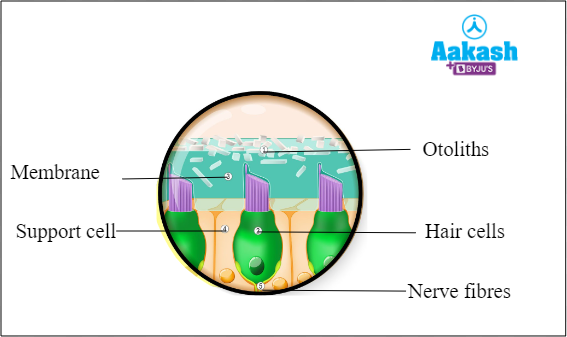
Fig: Macula
Semicircular canal
Three semicircular canals arise from the utricle. It consists of three canals which are present at the right angle to each other and are connected to the utricle. The canals are filled with endolymph. One end of each canal is swollen and known as the ampulla. Each ampulla consists of a sensory spot known as crista ampullaris that has a sensory epithelium on an elevation. The epithelium has conical and flask shaped sensory cells and supporting cells. The sensory cells bear stereocilia and kinocilium on one end and are connected to the vestibular nerve fibres on the other end. A dome shaped gelatinous sheath named cupula occurs over the cilia of the sensory cells. As we move or rotate our head, the movement of endolymph in the canals stimulates the stereocilia of the hair cells.

Fig: Semicircular canal
Function of Ear
Following are the important function of the ear:
- The ear helps in hearing by converting the sound waves into vibration that travel from the outer ear to the inner ear via the middle ear. The tiny hair cells of the organ of corti translate the vibrations into an electrical impulse that are transmitted to the brain by sensory nerves. Depending on the vibrations, impulses of different intensities are transmitted and the brain helps us to perceive the sound and identify its unique characteristics.
- The eustachian tube equalises the air pressure on either side of the eardrum or tympanum.
- The vestibular complex contains receptors that help to maintain static and dynamic body balance.
Mechanism of Hearing
The sound waves received by the pinna reach the tympanic membrane through the auditory meatus causing the tympanic membrane and eardrum to vibrate. As the hammer (malleus) is connected to the umbo of the tympanic membrane, the vibrations are transferred to the middle ear. The bones of the ear ossicles (malleus, incus and stapes) being connected to each other start vibrating and amplify the sound waves by a lever-like action. The stapes being connected to the membrane of the oval window, transfers these vibrations to the perilymph and endolymph of the inner ear through the oval window. As the vibrations reach the endolymph of scala media, it stimulates the basilar movement and tectorial membrane. The movement of fluid over the basilar membrane causes the stereocilia to rub against the tectorial membrane. As the stereocilia bend, the ion channels in the plasma membrane of the sensory hair cells open up. As calcium ions move into the sensory cells, a neurotransmitter named glutamate is released from the nerve fibres attached to the hair cells. The neurotransmitter molecules bind to the receptors of sensory neurons which synapse with the nerve fibres of the hair cells. Binding of neurotransmitters causes the sensory neurons to depolarise, thus generating an action potential and initiating a nerve impulse which is transmitted to the auditory region of the cerebral cortex of the brain through the cochlear branch of the auditory nerve. The brain analyses the impulses and helps us perceive the sound. The brain not only recognises the sound but also judges the direction, loudness and pitch of the sound.
Mechanism of Maintaining Equilibrium
The vestibular apparatus is the main organ for maintaining equilibrium.
Static equilibrium is maintained by macula of saccule and utricle. Gravitational pull causes the otoliths to come in contact with stereocilia and stimulates them. When the head is tilted or moved, otoliths come in contact with the stereocilia of different cells. This stimulates them and generates impulses that are carried to the brain via the vestibular branch of the auditory nerve. The cerebellum of the brain interprets the nerve impulses resulting in the awareness of body position with respect to ground, irrespective of the head position. Utricle senses the vertical movements and saccule senses the sideways movement of the head.
Dynamic equilibrium is detected by cristae of semicircular canals. Movements in any direction are sensed by bending of the cupula as well as hair of sensory cells in a particular crista. The sensory impulses are carried to the brain by the vestibular branch of the auditory nerve for interpretation and correction. Dizziness after spinning or long travel is due to disturbance in the endolymph or excessive sensitisation.

GIF: balancing by ears
Practice problems
Q1. Find the correct statement about the eustachian tube
(a) it equalises pressure on either side of the eardrum
(b) connects the middle ear to the pharynx
(c) forms a connection between inner ear and middle ear
(d) Both (a and (b)
Solution: The eustachian tube is the connection between the middle ear and the pharynx and helps to equalise pressure between the air in middle ear and external air entering the pharynx. This helps to equalise air pressure on either side of the eardrum and allows it to vibrate freely. The middle ear amplifies the sound waves and transmits to the inner ear. Hence the correct answer is option d.
Q2. Find the correct statement about Inner ear
(a) it is made up of bony labyrinth and and membranous labyrinth
(b) the bony labyrinth is enclosed by membranous labyrinth
(c) membranous labyrinth is surrounded by endolymph
(d) inner ear helps in hearing only
Solution: The inner ear is called the labyrinth. It is composed of a group of interconnected canals and sacs. The membranous labyrinth is present inside the bony labyrinth. A fluid known as perilymph surrounds the bony labyrinth. The membranous labyrinth is filled with the endolymph. Auditory receptors are located in the cochlea and vestibular apparatus maintains the body balance. Thus the inner ear is made up of bony and membranous labyrinth.
Thus, the correct option is a.
Q3. Match the following
|
Column I |
Column II |
|
A. Reissner’s membrane |
(i) covered by stratified epithelium and mucous membrane |
|
B. Incus |
(ii) ends at the fenestra ovalis |
|
C. Tympanic membrane |
(iii) forms the roof of scala media |
|
D. Scala vestibuli |
(iv) also known as anvil |
(a) A - iii, B - iv, C - i, D - ii
(b) A - i, B - ii, C - iii, D - iv
(c) A - iii, B - i, C - ii, D - iv
(d) A - i, B - iii, C - iv, D - ii
Solution: Reissner’s membrane forms the roof of the scala media and separates scala media and scala vestibuli.
Incus is the middle bone of the ear ossicles which is anvil shaped and is connected to malleus on one side and stapes on the other.
Tympanic membrane is covered by stratified epithelium on the outer side and mucous membrane on the inner side.
The scala vestibuli and scala tympani are filled with the perilymph. They are continuous distally through a narrow passage called helicotrema and are connected to the oval window (scala vestibuli) and round window (scala tympani) on the proximal end.
Thus, the correct option is a.
Q4. Find the incorrect match.
(a) Middle ear – amplification of sound waves
(b) Hair cells – possess stereocilia on one end and nerve fibres on the other
(c) Saccule and utricle – maintain static balance
(d) Crista ampullaris – help in hearing
Solution: Crista ampullaris is present in each of the ampulla and is responsible for sensing angular rotation to help us maintain dynamic balance. It has conical and flask shaped sensory cells and supporting cells. The sensory cells bear stereocilia and kinocilium on one end and are connected to the vestibular nerve fibres on the other end. A dome shaped gelatinous sheath named cupula occurs over the cilia of the sensory cells. The stereocilia of hair cells are stimulated by the movement of endolymph in the canals as we move or rotate our head.
Thus, the correct option is d.
FAQs
Question 1. What is the most common ear problem?
Answer: One of the most common ear problems is hearing loss which is of three main types - conductive, sensorineural, and a combination of both.
Conductive hearing loss arises due to hindrances in conducting the soundwaves which can be due to issues with the eardrum, ear canal or ear ossicles. Buildup of fluid or ear wax can also cause this. Sensorineural hearing loss develops due to damage to the nerves of the inner ear which can be due to exposure to loud noise or ageing.
Question 2. Can ear problems affect the nervous system?
Answer: Otitis media is a painful infection of the middle ear in which pus and mucus accumulates behind the eardrum. It occurs due to allergy or upper respiratory infection reaching the ear. The most fatal complication of otitis media is infection of the brain which causes a brain abscess due to accumulation of pus in the brain. This can lead to neurologic deficits and altered consciousness.
Question 3. Which are the common symptoms of ear diseases?
Answer: The symptoms of an ear infection depend on the cause and type of infection, but commonly include:
- Pain in the ear
- mild deafness or muffled hearing
- Discharge from the ear
- fever
- headache
- loss of appetite
- itchiness
- blisters on the outer ear
- buzzing or humming noise in the ear
- vertigo (loss of balance)
Question 4. Are our ears and eyes connected?
Answer: The inner ear is intimately connected to the muscles that move our eyes through a reflex called the vestibulo-ocular reflex or VOR. This reflex helps to attain gaze stability, that is, we are capable of focussing our eyes even when we are moving.
Youtube VIDEO:
Related Topics
|
Structure and types of neuron, Nerves, Myelinated and Nonmyelinated nerve fibres |
|
Introduction to Nervous System |
|
Eye: Location, Protection, Structure, Mechanism of vision, Adaptation and Accommodation |
|
Synapse and Transmission of impulses |
|
Reflex action and reflex arc |
|
Cranial Nerves |

 Call Now
 Let's Chat
 Share
Share