-
Call Now
1800-102-2727


Genetic Diversity

Genetic diversity, species diversity, and ecological diversity are the three levels of biodiversity. Genetic architecture is unique from individual to individual and expressed by hereditary-material DNA. A population is equipped to withstand stress from environmental factors due to a wide range of gene sets. One of the driving forces behind evolution is genetic diversity. It also serves as the chief criterion for natural selection.
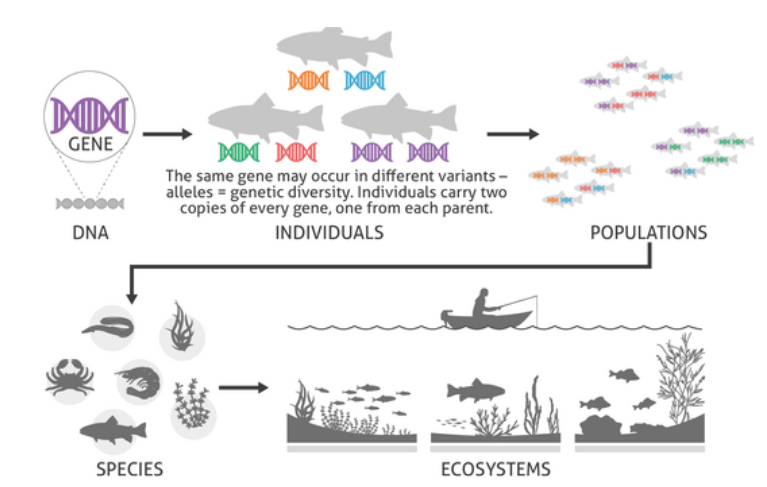
Image: Genetic Diversity
Table of Contents:
- What is Genetic Diversity?
- Significance of Genetic Diversity
- Components of Genetic Diversity
- Examples of Genetic Diversity
- Conservation of Genetic Diversity
What is Genetic Diversity?
Recombination of genetic material in the inheritance process leads to genetic diversity. It evolves with space and time. Sexual reproduction is essential for preserving genetic diversity due to generating unique offspring by fusing the parents' genes. Mutation of genes, flow, and genetic drift also generate genetic diversity.
Definition: Genetic diversity is characterised by the existence of genetic variability within species.
Significance of Genetic Diversity
Genetic diversity plays a crucial role in ecosystems. They include the following:
- Natural selection and the survival of the fittest are governed by environmental alteration due to natural or human inventions. Genetic diversity leads to the vulnerable variety dying, and the one who adapts to changes survives.
- Genetic diversity aids in a person's ability to adapt to stress, unfavourable environmental conditions, diseases, and distinct physical characteristics.
- The diversity in various genes that may resist diseases, pests or other conditions can be maintained. Genetic diversity is an essential factor for a healthy population.
- By cross-breeding numerous genetic variants, generating new plant species with desired traits like increased stress tolerance and disease resistance is possible.
- The frequency of unwanted hereditary characteristics is decreased by genetic diversity.
- Genetic diversity guarantees that certain species survivors are present in the ecosystem.
Components of Genetic Diversity
Genetic diversity is impacted by a wide range of evolutionary processes that involves genetic drift, mutation, natural selection and gene flow. However, a whole new set of alleles can only be produced through mutations.
1. Genetic Drift
Genetic drift is a random fluctuation in a population’s frequency of a given allele from generation to generation due to chance sampling events that are less prominent in larger populations.
2. Mutation
Modifications or alterations in the nucleotide sequence of DNA are called mutation. Thus, the alteration or replacement of genes and chromosomes is the chief cause of mutation. A population’s genetic structure can alter because of the new alleles created by mutations.
3. Natural Selection
Natural selection happens when individuals who can adapt to environmental alterations reproduce more often, changing the population's gene pool.
4. Gene Flow
Gene flow or gene migration is the migration of alleles among a population. The process involves allele transportation from one population to the other, causing the production of future generations with that allele. However, they possess distinct frequencies for this allele.
Examples of Genetic Diversity
There are numerous examples of genetic diversity. Some include-
- The essential qualities can be achieved when dogs are selectively bred.
- Several forms of rose, wheat, rice and flowers.
- More than 1000 species of mangoes in India.
- 50,000 distinct types of rice.
- A distinct variety of Rauvolfia, a medicinal plant, exists in Himalayan ranges, each possessing a distinct volume of chemical reserpine.
Conservation of Genetic Diversity
Practices like natural habitat destruction or selective harvesting lead to loss of diversity. It is essential to conserve diversity for human health and prevent species from being extinct. A lost species may hold a wide range of benefits to the ecosystem.
Growing genetically diverse and disease-resistant species is feasible by preserving diversity in conditions where the whole crop is deteriorated by drought or a sudden outbreak of disease. There are many methods to conserve biodiversity. They include
1. In situ Conservation
As it is difficult to conserve biodiversity, specific hotspots are identified and preserved to protect species that are endemic to a particular ecosystem and are in danger of extinction or endangered. For example, wildlife sanctuaries and national parks.
2. Ex-situ Conservation
Endangered plants and animals are removed from their natural ecosystem and conserved in specific habitats to offer special care and security. For example, botanical gardens, safaris and zoos. Also, it includes the following:
- Cryopreservation: Using the cryopreservation technique, gametes and threatened species are preserved in viable and fertile conditions for longer.
- Tissue Culture: Propagation of plants can be carried out, and in-vitro fertilisation of plants can be done through tissue culture.
- Genomic Library: A recent advancement in science that conserves genetic diversity is aided through the Genomic Library.
Practice Problems
Q1. Gene recombination during the process of inheritance can result in
a. Genetic diversity
b. In situ conservation
c. Ex-situ conservation
d. Gene flow
Ans. a. Genetic diversity
Genetic diversity occurs due to the recombination of genes in the inheritance process.
Q2. Genetic diversity alters with
a. Space
b. Time
c. Mutation
d. Both a and b
Ans. d. Both a and b
Genetic diversity is influenced by space and time, as they play a critical role in shaping it.
Q3. In situ conservation include
a. Animal reservoirs
b. National parks
c. Wildlife sanctuaries
d. All of the above
Ans. d. All of the above
In situ conservation includes wildlife sanctuaries, animal reservoirs and national parks.
Q4. Ex situ conservation include
a. Wildlife sanctuaries
b. National parks
c. Animal reservoirs
d. None of the above
Ans. d. None of the above
These come under in-situ conservation. At the same time, ex-situ conservation includes botanical gardens, zoological gardens and wildlife safaris.
Frequently Asked Questions
Q1. What is an ecosystem?
Answer: A geographical area that involves animals, plants and other organisms along with the abiotic pools with which they interact.
Q2. Who is the father of genetics?
Answer: Gregor Mendel is popularly known as the father of modern genetics, owing to the discovery of inheritance principles.
Q3. How does population size influence genetic diversity?
Answer: Certain populations lose genetic diversity more frequently than larger populations because of genetic drift or stochastic sampling error.

NEET Related Links
JEE MAIN Related Links
JEE Advanced Related Links
JEE Advanced Eligibility Criteria
JEE Advanced Chemistry Syllabus
JEE Advanced Registration Dates
CUET Related Links
Important Topics
Anemometer : Measurement of Wind Speed
Angular Acceleration Atomic Theory Audible and Inaudible Sound Average Speed and Average Velocity Average Velocity Avogadros Number Avogadros Hypothesis Azimuthal Quantum Number Balanced Force Bar Magnet Biconvex Lens Boyles Law Buoyancy Calorimeter Carnot Engine Celestial Bodies Centripetal And Centrifugal Force Concave and Convex Lenses Concave Convex Mirrors Contact and Non Contact Force Controlled Thermonuclear Fusion Convection Currents Convex Lens Convex Mirror Destructive Interference Difference Between Conduction Convection and Radiation Difference Between Electric Field and Magnetic Field Difference Between Heat And Temperature Difference Between Series And Parallel Circuits Differences Between Acceleration And Velocity Distance and Displacement Distance Time Graph Electrical Force : Electric Forces and Their Types Electromagnetic Waves : Definition, Equation and Properties of Electromagnetic Waves Electromagnetism Electron Spin Fluid Flow : Bernoullis Equation Derivation and Fluid Mechanics Fluid Friction : Types and Factors of Fluid Friction Frames of Reference : Inertial and Non- Inertial Frame of Reference Frequency and Wavelength Frictional Force Importance of Hydrosphere Instantaneous Speed and Velocity Introduction to Motion Kinetic and Potential Energy Difference Law Of Conservation of Energy Layers of the Earth Light Energy Light Sources List of physics scientists and Their inventionsLoudness of Sound
Magnetic Dipole Moment Magnetic Field Non - Contact Force Non - Renewable Energy Ohms Law Optics P Wave Physics Symbols Plane Mirrors Poissons Ratio Projectile Motion Properties of Water : Anomalous Expansion of Water Radius of Gyration Reflection of Light Reflection of Waves Relative Density Resonance Reverberation Rolling Friction Rotation and Revolution Screw Gauge Semiconductors and Insulators Sliding Friction Speed Time Graphs Static Friction Stefan Boltzmann Law Stress Tension Tension Force Thermometer: Clinical Laboratory Thermometer Types of Rocks Types of Waves Uniform Motion and Non Uniform Motion Unit of Voltage Uses of Convex Lens Uses Of Convex Mirror Uses of Electromagnet Uses of Optical Fibre Wave Wavelength of Light What is Scattering of Light Working of Electric Bell Conventional and Non-conventional Sources of Energy Buoyant Force Bulk Modulus of Elasticity Bernoulli’s Principle Angular Momentum Difference Between Speed And Velocity ForceUnit of Heat
Difference between Distance and Displacement Simple Microscope Derivation Of Equation Of Motion Thermometer: Clinical & Laboratory Thermometer Difference between Concave and Convex LensDerivation Of Lens Maker Formula
Unit Of Pressure Velocity Uses of Plane Mirror
Wave Theory of Light
Unit of Density Unit of Light Unit of Force Unit of Magnetic Field Unit of wavelength Unit of Viscosity Uses of Electroplating Young's Modulus
What is the Scattering of Light
Lenz Law Space Wave Propagation Schrodinger Wave Equation Relation between Fahrenheit and Celsius Refractive Index Potentiometer Working Pascal Law Oscillatory Motion Optical Instruments Newton's Laws of Motion - First Law Modulation and Demodulation Magnetic Flux Lens Formula and Magnification Kaleidoscope Faradays Law Epsilon Naught Value Energy Bands Electrostatics Electroscope AC Generator Unit of Current Lithosphere Bending Equation Derivation Difference Between Pound and Kilogram Semiconductor Devices OTEC - Ocean Thermal Energy Conversion Hall Effect Rectilinear Propagation of Light Difference Between Ammeter and Voltmeter Coefficient of Linear Expansion Ampere’s Law Cyclone and Thunderstorm Save The Environment From Pollution Particle Nature of Light Types of DC Motor Uses Of Transistor Derivation of Phase Rule Unit of Humidity

 Call Now
 Let's Chat
 Share
Share