-
Call Now
1800-102-2727


Functions of the Human Skeletal System

The key functions of the skeletal system are to support and offer a structural framework of the body. An adult human possesses a total number of 206 bones in the body. The human skeletal system consists of ligaments, cartilage, bones and tendons. The skeletal system of humans provides a definite shape to safeguard the internal organs. Infants have 300 additional bones, further fusing and combining to form larger bones. Osteology is the field of science that deals with bony structures and the structural and functional roles of the skeletal system.
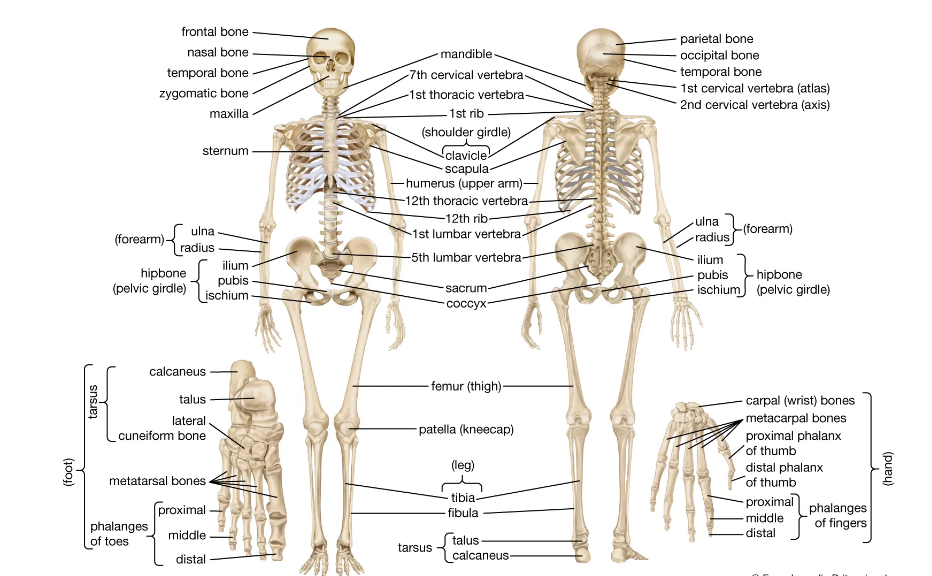
Image: Human Skeletal System
Table of Contents:
Functions of Bones
There are numerous distinct roles of human bones. They include-
- Aids in facilitating the movements of the body.
- The bones shape the body.
- Minerals like calcium and phosphate are stored in bones.
- Helps in providing support.
- RBCs (or red blood cells) are formed in the bones.
- Serves as a protecting shield for internal organs like the heart, lungs and brain.
Axial Skeleton
The axial skeleton can be categorised into two major types, i.e., axial and appendicular skeleton.
1. Axial skeleton
Axial bones constitute the middle axis which is formed of 198 bones. It involves the following regions of the human skeletal system.
a. Skull
Facial bones and cranium compose the human skull. The purpose of the cranium is to safeguard the human brain. It is composed of 8 plate-shaped bones that are linked with each other at meeting points called sutures. The remaining 14 bones altogether, with the cranium, create the facial bones. The only movable bone in the human skull is the mandible.
The skull’s main function is to support and protect the brain’s surrounding layers, meninges, cerebellum, brainstem, and eye orbits, which are safeguarded by the skull. The attachments of the muscles of the face and scalp are provided with structural support. Furthermore, it protects several vessels and nerves, innervating facial muscles, the brain and other linked parts. Internal organs are safeguarded more by skull hardening for combining and providing protection.
b. Hyoid
The anterior neck contains a hyoid, a U-shaped bone. It serves as a bridge between the postcranial skeleton and the skull. The hyoid bone facilitates the movement of the tongue and the swallowing of food and drinks. No articulations of other bones with hyoid bone have been observed.
c. Ribs
The long, curving bones that compose the rib cage are called ribs. The ribs comprise 24 bones in 12 pairs, creating the thorax’s protecting cage. The ribs shield internal thoracic organs. They terminate anteriorly as cartilage while articulating posteriorly with the vertebral column.
d. Sternum
The sternum, the breastbone, is a long bone in the chest's centre. The rib cage comprises the sternum and ribs. The clavicle or collarbone and the first seven ribs are linked together to the sternum.
e. Auditory Ossicles
The three middle ear bones called auditory ossicles are the malleus, incus and stapes. They are the tiniest bones in the human body. One of their tasks is to transmit sound from the air to the cochlea.
Vertebral Column
The axial skeletal system also encompasses the vertebral column. The vertebrae, a set of around 33 bones, comprise the vertebral column that is segregated by intervertebral discs. The vertebral column is categorised into five parts, i.e., Lumbar, sacrum, thoracic, cervical and coccyx.
The functions of the vertebral column are as follows:
- Provides balance for body weight to aid in structural support.
- Offers stiffness to the body.
- The vertebral column shields the spinal cord.
- Offers attachment to the pelvic girdles and pectoral girdles, and other muscles.
Cervical Vertebrae
The cervical are the thinnest and the most delicate bones of the vertebral column, which is composed of 7 vertebrae along the neck’s column. Their names reflect their position from the skull to the chest located from C1 to C7, i.e., the first to the seventh cervical vertebra. Atlas is the C1 vertebrae that support the cranium. Furthermore, C2 is also known as Axis because it is an axis around which the skull and the atlas rotate when the head is turned from one side to another.
Thoracic Vertebrae
It is located in the middle of the back of the human body. The basic function is to support the rib cage and protect the lungs and heart. The twelve thoracic vertebrae are called T1 to T12. They are unique and hold up the ribs and the other vertebrae.
Lumbar Vertebrae
The largest vertebral column, which comprises 5 vertebrae bones between the pelvis and rib cage, is called the lumbar vertebrae. They are named L1 to L5. L1 is located next to the pelvis, and L5 is near the thoracic vertebrae. The lumbar vertebrae serve as a load-bearing structure.
Sacral Vertebrae
The sacrum comprises five vertebrae that compose the sacral spine. The sacrum is a long vertebrae at the inferior end of the spine with a wedge-like shape. It is an extremely strong bone that holds onto the upper body's weight when it transfers from the pelvis to the legs.
Coccyx Vertebrae
Three to five rudimentary bones must be fused together to form a small triangular bone at the base of the vertebral column called the coccyx vertebrae. It is also called the tailbone, which is an attachment position for ligaments, muscles and tendons. When an individual falls abruptly, the coccyx may get fractured.
2. Appendicular Skeleton
126 bones form an appendicular skeleton in the adult human body. It includes pelvic and pectoral girdles and the bones such as shoulder girdles, lower and upper extremities, and pelvic bones. It is primarily sub categorised into 6 regions, as follows:
Arms and Forearms
There are six bones on the arm and forearm. The following are the large bones of the arm:
- The humerus links the radius and the ulna at the elbow after emerging from the shoulder socket.
- Radius is a forearm that extends from the elbow to the thumb side of the wrist.
- Ulna is a forearm that extends from the elbow to the pinky side of the elbow.
Shoulder Girdle
A group of four bones, the pectoral girdle or shoulder girdle, connects to each arm on both sides. The appendicular skeleton that supports the upper limbs involves the pectoral girdle. The scapula and the clavicle comprise the human’s pectoral girdles.
Hands
The fifty-four bones comprise hands that support the flexibility of the soft tissues. The three subcategories of hand bones are as follows:
- Carpals: The wrist area possesses 8 irregular forms of bones called carpals.
- Metacarpals: 5 metacarpal bones are connected to each digit.
- Phalanges: The finger bones are called phalanges. Each finger possesses three phalanges, but the thumb has only two phalanges.
Pelvic Girdle
A ring-like bony-shaped bone located in the lower part of the trunk consists of two bones named coccyx and sacrum. It is created of paired hip bones where every bone is composed of ischium, ilium and pubis. The primary functions of the pelvic girdles are as follows.
- The body weight is transmitted from axial to appendicular components while in motion.
- Offers attachments from numerous muscles and ligaments leading to movement.
Males have an android pelvis, while females possess a gynaecoid pelvis. The structural differences produce a great pelvic outlet that aids in the process of the birthing of the child.
Thighs and Legs
The appendicular skeletal system involving the lower limb, including thighs and leg bones, supports lower limb muscles. These muscles aid in jumping, walking, standing and running. The bones must be strong enough to sustain the weight of the body.
- The largest and heaviest bone in the body is Femur. Its proximal end is rounded prominence, i.e., the head of the femur.
- The two long bones in the lower leg are fibula and tibia. Despite being different bones, they are strongly connected at the knee and ankle.
- The knee joint is linked with the tibia’s top side, while the ankle joint is linked to the base. However, the tibia holds up the whole weight of the human body. Additionally, the fibula is essential to support the tibia.
Feet and Ankles
The foot serves as a firm platform for the body to support weight. It comprises numerous bones like tarsal, metatarsal, and phalanges.
- The tarsal is a group of eight irregular bones located close to the ankle on the foot.
- Five bones called metatarsals support a digit and attach phalanges to the tarsals.
- Each toe possesses three phalanges, i.e., distal, intermediate and proximal.
Tendons
Skeletal muscles are connected with the help of tendons and joint bones. They are composed of connective tissues.
Ligaments
They are similar to tendons and offer the attachment of two bones together. They are a form of connective tissue.
Cartilage
Cartilage aids in protecting the bones from wear and tear at joints. They are softer but firm and more flexible than bones. Furthermore, it creates a framework for several body parts, including ribs, nose, ear, bronchial tubes, etc.
Diseases Linked With Human Skeletal System
Numerous diseases are linked to bones. Some include-
- Paget's Disease: A chronic disorder that can lead to bone enlargement and mishappening.
- Osteoporosis: A bone disorder that involves the deterioration of bone density and raises fracture chances.
- Arthritis: An inflammation disorder in the joints leading to problems, motion pain, and limiting movement.
Practice Problems
Q1. The heaviest and largest and heaviest bone is-
a. Tendon
b. Cartilage
c. Tibia
d. Femur
Ans. d. Femur
The Femur is the heaviest and the largest bone in the human body.
Q2. The two longest bones in the lower leg are-
a. Tarsal and metatarsal
b. Pelvic girdle and knee
c. Tibia and Fibula
d. None of the above
Ans. c Tibia and Fibula
Tibia and fibula are the longest bones in the lower leg.
Q3. The forearm and arm constitute of-
a. 5 bones
b. 6 bones
c. 7 bones
d. None of the above
Ans. b. 6 bones
The arm and forearm possess 6 bones.
Q4. The cervical vertebrae are composed of-
a. 7 vertebrae
b. 8 vertebrae
c. 9 vertebrae
d. 5 vertebra
Ans. a. 7 vertebrae
The cervical vertebrae comprise 7 vertebrae. i.e., C1 to C7.
Q5. The vertebral column functions are-
a. Protects the spinal cord
b. Offers stiffness
c. Aids in structural support
d. All of the above
Ans. d. All of the above
The vertebral column supports balanced bodyweight, provides stiffness and protects the spinal cord.
Frequently Asked Questions
Q1. State advantages of exercise for the skeletal system.
Answer: Weight-bearing exercises like weightlifting and walking maintain bone density and strength, stimulating the formation of new tissue of bone and enhancing joint flexibility.
Q2. Can nutritional deficiency influence the skeletal system?
Answer: Nutritional deficiency has a bad influence on the skeletal system. For example, Vitamin D, Vitamin K and calcium deficiency can lead to the losing strength of bones leading to easy fractures.
Q3. Why does a newborn baby have more bones than adults?
Answer: While newborns do not have more bones than adults, their bones are still developing and contain more cartilage and different components that gradually fuse together and ossify over time. The number of separate bone structures reduces as the bones ossify and merge, resulting in the adult skeletal system with its 206 bones.

 Call Now
 Let's Chat
 Share
Share