-
Call Now
1800-102-2727


Semi -Technical Description of a Typical Flowering Plant: General Description of the Plant, Floral Diagram, Floral formula, Practice Problems, and FAQs

Look at the image given below. You have seen these types of arts. Can you tell me what is it? Yes, you are correct. It is called Mandala art. In the ancient Sanskrit language mandala means ‘circle’. Mandala is a geometric pattern or design which represents the deities or cosmos in various heavenly worlds. Geometric forms are used to create wonderful works of art in this way.
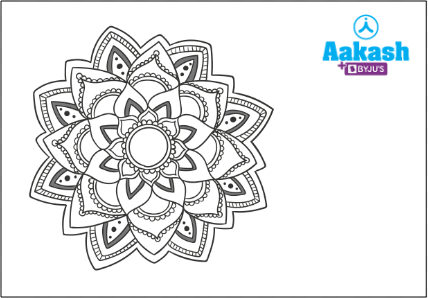
Fig: Art of Mandala
Now have a look at the below given image.
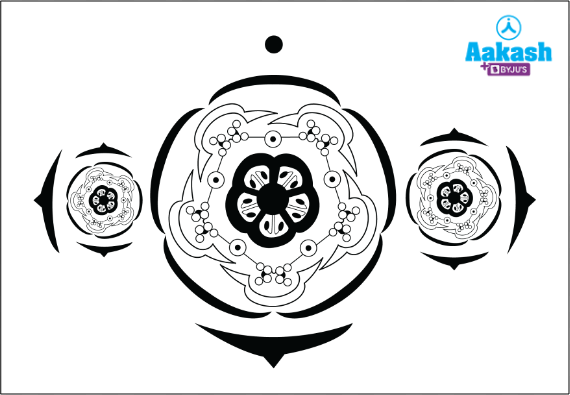
Fig: Floral diagram
Do you think this is the same as what you observed before? No. This is not a basic art form. This is a piece of botanical artwork and is commonly referred to as a floral diagram. Different morphological features of a flower creates its unique identity which can be represented in the form of a floral diagram or floral formula. Now you are interested to know more about this. Let’s explore the details of floral diagrams and floral formulas in depth in this article.
List of contents
- General description of an angiosperm plant
- Floral diagram
- Floral formula
- Floral formula vs floral diagram
- Practice Problems
- FAQs
General description of an angiosperm plant
Angiosperms or flowering plants are vascular plants in which the seeds are enclosed in fruits. A plant is normally described on the basis of the number of its attributes, such as habitat, habit, vegetative characters, floral characters, inflorescences, fruits, floral formulas, floral diagrams, and economic importances.
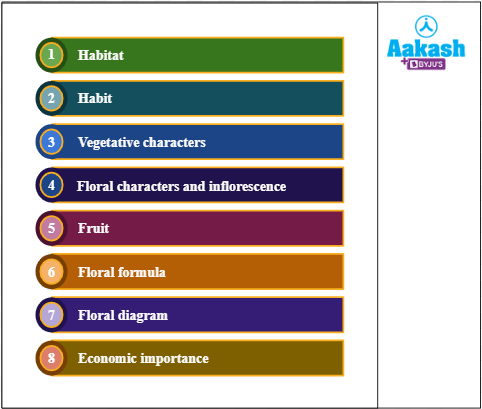
Fig: General characters of an angiosperm plant
Habitat
It is a place where the organism lives and is able to meet all its requirements. For example, an epiphyte like an orchid grows on a tree.
Habit
It is the general appearance of a plant. For example, herbs, shrubs or trees.
Vegetative characters
It includes information about the non-reproductive parts of the plant like root system, shoot system, leaves, fruits, seeds etc.
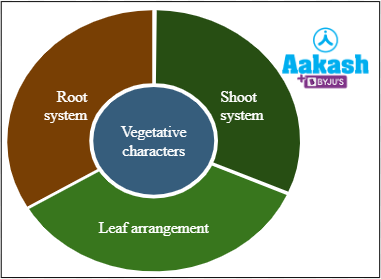
Fig: Vegetative characters
Root system
It is the part of the plants that normally present below the soil and helps the plant to attach to the substratum. It consists of the main root and its branches. It develops from the radicle of the seed. It can be a fibrous root system, adventitious root system or tap root system. Roots show modifications also depending on the species such as fleshy, conical, napiform, fusiform, aerial root, pneumatophores, nodulated roots etc.

GIF: Root system
Shoot system
It is the part of the plant that is normally seen above the level of soil. Stem refers to the ascending part of the plant axis that bears branches, leaves, flowers, and fruits. Together they form the shoot system. The shoot develops from the plumule of the seed. It can be branched or unbranched. It shows some modifications also depending on the species such as rhizome, corm, bulb, offset, runner, sucker, stolon etc.
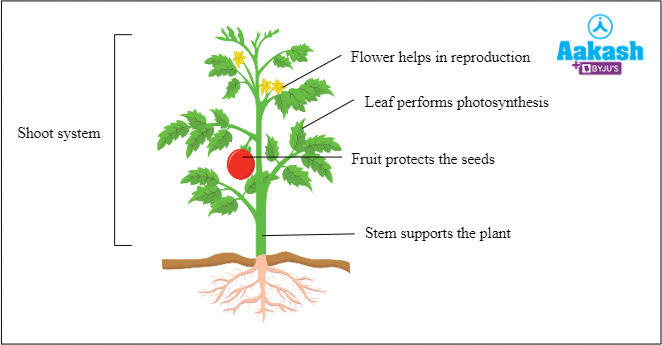
Fig: Shoot system
Leaf
It is the flattened, lateral outgrowth that arises on the node of a stem or its branches in a plant. It is typically green in colour and helps in photosynthesis. Buds arise from the axil of leaves and later develop into new branches or shoots.
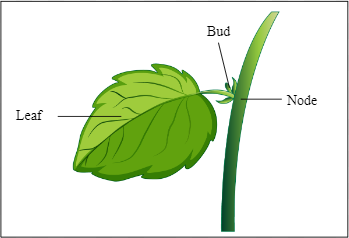
Fig: Structure of leaf
Floral characters
It includes information about the various parts of the reproductive structure of the plant like flowers.
Flower
It is a modified shoot which is considered as the ornament of an angiosperm plant. It normally possesses four whorls such as calyx, corolla, androecium and gynoecium. The flower can be unisexual (staminate or pistillate) or bisexual. It can be zygomorphic or actinomorphic based on symmetry. It can be hypogynous, perigynous or epigynous based on the position of the ovary. It can be trimerous, tetramerous or pentamerous based on the number of appendages..
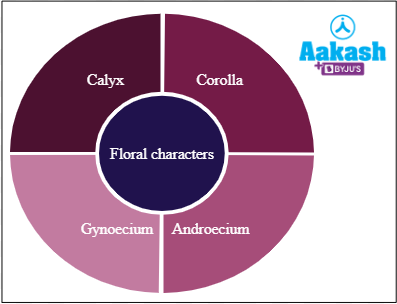
Fig: Floral characters
Parts of a typical flower
The following are the parts of a typical flower:
Calyx
It is the non-essential whorl of sepals and is normally green in colour. Its colour, shape, aestivation and number vary depending on the species.
Corolla
It is the non-essential whorl of petals and is normally coloured to attract the pollinators. Its colour, number, aestivation and shape vary depending on the species.
Androecium
It is the essential whorl of stamens and forms the male reproductive system of the plant. It possesses anthers and filaments. Its number, length of the filaments, its attachment site etc., varies depending on the species.
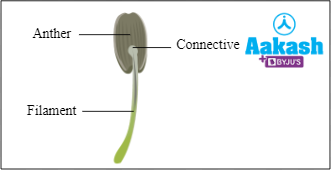
Fig: Structure of stamen
Gynoecium
It is the essential whorl of pistils or carpels or pistils and forms the female reproductive system. It possesses stigma, style and ovaries. Its number, arrangement, position, number of locules present etc., varies depending on the species.
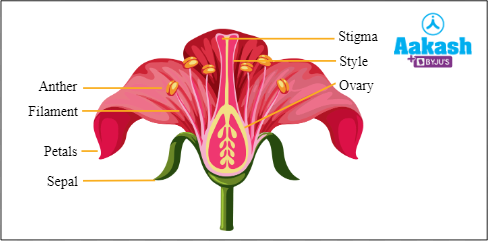
Fig: Structure of a typical flower
Inflorescence
It is the arrangement of a group of flowers on a stalk called peduncle. Examples include racemose and cymose inflorescence.
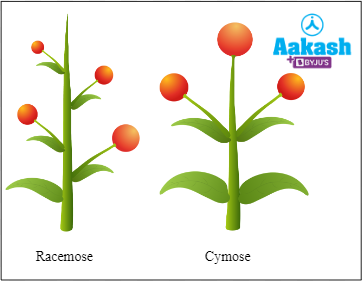
Fig: Inflorescence
Fruit
The mature and ripened ovary is called fruit. In certain cases they form from other floral parts like thalamus, perianth, peduncle etc. They are a great source of fibres, vitamins, and minerals. Examples include grapes, bananas, papayas, and watermelons. It is of different types based on the species. Examples include drupe, pome, berry etc.

Fig: Berry
Seed
Seeds are matured fertilised ovules. It possesses an embryonic plant enclosed in a protective shell.
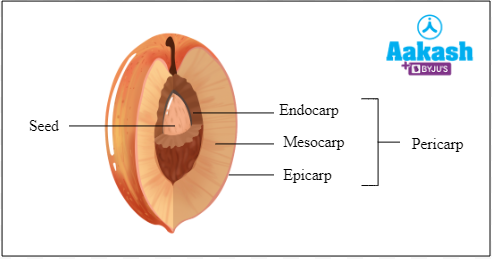
Fig: Seed
Floral formula
It is the scientific or symbolic representation of the floral characters. For example, the details of the floral formula in the Fabaceae family is given below:

Fig: Floral formula of Fabaceae family
Floral diagram
It is the diagrammatic representation of the theoretical transverse section and ground plan of a floral bud in relation to its mother axis. For example, the floral diagram of family Fabaceae is given below

Fig: Floral diagram of family Fabaceae
Economic importance
Impacts of a plant on the environment or its uses. For example, Fabaceae includes plants that produce pulses, which are rich sources of proteins. Examples include chickpea, gram or Bengal gram, moong (green gram), Indian beans (sem), red gram or arhar.
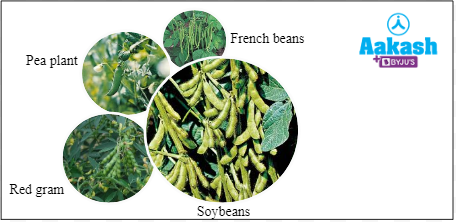
Fig: Pulses of family Fabaceae
Floral diagram
The floral diagram is a diagrammatic representation of the theoretical transverse section and ground plan of a floral bud in relation to the mother axis. Eichler in the 19th century introduced the same. It shows many characteristics of the flower which are not represented by its floral formula.
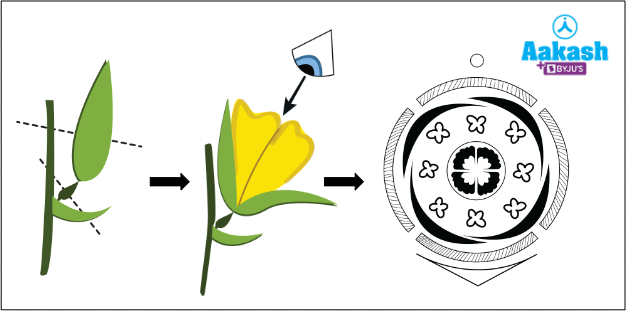
Fig: Floral diagram
Information provided by a floral diagram
A floral diagram gives a detailed account of various floral parts and insights into floral features. The following features are normally represented by the floral diagram:
- The number of the parts of a flower
- The arrangement of the parts, and their relationship with each other.
- The location of the mother axis with respect to the flower.
- Symmetry of the flower (zygomorphic or actinomorphic conditions).
- Aestivation of sepals and petals (valvate, imbricate, vexillary or twisted).
- The monothecous or dithecous nature of anthers.
- Number of locules in the ovary.
- Placentation (Marginal, parietal, axile, free central or basal)
- Nectary glands and their position.
- The parts of the flower-like calyx, corolla, androecium, and gynoecium are shown in successive whorls
- The calyx is drawn in the outermost whorl and the gynoecium is shown in the innermost whorl.
- Corolla and androecium are represented between calyx and gynoecium.
- The order of whorls when considered centripetally is as follows:
- Calyx → Corolla → Androecium → Gynoecium
- Floral formula also shows cohesion and adhesion in parts of whorls and between whorls.
Drawing a floral diagram
Consider a plant with the following floral characteristics:
- The mother axis is present and is shown by a circular dot in the posterior position.
- Flowers are actinomorphic.
- Sepals, petals, stamens and carpels are drawn using their respective symbols in their respective position.
- Four sepals are arranged such that a pair of sepals have both their margins overlapped by the margins of the other pair. Hence it shows imbricate aestivation.
- Four petals are arranged such that the margins of petals do not overlap each other. Hence it shows valvate aestivation.
- Androecium consists of six stamens arranged in two whorls. The outer whorl consists of two stamens while the inner whorl is composed of four stamens.
- Gynoecium is drawn in the centre of the floral diagram. It is bicarpellary (composed of two carpels). The carpels are in a fused condition (syncarpous) and the ovary is superior.
The floral diagram of the flowers borne on this plant can be represented in the following way:
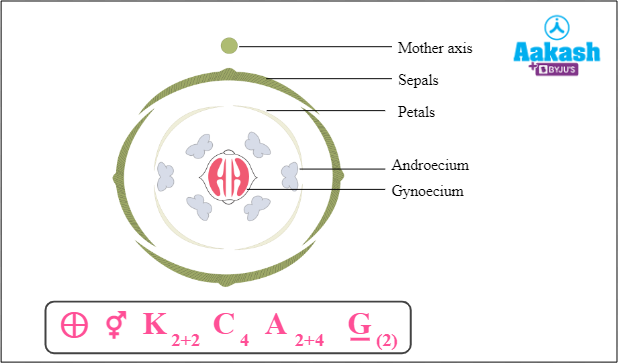
Fig: Floral diagram
Floral formula
Floral formula is a symbolic representation of floral parts using certain standard symbols.
Information provided by a floral formula
The following features are normally represented by the floral formula:
- It represents floral symmetry.
- It tells whether the flower is bracteate or ebracteate
- The number of petals, sepals, stamens, and carpels along with their nature of union is represented.
- The position of the ovary is represented by a symbol.
- Insertion of stamens also represented.
Symbols commonly used in floral formula
The following symbols are commonly used to represent the parts and number of floral appendages in the floral formula:
|
Symbol |
Description |
|
Br |
Bracteate |
|
Ebr |
Ebracteate (no bract) |
|
⊕ |
Actinomorphic flower |
|
% |
Zygomorphic flower |
|
♂ |
Staminate flower (male flower) |
|
♀ |
Pistillate flower (female flower) |
|
⚥ |
Bisexual flower |
|
K |
Calyx |
|
Kn |
Polysepalous calyx |
|
K(n) |
Gamosepalous calyx (Fusion of sepals indicated by brackets) |
|
C |
Corolla |
|
Cn |
Polypetalous corolla n = number of petals |
|
C(n) |
Gamopetalous corolla (Fusion of petals indicated by brackets) n = number of petals |
|
P |
Perianth (whorl of tepals) |
|
A |
Androecium |
|
An |
Stamens free n = number of stamens |
|
A(n) |
Fused stamens indicated by brackets (Synandrous condition) n = number of stamens |
|
|
Epipetalous condition (stamens attached to petals) |
|
|
Epiphyllous condition (stamens attached to tepals) |
|
G |
Gynoecium |
|
Gn |
Carpels free n = number of carpels |
|
G(n) |
Fused carpels indicated by brackets (Syncarpous condition) n = number of carpels |
|
|
superrior ovary |
|
|
inferior ovary |


Writing a floral formula
The floral symbols of a flower whose floral diagram has been given above can be represented in the following way:
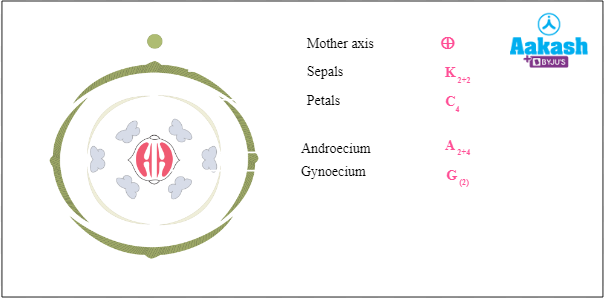
Fig: Depiction of floral diagram
Floral formula is as follows:
⊕ ⚥ K 2+2 C 4 A 2+4 G (2)
Floral formula vs floral diagram
|
Features |
Represented in floral formula |
Represented in floral diagram |
|
Presence or absence of bracts |
✅ |
✅ |
|
Symmetry of flower |
✅ |
✅ |
|
Sexual nature of flower |
✅ |
✅ |
|
Number, aestivation and attachment (cohesion or adhesion) of sepals |
✅ |
✅ |
|
Number, aestivation and attachment (cohesion or adhesion) of petals |
✅ |
✅ |
|
Number, aestivation and attachment (cohesion or adhesion) of tepals |
✅ |
✅ |
|
Number, adhesion or cohesion of stamens |
✅ |
✅ |
|
Number, adhesion or cohesion of pistils |
✅ |
✅ |
|
Position of ovary (epigynous, perigynous or hypogynous) |
✅ |
❌ |
Position of the ovary is the feature that cannot be represented by a floral diagram but by a floral formula.
Practice Problems
Q1. Match column I (Symbols in floral formula) with column II (feature of flower) and select the correct option:
|
Column I (Symbol) |
Column II (Feature) |
|
A. Zygomorphic |
|
2. k |
B. Bracteate |
|
3. % |
C. Superior ovary |
|
4. G |
D. Calyx |
A. 1 - A, 2 - B, 3 - C, 4 - D
B. 1 - B, 2 - C, 3 - A, 4 - D
C. 1 - B, 2 - D, 3 - A, 4 - C
D. 1 - C, 2 - A, 3 - D, 4 - B
Solution: The correct match of the floral symbols is given below:
|
Column I |
Column II |
|
B. Zygomorphic |
|
2. k |
D. Calyx |
|
3. % |
A. Zygomorphic |
|
C. Superior ovary |
Hence, the correct option is c.
Q2. What is a mother axis in a flower?
Answer: The main axis or mother axis in floral diagrams is not synonymous with the floral axis. It refers to where the stem of the flower is present in relation to the diagram. It is used for identifying the type of symmetry in the flower. It is shown by a circular dot in the posterior position.
Q3. What is imbricate aestivation?
Answer: Imbricate aestivation occurs when the margins of petals or sepals overlap without a defined direction. Examples include Cassia and gulmohur.
Q4. What is perianth in a flower?
Answer: Perianth is the outer whorl of tepals. In this condition there is no differentiation between petals and sepals present in the flower. It is represented by the letter ‘P’. Examples include the members of the Liliaceae family.
FAQs
Question 1. What are the limitations of floral formula?
Answer: The following are some of the limitations of the floral formula:
- It is impossible to depict any spatial patterns or conspicuous specific structures, such as nectaries, coronas, or appendages, of the flower.
- It is difficult to describe the exact position of different organs in the flower.
Question 2. Which fabric is made from the lotus stem thread?
Answer: Lotus silk is made from the stem thread of the lotus flower. This product is 100% cruelty-free.
Question 3. Which part of saffron flower is used as a flavouring agent in food?
Answer: The stigma and style part of the female reproductive system of the saffron flower are dried and used as flavouring agent and spice in food. Crocus sativus is the scientific name of the saffron plant.
Question 4. Which flower has the most fragrance in the world?
Answer: The jasmine flower has the most fragrance in the world. Jasminum officinale is the scientific name of the common jasmine plant.
Related Topics
|
Root and Its Parts: Root system, Structure of dicot and monocot root, Order, types, and functions of the root, Root modifications, Practice Problems, and FAQ’s |
|
The flower: Androecium, Gynoecium and Classification of flowers, Practice Problems and FAQs |
|
Inflorescence: Racemose and Cymose, Practice problems, FAQs |
|
The Flower: Pedicle, Parts of flower, General classifications, Practice Problems and FAQs |
|
The Stem : Structure of stem, Functions of stem, Shoot modifications, Practice Problems, and FAQs |

 Call Now
 Let's Chat
 Share
Share