-
Call Now
1800-102-2727


Eukaryotic Cells: Discovery, Location, Structure and Functions of Nucleus, Structure and Classification of Chromosomes

We all know how a family works together.
In every family, someone takes responsibility to handle everything and take care of everything, though there are other members too, who support that person to do the same.
This creates harmony among different members of the family.
Similarly in cells, the nucleus is that one member of the family who regulates all the activities of the cell. Other cell organelles also help it in doing so.
Nucleus has chromosomes which have all the information about how to regulate the activities.
The nucleus or karyon is the largest organelle of a eukaryotic cell. It is a pivotal organelle responsible for regulating almost all forms of cellular activities. On the basis of the nuclear advancement, a cell can either be prokaryotic (having primitive type of nucleus) or eukaryotic (having well defined nucleus).
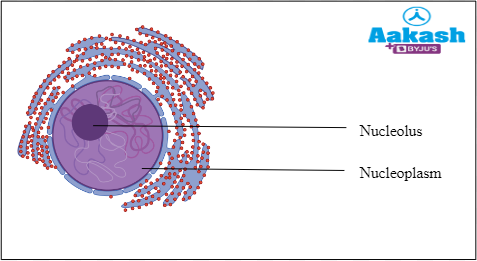
Fig: Nucleus
Table of contents
- Discovery of nucleus
- Location of nucleus
- Structural organisation of nucleus
- Structure of chromosomes
- Classification of chromosomes
- Functions of nucleus
- Practice Problems
- FAQs
Discovery of nucleus
Nucleus is defined as the double membrane bound eukaryotic cell organelle that contains the genetic material. It was first observed by Anton Van Leeuwenhoek, however Robert Brown described its structure for the first time in 1831.
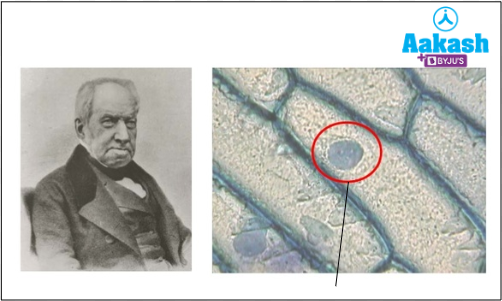
Fig: Robert Brown Fig: Discovery of nucleus
Flemming performed experiments and found that the material of the nucleus can be stained with the basic dyes like aniline dyes. He named it chromatin.
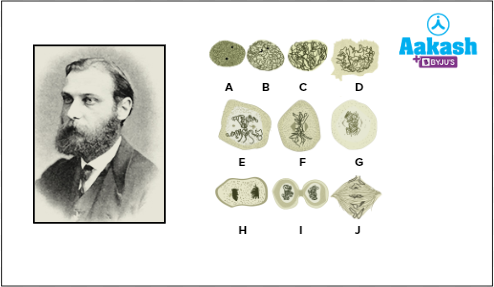
Fig: Walther Flemming Fig: Nucleus under the microscope
Location of nucleus
Nucleus is present in all eukaryotic cells except some cells like mature RBCs, sieve tube cells of plants etc. In plant cells, the nucleus is pushed to one side from the centre.
Structural organisation of nucleus
The nucleus of the interphase, that is the nucleus of a cell when it is not dividing, which has the following parts. It possesses highly extended nucleoprotein fibres named chromatin, nucleoplasm, nuclear envelope, nuclear material and nucleolus. Nucleolus are one or more spherical bodies present in the nucleus.
Nuclear envelope
It is also known as ‘karyotheca’ which consists of two unit membranes, the outer membrane and inner membrane. In between the outer and inner membrane, a fluid filled space is present, known as perinuclear space. The barrier present between the materials present inside the nucleus and the materials present in the cytoplasm is called perinuclear space. The outer nuclear membrane bears ribosomes on the surface and usually remains continuous with the endoplasmic reticulum. Small gaps in the nuclear membrane through which movement of RNA and protein molecules takes place in both directions between the nucleus and the cytoplasm, are known as nucleopores.
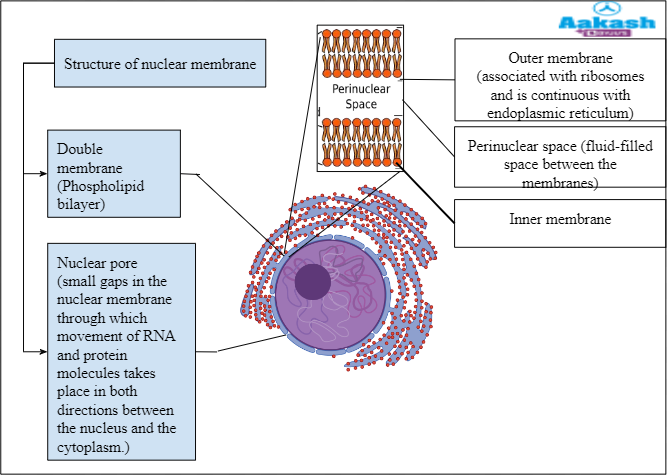
Fig: Nucleus
Nucleoplasm
Nucleoplasm, karyolymph or nuclear sap is a clear, jelly-like matrix present inside the nucleus. It contains water, lipids, proteins and dissolved ions. It provides the seat for DNA, RNA and ribosomal subunit synthesis. It contains two important structures like chromatin material and nucleolus.
Chromatin material
The term ‘chromatin’ means coloured material derived from the Greek term ‘Chroma’ which means ‘colour’. It is the thread-like structure present inside the nucleus and also known as ‘chromatin fibres.’ It is made up of DNA, RNA and nucleoproteins (histone and nonhistone proteins). During cell division these structures convert into thick and short, rod-like structures known as ‘chromosomes’.
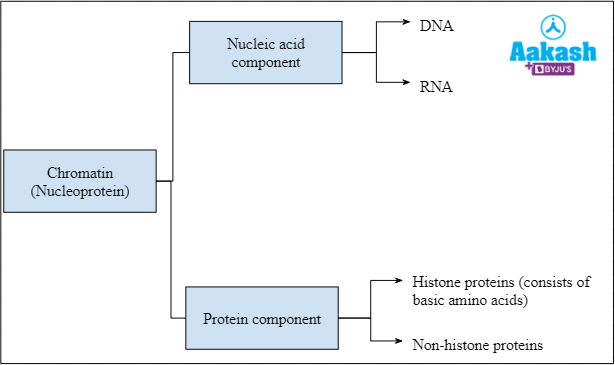
Fig: Composition of chromatin
Nucleolus
The nucleolus is formed of proteins and RNA, which form around the chromosomal regions. It is a dense, round, granular organelle which is not enclosed in a limiting membrane present in the nucleoplasm, hence the content of the nucleolus is continuous with the rest of the nucleoplasm. It is involved in active ribosomal RNA synthesis by providing a seat for this process. The number of nucleolus is high in cells involved in large amounts of protein synthesis.
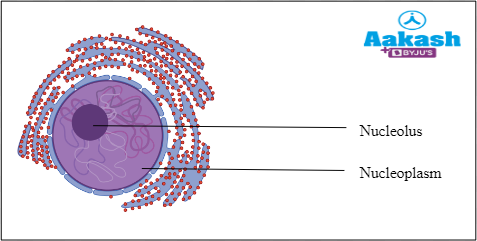
Fig: Location of nucleolus in nucleus
Structure of chromosomes
These are the condensed form of chromatin, containing genetic material ‘DNA’. Every cell has a fixed number of chromosomes in it. Each chromosome consists of two equal halves, known as ‘sister chromatids’, which are held together at one point, called ‘centromere or primary constriction’. On both sides of the centromere, disc shaped structures called kinetochores are present. The non-staining secondary constrictions are present at constant locations in some chromosomes. This gives the appearance of a small fragment to the chromosome called the satellite.
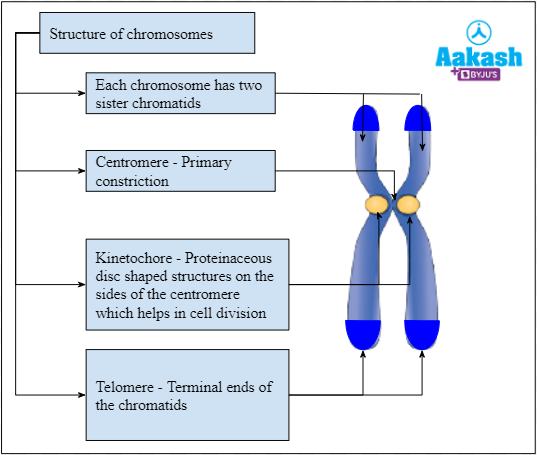
Fig: Structure of chromosome
Classification of chromosomes
On the basis of the position of centromere on a chromosome, it is divided into four types.
-
Metacentric chromosomes - Centromere is almost in the middle and both the arms of chromosomes are equal in length.
-
Submetacentric chromosomes - Centromere is slightly away from the midpoint, thus one arm is slightly longer than the others.
-
Acrocentric chromosomes - Centromere is nearly at the end thus one arm is very short and the other is very long.
-
Telocentric chromosomes - Centromere is at the tip of chromosome thus only a single arm is there.

Fig: Types of chromosomes
Functions of nucleus
- It is involved in cell maintenance and growth.
- It regulates cellular metabolism.
- It brings about cell replication whenever needed.
- It contains genetic information for the reproduction, development and metabolism.
- It takes part in ribosome synthesis.
Practice Problems
Q1. What keeps the nucleus separated from cytoplasm?
a) Protoplasm
b) Cell membrane
c) Cell wall
d) Nuclear membrane
Solution: Nuclear envelope or ‘karyotheca’ consists of two unit membranes, the outer membrane and inner membrane. In between the outer and inner membrane, a fluid filled space is present, known as perinuclear space. The barrier between the materials present inside the nucleus and the materials present in the cytoplasm is called perinuclear space.
Q2. Nucleus contains some thread-like structure, known as _______________.
(a) Nucleolus
(b) Genes
(c) Chromatin fibres
(d) Ribosomes
Solution: The thread-like structure inside the nucleus is known as ‘chromatin fibres.’ It is made up of DNA, RNA and nucleoproteins (histone and nonhistone proteins). During cell division these structures convert into thick and short, rod-like structures known as ‘chromosomes’.
Q3. Chromatin material is composed of ______________.
(a) DNA
(b) RNA
(c) DNA and proteins
(d) DNA, RNA and proteins
Solution: Chromatin fibres or chromatin material is made up of DNA, RNA and nucleoproteins (histone and Nonhistone proteins).
Q4. What is the main role of the nucleolus?
(a) DNA synthesis
(b) ATP production
(c) rRNA synthesis
(d) Protein synthesis
Solution: Nucleolus is involved in active ribosomal RNA synthesis by providing a seat for this process.
FAQs
Q1. How are the chromosomes produced in the nucleus?
Solution: Inside the nucleus some thread-like structures are found which are known as ‘chromatin fibres.’ It is made up of DNA, RNA and nucleoproteins (histone and nonhistone proteins). During cell division these structures convert into thick and short, rod-like structures known as ‘chromosomes’.
Q2. Write down the importance of chromosomes in a cell nucleus?
Solution: Chromosomes contain DNA which is the hereditary unit of life. Equal amount of this DNA is distributed in all the cells of the body in the form of chromosomes during cell division.
Q3. Write down the main functions of the nucleus?
Solution: The main functions of nucleus are as follows:
- It is involved in cell maintenance and growth.
- It regulates cellular metabolism.
- It brings about cell replication whenever needed.
- It contains genetic information for the reproduction, development and metabolism.
- It takes part in ribosome synthesis.
Q4. What is the composition of a nucleus?
Solution: The interphase nucleus (nucleus of a cell when it is not dividing) has highly extended nucleoprotein fibres called chromatin, nuclear material and one or more spherical bodies called nucleoli. The nucleus possess the following parts:
- Nuclear envelope
- Nucleoplasm
- Chromatin and chromosome
- Nucleolus
YOUTUBE LINK: https://www.youtube.com/watch?v=eFul6cULbzU

 Call Now
 Let's Chat
 Share
Share