-
Call Now
1800-102-2727


Electrovalent Bonding

Atoms strive to attain noble gas configuration for stability. The need and nature of elements to attain stable structure and lower energy configuration lead them to bond. The chemical bonds thus formed are referred to as attractive force, which joins two or more atoms together. The bonding witnesses the participation of electrons in the outermost shell. The electrons may be shared or transferred, leading to different types of bondings. Electrovalent bonding is hence a type of chemical bonding.
Table of Contents
- Electrovalent Bonding
- Factors Leading to Electrovalent Bond Formation
- Factors Contributing to Separation of Electrovalent Bond
- Properties of Electrovalent Bonding
- Examples of Electrovalent Bonds
- Practice Problems
- Frequently Asked Questions
Electrovalent Bonding
The elements with high electronegativity tend to attract electrons towards themself from the electropositive elements. This electron transfer brings together the elements and joins them with the electrostatic force of attraction. The electrostatic force of attraction forms due to the development of oppositely charged ions where the electronegative element gains a negative charge while the electropositive element gains a positive charge.
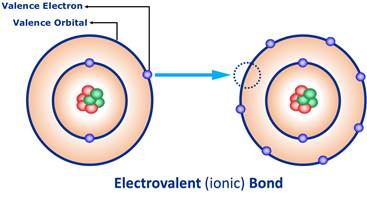
Image: Electrovalent bonding
Electrovalent bonding is also known as ionic bonding. These bonds form only between metals and nonmetals. The metals or alkali and alkaline earth metals lose electrons due to the presence of an excess of them. At the same time, the non-metals gain electrons due to the lack of them in their outermost shell. Thus, the metals and non-metals form ionic compounds that dissociate into an aqueous solution as ions. The metals form cations, and nonmetals form anions.
Factors Contributing to Electrovalent Bond Formation
The significant factors required to allow the formation of electrovalent bonds are:
- Presence of lowest ionisation enthalpy to prevent ionisation.
- The highest electron gain enthalpy in the non-metals.
- The lattice enthalpy must be significantly higher in the formation of the crystal lattice.
- The small size of ions leads to stable lattice structure formation.
Factors Leading to Separation of Electrovalent Bond
The factors leading to the separation of electrovalent bonds include:
- High thermal energy through high temperature disrupts the electrostatic forces.
- The dissolving of ionic compounds in polar solvents
- An external electric field exerts forces on ions, thus separating them.
- The increased pressure and the presence of other chemicals influence the electrovalent bonding.
Properties of Electrovalent Bonding
The ionic or electrovalent bonds exhibit different characteristic properties such as:
- The presence of cations and anions joined together by a strong, attractive force.
- The high melting and boiling points are due to the requirement of a significant amount of energy to break the ionic bonds.
- The high solubility in polar solvents thus exhibits higher dissociation in solvents such as water.
- They are of brittle nature. It interprets that these compounds yield to stress or force. The forces change the positioning of cations and anions, bringing the like charges to close proximity. This leads to easier fractures.
- The conductivity is higher in ionic compounds in a molten state or solution. The dissociation of ions imparts conductivity as the flow of charges or electrons causes the conduction of electricity.
- The electrovalently bonded compounds are harder in nature due to strong ionic bonds in the crystal lattice structure. The rigid and orderly arrangement of lattices contributes to the hardness of the compound.
- The electrovalent compounds have crystal lattice structures characterised by regular and three-dimensional crystal lattice structures. The cations and anions arrange themselves in alternate patterns with maximum attractive and minimum repulsive forces, thus imparting stability to the crystal lattice.
Examples of Electrovalent Bonds
Electrovalent or ionic bonds are very common. A few examples are:
- Sodium Chloride: Sodium is a metal that donates one electron to the non-metal chlorine. Sodium forms a cation, and chlorine forms an anion which is eventually held together by an electrovalent bond. The solubility in water and the inability to degrade the common salt at high temperature exhibits the properties of ionic bonds.
- Calcium carbonate: It is found in limestone, comprising calcium as metal cations. The anions are carbonate ions. The compound involves the transfer of two electrons to form an electrovalent bond.
- Potassium Iodide: Potassium is another metal that donates one electron to the non-metal iodine.
- Magnesium Oxide: The magnesium ions act as cations, while oxygen ions act as anions. The transfer occurs of about two electrons allowing elements to attain noble gas configuration.
- Aluminium Chloride: It is an ionic compound where cations and anions do not hold the same magnitude of charge. The aluminium forms cations by donating three electrons. Chlorine forms cations, while each atom receives one electron. Hence, the compound involves one aluminium ion and three chlorine ions.
Practice Problems
Q1. Which bond forms between metals and nonmetals?
a. Covalent Bond
b. Coordinate Bond
c. Electrovalent Bond
d. Metallic Bonds
Ans. c. Electrovalent Bond
The electrovalent bonds are formed by the electrostatic force of attraction between cations and anions.
Q2. What happens to ionic character across the period and down the group?
a. Increases, Increases
b. Increases, Decreases
c. Decreases, Increases
d. Remains the same for both
Ans. a. Increases, Increases.
The electronegativity difference between the elements increases across the period, and the size of the atom increases down the group leading to higher electronegativity.
Q3. Which has the highest melting and boiling point among the stated options?\
a. NaCl
b. NaI
c. NaF
d. NaBr
Ans. NaF
The small ionic radii contribute to the highest melting and boiling point compared to other options.
Frequently Asked Questions
Q1. What do the breakpoints in the cooling curve of ionic compounds state?
Ans. The first breakpoint indicates the melting point, while the second breakpoint is the solidification or freezing point of the ionic compounds.
Q2. Can ionic compounds be gases?
Ans. Generally, ionic compounds exist as solids. However, they can exist as gases at low pressure and high temperature.
Q3. What is the difference between ionic and covalent bonds?
Ans. Electrovalent bonds are formed by the transfer of electrons, while covalent bonds are formulated through sharing of electrons. Covalent bonds are stronger than ionic bonds.
Q4. What is lattice energy?
Ans. Lattice energy is the energy required to break the crystal lattice structure of an ionic compound, resultantly separating it into constituent ios. It is influenced by ion charges and sizes.

 Call Now
 Let's Chat
 Share
Share