-
Call Now
1800-102-2727


Ecological Succession

Ecological Succession
The remarkable tendency of nature to adapt and change over time is a fascinating process called Ecological succession. It determines the steady and anticipated alteration in an ecosystem’s structure and composition. Ecological succession is a key factor in shaping our natural world, from arid landscapes to thriving forests and a wide range of habitats.
Table of Contents:
- What is Ecological Succession?
- Types of Ecological Succession
- Stages of Ecological Succession
- Characteristics of Ecological Succession
- Importance of Ecological Succession
- Examples of Ecological Succession
- Causes of Ecological Succession
- Conservation and Restoration of Ecological Succession
- Practice Problems
- Frequently Asked Questions
What is Ecological Succession?
A process through which a community of distinct organisms within an environment changes over time is popularly known as Ecological Succession. It happens in places that are either lifeless or have endured certain disturbances like deforestation or volcanic eruptions. The ecosystem gradually evolves from a simple and unstable form to a complex and stable form through a series of stages.
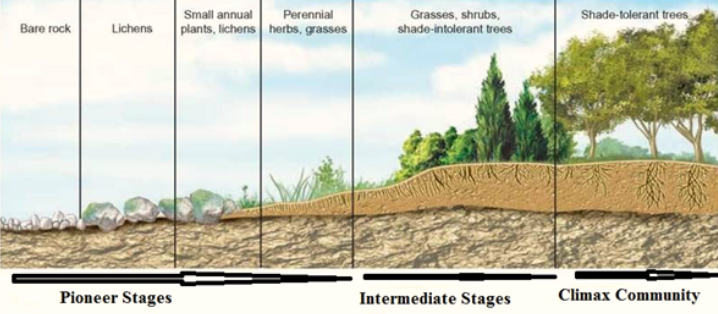
Image: Pioneer species Intermediate species Climax species
Types of Ecological Succession
Ecological succession can be divided into the following types.
1. Primary Succession
Primary succession occurs in lifeless regions where the soil cannot sustain life or lacks soil. The planet was made up of rocks, and thus there was no soil. Later microorganisms degraded and eroded the rocks to form soil. Furthermore, the soil has become the foundation of plant life. The plants aid in primary succession to the climax community and assist numerous species in their survival. In case the primary ecosystem gets demolished, secondary succession occurs.
2. Secondary Succession
Secondary succession occurs when the primary ecosystem gets destroyed due to climatic or human activities. For example, fire results in the destruction of forests. After facing the destruction, secondary succession involves the recolonisation of the region. Larger plants emerge after the smaller plants. Tall trees shade the ground from the sun and alter the organism’s structure below the canopy resulting in the climax community.

Image: Primary and Secondary Succession
Source: Embibe
Stages of Ecological Succession
Throughout the distinct stages of ecological succession, habitat and species mix. They are as follows.
1. Nudation
The creation of arid land due to forest fires, volcanic eruptions, severe floods, landslides, drought, and so on is called the Nudation stage.
2. Invasion
The introduction of reproductive bodies or seeds to the land, which aids in the spread of habitation in the region, is called the Invasion stage.
3. Competition and Coaction
Uprising invasive species in the land within a limited period is known as Competition and Coaction.
4. Reaction
The Reaction stage involves the actions of organisms inhabited by the region to modify the environmental conditions. It triggers species displacement and replacement in the region.
5. Stabilisation
The Stabilisation stage at which the climax community establishes. It is a mature, autonomous, stable and final process of succession.
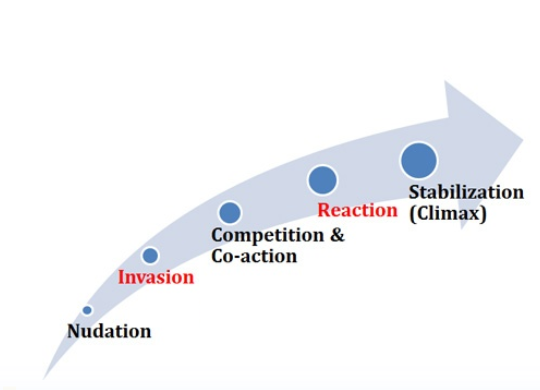
Image: Stages of Ecological Succession
Characteristics of Ecological Succession
Subsequent characteristics have been possessed by ecological succession. They include the following:
- It is the outcome of differences in the community’s physical atmosphere.
- Community development is executed in a systematic procedure.
- It incorporates variation in species structure and increasing species variety.
- New community development is regulated by nutrient variation.
- Ecological succession works in a stabilised ecosystem.
Importance of Ecological Succession
Ecological succession is beneficial for the following reasons below:
1. Soil Formation And Nutrient Cycling
Ecological succession plays a key role in soil formation. Pioneer species break down rocks. Distinct stages utilise the accumulation of organic matter from microorganisms' degraded rocks, which enhances the quality of soil and thus is helpful for plant growth.
2. Ecosystem Services
Ecological succession makes many ecosystem services crucial for humans. For example, forests grown because of ecological succession are essential for carbon sequestration, water control, climate change mitigation, air purification and offering habitats for pollination. All these actions aid in a healthy and properly functioning environment.
3. Biodiversity
Biodiversity is stimulated by ecological succession to produce a wide range of habitats that promote distinct plants and animal species. Each level of succession offers different ecological niches which support a variety of creatures.
4. Conversion and Restoration
Conservation procedures are important to protect and maintain diversity and ecosystem services. In contrast, restoration is a crucial step to ease the natural procedures of ecological succession, which ensures the conservation of ecosystems to reoccupy their functions.
Examples of Ecological Succession
Some examples are as follows.
1. Coral Reefs
Small coral polyps have colonised rocks. Polyps get to multiply and develop to generate coral colonies. Because of the structure of coral reefs, it draws the attention of small fishes and crustaceans utilised as food by larger fishes. Thus, making coral reefs completely functional.
2. Acadia National Park
Once the park faced a huge fire, restoration was left for nature. For several years, only tiny plants grew on the burnt soil, but later it enhanced the soil fertility resulting in the diversity in tree species. The only difference is that previously the trees were evergreen, while after restoration, trees are deciduous, and thus, the leaves fall annually.
Causes of Ecological Succession
Majorly, biotic and climatic factors are responsible for deteriorating the region’s population. Other than natural depletion, humans also play a role in damaging the ecosystem. Some of the primary causes of ecological succession are as follows.
1. Climatic Change
Climate change involves temperature alterations and precipitation patterns. Ecological succession provides balance and mitigates environmental conditions.
2. Disaster
Natural disasters like landscape, drought, wildfire, floods and so on disrupt the vegetation; thus, ecological succession occurs in that space.
3. Soil development
To accumulate organic matter and enhance soil fertility for proper growth and development of plants and numerous other organisms. It is important for nutrient availability, pH balance, and food source.
4. Human Activities
Activities like deforestation and vegetation removal cause ecological succession. At the same time, urbanisation, agriculture and infrastructure development result in the loss of natural ecological succession.
Conservation and Restoration of Ecological Succession
To conserve and restore ecological succession, we must perform certain tasks, including the follows:
1. Preserve and protect natural regions
2. Enhance the connectivity of diverse habitats.
3. Ignore fragmentations of habitat.
4. The implication of sustainable land methods.
5. Collaborate with scientists and researchers who provide consultation strategies.
Practice Problems
Q1. The causes of ecological succession are
A. Wind
B. Fire
C. Soil erosion
D. All of the above
Ans. D. All of the above
Ecological succession can occur due to soil erosion, fire or wind.
Q2. Acadia National Park suffered
A. A huge wildfire
B. Soil erosion
C. Flood
D. Drought
Ans. A. A huge wildfire
Acadia National Park has experienced a huge wildfire.
Q3. A succession in aquatic habitat is called
A. Xerosere
B. Halosere
C. Senile
D. Hydrosere
Ans. D. Hydrosere
Hydrosere is the succession of aquatic habitats.
Frequently Asked Questions
Q1. Name the types of seres.
Answer: The seres are categorised as follows.
a. Hydrosere
b. Xerosere
c. Lithosere
d. Psammosere
e. Senile
f. Halosere
g. Eosere
Q2. What is cyclic succession?
Answer: The alterations in the ecological structure in a cyclic manner are called cyclic succession. For example, certain plants remain dormant throughout the year but raise all at once.

 Call Now
 Let's Chat
 Share
Share