-
Call Now
1800-102-2727


Dry fruits: Definition, Types and Examples, practice problems and FAQs

You must have often heard your mother saying that you should have more almonds, cashews and walnuts to be healthy and more intelligent. We generally call these food items as nuts but did you know that these nuts are actually fruits? Mind blown? Well, that’s a fact. When we think of fruits, we mostly think about sweet and fleshy fruits such as mango, apple, banana, etc. But some fruits can be dry too and nuts are one of those. In this article we will discuss dry fruits and their types.
Table of Contents
Fruits
A fruit is a seed-bearing structure that develops from the ovary of a flowering plant post-fertilisation in sexually reproducing plants. After the process of fertilisation, usually all the parts of a flower wither away, except for the ovary and the ovules which mature into the fruits and the seeds, respectively. The fruits' main purpose is not merely to nourish you or please your palate. Yes! The main purpose of a fruit is to protect the seeds they enclose. In fact, in certain plants fruits can be inedible, unappealing or too little to be used as food. However, some fruit varieties such as bananas and grapes may not have seeds. These fruits are parthenocarpic, or seedless fruits. Fruits of different plants can vary in shapes, colours, taste, texture, nutritional value and even in longevity. Now let's take a closer look at the various parts of a fruit.
Fig: Flowers to fruit
Parts of fruit
Fruit has two parts, pericarp and the seed. Seed is the developed ovule. Pericarp is the ripened ovary wall. This pericarp could be thin and delicate, thin and rigid, or thick and meaty. Pericarp (fruit wall) is differentiated into 3 layers:
- Epicarp -outermost wall / Skin
- Mesocarp - middle layer, tissue between epicarp and endocarp
- Endocarp - innermost layer, Covering of the seed
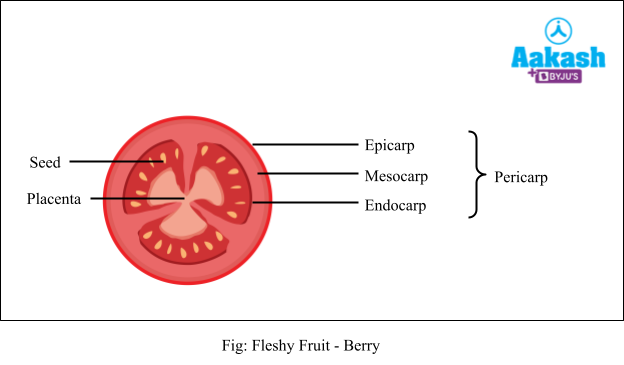
However, the ovarian wall does not always develop into a juicy, delicious fruit like that in a peach or a mango. For instance, it turns into a dry, brittle protective pod in kidney beans.
Types of fruits
Fruits are of three types based on how they develop:
- True fruits - These fruits usually develop from a mature ovary. Example: mango, coconut, grapes
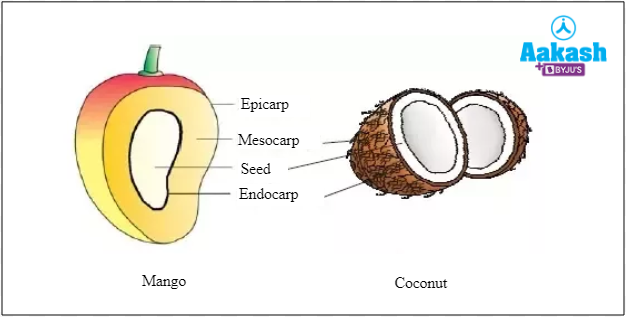
Fig: True fruits
- False fruits - These fruits develop from parts of the flower other than the ovary, such as the thalamus in case of apple.
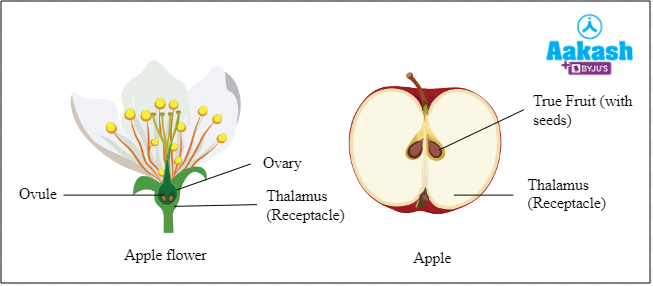
Fig: False fruits
- Parthenocarpic fruits - These fruits develop without fertilisation of the ovules. These are seedless fruits which occur naturally or can be induced also. Eg: Seedless varieties of banana, watermelon, grapes.
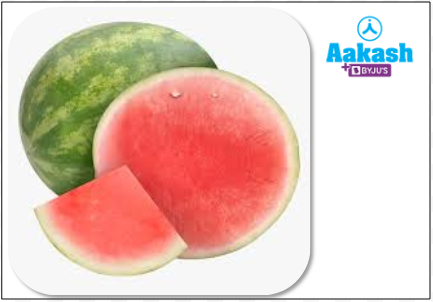
Fig: Parthenocarpic fruit
Types of true fruits
Based on the type of ovary they develop from, the true fruit can be -
- Simple fruits - These develop from monocarpellary ovary (e.g., apricot, mango) or multicarpellary syncarpous ovary (e.g., orange).
Fig: simple fruit
- Aggregate - These fruits develop from the multicarpellary apocarpous ovary of a single flower. Eg: Raspberry fruit.
Fig: aggregate fruit
Types of simple fruits
Simple fruits are of two types: fleshy fruits and dry fruits.
- Fleshy fruits - Fleshy fruits are those in which pericarp is differentiated into epicarp, mesocarp and endocarp.
- Dry fruits - These fruits are made up of a dry pericarp that lacks distinct epicarp, mesocarp, and endocarp layers. A dry pericarp encloses the seeds. They are of three types: dehiscent, indehiscent and schizocarpic.
Dry fruits
Dehiscent fruits
In these fruits pericarp dehisces/ruptures after maturing and seeds are dispersed. These are of five types -
Legume
Legume is a dry fruit with a single, folded carpel, several seeds, and two sutures along which it dehisces, e.g., pea, bean.
Fig: legume- pea
Capsule
Capsule is a dry, dehiscent fruit that is composed of many fused carpels. Depending on the species, the capsule may split apart in a number of different ways, e.g., poppy.
Fig: Capsule - Poppy
Follicle
Follicle is a dry dehiscent fruit that grows from a single ripening ovary and undergoes one splitting before seed release. The splitting is lengthwise and along the edge of the carpel. They can appear individually or in clusters, e.g, milkweed.
Fig: Follicle - milkweed
Siliqua
Siliqua dry fruit, is a kind of fruit (seed capsule) with two united carpels whose length exceeds their combined breadth by more than three times, e.g., cabbage
Fig: Siliqua-Cabbage
Silicula
A silicula is a particular kind of capsular dehiscent fruit with a superior, syncarpous ovary and a replum, or false septum, on it. The fruit is a little, flattened variation of the siliqua. When the siliqua fruit becomes longer and more flattened and has a few seeds, it is known as a silicula, e.g., Iberis amara.
Fig: Silicula - Iberis
Indehiscent fruits
In these fruits pericarp does not dehisces/ruptures even after maturing.They are of following types:
Achene
An achene is a dry, indehiscent fruit which is one seeded. In such fruits the seed is attached to the pericarp at one point, for example unit fruits of sunflowers. Other examples are fruits of Mirabilis jalapa, Clematis, etc.
Fig: Achene of Mirabilis
Caryopsis
This fruit develops from monocarpellary ovary having a single seed in this seed is fused to the pericarp, e.g., wheat
Fig: Crayopis
Nut
Nuts are simple, dry, one chambered, indehiscent, one seeded fruits. Nut develops from bicarpellary or multicarpellary syncarpous gynoecium. Pericarp (the fruit wall) is hard and woody. Example: Hazel, cashew nut, litchi, oak nut, etc.
Fig: Nut
Cypsela
It is a dry,single-seeded indehiscent fruit which develops bicarpellary, syncarpous,inferior ovary. In these fruits the seed coat and the pericarp are free from each other. They have a bunch of hair attached to them called Pappus, which helps in fruit dispersal, e.g., dandelion.
Fig: Cypsela
Samara
Samara is a dry fruit that is a winged achene. In this fruit a flattened wing of fibrous, papery tissue forms from the ovary wall which surrounds their seeds, e.g., Indian Elm, (Holoptelea integrifolia), Elm (Ulmus), etc.
Fig: Samara of Elm
Schizocarpic or Splitting fruits
Dry fruits like schizocarpic fruits separate into single-seeded, indehiscent portions known as mericarps as they mature. They are also known as splitting fruits. They arise from a single ovary of a flower. There are different types of schizocarpic fruits.
Cremocarp
Cremocarp ia schizocarp,dry fruit. It is made up of two one-seeded carpels. Before the seeds are dispersed, these may continue to be distinct and attached to the main thread of support, e.g., coriander.
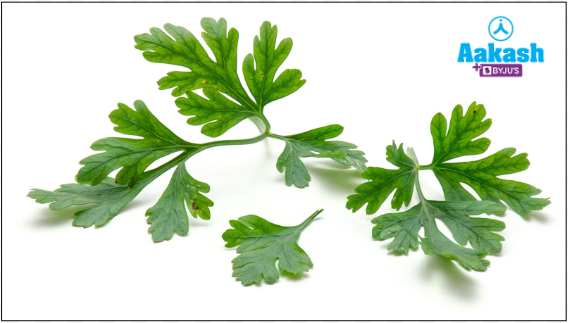
Fig: Cremocarp
Carcerulus
This fruit is another example of a schizocarpic variety that divides into several single-seeded, indehiscent mericarps. Ocimum and Alcea rosea are two examples.
Fig: Carcerulus of Alcea
Regma
Regma is also a variety of schizocarpic fruit in which the mature fruit splits into one cocci-like seeded dehiscent component, e.g., castor fruit.
Fig: Regma of Castor
Lomentum
A lomentum is a dry, dehiscent, schizocarpic fruit that separates into single, seed-containing segments. The fruit is compressed among the seeds that are there. When the segments are squeezed together, it separates, leaving one seed in each piece. It is a kind of dried fruit that divides into pieces as it ages, e.g., Mimosa and Acacia arabica, etc.
Fig: Lomentum of Acacia
Compound Samara
Compound samara is a compound or syncarpous ovary's fruit, which has a pericarp that forms a wing-like structure for dispersing seeds. This fruit is also referred to as a double samara, e.g., Hiptage, Acer, etc.
Fig: Compound Samara of Acer
Practice question
Q1. What type of fruit is lomentum?
- Achenial
- Composite
- Schizocarpic
- Syconic
Solution: Lomentum is a type of schizocarpic fruit. Schizocarpic fruit is a type of indehiscent fruit known which is made up of two carpels that, when they reach maturity, separate into two one-seeded fruits along the midline. A lomentum separates into single, seed-containing segments. The fruit is compressed among the seeds that are there. When the segments are squeezed together, it separates, leaving one seed in each piece. It is a kind of dried fruit that divides into pieces as it matures.
Thus, the correct option is c.
Q2. Which one of the following is an indehiscent fruit?
- Caryopsis
- Pod
- Follicle
- Berry
Solution: Caryopsis is a dry single-seeded indehiscent fruit. Indehiscent fruit is a type of fruit where the fruit will not split open naturally after it is ripened. Here, the fruit wall is fused to the testa of the seed. Example: Rice, oats. Thus, the correct option is a.
Q3. Which one among the following is a true nut?
- Groundnut
- Areca nut
- Cashewnut
- Coconut
Solution: Nuts are simple, dry, one chambered (unilocular), one seeded fruits. Nuts develop from a bicarpellary or multicarpellary syncarpous (united carpels) ovary. Pericarp or the fruit wall is hard and woody. Example: Cashew nut, litchi, oak nut, etc. Thus, the correct option is c.
Q4. Which of the following has the cremocarp fruit?
- Maple
- Dandelion
- Larkspur
- Coriander
Solution: The type of dry fruit known as a schizocarp, or cremocarp, is made up of two one-seeded carpels. Before the seeds are dispersed, these may continue to be distinct and attached to the main thread of support. These belong to the Apiaceae family which also includes coriander. Thus, the correct option is d.
FAQs
Q1. Siliqua is a fruit of which family?
Answer: Siliqua is a simple,dry fruit that belongs to the Cruciferae family which is made up of two united carpels.
Q2. An aggregate fruit develops from what type of ovary?
Answer: An aggregate fruit develops from multicarpellary (several carpels) apocarpous (free carpels) gynoecium of a single flower. Such types of aggregate fruits are known as ‘etaerio’ (means group). Example: Raspberry.
Q3. Why are dry fruits called dry fruits?
Answer: Dry fruits are a type of simple fruits. Simple fruits are of two types: fleshy fruits and dry fruits. Dry fruits are so-called because they are not dry and not fleshy and lack the three layers of the epicarp, mesocarp, and endocarp in their pericarp (fruit wall). Simple fruits with a fleshy pericarp are known as fleshy fruits.
Q4. What are syncarpous and apocarpous ovaries?
Answer: Syncarpous ovaries are the ones which have fused carpels and apocarpous ovaries are the ones which have free carpels.

 Call Now
 Let's Chat
 Share
Share