-
Call Now
1800-102-2727


Difference Between Integument And Testa

Two distinct types of gametes, i.e., male and female, execute sexual reproduction, where the female gamete is called an ovule, and the pollen carries the male gametes. When both the gametes come together, they produce a diploid zygote. The ovule is carried by the structure called the ovary, where integuments act as a protective covering for the ovule to safeguard it. Furthermore, the ovule develops into a seed after fertilisation, and the outer integument grows into the Testa, a covering for the seed.
Table of Contents
- What is Integument?
- What is Testa?
- Similarities between Integument and Testa
- Key Differences Between Integument and Testa
- Practice Problems
- Frequently Asked Questions
What is Integument?
The integument acts as a protective outer layer for the ovule. Concerning angiosperms, they possess two integuments encircling the ovule, while the gymnosperm only possesses one integument for the defence. Integuments are structurally thin and smooth, consisting of living cells. Thus, it does not have sclereids in comparison to Testa. Additionally, the nucellus is not entirely enclosed by integuments and remains open at the micropyle to allow pollen to pass through the ovule and trigger syngamy. The origination of the integument takes place from the chalazal end of the ovule, but the structure is referred to as the pre-fertilised. After fertilisation and maturation, the integument transforms into a testa or seed coat.
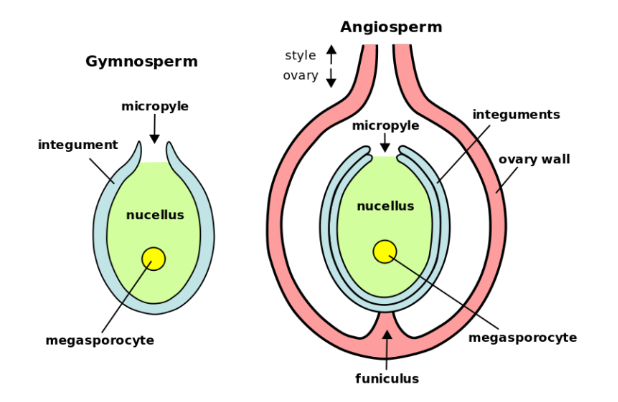
Image: Integument
What is Testa?
Testa is popularly called the outermost covering of a seed, working as a protecting shield for defence. Thus, it is one of the two seed covers possessing a brownish hue. The extrinsic integument generates Testa, thus known as the post-fertilisation structure. Based on structural formation, Testa is further divided into two layers, i.e., endotesta and exotesta. The main function of the Testa is to provide a shield for developing embryos from certain mechanical injuries or dehydration.
Furthermore, during the dispersal of seed, the Testa shields the seeds. Therefore, they consist of dead cells like sclereids forming a covering layer that is structurally hard and thick. Additionally, the Testa does not allow water to pass through the layer, which may result in the seed's dormancy.
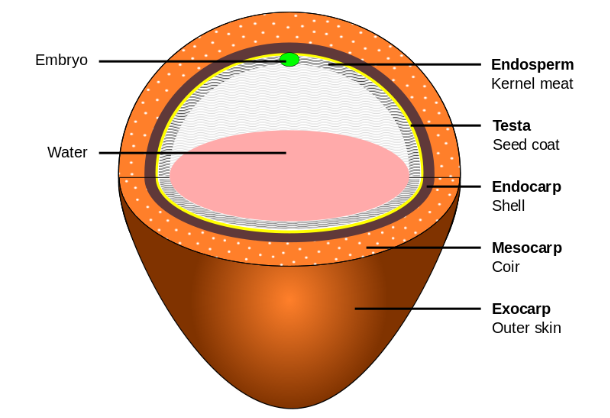
Image:: Testa
Similarities between Integument and Testa
There are certain similarities between Integument and Testa. They are as follows.
- Both can be observed in flowering plants.
- Both structures are linked with sexual reproduction in plants.
- After fertilisation, the ovule matures, and the integument becomes a seed coat.
Key Differences Between Integument and Testa
The two structures have numerous significant differences, i.e., integument and Testa. They are as follows.
|
Integument |
Testa |
|
It is a protective shield for the ovule. |
It is a protective shield for the seed. |
|
It defends the ovule from damage coming from the exterior environment. |
It defends the developing embryo from exterior environmental factors. |
|
Structurally thin |
Structurally thick |
|
Composed of living cells. |
Composed of dead cells. |
|
It is derived from the Chazal end of the ovule. |
It originated from the ovule’s outer integument. |
|
Sclereids are absent in the integument. |
Sclereids are present abundantly in the testa. |
|
Water is permeable |
Water cannot pass through the testa, thus impermeable. |
|
Not involved in seed dormancy |
Seed dormancy occurs due to water impermeability. |
Practice Problems
Q1. Testa is made up of
A. Dead cells
B. Live cells
C. Proteins
D. None of the above
Ans) A. Dead cells
The testa comprises dead cells like sclereids.
Q2. Which is not present in the structure of testa
A. Endocarp
B. Exocarp
C. Mesocarp
D. Funiculus
Ans) D. Funiculus
Funiculus is present in the ovule covered with an integument. The endocarp, mesocarp and exocarp are the layers of the shell in the testa.
Q3. Testa is divided into subparts, i.e.,
A. Exotesta
B. Endotesta
C. Meditesta
D. Both a. And b.
Ans) D. Both a. and b.
Testa is subdivided into two layers called endotesta and exotesta.
Frequently Asked Questions
Q1. Can testa have distinct features based on different plants?
Answer: Yes, testa possesses distinct characteristics based on the different plants and differs in textures, colour, and patterns. Certain testa also possesses specific structures involving wings and hooks, which help in the dispersal of seeds.
Q2. Can we remove testa from the seed?
Answer: Testa can be removed from the seed, but it results in the exposure of an embryo entirely, which can receive potential harm or damage from the environment.
Q3. Can we eat testa?
Answer: Certain testa are edible, completely relying on the plant type and the testa's nature. Mostly it is preferred not to eat as it is hard and palatable. For example, almonds and peanut testa are removed in major cases.

 Call Now
 Let's Chat
 Share
Share