-
Call Now
1800-102-2727


Difference Between Heredity And Inheritance

Fundamental biological concepts like heredity and inheritance help us to understand how genetic information is passed from generation to generation and explain how transmission of genetic elements, traits and characteristics within families and populations are interpreted.
Table of Contents:
- What is Heredity?
- What is Inheritance?
- Types of Inheritance
- Key Differences Between Heredity and Inheritance
- Problems Linked with Heredity and Inheritance
- Future of Heredity and Inheritance
- Practice Problems
- Frequently Asked Questions
What is Heredity?
As per the scientific definition of heredity, genetic makeup influences specific traits and features more than the environment. For example, tanning is not genetic but has an environmental influence on the body, while the eyes' colour indicates the offspring's hereditary character.
Heredity and biological inheritance are commonly used together but have major differences. The word inheritance came from the Latin word ‘Heridat’. The ribonucleic acid (RNA) molecules carry the genetic information, which codes for a wide range of distinct proteins. The life patterns you observe are the interaction between proteins and the surroundings or environment.
The sophisticated process of DNA replication and reproduction leads to the emergence of a wide range of life forms, resulting in undergoing mutation and recombination of cells in an organism. DNA is the key component for heredity in all eukaryotes, even in bacteria. The theory of evolution by two scientists, Charles Darwin and Alfred Wallace, has best explained the concept that covers how and why each distinct trait is influenced.
What is Inheritance?
Inheritance is the phenomenon that involves the transmission of genetic information from one generation to another. Modern knowledge of inheritance relies on the work attributed to the scientist Gregor Mendel, who worked on inheritance laws while residing in the monastery. He is well-known as the father of genetics.
Sex cells involve DNA which transfers information as molecular instructions, which further is helpful in the reproduction of an organism. During the reproduction phase of human beings, genetic material from both maternal and paternal sides is joined and passed on to a single individual. Even upon inheriting genetic information from both parents, the offspring holds some traits and characteristics which are predominant from each parent.
Types of Inheritance
There are four types of inheritance. They are as follows.
-
Complete Dominance
In complete dominance, the dominant allele ensures that the expression of the recessive cell is concealed in the inheritance pattern. Allele is one or two distinct variants of the same gene. For example, suppose orange and yellow flowers are crossed. In that case, the dominant one will be expressed with the phenotypic ratio 3:1 and the genotypic ratio 1:2:1, where 1 represents one homozygous dominant, 2 represents heterozygous alleles, and again 1 represents the homozygous recessive allele.
-
Incomplete Dominance
In the case of heterozygous offspring, incomplete dominance involves equality in genotypic and phenotypic characteristics. It is because they exhibit intermediate features. Thus, each genotype in incomplete dominance has its phenotype. It is called partial or semi-dominance.
Genotype is the genes that occur in the organism, whereas phenotypic characteristics involve the physical appearance of an organism. Heterozygous offerings involve the presence of two distinct alleles for a characteristic in the offspring. On the other hand, homozygous offspring involve two similar alleles representing a trait in the offspring. For example, if a red and white flower cross together, they will form a pink flower. The phenotypic and genotypic ratio in incomplete dominance will be 1:2:1.

Image: Incomplete Dominance
-
Codominance
In codominance, both a and b alleles are expressed, which does not represent or mask their dominance. For example, if red and white flowers are crossed, the result will be a combination of red and white flowers. The phenotypic and genotypic ratio in codominance will be 1:2:1.
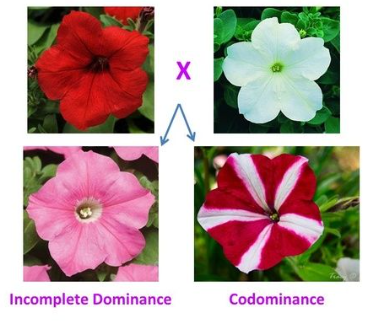
Image: Incomplete Dominance and Codominance
-
Sex-Linked
Sex-linked is a type of inheritance which involves the presence of genes in the sex chromosome. Thus, the X chromosome tends to have more genes than the Y chromosome. The ratio will be 1:1.
Key Differences Between Heredity and Inheritance
|
Heredity |
Inheritance |
|
Sexual and asexual characteristics are passed on to offerings. |
Genetic information is passed on from parents to offerings. |
|
Genetic information is acquired from parents by offerings. |
Genetic information passes by DNA in the form of chemical codes. |
|
Zygote is formed by the fusion of the mother’s egg and the father’s sperm, consisting of genetic information from both the maternal and paternal sides. |
Chromosomes pass on genetic materials. |
|
Traits are passed on to offerings and then transferred to their generations. |
Each gamete plays a role in sexual reproduction involving their contribution to the production of genetic material. |
|
Traits like eye colour, complexion, height, and intelligence are expressed. |
Diseases like haemophilia can be passed on in inheritance. |
Problems Linked with Heredity and Inheritance
Numerous disabilities and disorders are caused due to alterations or mutations in the genes or chromosomes during reproduction. Certain genetic abnormalities are directly inherited, while others are a bit complex.
-
Single Gene Abnormalities
The abnormalities occur due to the mutation in a single gene. The diseases caused due to single gene alteration are sickle cell anaemia, cystic fibrosis and Huntington’s disease. The abnormalities can either be dominant or recessive.
-
Chromosome Abnormalities
Chromosomal abnormalities occur due to the chromosome's change in structure or number. For example, trisomy 21, also called Down syndrome, is caused due to a copy of chromosome 21. The abnormalities occur during the fault in the distribution of chromosomes while the division of cells.
-
Multifactorial Abnormalities
The anomalies caused due to genetics along with environmental factors influence multifactorial abnormalities. The interactions between multiple genes and environmental factors trigger deadly diseases like cancer, diabetes and cardiac disorders. These anomalies possess complex inheritance patterns that frequently combine hereditary genetic traits with environmental factors.
Future of Heredity and Inheritance
Advancements in genetics, epigenetics, stem cells, and molecular biology have influenced a positive approach to finding a deeper understanding of heredity and inheritance. Projects like The Human Genome Project and CRISPR-Cas9 enabled scientists and researchers a remarkable approach to finding the genes and their functions better and correcting or modifying the abnormal genes with updated technologies. It helped individuals a lot in treating their genetic abnormalities.
Furthermore, ongoing research on stem cells and epigenetics favour heredity, and interference has positively impacted an individual’s health by understanding the interlinks between nature and gene expression.
Practice Problems
Q1. Who is the father of genetics?
A. Gregor Mendel
B. Carl Linnaeus
C. Rachel Carson
D. Francis Crick
Ans. A. Gregor Mendel
Gregor Mendel was a scientist popularly known as the father of Genetics.
Q2. Who introduced the word Genetics?
A. Rachel Carson
B. William Bateson
C. Gregor Mendel
D. Francis Crick
Ans. B. William Bateson
Willian Bateson introduced the term Genetics in 1905.
Q3. Genetics is the study that deals with
A. Heredity
B. Variation
C. Genes
D. All of the above
Ans. D. All of the above
Genetics involves the study of heredity, inheritance, genes, chromosomes and gene variations and external factors affecting organisms.
Frequently Asked Questions
Q1. Who is the father of Biology?
Answer: Aristotle is popularly known as the father of Biology. And also the father of Zoology, a branch of biology dealing with animals and humans.
Q2. What is a double helix in DNA?
Answer: Double helix shapes the deoxyribonucleic acid (DNA). It is the arrangement of nucleotides in two long strands forming a spiral-like structure.
Q3. State the function of the protein.
Answer: Proteins are needed to properly structure, regulate and function the body's cells, tissues and organs.

NEET Related Links
JEE MAIN Related Links
JEE Advanced Related Links
JEE Advanced Eligibility Criteria
JEE Advanced Chemistry Syllabus
JEE Advanced Registration Dates
CUET Related Links
Important Topics
Anemometer : Measurement of Wind Speed
Angular Acceleration Atomic Theory Audible and Inaudible Sound Average Speed and Average Velocity Average Velocity Avogadros Number Avogadros Hypothesis Azimuthal Quantum Number Balanced Force Bar Magnet Biconvex Lens Boyles Law Buoyancy Calorimeter Carnot Engine Celestial Bodies Centripetal And Centrifugal Force Concave and Convex Lenses Concave Convex Mirrors Contact and Non Contact Force Controlled Thermonuclear Fusion Convection Currents Convex Lens Convex Mirror Destructive Interference Difference Between Conduction Convection and Radiation Difference Between Electric Field and Magnetic Field Difference Between Heat And Temperature Difference Between Series And Parallel Circuits Differences Between Acceleration And Velocity Distance and Displacement Distance Time Graph Electrical Force : Electric Forces and Their Types Electromagnetic Waves : Definition, Equation and Properties of Electromagnetic Waves Electromagnetism Electron Spin Fluid Flow : Bernoullis Equation Derivation and Fluid Mechanics Fluid Friction : Types and Factors of Fluid Friction Frames of Reference : Inertial and Non- Inertial Frame of Reference Frequency and Wavelength Frictional Force Importance of Hydrosphere Instantaneous Speed and Velocity Introduction to Motion Kinetic and Potential Energy Difference Law Of Conservation of Energy Layers of the Earth Light Energy Light Sources List of physics scientists and Their inventionsLoudness of Sound
Magnetic Dipole Moment Magnetic Field Non - Contact Force Non - Renewable Energy Ohms Law Optics P Wave Physics Symbols Plane Mirrors Poissons Ratio Projectile Motion Properties of Water : Anomalous Expansion of Water Radius of Gyration Reflection of Light Reflection of Waves Relative Density Resonance Reverberation Rolling Friction Rotation and Revolution Screw Gauge Semiconductors and Insulators Sliding Friction Speed Time Graphs Static Friction Stefan Boltzmann Law Stress Tension Tension Force Thermometer: Clinical Laboratory Thermometer Types of Rocks Types of Waves Uniform Motion and Non Uniform Motion Unit of Voltage Uses of Convex Lens Uses Of Convex Mirror Uses of Electromagnet Uses of Optical Fibre Wave Wavelength of Light What is Scattering of Light Working of Electric Bell Conventional and Non-conventional Sources of Energy Buoyant Force Bulk Modulus of Elasticity Bernoulli’s Principle Angular Momentum Difference Between Speed And Velocity ForceUnit of Heat
Difference between Distance and Displacement Simple Microscope Derivation Of Equation Of Motion Thermometer: Clinical & Laboratory Thermometer Difference between Concave and Convex LensDerivation Of Lens Maker Formula
Unit Of Pressure Velocity Uses of Plane Mirror
Wave Theory of Light
Unit of Density Unit of Light Unit of Force Unit of Magnetic Field Unit of wavelength Unit of Viscosity Uses of Electroplating Young's Modulus
What is the Scattering of Light
Lenz Law Space Wave Propagation Schrodinger Wave Equation Relation between Fahrenheit and Celsius Refractive Index Potentiometer Working Pascal Law Oscillatory Motion Optical Instruments Newton's Laws of Motion - First Law Modulation and Demodulation Magnetic Flux Lens Formula and Magnification Kaleidoscope Faradays Law Epsilon Naught Value Energy Bands Electrostatics Electroscope AC Generator Unit of Current Lithosphere Bending Equation Derivation Difference Between Pound and Kilogram Semiconductor Devices OTEC - Ocean Thermal Energy Conversion Hall Effect Rectilinear Propagation of Light Difference Between Ammeter and Voltmeter Coefficient of Linear Expansion Ampere’s Law Cyclone and Thunderstorm Save The Environment From Pollution Particle Nature of Light Types of DC Motor Uses Of Transistor Derivation of Phase Rule Unit of Humidity

 Call Now
 Let's Chat
 Share
Share