-
Call Now
1800-102-2727


Desert, Practice Problems and FAQs

Most of you like to watch movies but the genre of the movies you watch varies, right?. If you like to watch Hollywood movies, just think about a stereotypical scenario where they introduce the protagonist of the movie in an Arabian country!! What all things you can see in that particular part of the movie?
They will depict an Arabian country as hot as possible by showing the deserts and the mirage formed due to heat or temperature. They will also show the people going with camels and the dry vegetation with less number of trees and shrubs. You might feel like the protagonist of the movie is now trapped in an arid climate, right?. As he will be sweating and may not be adapted to that particular climate. What should be the reason for this? This is because he or she is from another place with an entirely different climate and was not able to adapt to the desert environment. So it is clear that the animals and plants living in the desert have some adaptations to live there.
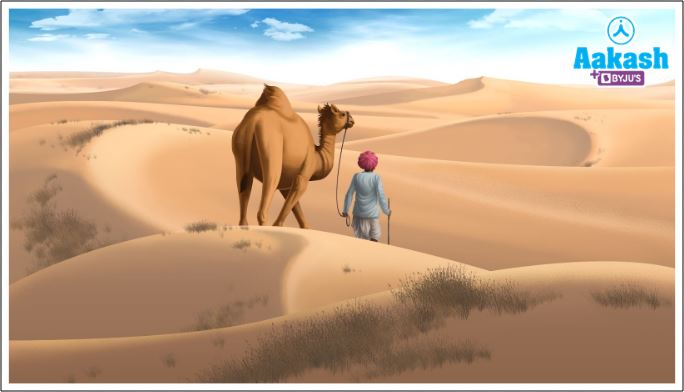
Fig: Desert in movies
Another misconception is that the deserts are only in Arabian countries. You might be familiar with the Thar desert located in Rajasthan. Now you understand that most of the regions of the Earth which are distributed around the tropic of Cancer and the tropic of Capricorn are deserts. In this article we are going to discuss more about the deserts which is an important biome. Any regional unit that has a particular type of plants, animals and climate is categorised as biome.
Table of contents
- Desert
- Types of deserts
- Flora of deserts
- Fauna of deserts
- Importance of deserts
- Practice Problems
- FAQs
Desert
Any large, extremely dry area of land with sparse vegetation is called a desert. It is one of the important biomes that supports the community of plants and animals that are adapted to harsh environments.
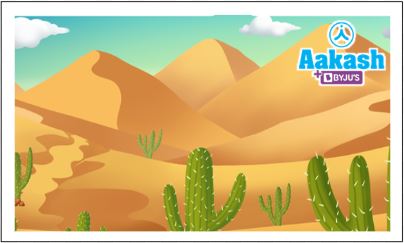
Fig: Desert
Precipitation in deserts
The amount of precipitation in a desert is very less, but it is hostile for many plants and animals. The number of plants and animals present in a desert is very less when compared to other biomes like forests, grasslands, aquatic ecosystems etc. Due to this reason or the lack of vegetation, denudation (wearing away of terrestrial surface) happens in deserts. Most of the deserts are distributed around the tropic of Cancer and the tropic of Capricorn. Most of the deserts lie between the 30°N and 35°S latitudes.
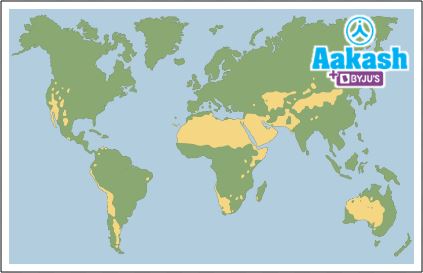
Fig: Location of deserts
Sandy storm
The desert soil is always sandy or rocky. Hence sandy storms are frequent in desert biomes. It is type of strong wind in a desert that carries a large amount of sand

Fig: Sandy storm
Climate of desert
Desert biomes are characterised by extremely low rainfall and prolonged moisture scarcity. It receives less than 50 centimetres of rainfall annually. The evaporation from soil always exceeds rainfall by 7 to 50 times. Hence deserts always have a dry climate. After the Polar climate, the climate of hot deserts is the second most common type of climate on the Earth and it covers 14.2% of the Earth’s total land area. Deserts are extremely hot during the day and very cold during the night.
Temperature of desert
When compared to other biomes, the temperature of deserts are always high. The day temperature in a desert is approximately 50 to 60 oC. At night the temperature falls down by -3.9 °C.
Types of deserts
Deserts can be classified on the basis of the annual rainfall and temperature.
On the basis of annual rainfall
Deserts can be classified into two, on the basis of the annual rainfall as follows:
- True deserts
- Extreme deserts
True deserts
Those deserts receive not more than 25 centimetres (10 inches) of precipitation in a year are called true deserts. These deserts have exceedingly sparse vegetation. Examples include the Great Basin of the United States.
Extreme deserts
Those deserts which have not received any rainfall, or other precipitation, for at least the last two million years are called extreme deserts.
On the basis of temperature
Depending on the temperature the deserts are distinguished into four types and are as follows:
- Hot deserts
- Semi arid deserts
- Coastal deserts
- Cold deserts
Hot deserts
The desserts that are warm throughout the year and very hot in the summer are hot deserts. These deserts get little rainfall during winters. The temperature can reach a maximum of 43.5 - 49 °C here. This is due to the fact that the rain falling on the deserts evaporates before it reaches the ground. The soil of hot deserts are coarse textured, rocky, shallow and with good drainage.
Flora of hot deserts
Examples of flora observed in hot deserts are Yucca, Ephedra, Agave etc.
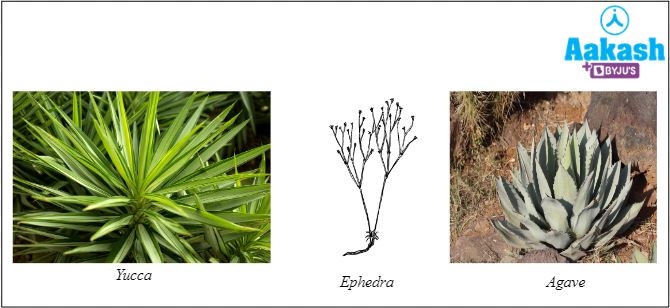
Fig: Flora of hot desert
Fauna of hot deserts
Most of the fauna of hot deserts are nocturnal carnivores. The common examples of fauna seen in hot deserts are burrowers like kangaroo rats (Dipodomys).
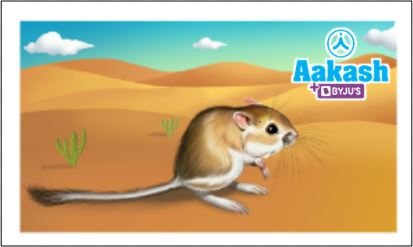
Fig: Kangaroo rat
Examples of hot deserts
Examples of hot deserts are Atacama desert of Chile, Sahara desert of Africa, Thar desert or the great Indian desert etc.
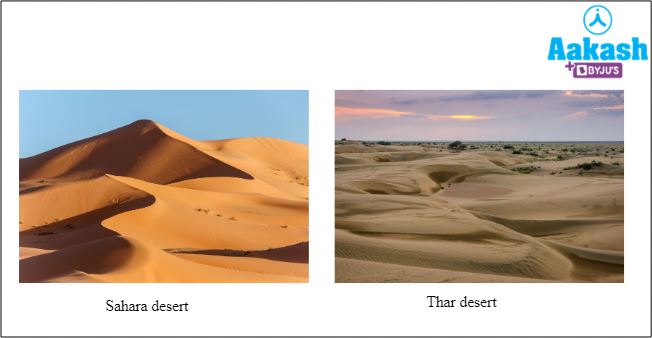
Fig: Examples of hot deserts
Semi arid deserts
The deserts with moderately long and dry summers and low rainfall are called semi arid deserts. The summer temperatures do not go above 38 °C and evening temperatures are around 10 °C. The cool nights help the flora and fauna to reduce the moisture loss from the body. The soil of semi arid deserts are sandy and fine-textured. It can also be loose rock fragments, gravel or sand.
Flora of semi arid desert
Many flora of semi-arid deserts have spines which provide protection from hazardous environments. Examples include creosote bush (Larrea tridentata) and jujube plant (Ziziphus jujuba Mill.).
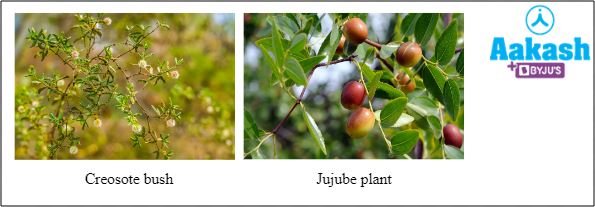
Fig: Flora of semi arid desert plants
Fauna of semi arid desert
The common examples of fauna of semi-arid desert are jack rabbits (Lepus californicus), kangaroo rats, skunks (Mephitidae) etc. Insects like grasshoppers and ants can also be seen. Reptiles like lizards, snakes and birds like burrowing owls (Athene cunicularia) can also be seen here.
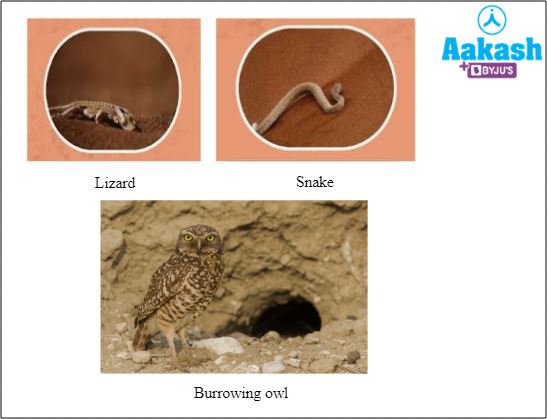
Fig: Fauna of semi arid deserts
Examples of semi arid deserts
The examples of semi-arid deserts are Utah, Montana and the Great Basin of the United States.
Coastal deserts
The deserts that occur in moderately cool to warm areas are called coastal deserts. The winters are cool and it is followed by moderately long and warm summers here. The annual temperature is 35 °C. The soil of coastal deserts are fine-textured with a moderate salt content and have poor drainage.
Some flora of coastal deserts have extensive root systems that are close to the surface. So that they can take advantage of any rain showers.
Flora of coastal deserts
The major flora of this desert are salt bush (Atriplex), buckwheat bush (Eriogonum), and yellow rabbitbrush (Chrysothamnus).
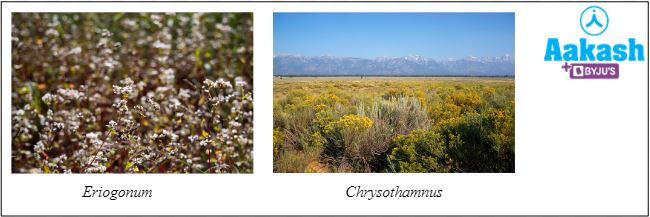
Fig: Flora of coastal desert
Fauna of coastal desert
The major examples of fauna of coastal deserts are as follows:
- Insects
- Mammals like coyotes (Canis latrans) and badgers (Meles meles).
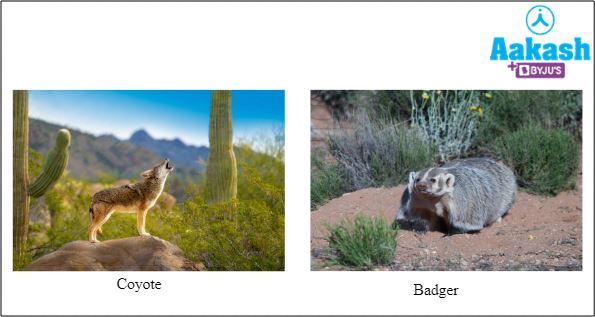
Fig: Animals of coastal desert
- Birds like the great horned owl (Bubo virginianus), the bald eagle (Haliaeetus leucocephalus) etc.
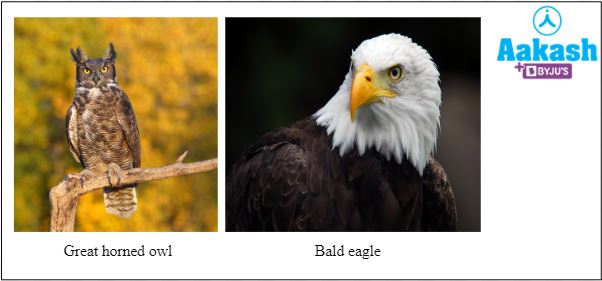
Fig: Birds of coastal desert
- Reptiles like lizards and snakes.
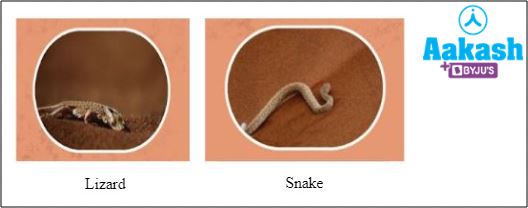
Fig: Reptiles of coastal desert
Example of coastal desert
A common example of coastal deserts are Atacama in Chile.
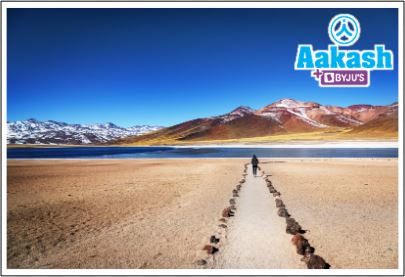
Fig: Atacama in Chile
Cold deserts
The deserts that are characterised by the cold winters with snowfall and high overall rainfall throughout the winter and occasionally over the summer are called cold deserts. The summers are moist, short and moderately warm here. The mean summer temperature in cold deserts is between 21 - 26 °C. Cold deserts have heavy, silty, and salty soil.
Flora of cold deserts
The flora is widely scattered in this kind of desert. The major plants are deciduous with spiny leaves. Examples include shadscale (Atriplex canescens) and camel's thorn (Vachellia erioloba).
Fauna of cold deserts
The common examples of fauna are jack rabbits, kangaroo rats and antelope ground squirrels (Ammospermophilus).
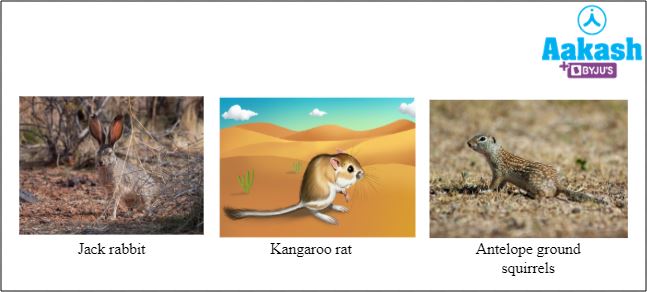
Fig: Examples of fauna in cold desert
Examples of cold deserts
The examples of cold deserts are Tibet and Gobi desert of Mongolia.
Flora of deserts
The flora of desert are adapted to live in dry and arid environments. The major adaptation of desert plants is to conserve water for survival. But there are different types of desert plants.
Types of flora in desert
The desert biomes possess scanty vegetation and it is dominated by three types of life forms. They are as follows:
- Ephemeral annual herbs
- Succulent xerophytes
- Non-succulent shrubs and trees
Ephemeral annual herbs
The plants that grow only when there is sufficient moisture are called ephemeral annual herbs. They have short life cycles and are adapted to take short wet periods. An example is mouse-ear cress (Arabidopsis thaliana).
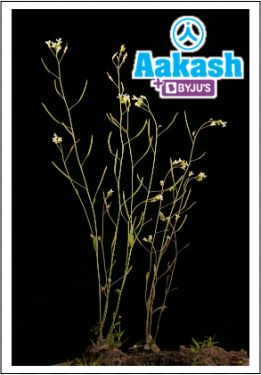
Fig: Arabidopsis thaliana
Succulent xerophytes
The plants which store water in their tissues are called succulent plants. An example is cactus (Cactaceae), which stores water in their fleshy stems.
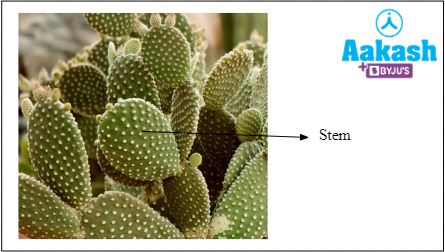
Fig: Cactus
Non-succulent shrubs and trees
The plants whose deep tap roots may reach the water table are called non-succulent plants. Examples include miswak (Salvadora), Athel pine (Tamarix) and mesquite (Prosopis).
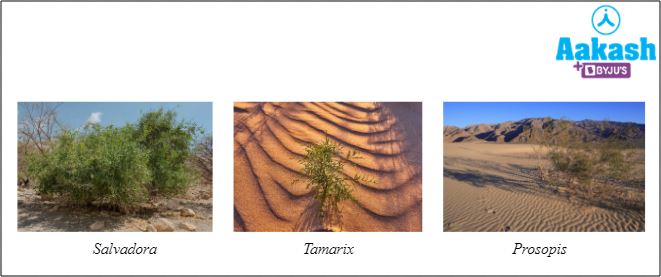
Fig: Non-succulent plants
Adaptations of flora in desert
Anatomical, morphological and physiological adaptations can be observed in the desert plants. All the adaptations are majorly for the prevention of water loss from the body.
Anatomical adaptations
The major anatomical adaptations of flora in a desert are as follows:
- Thick layer of cuticle helps to reduce the transpiration.
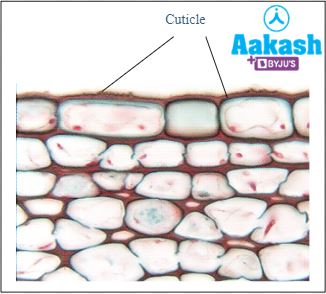
Fig: Cuticle
- Presence of sunken stomata to minimise the water loss through transpiration.
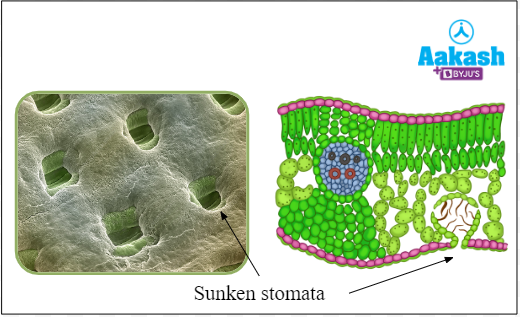
Fig: Sunken stomata
Morphological adaptations
The major morphological adaptations of flora in a desert are as follows:
- Short woody trees and ground-hugging shrubs are present in the desert.
- Leaves are small and thick. The thick and fleshy leaves take in large quantities of water when it is available and store it for future use.
- In cactus, Opuntia the leaves are reduced to spines and photosynthesis is carried out by the stems. Such modified flat stems are called phylloclade.
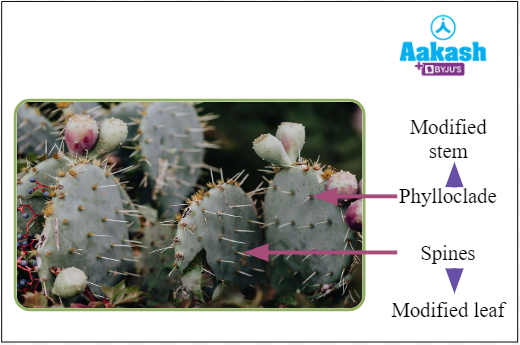
Fig: Opuntia
- The presence of silvery or glossy leaves reflects more radiant energy.
Physiological adaptations
The major physiological adaptations of flora in a desert are as follows:
- To avoid the water loss, xerophytic plants undergo CAM (Crassulacean Acid Metabolism) pathway.
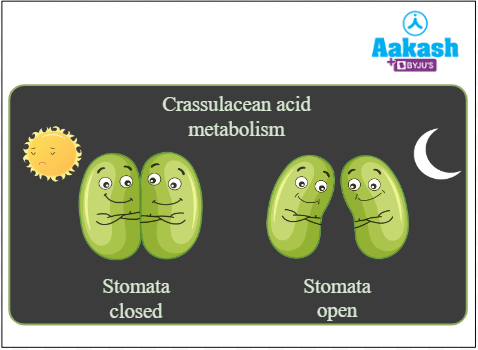
Fig: Crassulacean Acid Metabolism
- The stomata opens only at night to reduce the transpiration.
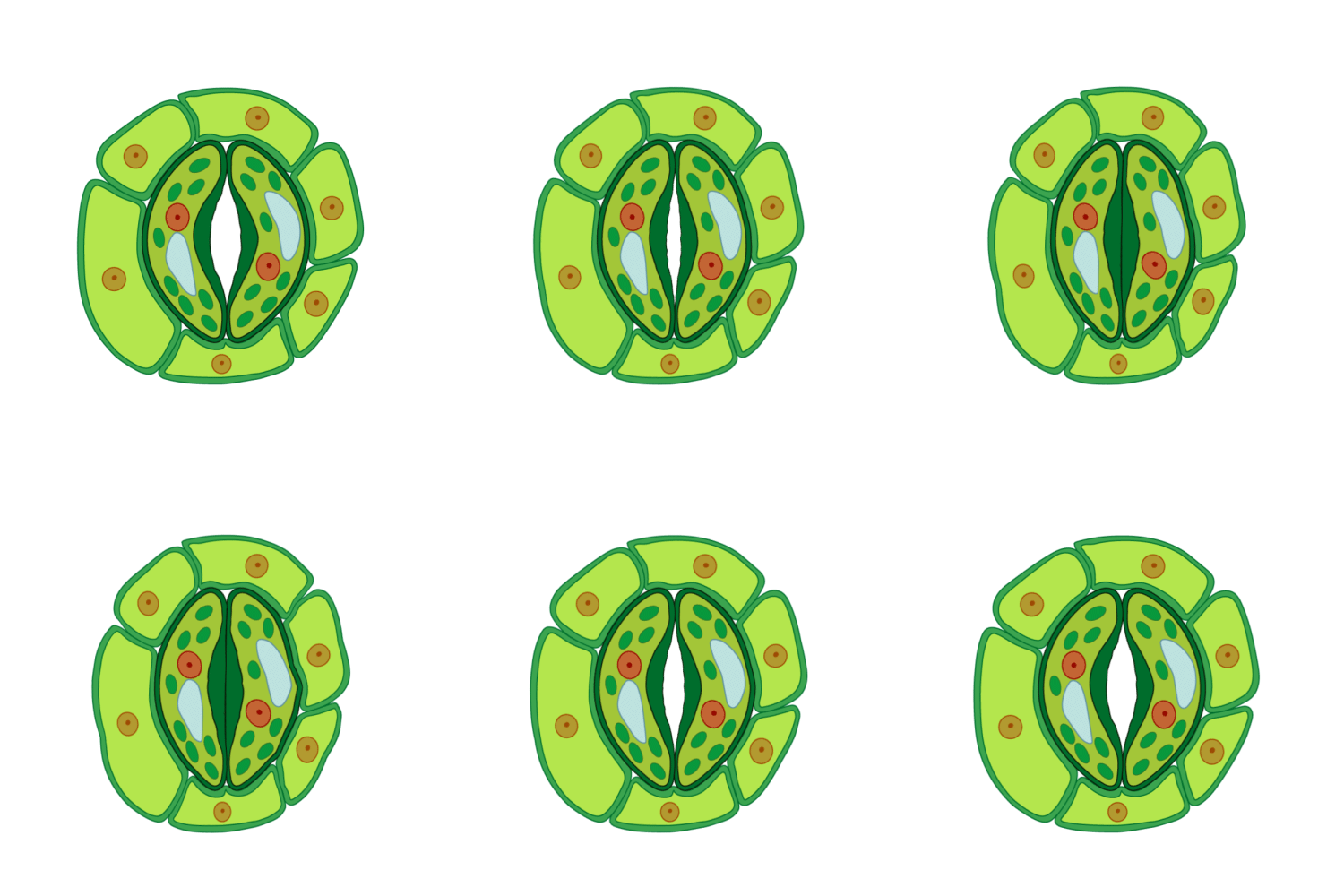
GIF: Stomata
Fauna of deserts
Animals with adaptations to live in an arid climate or deserts are called xerocoles. Water conservation or heat tolerance are the major adaptations of desert animals. The desert makes home for many insects, reptiles, birds and small mammals. Large animals except camels are not able to live in the desert, because they are not able to find shelter in the sunny desert.
Adaptations of fauna in desert
Just like the flora, there are many behavioural, physiological and structural adaptations present in the fauna of the desert.
Behavioural adaptations
The major behavioural adaptations of desert animals are as follows:
- Small animals seek shelter under burrows and they are adapted to make such burrows that are cooler than the above ground.
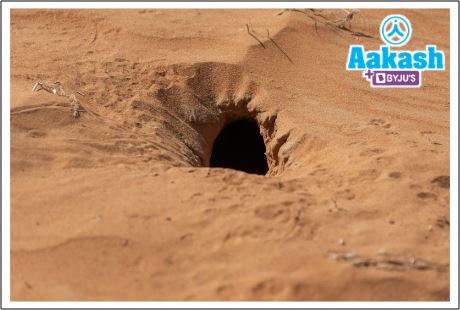
Fig: Burrows in desert
- Amphibians have an accelerated life cycle for larvae, so that they can reach maturity before the evaporation of water.
- Most animals are inactive during day time and hunt at night (nocturnal animals), so that there will be less water loss.
- Desert lizards maintain a constant body temperature throughout the day by alternatively warming up in the sun and moving under the shades.
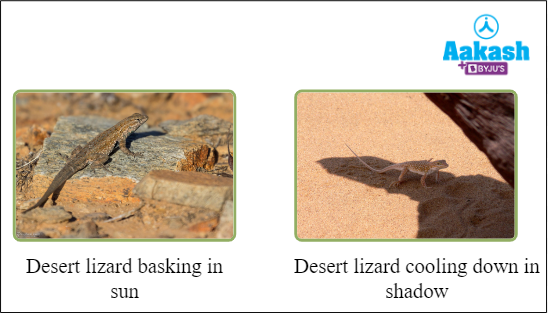
Fig: Behavioural adaptations of desert lizard
Physiological adaptations
The major physiological adaptations of desert animals are as follows:
- Some animals have salt glands which allow the secretion of salt without losing the water.
- Sweat glands are absent in some animals.
- Tiny kangaroo rats are able to live in the deserts of North America (Southwest USA) with scanty rains and almost no water source.
- The kangaroo rat has adapted by generating water through fat oxidation and this metabolic water produced is enough for their survival.
- To reduce the water loss the kangaroo rats excrete concentrated urine as nitrogenous wastes.
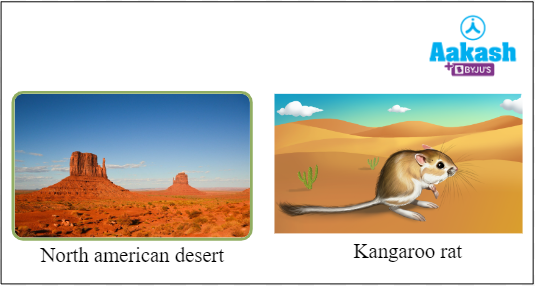
Fig: North American desert and Kangaroo rat
- Storage of fat in humps or tails is another important adaptation made by desert animals. An example is the camel (Camelus) that generates water by oxidation of fats in the hump.
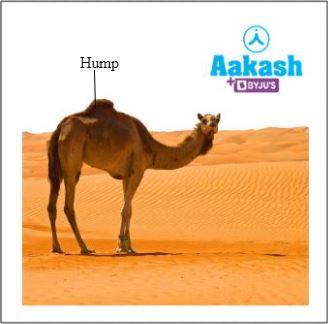
Fig: Camel
- Some animals like fairy shrimps (Anostraca) lay dormant eggs that hatch only when the conditions are suitable.
Structural adaptations
The major structural adaptations of desert animals are as follows:
- Heavy eyelashes of camels help them to cover the eyes from the blowing sand.
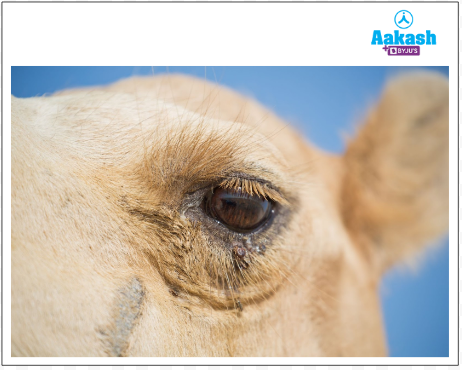
Fig: Heavy eyelashes in camels
- Nostrils of camels are reduced in size and the nasal countercurrent system reduces the loss of moisture during exhalation.
- The broad padded feet of camels help them to walk comfortably in the sand without sinking.
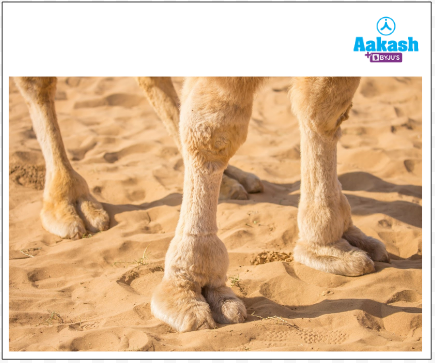
Fig: Feet of camels
- Spiny or confined skin is present in Horned lizards or Phrynosoma.
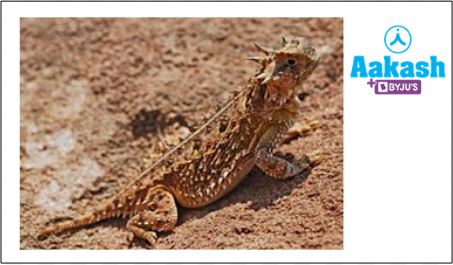
Fig: Phrynosoma
- Moloch or the thorny dragon can absorb water from the moist sand with their spiny skin.
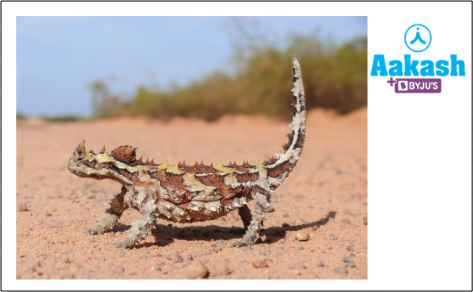
Fig: Moloch
Importance of deserts
The desert is an important biome with many mineral deposits, hence it is an important place for mineral resources and also supports the economy of the world. Apart from this there are many ecological importance for the deserts. Some of them are follows:
- Deserts are prone to changes, since they have a most extreme environment. So they are indicators of climate changes.
- Deserts provide home to 17% of the human population who are adapted to various desert biomes.
- It is a biome which provides habitat for many endemic species, like camels, kangaroos, cactus etc.
- Some shrubs and trees that produce dates (Phoenix dactylifera) and olives (Olea europaea) are globally important food crops.
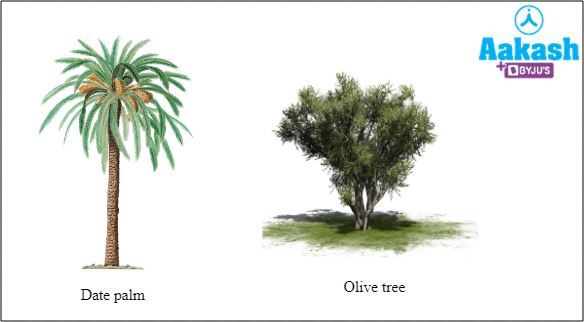
Fig: Economically important crops in desert
- Deserts are a net carbon sink and provide some relief from the increase in greenhouse gases.
- Deserts are an important source to generate renewable energy through solar panels.

Fig: Solar panel
Practice Problems
1. How are deserts classified on the basis of the annual rainfall?
a. True deserts and extreme deserts
b. Hot deserts and semi arid deserts
c. Coastal deserts and cold deserts
d. True deserts and cold deserts
Solution: Deserts can be classified on the basis of the annual rainfall and temperature. Deserts are classified into two, on the basis of the annual rainfall. They are true deserts and extreme deserts. Those deserts receive not more than 25 centimetres (10 inches) of precipitation in a year are called true deserts. These deserts have exceedingly sparse vegetation. Examples include the Great Basin of the United States. Those deserts which have not received any rainfall, or other precipitation, for at least the last two million years are called extreme deserts. Hence the correct option is a.
2. Find out the type of desert from the following statements.
i) Cold winters with snowfall and high overall rainfall throughout the winter
ii) The mean summer temperature is between 21 to 26 °C.
iii) The flora is widely scattered.
iv) The examples are deserts of Tibet and Gobi.
a. Hot deserts
b. Semi arid deserts
c. Coastal deserts
d. Cold deserts
Solution: Depending on the temperature the deserts are distinguished into four types and are hot deserts, semi arid deserts, coastal deserts and cold deserts. The deserts that are characterised by the cold winters with snowfall and high overall rainfall throughout the winter and occasionally over the summer are called cold deserts. The summers are moist, short and moderately warm. The mean summer temperature in cold deserts is between 21 - 26 °C. Cold deserts have heavy, silty, and salty soil. The flora is widely scattered in this kind of desert. The major plants are deciduous with spiny leaves. The common examples of fauna are jack rabbits, kangaroo rats, and antelope ground squirrels. The examples of cold deserts are Tibet and Gobi. Hence the correct option is d.
3. Which of the following is incorrect about the morphological adaptations of flora in a desert?
a. Tress are short, woody and shrubs are ground-hugging
b. The thick and fleshy leaves take in large quantities of water
c. Xerophytic plants undergo CAM pathway
d. The leaves are reduced to spines
Solution: There are many morphological adaptations of flora in a desert. Short woody trees and ground-hugging shrubs are present in the desert. Leaves are small and thick. The thick and fleshy leaves take in large quantities of water when it is available and store it for future use. In cactus like Opuntia the leaves are reduced to spines and photosynthesis is carried out by the stems. Such modified flat stems are called phylloclade. The presence of silvery or glossy leaves reflects more radiant energy. To avoid the water loss, xerophytic plants undergo CAM (Crassulacean Acid Metabolism) pathway. But it is a physiological adaptation. Hence the correct option is c.
4. Find out the correct physiological adaptations of animals in the desert.
i) Generating water by fat oxidation.
ii) Storage of fat in humps or tails.
iii) Presence of sweat glands.
iv) Laying dormant eggs that hatch only when the conditions are suitable.
a. i, ii, iii and iv
b. i, ii and iv
c. i and ii
d. ii, iii and iv
Solution: There are many physiological adaptations for desert animals. Some animals have salt glands that allow the secretion of salt without the loss of water. Sweat glands are absent in some animals. Tiny kangaroo rats are able to live in the deserts of North America (Southwest USA) with scanty rains and almost no water source. The kangaroo rat has adapted by generating water by fat oxidation and the metabolic water produced is enough for their survival. To reduce the water loss the kangaroo rats excrete concentrated urine as nitrogenous waste. Storage of fat in humps or tails is another important adaptation of desert animals. An example is the camel that generates water by oxidation of fats in the hump. Some animals like fairy shrimps lay dormant eggs that hatch only when the conditions are suitable. Hence the correct option is b.
FAQs
1. Where is the largest desert in the world located?
Answer: Antarctic desert is the largest desert in the world. It is located in the southern hemisphere in the Antarctic continent. The size of the desert is 14,000,000 kilometres or 5,500,000 square miles.
2. Which is the first desert on the Earth?
Answer: Namib is believed to be the world's first or oldest desert. The age of the Namib desert is about 55 million years.
3. Who found the desert?
Answer: European explorers explored deserts in the beginning of the 18th century. A Franciscan friar called Francisco Garcés first explored the Colorado and Mojave deserts in 1776. He recorded the information about real desert inhabitants.
4. What colour is the desert soil?
Answer: Usually the colour of desert soil is grey, brown or brick red. Sometimes the soils are covered with dark, shiny rocks or small stones. These stones are observed in the most arid part of Sonoran desert.
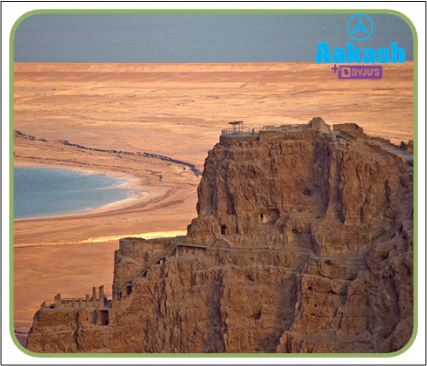
Fig: Desert

NEET Related Links
JEE MAIN Related Links
JEE Advanced Related Links
JEE Advanced Eligibility Criteria
JEE Advanced Chemistry Syllabus
JEE Advanced Registration Dates
CUET Related Links
Important Topics
Anemometer : Measurement of Wind Speed
Angular Acceleration Atomic Theory Audible and Inaudible Sound Average Speed and Average Velocity Average Velocity Avogadros Number Avogadros Hypothesis Azimuthal Quantum Number Balanced Force Bar Magnet Biconvex Lens Boyles Law Buoyancy Calorimeter Carnot Engine Celestial Bodies Centripetal And Centrifugal Force Concave and Convex Lenses Concave Convex Mirrors Contact and Non Contact Force Controlled Thermonuclear Fusion Convection Currents Convex Lens Convex Mirror Destructive Interference Difference Between Conduction Convection and Radiation Difference Between Electric Field and Magnetic Field Difference Between Heat And Temperature Difference Between Series And Parallel Circuits Differences Between Acceleration And Velocity Distance and Displacement Distance Time Graph Electrical Force : Electric Forces and Their Types Electromagnetic Waves : Definition, Equation and Properties of Electromagnetic Waves Electromagnetism Electron Spin Fluid Flow : Bernoullis Equation Derivation and Fluid Mechanics Fluid Friction : Types and Factors of Fluid Friction Frames of Reference : Inertial and Non- Inertial Frame of Reference Frequency and Wavelength Frictional Force Importance of Hydrosphere Instantaneous Speed and Velocity Introduction to Motion Kinetic and Potential Energy Difference Law Of Conservation of Energy Layers of the Earth Light Energy Light Sources List of physics scientists and Their inventionsLoudness of Sound
Magnetic Dipole Moment Magnetic Field Non - Contact Force Non - Renewable Energy Ohms Law Optics P Wave Physics Symbols Plane Mirrors Poissons Ratio Projectile Motion Properties of Water : Anomalous Expansion of Water Radius of Gyration Reflection of Light Reflection of Waves Relative Density Resonance Reverberation Rolling Friction Rotation and Revolution Screw Gauge Semiconductors and Insulators Sliding Friction Speed Time Graphs Static Friction Stefan Boltzmann Law Stress Tension Tension Force Thermometer: Clinical Laboratory Thermometer Types of Rocks Types of Waves Uniform Motion and Non Uniform Motion Unit of Voltage Uses of Convex Lens Uses Of Convex Mirror Uses of Electromagnet Uses of Optical Fibre Wave Wavelength of Light What is Scattering of Light Working of Electric Bell Conventional and Non-conventional Sources of Energy Buoyant Force Bulk Modulus of Elasticity Bernoulli’s Principle Angular Momentum Difference Between Speed And Velocity ForceUnit of Heat
Difference between Distance and Displacement Simple Microscope Derivation Of Equation Of Motion Thermometer: Clinical & Laboratory Thermometer Difference between Concave and Convex LensDerivation Of Lens Maker Formula
Unit Of Pressure Velocity Uses of Plane Mirror
Wave Theory of Light
Unit of Density Unit of Light Unit of Force Unit of Magnetic Field Unit of wavelength Unit of Viscosity Uses of Electroplating Young's Modulus
What is the Scattering of Light
Lenz Law Space Wave Propagation Schrodinger Wave Equation Relation between Fahrenheit and Celsius Refractive Index Potentiometer Working Pascal Law Oscillatory Motion Optical Instruments Newton's Laws of Motion - First Law Modulation and Demodulation Magnetic Flux Lens Formula and Magnification Kaleidoscope Faradays Law Epsilon Naught Value Energy Bands Electrostatics Electroscope AC Generator Unit of Current Lithosphere Bending Equation Derivation Difference Between Pound and Kilogram Semiconductor Devices OTEC - Ocean Thermal Energy Conversion Hall Effect Rectilinear Propagation of Light Difference Between Ammeter and Voltmeter Coefficient of Linear Expansion Ampere’s Law Cyclone and Thunderstorm Save The Environment From Pollution Particle Nature of Light Types of DC Motor Uses Of Transistor Derivation of Phase Rule Unit of Humidity

 Call Now
 Let's Chat
 Share
Share